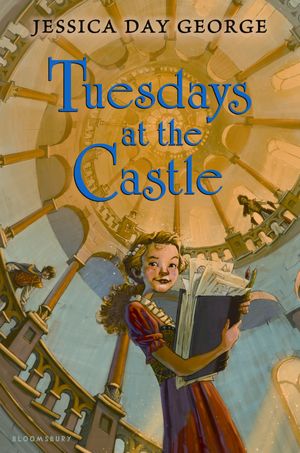
Tuesdays at The Castle (MG)

Tuesdays at the Castle. Jessica Day George. 2011. Bloomsbury. 254 pages.

Whenever Castle Glower became bored, it would grow a new room or two. It usually happened on Tuesdays, when King Glower was hearing petitions, so it was the duty of the guards at the front gates to tell petitioners the only two rules the Castle seemed to follow. Rule One: the Throne Room was always to the east. No matter where you were in the castle, if you kept heading east you would find the Throne Room eventually. The only trick to this was figuring out which way east was, especially if you found yourself in a windowless corridor. Or the dungeon. This was the reason that most guests stuck with Rule Two: if you turned left three times and climbed through the next window, you'd end up in the kitchens, and one of the staff could lead you to the Throne Room, or wherever you needed to go. Celie only used Rule Two when she wanted to steal a treat from the kitchens, and Rule One when she wanted to watch her father at work. Her father was King Glower the Seventy-Ninth, and like him, Celie always knew which way was east.

I liked Tuesdays at the Castle. I really liked it. It definitely reads like a fairy-tale inspired fantasy novel. Celie, our heroine, is the fourth child of the King and Queen. And she is the one the Castle loves best of all, perhaps. Though the Castle has also chosen preference to the second son, Rolf. The Castle has indicated that Rolf will be the next King.

The novel opens with the children awaiting the return of their parents and oldest brother. Instead of a happy reunion, however, they receive some shocking news. There was an ambush. Their parents are dead. Their brother is dead. Many of the escorts are dead. True their bodies were not found. But it's just a matter of finding them now.

Celie is one of the people who refuses to believe the news and continues to hope. She feels that if her parents were truly dead the Castle itself would know it--and show it. Her parents rooms would have changed, and her brother's room would have changed too.

The Castle DOES want to show her something, but acting on what she's learned will be risky...

Read Tuesdays In The Castle
  • If you're a fan of Jessica Day George's previous novels (Dragon Slippers, Dragon Flight, Dragon Spear, Princess of the Midnight Ball, Princess of Glass, Sun and Moon, Ice and Snow).
  • If you're a fan of Shannon Hale, Gail Carson Levine, or Diana Wynne Jones
  • If you're a fan of fantasy novels for children

© 2012 Becky Laney of Becky's Book Reviews

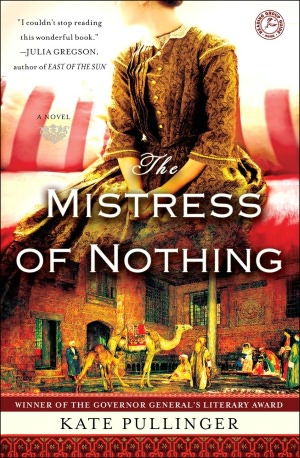
The Mistress of Nothing

The Mistress of Nothing. Kate Pullinger. 2011. Simon & Schuster. 272 pages.

The truth is that, to her, I was not fully human.

I found The Mistress of Nothing to be a fascinating historical novel. The narrator, a 'spinster' named Sally, serves as lady's maid to Lady Duff Gordon. Lady Duff is dying, but the doctors feel a change in climate might postpone the end a few years at least. So Lady Duff separates herself from her family, her friends, her society--she LOVES to be the center of it all--and heads to Egypt with her maid, Sally Naldrett.

Set, for the most part, in Egypt during Victoria's reign (1860s), this novel is so very, very fascinating. It tells the story of how two English women adapted to Egypt--to a new culture, society, way of life. One of the first things they do is hire a dragoman, Omar. These three become very, very close. But even in their 'close' moments, there is a very real distinction between servant and mistress. Lady Duff may act friendly, but she is above them both. They are her paid servants. They owe their loyalty to her. They almost belong to her--as far as she sees it. Sally forgets this for a time. But she'll have months--if not years--to see the truth of the matter.

So, this novel is about what happens when these two 'servants' fall in love with each other. One a seemingly proper English woman, the other an Egyptian man...

This novel was such a good, quick read. I'm not sure I loved it. But I sure found it hard to put down!

Read The Mistress of Nothing
  • If you love historical fiction
  • If you love novels based on true people and events
  • If you have an interest in Egypt--past or present
  • If you enjoy novels set during the Victorian time period
  • If you enjoy bittersweet romance

© 2012 Becky Laney of Becky's Book Reviews
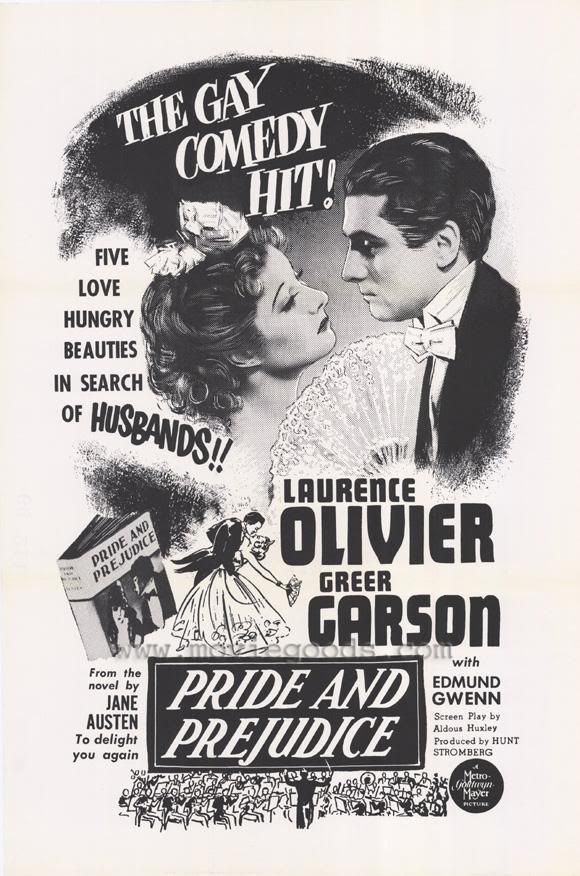
The Sunday Salon: Watching Pride and Prejudice

Recently I watched the 1940 adaptation of Pride and Prejudice. Though adaptation may not be quite the best word for it! This is the second time I've seen this black and white film, and my impressions have changed a bit since the first time. For the better, I think.

I think I'll start with what I didn't like first. The biggest issue I have with this film is the costuming. Elizabeth Bennet and her sisters should not be dressed like Scarlett O'Hara. Pride and Prejudice was published in the Regency period, and it's only natural to imagine Jane, Elizabeth, Mary, Kitty, Lydia, etc. dressing from that time period. (Though I could see if film-makers wanted to set it in the previous decade of the 1790s).The costumes used in this film are lovely--if the film was set a couple of decades later. But these costumes are just 'generic' nineteenth-century.

The music is lovely. The sets are great. The dialogue works, for the most part. While I did notice that this abridgment takes away many, many, many scenes from the book. ( A few of things missing from this adaptation are the visit to Pemberley, Elizabeth meeting with Georgiana, and the letter from Darcy to Elizabeth confessing all.) It adds more than a few new scenes to the story. Like Darcy and Elizabeth doing archery together. Like Darcy's conversation with Lady Catherine. And these scenes, while not original, add something charming to the story. ESPECIALLY Darcy's conversation with his aunt!!!

The pacing. This is a very fast-paced movie! I think it's a purposeful rushing. Take the opening scene where Mrs. Bennet and her daughters are in town shopping when they hear the news that there's a new bachelor in town. The way they all RUSH through their errand and RACE home--actually RACE home in order to get Mr. Bennet to go visiting their new neighbor is just hilarious. I mean, you can see why the Bennet women might be known as being so very, very silly. There are other scenes in the movie that make this more a COMEDY than a drama. The romance is still there--the romance between Elizabeth and Darcy gets ALL the attention. (Jane appears to be only slightly more sensible than her sisters. Then again, Charles Bingley doesn't come across all that sensible either!) There is something to be said for this one as a comedy. I mean that is definitely ONE way the novel could be interpreted. There are some naturally silly things in it.

The characters. Did I like this Elizabeth? Yes, I did. I liked her very much. Did I like this Darcy? Yes! He didn't seem all that moody in this one. His interest was practically evident after their first meeting. And it does look like he purposefully visited his aunt just so he could see Elizabeth again. The romance between these two is evident--in a good way! I mean these two make a great couple together on screen. And so it was enjoyable to see their scenes together.

Now, there are two characters that I just LOVE AND ADORE from this version. One is Mary Bennet. The other is Lady Catherine. Both of these shine and sparkle in this film!!! This version of Mary has to be my absolute favorite Mary ever. And the same goes with Lady Catherine. I just love, love, love her scenes!!! Especially the changes made to her character. Especially her final scene with Darcy!

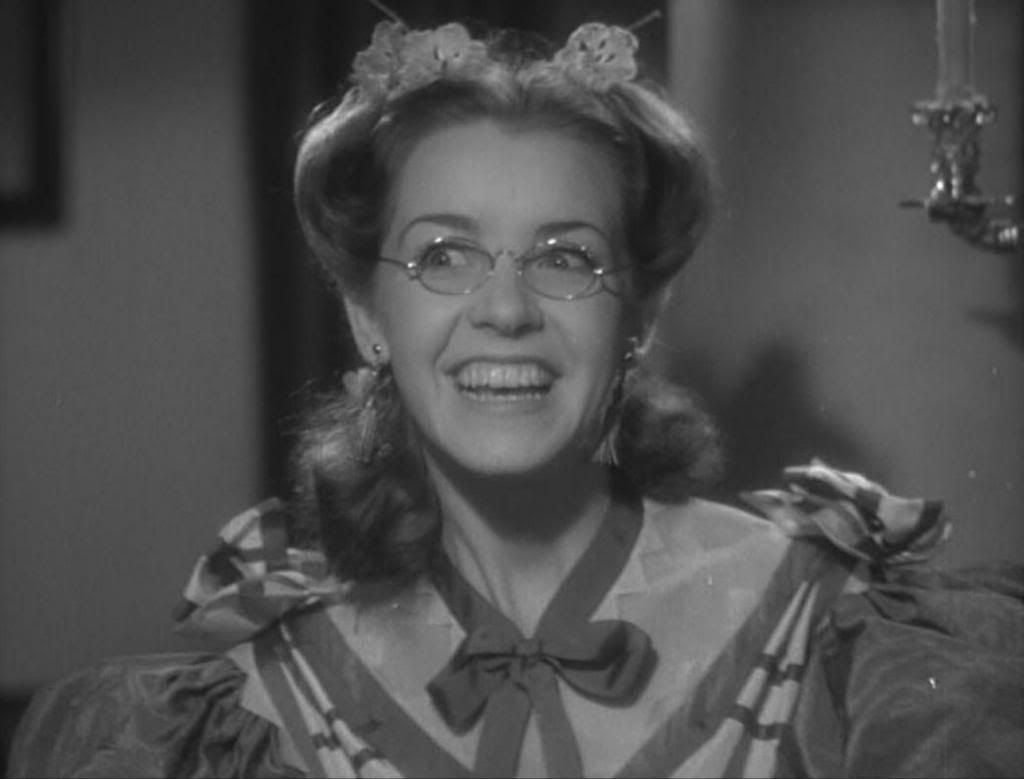
She is tolerable
Darcy and Elizabeth have some flirting time together before her family's silliness gets in the way
The archery scene
See how tender Darcy is with her, how kind
Darcy's first proposal
Lady Catherine visits Elizabeth

Have you seen this movie? What did you think? Did you like the changes they made to the story and the characters? Or do you think that Austen needs no improving?

© 2012 Becky Laney of Becky's Book Reviews
Crow (MG/YA)

Crow. Barbara Wright. 2012. Random House. 304 pages.

The buzzard knew. He gave the first warning. I was playing in the backyard while my grandmother stirred the iron wash pot over the fire. She had gray hair and a bent back. Standing, she looked like the left-hand side of a Y. If she'd been able to straighten her back, she would have been taller than me, but since she couldn't, we were the same height. I called her Boo Nanny. She joked that I should call her Bent Granny. 

Crow by Barbara Wright is a book that I could gush on and on and on about. Because it is just that wonderful. Because the characterization was amazing. Because the narrative voice was so strong. Because the story was incredibly compelling. Because the drama was so intense. Because it is a story that NEEDS to be told. Because it is so heartbreaking. I mean this book just keeps tugging and tugging and tugging at your heart.

Set in 1898 in Wilmington, North Carolina, Crow is a dramatic story of the events leading up to Wilmington Massacre of 1898. (Had you heard of it before? I sure hadn't.) It is narrated by an eleven year old boy, Moses Thomas. He is close to his family--especially his grandmother, Boo Nanny, and his father, whom he admires. (His father is one of four black aldermen in Wilmington; there are ten aldermen all together. His father also works for the Wilmington Daily Record, "the only Negro daily in the South.") Family dynamics feature prominently in this novel. The Thomas family is not presented as perfect--far from it--the tensions between family members, especially between the father and Boo Nanny (his mother-in-law) are fierce. But never for a second, did I doubt how strong and resilient and loving this family could be. Their kindness for one another, their concern for one another, their joy of being together, well, it was something I loved seeing.

So Crow is a novel about race relations, racial tensions between the black and white communities in Wilmington, North Carolina. It is about MORE than that. It is a novel with depth, substance. It is a meaning-of-life kind of novel, I thought. But the subject matter can't be ignored.

One of the big issues of the book is how the editor of the Wilmington Daily Record wrote an editorial in response to something he'd read. A woman who was calling for action, encouraging men to lynch those blacks who dared (or allegedly dared) to be "too forward" with white women. He dared to look at the other side of the issue. What about those white men who forced themselves on black women? What about all the slave owners who became involved with their slaves--with or without consent. What about all the white men that fathered children with their slaves? If interracial involvement was wrong, immoral, dangerous, something to be avoided at any and all costs, shouldn't it work both ways? Much more about this can be found on this website, 1898 Wilmington Debunking the Myths. His editorial made him no friends--only enemies on both sides. For his editorial made the white community angry and aggressive and ready to attack. And the black community did not want to fight this battle--did not want to be the target.

Of course, that isn't the only factor in the novel. It isn't that simple. It's also about Republicans and Democrats. The constitution. The right to vote in elections. It's about justice and equality. Or should that be injustice and inequality? Crow is set during an election year, and politics is VERY important.

Crow isn't just an issue book though. I know it may sound like an "important" book, an "issue" book. But it's also a good book if you're looking for a compelling story with a strong narrative. If you enjoy coming of age stories. If you can appreciate good writing, good characterization, then you'll find something special in Crow.

"There is not one Constitution for white folks and a separate one for black folks. There is one Constitution for all Americans, no matter what the color of their skin, and it promises us the right to vote. This is what we are guaranteed, and we will settle for nothing less." (220) 

Read Crow
  • If you're looking for a great book; strong narrative voice, amazing characterization, memorable characters, great storytelling, great writing.
  • If you're looking for a book set in the American South from an African-American perspective
  • If you're looking for historical fiction set during this time period, 1890s
  • If you're looking for a book with heart and soul, depth and substance
  • If you're looking for historical fiction based on real events (though the Thomas family is fictional, a handful of characters were based on real people, Wright even used their own words.)

© 2012 Becky Laney of Becky's Book Reviews

The Stars My Destination

The Stars My Destination. Alfred Bester. 1956. My edition, published in 1996, has an introduction by Neil Gaiman. Knopf Doubleday. 272 pages.

This was a Golden Age, a time of high adventure, rich living, and hard dying...but nobody thought so. This was a future of fortune and theft, pillage and rapine, culture and vice...but nobody admitted it. This was an age of extremes, a fascinating century of freaks...but nobody loved it. All of the habitable worlds of the solar system were occupied. Three planets and eight satellites and eleven million million people swarmed in one of the most exciting ages ever known, yet minds still yearned for other times, as always. The solar system seethed with activity...fighting, feeding, and breeding, learning the new technologies that spewed forth almost before the old had been mastered, girding itself for the first exploration of the far stars in deep space; but--


The Stars My Destination has a great beginning. The opening had me hooked. After reading The Demolished Man, I knew I wanted to read more Bester, but reading the opening paragraphs of The Stars My Destination made me want to read more Bester now. Unfortunately, for me, by the end of the novel, my excitement had lessened. For me, The Stars My Destination just wasn't as magical, as perfect, a read for me as The Demolished Man. It might be for you though.

The Stars My Destination begs the question how far would you be willing to go for revenge?! The narrator of The Stars My Destination is Gully Foyle. He was the sole survivor of a horrible accident in space. He's trapped in a small compartment of the spaceship for days, weeks, months. When he catches a glimpse of another ship, when he dares to try to catch their attention, he sees that ship purposefully pass him by. He sees a ship that could help him, could save him, willfully leave him there...something in him snaps. His whole life becomes about revenge, about tracking down the men and women on that ship, of learning who gave the order to not help him, of learning everything he can about its crew, its mission. He has to know WHO is to blame, he wants to know WHY they did what they did. So Gully Foyle is a man on a mission, he desperately wants answers.

Gully Foyle isn't exactly a nice guy, a comfortable-to-be-around narrator. His actions are more than a little questionable, ethically speaking. Which makes sense, in a way. Because others haven't treated him all that well either. And there are definitely more than a handful of guys in this novel that are out to get him as much as he's out to get them. So it's mutual--this chasing, this hating, this struggle.

One of the interesting aspects of this science fiction novel was the idea of teleportation. In Demolished Man the focus was on telepathy, on how being able to read people's minds could shape a society, could change the rules up. In The Stars My Destination the idea is about teleporting--the ability to jaunte, to move yourself--by forceful thinking--from one place to another. Some can jaunte fifty miles, others can jaunte a thousand miles. But it's something that is being taught to almost everyone. And this is reshaping society, changing the rules, upsetting things. Not for better or worse exactly. Just making things differently. One of things Bester mentions, for example, is how this effects the social classes. First, the rich cling to their superiority by choosing not to jaunte. The wealthier a person is, the slower their mode of transportation. A truly wealthy person might choose to travel by horse and buggy. Second, this effects security. You don't necessarily want just anyone teleporting themselves into your house or office. Third, and I'm not quite sure why this is, it effects women's place in society. Dramatically. Men lock their women away in doorless, windowless rooms--rooms that only they know how to jaunte to--whether this is to "protect" women from intruders or because they want to have ultimate control over them is debatable.

The Stars My Destination is an intriguing novel. And I am glad I read it. But I didn't exactly feel a personal connection with it.

Read The Stars My Destination
  • If you want to read classic or vintage science fiction from the 1950s
  • If you're a fan of The Demolished Man
  • If you're a fan of science fiction
  • If you like stories about power struggles, politics, wars, and refugees
  • If you like stories about revenge and hate
  • If you don't mind if your narrator is unethical/immoral

© 2012 Becky Laney of Becky's Book Reviews
The Worthing Saga

The Worthing Saga. Orson Scott Card. 1990. Tor. 465 pages.

In many places in the Peopled Worlds, the pain came suddenly in the midst of the day's labor. It was as if an ancient and comfortable presence left them, one that they had never noticed until it was gone, and no one knew what to make of it at first, though all knew at once that something had changed deep at the heart of the world. 

The Worthing Saga is one of my favorite, favorite, favorite books. It's one of the few books that I actually crave. I don't always indulge in a reread, after all it isn't fair to all the other books out there. I can't just read and reread Worthing Saga every time I think of it, every time I remember just how much I love it. I have to show some restraint after all. But it has been a few years since my last reread, and I had to save something truly special for Carl's sci-fi experience, didn't I?

So what do I love about The Worthing Saga? I love the stories, the storytelling, the framework. I love the characters. I LOVE the characterization. Even if I don't exactly "love" (have warm, cozy feelings about) each individual character. I think Card did an amazing job with The Worthing Saga in creating good, memorable characters. These are characters that--at least for me--stay with me always. Characters like Hoom, for example. Each chapter is like an old friend. Well, almost all chapters. There are two or perhaps three stories that I could do without completely. The lifeloop acting chapter, for example, I could do without completely!!!! But I think what I love most about The Worthing Saga is the layering, how it has depth and substance. How it has a definite message, but instead of being annoying, it somehow works all the same. This science fiction book is thought-provoking, challenging. It encourages you to think about deep things, to explore questions like why is there pain? why is there suffering? would the world be a better place without pain, without suffering? Is pain a necessary evil? Do we only feel joy and happiness because we know about pain and sorrow? what makes life beautiful? do we become better people through our struggles with life?

The Worthing Saga is a science fiction novel. It is a novel with a framework. Readers first meet a young boy, Lared, and his sister, Sala, on the day of pain, the day when this planet, this society, first experiences an awareness of pain, suffering, grief. From that day on, pain and death become all-too-real possibilities...for the young and old. From that day on, actions have consequences. Soon after 'the day of pain' two strangers come into their lives, come to their parents inn, Jason and Justice. These two choose Lared to be their scribe, to share with the world, their story. A story that spans many, many, many centuries.

The Worthing Saga is a GREAT book that I just LOVE AND ADORE.

Read The Worthing Saga
  • If you love science fiction
  • If you love science fiction set on multiple planets, science fiction with space travel, science fiction with colonization, science fiction with ethical dilemmas
  • If you love books with great characterization and powerful storytelling
  • If you love books that deal with larger issues in life

© 2012 Becky Laney of Becky's Book Reviews

Library Loot: Second Trip in February

New Loot:

Balloons Over Broadway: The True Story of the Puppeteer of Macy's Parade by Melissa Sweet
Heart and Soul: The Story of America and African Americans words and paintings by Kadir Nelson
Never Forgotten by Patricia C. McKissack; artwork by Leo & Diane Dillon
Listen to My Trumpet by Mo Willems
Chime by Franny Billingsley
Girl Reading by Katie Ward
Hurricane Dancers: The First Caribbean Pirate Shipwreck by Margarita Engle
The Dark City by Catherine Fisher
The Lost Heiress by Catherine Fisher
The Hidden Coronet by Catherine Fisher
The Margrave by Catherine Fisher
Whittington by Alan Armstrong
Hattie Big Sky by Kirby Larson
Ashes by Ilsa J. Bick
Surviving the Applewhites by Stephanie S. Tolan
Daughter of Smoke and Bone by Laini Taylor
Seven Wonders of Sassafras Springs by Betty Birney
Elijah of Buxton by Christopher Paul Curtis
Always Neverland by Zoe Barton
A Cat of a Different Color by Steven Bauer
The Wonderful Wizard of Oz by L. Frank Baum
The Marvelous Land of Oz by L. Frank Baum
Dragonswood by Janet Lee Carey
Circus Galacticus by Deva Fagan
Tankborn by Karen Sandler
Down the Mysterly River by Bill Willingham


Leftover Loot:

The Boneshaker by Kate Milford
Life: An Exploded Diagram by Mal Peet
Fracture by Megan Miranda
Young Fredle by Cynthia Voigt
Roll of Thunder, Hear My Cry by Mildred D. Taylor
Moon Over Manifest by Clare Vanderpool
The Dark Is Rising, The Complete Sequence by Susan Cooper
The Doll Shop Downstairs by Yona Zeldis McDonough
The Cats in the Doll Shop by Yona Zeldis McDonough
King, Kaiser, Tsar: Three Royal Cousins Who Led the World To War by Catrine Clay
Liesl & Po by Lauren Oliver

Book Trailers for NEW loot:


Library Loot is a weekly event co-hosted by Claire and Marg that encourages bloggers to share the books they’ve checked out from the library. If you’d like to participate, just write up your post-feel free to steal the button-and link it using the Mr. Linky any time during the week. And of course check out what other participants are getting from their libraries.   

© 2012 Becky Laney of Becky's Book Reviews