Tampilkan postingan dengan label library book. Tampilkan semua postingan

Code Name Verity (YA/Adult)

Code Name Verity. Elizabeth Wein. 2012. Hyperion. 352 pages.

I am a coward. I wanted to be heroic and I pretended I was. I have always been good at pretending. I spent the first twelve years of my life playing at the Battle of Stirling Bridge with my five big brothers--and even though I am a girl, they let me be William Wallace, who is supposed to be one of our ancestors, because I did the most rousing battle speeches. 

So many people have gushed about reviewed Code Name Verity by Elizabeth Wein. And so many have just LOVED it and found it amazing. I have been meaning to read this one for a few months now, but, I personally found the novel difficult to get into. It just wasn't working for me...at all. I found the framework of the story to be frustrating and confusing. The jumping back and forth between first person and third person, etc. And the main character, the narrator, I found her difficult to connect with. But I really didn't want to return this one to the library unread...again. So I decided to read it no matter what. And after two hundred pages, this one finally started working for me. And by the end, it definitely worked for me. By the end, I could see why people did love it. But it took reading the whole novel--seeing the big picture--for me to be able to appreciate it.

Code Name Verity is about two women serving their country during World War II. One woman is a spy; the other woman is a pilot. One fateful night, the two are together in a plane over France. One woman is captured several days later, and interrogated. This novel is her "cooperation" with the enemy. Through this written account--an account where she both speaks directly to her captors and relates events of the past (these are written in third person omniscient), readers come to know both women...

Read Code Name Verity
  • If you are interested in World War II, 
  • If you are interested in pilots and spies and secret operations
  • If you are interested in reading about strong, brave women
© 2012 Becky Laney of Becky's Book Reviews

The Story of the Trapp Family Singers

The Story of the Trapp Family Singers. Maria Augusta Trapp. 1949/2001. HarperCollins. 320 pages.

Somebody tapped me on the shoulder. I looked up from the workbooks of my fifth graders, which I was just correcting, into the lined, old face of a little lay sister, every wrinkle radiating kindness. "Reverend Mother Abbess expects you in her private parlor," she whispered. Before I could close my mouth, which had opened in astonishment, the door shut behind the small figure. Lay sisters were not supposed to converse with candidates for the novitiate.

This is the true story that "inspired" my favorite musical The Sound of Music. For the most part, the book is fascinating--especially the first half of the book. Readers meet the young woman sent to be governess to a retired sea captain with many children. In the book, she's to be governess only to one of his daughters, the rest either have nursemaids, attend schools, or have their own tutors. There are definitely some big differences between the book and the movie--between truth and fiction. (For example, the names of the children are different, as is the chronology of the story. The couple married years before Hitler came to power; they married in 1927!) They began singing together as a family out of love for music, yes, but also out of financial necessity.

The book chronicles:

Maria's first eight or nine months as a governess, particular attention is paid to their first Christmas
Maria's new role as wife and mother
Austria's changing economy and politics in the 1930s
The family's flight from Austria and immigration to the United States
The family's first experiences in America as they go on tour and learn English
The family's (forced) return to Europe--fortunately, only for a few months.
The family's return to the United States, their continuing tours
The family's settling down in America (a bit more about their tours, building of their house, building of their music camp)
The private life of the family (recollections of holidays, feast days, birthdays, Christmases, vacations, etc.)

The book is great on capturing the family's dependence on God, their reliance on God to deliver them and provide for them no matter the circumstance. The book is also great at capturing a specific time, place, and culture. For anyone curious about what it was like to be living in Austria in the 1920s and 1930s, this is a must read. For those interested in the immigrant experience during this time period, it is just a fascinating account! To see American culture--and language--from this outside perspective. The book was published in 1949, but it was up to date--so readers do get perspective on World War II from their perspective, also what the family tried to do to help Austria after the war was over.

I really LOVED this one!!!

Favorite quotes:
One of the greatest things in human life is the ability to make plans. Even if they never come true--the joy of anticipation is irrevocably yours. That way one can live many more than just one life. (214)
One night I tenderly consulted by private calendar, "time eaters" we had called them at school, and it showed only thirteen more days in exile. The next morning I started spring cleaning. Under my direction the maids were taking down the curtains and proceeding to brush the walls, when I saw the three youngest children knock on the door of the study. It didn't take long and out they came again. Running over to me as I stood on a ladder washing a big crystal chandelier, they yelled from afar: "Father says he doesn't know whether you like him at all!" "Why, of course, I like him," I answered, somewhat absentmindedly, because I had never washed a chandelier before. I noticed only vaguely that the children disappeared behind the study door again. That same night I was arranging flowers in several big, beautiful oriental vases. This was the last touch, and then the spring cleaning was over, and it had been really successful. When I had arrived at the last vase, the Captain came in. Stepping over to me, he stood and silently watched what I was doing with the peonies. Suddenly he said, "That was really awfully nice of you." An altogether new tone in his voice, like the deep, rich quality of a low bell, made me look up, and I met his eyes, looking at me with such warmth that I lowered mine immediately again, bewildered. Automatically I asked what was so nice of me, as I only remembered that awful letter. "Why," he said, astonished, "didn't you send word to me through the children that you accepted the offer, I mean, that you want to marry me?" Scissors and peonies fell to the floor. "That I want to--marry you?" "Well, yes. The children came to me this morning and said they had had a council among themselves, and the only way to keep you with us would be that I marry you. I said to them that I would love to, but I didn't think you liked me. They ran over to you and came back in a flash, crying that you had said, 'yes I do.' Aren't we engaged now?" Now I was out of gear. I absolutely did not know what to say or what to do; not at all. The air was full of an expectant silence, and all I knew was that in a few days I would be received into my convent, and there stood a real, live man who wanted to marry me. (57-58)
Read The Story of the Trapp Family Singers
  • If you enjoy biography and memoirs
  • If you love The Sound of Music
  • If you want to learn more about Austria/Europe in the 1920s, 1930s
© 2012 Becky Laney of Becky's Book Reviews

Mothership (YA)

Mothership: Book One of the Ever-Expanding Universe. Martin Leicht and Isla Neal. 2012. Simon & Schuster. 320 pages.

As far as scientists have been able to determine, the primary function of the human coccyx, or tailbone, is to remind us that once upon a time we were all monkeys or something. But I happen to know that it can still serve a useful purpose. Say, for example, that a pregnant teenager three weeks from her due date, who weighs, oh, approximately 145 pounds (lay off, all right? The baby loves ice cream), were shoved down forcefully on a Treadtrack in gym class by a bitchy cheerleader. 

 Our heroine, Elvie Nara, is one of many students attending a special high school for pregnant teens. The school is in space--a space cruiser in Earth's orbit. When her father enrolled her, she had no idea that Britta McVicker would also be there. The hate is mutual. Their due dates are only weeks apart--and for better or worse--their babies will be siblings. Of course, Elvie isn't sure if Britta is aware of that little fact. The thought repulses Elvie actually. Despite the opening paragraph, Elvie rarely thinks in terms of carrying 'a baby.' An "it" or "goober" at best. Elvie definitely has no intention at all of ever, ever, ever feeling maternal.

On the day of the incident when Elvie is alone and eating ice cream, the ship--cruiser--is attacked by another ship. And thus the scare begins, Elvie racing to join the other girls--hoping to stay ahead of the mysterious gunned invaders. She meets a few other girls on the way, and convinces them to join her in her flight. But what she witnesses next...well...it's almost unbelievable. For she witnesses her teachers drowning her classmates. And then one of the invaders tells her that her teachers were in fact evil aliens. And he should know, because, he is an alien too....

Is there any part of Mothership that isn't over-the-top? I'm not sure that there is. I would say that this one should please fans of Bumped and/or Beauty Queens. The narrator, Elvie, is full of snark. (For those that require clean reads--look elsewhere.) And the book is about as believable as Earth Girls Are Easy. The novel is set in the future--2074.

The story is revealed in alternating chapters--jumping between the present (on board the spaceship) and the past (in the months and weeks leading up to her pregnancy). Ducky, her best, best friend is a big part of these flashbacks.

Read for Presenting Lenore's Dystopian August.  

Read Mothership
  • If you like silly, over-the-top, funny adventures that require a suspension of disbelief
  • If you like snarky narrators
  • If you're looking for aliens in your YA

© 2012 Becky Laney of Becky's Book Reviews

To Die For

To Die For: A Novel of Anne Boleyn. Sandra Byrd. 2011. Howard Books. 332 pages.

There are many ways to arrive at the Tower of London, though there are few ways out. 

Sandra Byrd's To Die For is an excellent historical romance novel. The narrator is Meg Wyatt, sister to Thomas Wyatt; she is best friends with Anne Boleyn. While I've read plenty of historical fiction set during this time period, it's rare for Anne Boleyn to be presented so sympathetically. I really came to care for both Meg and Anne. The novel begins in 1518 and ends soon after Anne's death. While the focus is definitely on life in the court of Henry VIII, one can also see it as a novel about the English Reformation. It highlights that while for some the Reformation was a convenient way for the King to get his own way all the time, that there were many, many people in England who were true Reformers, and genuinely believed in the Reformation and were eager to get their hands on an English Bible and read the Scriptures for themselves.

In addition to the "romance" between Anne Boleyn and Henry VIII (he is not presented sympathetically), the novel tells Meg's story. Her life being as good an example as any as to what a woman might expect from life at this time.

This historical romance was very enjoyable. Loved the writing, loved the characterization, loved the setting. It felt very personal, in a way, getting a glimpse of the close friendship between two women. For example, Meg being there for her during the birth of her daughter, Elizabeth, and for her two miscarriages. This was a very emotional novel for me, and I definitely wasn't expecting to feel such a strong connection with the heroines.

Read To Die For
  • If you are interested in the Tudors; in Henry VIII and his six wives
  • If you enjoy historical fiction/historical romance
© 2012 Becky Laney of Becky's Book Reviews

Gilt (YA)

Gilt. Katherine Longshore. 2012. Penguin. 416 pages.

"You're not going to steal anything." I left the question--Are you?--off the end of the sentence. But Cat heard it anyway. 

I'm not quite sure how I feel about this book cover. Would you be able to tell from the cover that this is historical fiction? That this book is in fact about Catherine Howard, one of the doomed wives of Henry VIII?

Gilt is told from the perspective of one of Catherine's companions, Kitty Tylney. (Catherine is "Cat", she is "Kitty.") Their relationship--friendship--isn't quite one-sided, but, Cat definitely is the boss, and there is some manipulation going on, I believe. It's a toxic friendship, in a way. It isn't exactly in Kitty's best interest to be best, best, best friends with Catherine Howard. Sure, it means that when Catherine Howard marries the King of England, that there is an invitation to go to court and be one of her maids, but she's not a lady, and her tasks are servants' tasks, in a way. And even before Cat married the Henry VIII, she wasn't easy to counsel, if Cat wants something, she wants it, won't be talked out of it. As you might have guessed, I had a hard time liking Catherine Howard. At least as she is portrayed in this novel! How did I feel about Kitty? Well, I pitied her to a certain degree. Kitty isn't always the wisest person in the world, but, she was truly in a horrible place. On the one hand, Kitty knows Cat is stupid and making HUGE mistakes with her life. Kitty is being asked to cover up her friend's mistakes, and, that makes Kitty very unhappy. She knows that if she talks, Cat, will die. That if the truth is uncovered, no matter who uncovers it, Cat will die. She may feel used, in a way, by her friend, but, she doesn't wish her friend harm. What Kitty learns is that court life isn't all that glamorous and charming. That many unpleasant things go on at court, that wearing fancy clothes may not be worth the emotional stress of court life.

Did I love it? Probably not. Did I like it? Yes, I liked it well enough. I have read a handful of books set during this time period, quite a few focusing on Catherine Howard. It isn't my new favorite, but, it's an interesting book.

Read Gilt
  • If you're a fan of historical fiction 
  • If you like a little political intrigue, a little romance with your historical fiction
  • If you are interested in Henry VIII and his wives

© 2012 Becky Laney of Becky's Book Reviews

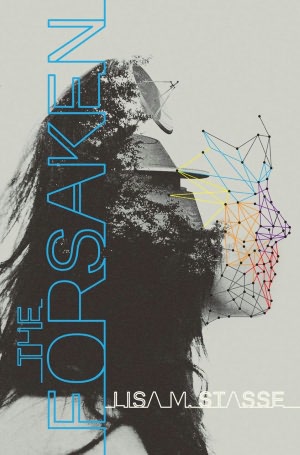
The Forsaken

The Forsaken. Lisa M. Stasse. 2012. Simon & Schuster. 375 pages.

At first I think the hammering sound is the noise of waves crashing down on white sand.

Alenna has "failed" her GPPT (Government Personality Profile Test) and has been sent to Prison Island Alpha. She's heard about the island, obviously, in the past few years, everyone has. She's even seen some of the violence from the island on screen, with the image of one boy, in particular, staying with her in the day or so leading up to her own "test." She never thought she'd be one to fail the test, she never thought she'd test positive for being violent, out of control, a potential danger to others. But she woke up on the island, and though she knows it has to be a mistake, how, do you survive long enough to prove that?

Soon after she wakes up on the island, she meets David, another "mistake" of sorts. He seems so very sane! The two work together--especially at first--trying to survive their first day or two. But they're just beginning to trust one another when they are claimed by different factions on the island. David is taken by the Drones on the "Monk" side of the island, Alenna is taken by the other side. She's given a truth serum, and trained to be a warrior. She makes a couple of friends and finds her place. Liam and Gadya are perhaps the two closest to her.

The book is obviously a thriller with plenty of secrets, secrets, and more secrets.

I enjoyed this one. Is it the best dystopian ever? No. But for those wanting another series like James Dashner's Maze Runner, for those that don't mind more-of-the-same from their dystopias, then this one could satisfy. The world-building isn't amazing. The characters aren't that well-developed. The relationships between the characters aren't fully explored. Is there a love triangle? I don't think so. Not really. True, the main character TALKS to two guys. (She talks to more than two guys.) But the fact that she talks to David and tries to listen and understand him does not mean that she sees him in that way, and there is not proof that he has those kinds of feelings for her either. 


Read for Presenting Lenore's Dystopian August.  


Read The Forsaken
  • If you're in the mood for a YA dystopia
  • If you don't mind a familiar feel to your dystopia
  • If you are looking for something fast-paced and action-driven

© 2012 Becky Laney of Becky's Book Reviews

For Darkness Shows the Stars (MG/YA)

For Darkness Shows the Stars. Diana Peterfreund. 2012. HarperCollins. 416 pages.

Elliot North raced across the pasture, leaving a scar of green in the silver, dew-encrusted grass. Jef followed, tripping a bit as his feet slid inside his too-big shoes. 

I really enjoyed Diana Peterfreund's For Darkness Shows the Stars. Did I enjoy it because it was a futuristic dystopia, OR, because it was a retelling of Jane Austen's Persuasion? A bit of both. For those expecting Captain Malakai Wentforth to be as swoon-worthy as Captain Wentworth, well, you might be disappointed. Might. For Kai's romance with Elliot North doesn't exactly mirror that of Wentworth and Anne Elliot. Peterfreund has definitely made this story her own.

For Darkness Shows the Stars is definitely a novel about social class or status. There are three "types" of people in this futuristic world: the Luddites, those with the highest status and wealth, the elite, those that have estates and titles, those that MATTER; the Reduced, those with slave status, essentially, they are thought to be mindless sub-humans, incapable of thought and feelings, definitely thought to be genetically inferior; the POST-Reductionists, the children of the Reduced who happen to be smart enough to function with more independence in the world, they have skills and abilities that make them worth something, they are not thought to be mindless and incapable, but, they're "socially" inferior to the Luddites. No matter how smart or brilliant a POST is, no matter how much money they acquire, they will never be on equal status with the Luddites.

Kai and Elliot grew up together; they share a birthday in fact. (Actually, there are three that share an exact birthday: Kai (Post), Elliot (Luddite), and Ro (Reduced).) But their friendship always had to be a secret, for if Elliot's father or older sister, Tatiana, found out, then everyone would get in trouble. Elliot enjoyed Kai's company, enjoyed spending time with him in the barn, enjoyed watching him fix things--he's a mechanic, the son of a mechanic. But when Elliot chose not to run away with Kai when they were fourteen (or possibly fifteen?), the friendship was broken. He chose to leave the estate, to risk everything in hopes of finding a better future. Elliot hasn't heard from him since the day he left, and he still matters to her. She chose to stay not because she didn't love him, but, because she needed to be responsible, because she was the ONLY one capable of being responsible on the estate, the only one who cared for the welfare of the Reduced, and also respected the Posts.

Meanwhile, Elliot's life has been as unpleasant as ever. Her father and sister are heartless and selfish and at times cruel. The novel opens with her father destroying his daughter's wheat field--weeks before harvest. That wheat could have helped feed the Reduced, it could have been sold for a profit, as well, to help the estate. But her father's "need" for a race track was more important. He's unwilling to see that the estate is struggling financially that they have a responsibility to the Reduced and the Posts that work their land/manage the estate. Elliot doesn't even bother protesting; true, the damage is already done and nothing can bring her wheat back, but, she also has a secret of her own. That wheat was her wheat--her special experimental seed. And Luddites do NOT under any circumstances experiment.

So in an effort to help finances, Elliot decides to rent out the estate to Cloud Fleet....and one of the guests is Captain Malakai Wentforth. Of course, there are plenty of other guests as well.

I enjoyed meeting the different characters in For Darkness Shows the Stars. Since this is a retelling, there is always a chance that the characters could have been weak, shallow copies of the original. For the most part, that was not the case.

I also enjoyed the story; there were just enough twists in the story that it really worked as an original story. The dystopian setting was interesting to me. I didn't have all my questions answered--at least not right away--and this futuristic society definitely added something to the story. 

Read for Presenting Lenore's Dystopian August

Read For Darkness Shows the Stars
  • If you enjoy science fiction, dystopias, post-apocalyptic fiction
  • If you enjoy futuristic stories 
  • If you are interested in a new retelling of Jane Austen's Persuasion
  • If you enjoy a little romance in your science fiction

© 2012 Becky Laney of Becky's Book Reviews

The Stories of Ray Bradbury

The Stories of Ray Bradbury. Ray Bradbury. 1980/2010. Everyman's Library. 1063 pages.

It would be difficult to try to review a collection of one-hundred short stories by Ray Bradbury. My thoughts on these stories are scattered over two years. (To visit the other posts in the series: first twelve, next twenty-six, next three, next ten, next twelve, next-to-last twenty-two, final fifteen.) The collection is very diverse: science fiction, fantasy, horror, mystery, and realistic fiction. There are stories celebrating friendship, love, marriage, and family. And stories depicting the break down of human relationships. Some of the stories are extremely dark and disturbing, others very light and humorous.

Here are my thoughts on the MOST memorable:

The Coffin

There was any amount of banging and hammering for a number of days; deliveries of metal parts and oddments which Mr. Charles Braling took into his little workshop with a feverish anxiety.
"The Coffin" is just creepy. Readers meet two brothers--Charles and Richard. One brother dies soon after completing his "custom" coffin. He boasts to his brother about how revolutionary this coffin is--how it is a complete all-in-one funeral experience. "Simply place body in coffin--and music will start." His brother is curious. Perhaps a little too curious?!

There Was an Old Woman

"No, there's no lief arguin'. I got my mind fixed. Run along with your silly wicker basket. Land, where you ever get notions like that? You just skit out of here; don't bother me, I got my tattin' and knittin' to do, and no never minds about tall, dark gentlemen with fangled ideas."
"There Was An Old Woman" shows just how stubborn one woman is to conquer death. She refuses--I mean REFUSES to believe in death. So what happens when she dies and her body is taken away? You might just be surprised.

The Scythe

Quite suddenly there was no more road.
"The Scythe" is also quite interesting! It is about a desperate man with a family who suddenly finds himself in a new situation. Finds himself in plenty for once. But there is a price to pay for having everything so perfect. Is he willing to pay that price? He may have no choice!

There Will Come Soft Rains

In the living room the voice-clock sang, Tick-tock, seven o'clock, time to get up, time to get up, seven o'clock! as if it were afraid that nobody would. The morning house lay empty.  
 "There Will Come Soft Rains" is a very, very, very lonely story where we get a glimpse--just a small glimpse perhaps--of the desolation and destruction of life as we know it in at least one human city. We see the ending of an era, perhaps. There are no human characters in this one.

The Murderer

Music moved with him in the white halls. He passed an office door: "The Merry Widow Waltz." Another door: Afternoon of a Faun. A third: "Kiss Me Again." He turned into a cross corridor: "The Sword Dance" buried him in cymbals, drums, pots, pans, knives, forks, thunder, and tin lightning. All washed away as he hurried through an anteroom where a secretary sat nicely stunned by Beethoven's Fifth. He moved himself before her eyes like a hand; she didn't see him.
Have you read it? You should! It was written in 1953. Albert Brock's first victim? The telephone? His second victim? The television. Our hero in this short story has had it with technology. Has had enough of being connected--always connected--with everybody, with everything.  He's on a mission to deliver man from modern 'conveniences'. 

The Fire Balloons

Fire exploded over summer night lawns.
In it two priests go to Mars as missionaries. One at least was expecting, was hoping, to meet Martians, to actually BE a missionary TO Martians, to an alien species. So when given the opportunity of going out into the hills and trying to communicate with blue balloon-like hovering creatures OR ministering to humans who have migrated to Mars, the answer is clear to Father Peregrine. But do the Martians need his church? This story has one of my favorite quotes:

"Father Peregrine, won't you ever be serious?"
"Not until the good Lord is. Oh, don't look so terribly shocked, please. The Lord is not serious. In fact, it is a little hard to know just what else He is except loving. And love has to do with humor, doesn't it? For you cannot love someone unless you put up with him, can you? And you cannot put up with someone constantly unless you can laugh at him. Isn't that true? And certainly we are ridiculous little animals wallowing in the fudge bowl, and God must love us all the more because we appeal to His humor."

"Exorcism"

She came out of the bathroom putting iodine on her finger where she had almost lopped it off cutting herself a chunk of coconut cake.
My thoughts: I believe this one is supposed to be a comedy! I certainly read it that way. A rivalry gone wrong between two women who want to be president of the same club. One woman, the narrator, is the clumsiest woman in town. She's accusing her neighbor and fellow club-member of being a witch and using witchcraft to keep her from winning the election. (She always has only one vote--her own.) She also writes out a list of every "accident" and illness she's had in the past year. (She totals it all up and says that this other woman is responsible for $98 worth of medicine.) No one is taking her seriously, which, is a good thing I suppose. It ends in laughter and tears.


The Wonderful Ice Cream Suit

It was summer twilight in the city, and out front of the quiet-clicking pool hall three young Mexican-American men breathed the warm air and looked around at the world. 
This story, on the other hand, I remember quite well! I just loved it, found it very fun, rather light-hearted, charming in tone and not too dark. It is a story about a group of friends who came together, in a way, because they are all the same size. Because they are the same size, they can share this one wonderful, marvelous suit. A suit that none of the men could have dreamed of buying on their own. But they take turns wearing it, and have the time of their lives.

Dark They Were, and Golden-Eyed

The rocket metal cooled in the meadow winds. 
Another short story that I just LOVED AND ADORED. This one is science fiction, it is set on Mars. It's the story of human settlers on Mars...and that's all I'm going to say about that. But it was FABULOUS. This one was not from Martian Chronicles, but, it was included in S is for Space.

Frost and Fire

During the night, Sim was born. He lay wailing upon the cold cave stones. His blood beat through him a thousand pulses each minute. He grew, steadily.
This (long) short story certainly grew on me as I read it. The first few pages I was skeptical, but, once I began to realize what was going on, I was hooked! This science fiction story is narrated by a boy named Sim. In the opening pages, he's a newborn. And we're seeing the world through his eyes--as he tries to make sense of the world around him. The environment is just as strange and foreign to readers almost. But. It is set on another planet, and the expedition was a total disaster. The humans live twenty-two hours a day in a cave--only braving the environment one hour at dawn, one hour at twilight. But even living in the caves is not protection enough--the environment is too damaging; it is changing human growth rate and effecting the life span. When Sim is born--the human life span in his particular cave is just eight days. In those days, he'll grow into a man, perhaps have a child of his own, before dying of old age. Sim is not accepting that fate--and he's determined to do something about it.
I also enjoyed: "I Sing the Body Electric," "A Medicine for Melancholy," "A Scent of Sarsaparilla," "The Great World Over There," and "The Black Ferris." Several of these were in Martian Chronicles, and were very enjoyable, but, since I've already talked about them in that post/review, I didn't necessarily feel I had to cover them in this one. 

© 2012 Becky Laney of Becky's Book Reviews

Kindred Souls

Kindred Souls. Patricia MacLachlan. 2012. HarperCollins. 119 pages.

My grandfather, Billy, hears the talk of birds. He leans out the open bedroom window with his head tilted to listen in the warm prairie morning.

Kindred Souls is the kind of children's book I have come to appreciate as an adult, but, the kind of book that I would NEVER have wanted to read as a child. In other words, it's one of those books. You know, the kind, the kind that introduces you to a wonderful old man AND a dog. And you have every right to be suspicious that the end will destroy your emotional well-being.

Jake, our narrator, is ten and confident; confident that everything will stay the same, confident that life is good and will stay that way. Sure, his grandfather, Billy, is eighty-eight, sure he's moved in with them. But he will live FOREVER. Don't ask him how he knows, it's enough that he believes. The novel begins with the two going on their usual walk. Billy is talking--again--about the sod house where he was born. He is wishing--again--that it hadn't fallen into such horrible condition. He is telling Jake--again--about the old days. This time Billy seems extra-sad, so Jake asks him a simple question: "How hard is it to cut a brick of sod?" And so the idea is born that a new sod house will be built...

And then there is the arrival of Lucy, a stray dog, that seems to be the perfect companion for Billy. Billy and Lucy seem to be best, best, best friends from the very first moment they meet.

This book is about an unforgettable summer.

Read Kindred Souls
  • If you like bittersweet children's books
  • If you like emotional family stories
  • If you are a fan of Patricia MacLachlan
  • If you like dog stories
© 2012 Becky Laney of Becky's Book Reviews

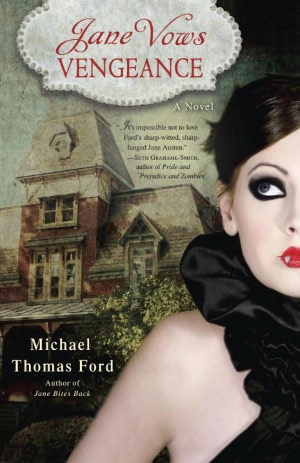
Jane Vows Vengeance

Jane Vows Vengeance. Michael Thomas Ford. 2012. Random House. 288 pages.

"What about this one?" Jane glanced at the magazine Lucy was holding up, opened to a picture of a bride standing in a field of daisies. 

This is the third novel in Michael Thomas Ford's paranormal series. The first is Jane Bites Back, and the second is Jane Goes Batty. If you've enjoyed the first few books in the series, you'll probably want to pick this one up too.

Jane Fairfax owns a bookshop and has recently had a novel published, even had that novel adapted into a movie, of sorts. But she's a woman keeping a secret from her husband-to-be. She's a vampire AND she's Jane Austen. While this knowledge certainly isn't common information, there are a LOT of people in her life who do know, including Walter's mother--Jane's future mother-in-law. By the way, his mother is keeping a BIG, BIG, BIG secret from him too. Poor Walter! No one ever tells him anything!

This novel sees the couple heading to Europe along with their friends and family. (Lucy, Ben, and Miriam, the mother-in-law). It isn't quite a wedding trip or a honeymoon trip--emphasis on the word quite. For Walter, it's a work-related trip, a select group will be touring historic homes. Sound boring? Well, some paranormal activity will liven things up a bit.

This novel had its moments. There were a few sparkly conversations, mainly between Jane and Byron, that made me happy I decided to continue on in this series. There were times this one almost almost worked for me. Some good scenes, some interesting developments. But at other times this novel was a mess. I'm not sure if it's because this book focused on the personal relationship between Jane and Walter, if it's because the book follows the couple's vacation, if it's because the focus was more on Jane trying to meet everyone else's expectations. But something felt off about it. This one had less social commentary, less satire, perhaps.

S
P
O
I
L
E
R

I think this one tried to pay tribute to Agatha Christie and mystery novels, but, that aspect didn't quite work for me. As a mystery this one didn't quite work for me. So what I was left with was a somewhat boring story about Walter and Jane trying to get married peacefully and without a lot of fuss. The scene that probably bothered me the very most was their first attempt to marry. And the wedding is interrupted by Jane's husband. And the guests talk openly about Jane being a vampire, the marriage occurring almost two hundred years in the past, etc. And Walter has not left the room. The author didn't give any indication that Walter left the room, OR, that the guests were huddled together whispering, OR, that the guests left the room to talk together...AND we're supposed to believe that Walter didn't listen closely enough to catch on to the fact that Jane is a vampire....and he's completely SURPRISED by the revelation later on in the novel. I think another issue I have with the novel, with the series, is that Walter isn't a fully developed character. We don't know him well enough to love him, though we can respect that Walter is a good match for Jane, I suppose. Mainly he's just there, and sometimes he's there and reacts.

Read Jane Vows Vengeance
  • If you enjoy paranormal novels
  • If you like satire/humor

© 2012 Becky Laney of Becky's Book Reviews

The Far Side of the Sky

The Far Side of the Sky. Daniel Kalla. 2012. Tom Doherty Associates. 464 pages.

The shadow still swayed over the pavement. Franz Adler tried to blink away the memory of his brother's dangling corpse and the silhouette it cast across the sidewalk, but the image looped over and over in his head.

The Far Side of the Sky provides a unique look at World War II. Franz Adler is able to flee Vienna, Austria, after Kristallnacht with his young daughter, Hannah, and his sister-in-law, Esther. Also accompanying them is an artist Ernst Muhler who fears persecution as well. (He joins them at the very last minute when his boyfriend decides to join the Nazis.) Their destination is Shanghai, one of the few places welcoming Jewish refugees.

The Far Side of the Sky is about the Jewish refugee community in Shanghai. Readers get glimpses of refugee life in 1938-9, 1940, 1941, 1942. (For example, the narrative might cover one or two months in a given year, and then jump to the next year.)

The main characters are:

Franz Adler, a Jewish doctor who divides his time between two hospitals in Shanghai, one of the hospitals is for Jewish refugees.

Soon Yi Mah (Sunny) a biracial (American/Chinese) nurse who divides her time between two hospitals. Her father was a doctor, and, she too has a gift for doctoring. But Dr. Reuben, one of the surgeons at the other hospital absolutely hates her and feels she doesn't know her place. She's intelligent, resourceful, courageous.

Of course there are dozens and dozens of minor characters of many ethnicities. 

The story was very fascinating. The author note reveals that much is based on fact, that he spent a great deal of time researching the Jewish refugee experience in Shanghai. And since this was the first I've heard of it, it was definitely fascinating to me. However. I was disappointed in the distant characters. Though readers follow the stories of these characters, I personally never felt connected with them. I knew enough about them to care about their fates, what happened next, etc. But I never felt like I knew them.

I'm not sure this book did a good job with relationships between characters either. For example, readers know that Franz is a father, but, except for two or three scenes, we don't really see Hannah interacting with Franz. We know that Hannah provides motivation for Franz--that his concern for Hannah moves the plot forward, but as for knowing Hannah, that just doesn't happen. We don't get the details of his personal life outside the hospital very often. Again, we know that Franz is taking care of Esther, his sister-in-law, but as for his sister-in-law having any character of her own, I just don't see it. There are a handful of scenes now and then. But even in those scenes she seems one-dimensional and just there. So many of the characters seem one-dimensional. The story itself is fascinating enough--the action, the danger, the uncertainty--but the characters just don't seem to match that.

The setting is unique and interesting. The story is fascinating and compelling. The characters, well, they disappointed me. But. I think there is enough to enjoy this one that I'd definitely still recommend it.

Read The Far Side of the Sky
  • If you are interested in the 1930s and 1940s, particularly the war years
  • If you are interested in reading books set in Shanghai, in China
  • If you are interested in reading a Jewish refugee book in a very different setting
  • If you are interested in doctors, nurses, surgeons, hospitals, etc. 

© 2012 Becky Laney of Becky's Book Reviews

Four 2012 Picture Books

Maudie and Bear. Jan Ormerod. Illustrated by Freya Blackwood. 2012. Penguin. 48 pages.

"I need some exercise," said Maudie.
"Fresh air would be nice," said Bear.
"How about a bike ride?" said Maudie. 
"Let's go," said Bear. 
"One moment," said Maudie. "I need my sunglasses."
Soon Maudie came back with her sunglasses.
"Ready?" asked Bear.
"One moment," said Maudie. "I'll fetch our hats."
"Ready?" asked Bear.
"One moment," said Maudie. "I need my scarf."

 Maudie and Bear is a picture book with five individual stories starring Maudie and Bear. The first story, "The Bike Ride" is about the two getting some "exercise" in on a nice day. Readers will probably notice that it's Bear doing the exercise and Maudie having all the fun. The second story, "Home Sweet Home," has a moody Maudie taking on the role of Goldilocks. It is an odd story, in my opinion, and I'm not quite sure what to make of Maudie's moodiness at the end of the story. (Has she learned anything or not?) "The Snack" stars a demanding Maudie and an ever-patient Bear. Her contribution to the big snack is gathering dandelions. Bear's is to prepare all the food. But not just prepare any food. Certain foods in certain ways. And the table has to be just so, etc. This story probably is my least favorite. It's one thing to ask for a snack or meal--it's another to be so perfectionist about it. What really bothers me is that after all this work, SHE DOESN'T EVEN EAT IT. "Making Up" stars a sensitive and moody Maudie. When Maudie is dancing, Bear got the giggles. Bear does apologize for laughing, but Maudie stomps off mad anyway. How long will she stay mad? And what will Bear have to do to make it up to her? The fifth and final story is "Telling Stories." In this one, Maudie gets upset with Bear for falling asleep when she is telling a story. This one may just be my favorite of the five.
"Bear," said Maudie, "let's both sit in your big chair while you tell me a story."
"Certainly," said Bear.
So Bear told Maudie a story.
"That was a good story," said Maudie. "Now I will tell you a story. Once upon a time, long, long ago and far, far away..."
Bear closed his eyes.
"Bear!" said Maudie. "Do not go to sleep while I am telling you a story."
"I am not asleep," said Bear. "I am listening with my eyes shut."
I enjoyed some of the stories in this picture book, but not all five. Maudie can be a brat, at times, highlighting how children can be self-centered or self-absorbed. But I saw something more than that in Maudie too. Is this truly a book about friendship? Or is it a book about the parent-child relationship?

This one was originally published in Australia.

Read Maudie and Bear
  • If you're looking for books about family or friends
  • If you're looking for picture books with multiple stories
  • If you're looking for books that highlight the different emotions kids experience 
  • If you're looking for international picture books


Minette's Feast: The Delicious Story of Julia Child and Her Cat. Susanna Reich. Illustrated by Amy Bates. 2012. Abrams. 40 pages.

Minette Mimosa McWilliams Child was a very lucky cat, perhaps the luckiest cat in all of Paris. Day and night she could hear the bells of Sainte-Clotilde tolling the hour. And day and night she could smell the delicious smells of mayonnaise, hollandaise, cassoulets, cheese souffles, and duck pates wafting from the pots and pans of her owner, Julia Child. But life had not always been like this for Minette. Oh no, not at all.

I really enjoyed Minette's Feast. This picture book shares with readers the story of Julia Child's time in Paris through the eyes of a cat. A cat who mostly preferred mouse or bird--but could sometimes be tempted by the treats of her owner, Julia Child. While Bon Appetit! spans Julia's whole life, this one is more focused on a specific time and place. I love the glimpse of French culture--the sprinkling of French words. I do enjoy the cat's perspective, for the most part. Though this cat is a little too obsessed with mice! I really enjoyed the illustrations as well. I thought she did a great job of capturing Julia and Paul, and, of course the many many moods of the cat.

Read Minette's Feast
  • If you love cats
  • If you love Julia Child and/or cooking
  • If you are looking for picture books highlighting French culture


Just Because You're Mine. Sally Lloyd Jones. Illustrated by Frank Endersby. 2012. HarperCollins. 32 pages. 


Little Red Squirrel and his daddy were playing in the big wood. "Daddy!" shouted Little Red Squirrel. "Look at me!" And he scampered off. First Little Red Squirrel showed his dad his Super Fast Running. He  ran between the two elm trees, racing as fast as he could, faster than the wind. "Little Red Squirrel," his daddy called after him. "Did I tell you today that I love you?" 
"Because why?" asked Little Red Squirrel. (He was spinning now, faster and faster, round and round in circles. "Daddy," said the spinning Little Red Squirrel. "Do you love me because I'm fast?" (Then he fell over, of course, because he was so dizzy.)

While I have seen people comparing this one to the Love You Forever, I'm not sure that's a fair comparison. To me, it feels more like Guess How Much I Love You. Will it please every reader? Of course not. Some people do not like their picture books so sweet and sugary. (It does remind me of the Mr. Rogers' song "It's You I Like.") But I did enjoy certain aspects of it. I did like the message that a parent's love is unconditional. It's NOT based on performance. It's not based on beauty or talent or skill. I do think this one would be a great one for Christian families illustrating the Father's love for his children--the spiritual concept of adoption or even election.

Read Just Because You're Mine
  • If you like super-sweet, affectionate books about the parent-child relationship
  • If you are looking for picture books with the theme of unconditional love

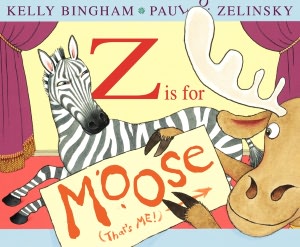
Z is for Moose. Kelly Bingham. Illustrated by Paul O. Zelinksy. 2012. HarperCollins. 32 pages. 

A is for Apple
B is for Ball
C is for Cat
D is for Moose
Moose? No. 
Moose does not start with D. You are on the wrong page. 

Z is for Moose may just be my favorite of the picture books I'm reviewing today. It is fun and playful and would be great to read aloud! It is one of the best alphabet books I've read in years!!! In this one, Zebra is the boss of the alphabet book. Zebra has a clipboard and knows exactly how things should go. But Moose, well, Moose has ideas too. And he doesn't want to wait around for the letter M. Beginning with the letter D, Moose is pretty insistent that he be a part of every page of this one!!! Not everyone is happy about this, of course, the Queen looks quite startled!!! Will Moose get a proper turn?

I just loved, loved, loved Z is for Moose!!! I would definitely recommend it!

Read Z is for Moose
  • If you want to laugh!
  • If you enjoy funny alphabet books!
  • If you're looking for a Moose to love!

© 2012 Becky Laney of Becky's Book Reviews

Mrs. Robinson's Disgrace

Mrs. Robinson's Disgrace: The Private Diary of A Victorian Lady. Kate Summerscale. 2012. Bloomsbury. 304 pages.

In the evening of 15 November 1850, a mild Friday night, Isabella Robinson set out for a party near her house in Edinburgh.

Did I enjoy this one as much as Kate Summerscale's The Suspicions of Mr. Whicher? No. Not even close. But that doesn't mean it wasn't interesting and at times thought-provoking. Mainly it made me very thankful to be living in this century. So what is Mrs. Robinson's Disgrace about? A little bit of everything:

science, evolution, "modern" medicine, mental illness and insanity, phrenology, homeopathic medical treatments, marriage, divorce, adultery, double standards, court systems, scandals, conformity and nonconformity, women's roles and women's rights, diaries and journals, creative act of writing, famous authors, famous books, etc.

Mrs. Robinson kept a diary. In her diary she wrote about the men--married and single, young and old--whom she fancied. She was a married woman, a mother of three. And it might not have been exactly mature to write about each man she had a crush on--some of them were her son's tutors--and to record each interaction--mainly conversations in a group setting, perhaps a walk or outside excursion--again in a group setting often with the children or others. What she wrote about one married man, a Dr. Edward Lane, went beyond that. She was seeking treatment at Moor Park, a health resort where Lane practiced his methods. She wrote of a handful of private walks where they kissed and confessed longings. She wrote of an interlude in his study and another in a carriage. Several years later, her husband read his wife's diary and discovered that his wife hated him--completely and absolutely--and lusted after all these other men. He sought a divorce with his wife's stolen diary as the only proof or witness to adultery. But was the diary enough proof to condemn his wife and grant him the divorce?

The first half of Mrs. Robinson's Disgrace is a reconstruction of events leading to the diary's discovery. Readers learn very briefly about Isabella's childhood and upbringing, about her first marriage and first son. Then readers learn of her marriage to Mr. Robinson and the birth of their two sons. They learn of her disgust and hatred of her husband. They learn of her delight in seeking out the company of handsome, intelligent, often-younger, sometimes-married men. They read of her interest in science and medicine and literature; Also of her complete rejection of God and Christianity. She's encouraged, for example, by George Combe and phrenology. His reading of her skull confirms--in her mind--her particular weaknesses. Though later he goes a long way in distancing himself from her and seems repulsed and worried when he learns that she has written about him quite a lot in her diary. Readers learn about Mrs. Robinson's "uterine disease." Turns out that "uterine disease" is code for a woman being insane.

The second half of Mrs. Robinson's Disgrace is a reconstruction of the divorce trial in the courts. Readers learn about the three (or so) lawyers involved in the case. Those representing Mr. Robinson, Mrs. Robinson, and Mr. Lane. Particular attention is paid to the defense of Mrs. Robinson. In addition, it chronicles what the press said about the case, etc. It concludes with the verdict and the aftermath of the case.

One thing I liked about Mrs. Robinson's Disgrace is that readers do get to decide on their own how they feel about it. She presents the facts, but lets readers make up their minds as to what those facts mean. Was she insane? Was she telling the truth? Was she embellishing and exaggerating things for her diary? Did she know if she was? Did she see the diary as being truth or fiction or a blend of the two? Was Mr. Lane lying? Was he trying to cover up his indiscretions and protect his family and reputation? Or was he a victim of one woman's obsession?

Read Mrs. Robinson's Disgrace
  • If you want to be equally disturbed and fascinated 
  • If you have a wide interest in all things Victorian; Summerscale does ramble and introduce many off topic subjects. 


© 2012 Becky Laney of Becky's Book Reviews

Love From Your Friend, Hannah

Love From Your Friend, Hannah. Mindy Warshaw Skolsky. 1998. DK. 246 pages.

September 27, 1937
Dear Edward,
I got your name and address from a piece of paper I picked out of a box that says Pen Pals on a corner of my teacher's desk. I've never done this before and I don't know exactly what to say. So I'll just pretend I'm talking. 

Hannah Diamond is the heroine of Mindy Warshaw Skolsky's Love From Your Friend, Hannah, a historical novel set in Grand View, New York in the 1930s. What should you know about Hannah? Well, she's a young girl who is missing her best friend, Aggie, who moved away. She's part of her classroom's pen pal program, but, she has DRAWN THE NAME OF A BOY! And since the teacher saw her draw his name, she can't put that piece of paper back to draw another name--no matter how much she wants to. Since her first letter to him is a total disaster, she decides to focus her energy on writing letters to other people. Surely she'll be able to find someone who wants to be friends...

Here is the disastrous reply from Edward:
Dear Hannah,
I haven't got a mountain.
I have a cow.
Edward Winchley
P.S. I don't like to read books. I don't like to write letters either. My teacher made me put my name on that piece of paper.
So who does Hannah decide to write? Well, her grandma, her aunt Becky, her best friend Aggie, and the President of the United States--Franklin D. Roosevelt, for starters...

The novel is composed of her letters to other people, and the letters she receives from other people.

I loved this one. I just LOVED, LOVED, LOVED it. I loved Hannah so very, very much!!! And I ended up just LOVING Edward!!!!

Hannah on reading:
My favorite thing in the world to do is read a book. I read Heidi, which I love, then I read another book, then I read Heidi again. If I stopped reading Heidi in between the other books, I'd be able to read twice as many books, but the thing is I like reading Heidi. So I do. (93)
Edward on reading:
Guess what I read for the second book the teacher said I had to read? Don't laugh. I read that one that you said you like so much. Heidi. Even though Heidi was a girl, you said there was a boy in it too. Peter. But you know what boy I liked the best? He wasn't a boy anymore. He was a grandfather--Heidi's grandfather. I would like to have Heidi's grandfather for a grandfather. I don't think he would bother me about talking or reading--or anything. (161)
Hannah on writing a book report:
Now, about the book report. I can't write it for you because your teacher would know just like you couldn't do my arithmetic because then my teacher would know. Teachers are like mothers--they always know!
But I can help give you some tips...
Tell the name of the book. Tell the name of the author. The Wizard of Oz was written by L. Frank Baum. Tell if you think he's a good writer. Tell the names of all the characters in the book. Tell what they did. Tell where they went. Tell who they were looking for. Tell what they finally found. Tell how they treated one another. Tell about their feelings. Tell that you read some to your sister. Tell that she liked it. Read some to a friend. Then you can even tell that your friend liked it. By that time, Edward, you'll have so many lines your teacher will leave you alone. (113)
Hannah to her Aunt Becky:
About finding me a present to make up for missing the movie, that was very nice of you. My mother said it'll be a consolation prize. But you don't have to bother knitting me any clothes because I already have so many clothes you knitted me. I have sweaters, jackets, scarves, and mittens. I even still have the red-and-white stocking cap that matches Skippy's jacket and that I wore up to the top of the mountain the time we had the big snow. And when my one galosh came off and I couldn't find it under the snow, I walked down the mountain with your stocking cap on my foot.
One thing about your knitting, Aunt Becky, it never wears out, so you see, you don't really have to knit me anything new. (74)
Read Love From Your Friend, Hannah
  • If you like historical fiction set in the 1930s
  • If you're looking for a great book set during the Depression
  • If you're looking for a book-loving heroine
  • If you're looking for a book about friendship, about pen pals, about school
  • If you're looking for a family-friendly children's book 

© 2012 Becky Laney of Becky's Book Reviews

Earth Unaware: The First Formic War

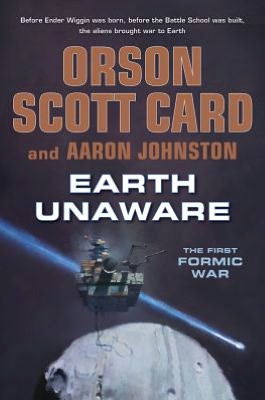
Earth Unaware. Orson Scott Card and Aaron Johnston. The First Formic War. 2012.  Tor. 368 pages.

Victor didn't go to the airlock to see Alejandra leave the family forever, to marry into the Italian clan.

Earth Unaware is an experience. Orson Scott Card is as wonderful as always. In fact, I'd say this may just be my most favorite Card novel of recent years. His characters are so incredibly human, so very, very flawed. Because of their complex relationships with one another, there is a genuineness to them. That doesn't mean readers will connect with each and every character. In fact, this novel has a character I loathe more than any other Card creation: Lem Jukes. Since this novel rotates narrators (or main characters), every Jukes chapter was painful. I was just SO VERY VERY VERY ANGRY at him. I reacted very strongly to him. But that isn't really a big surprise. I reacted strongly to so many characters in this one. Major and minor characters that I just CARED for. Which made almost every loss something to be FELT.

There are essentially "three" big stories being told in Earth Unaware. Two of the stories happen in space. El Calvador is an asteroid mining ship--a family-owned free mining ship. Victor's story, for the most part, occurs on El Calvador. This is the ship that first spots the Formics; well, they are the first to notice that an alien ship is heading towards Earth at faster than light speed. Lem Jukes is captain of a corporation ship. His interest in asteroids isn't quite like El Calvador's. Jukes is working on an invention with a lot of potential--something having to do with a gravity laser. After a successful test or two, he's ready to try the glaser on a bigger object. The object he has in mind happens to be the asteroid that El Calvador is mining at the moment. He decides to "bump" them--destroying their laserline communications--long range communicator--in the process.

The third story is, in a way, the lesser of the three stories. It is set on Earth and involves the military. It centers on a man, Wit O'Toole, forming a special military unit, Mobile Operations Police. One of the recruits is Mazer Rackham. But this isn't his story just yet. He's still undergoing testing, at this point. And the war has not begun. So while he will be very important in the other books in this series, this isn't his time just yet.

Earth Unaware is an exciting, suspenseful science fiction novel. I found the pacing to be just right. (True, some of the chapters seemed like a bit of an interruption, especially close to the end, but for the most part, the book was incredibly INTENSE, painfully INTENSE.) Readers learn about the ship who first spotted the Formic ship--the alien ship. Readers witness the destruction of the first encounter between humans and Formics. And anxiously readers wait and hope that one of the ships who know about the coming aliens will be able to send news to Earth.

This was an incredible reading experience--very emotional. It's a novel to be felt as well as read. The characterization was great. The storytelling and pacing was great too. I just loved it. This is one I'll definitely want to reread. 

Read Earth Unaware
  • If you're a fan of Orson Scott Card
  • If you're a fan of Ender's Game--even if you're not a fan of the other books in the series
  • If you enjoy science fiction
© 2012 Becky Laney of Becky's Book Reviews
The Dead Witness

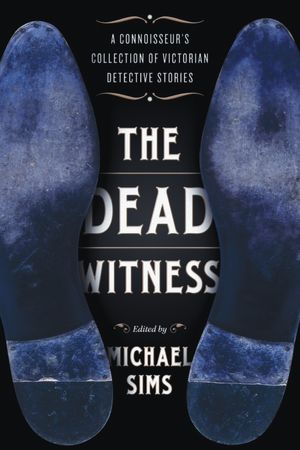
The Dead Witness: A Connoisseur's Collection of Victorian Detective Stories. Edited by Michael Sims. 2011. Walker & Company. (Late December 2011). 608 pages.

The Dead Witness is a short story collection that I absolutely LOVE, LOVE, LOVE. Now I am not usually a short story person, I feel it's important for everyone to know that. There are a couple of authors whose short fiction I enjoy, but, for the most part I like my novels.  But. I just LOVED this collection. I think it is a real MUST-READ.

Readers are introduced to twenty-two authors and twenty-two short stories. Each introduction was written by Michael Sims who did a fabulous job. There's just enough in each introduction to make you curious and eager to read their work, some of the introductions tease more than others. For example, they mention other stories, other novels, etc. The introductions are anything but boring! The authors presented are English, American, Canadian, Australian, and French. The collection includes men and women authors and men and women detectives! Some were narrated by a man or woman who just 'accidentally' got involved in the case, who just happened to put the clues together to solve the mystery. Others were narrated by amateur and professional detectives. (For example, The Diary of Anne Rodway is narrated by someone who just happens to become involved in this mystery. Her good friend, her roommate, is killed. She feels it was murder and has a clue or two to go by.)
  • The Secret Cell by William E. Burton
  • The Murders in the Rue Morgue by Edgar Allen Poe
  • On Duty With Inspector Field by Charles Dickens
  • The Diary of Anne Rodway by Wilkie Collins
  • You Are Not Human, Monsieur d'Artagnan by Alexandre Dumas, pere
  • Arrested on Suspicion by Andrew Forrester Jr.
  • The Dead Witness, or, The Bush Waterhole by W.W. (Mary Fortune)
  • The Mysterious Human Leg by James McGovan (William Crawford Honeyman)
  • The Little Old Man of Batignolles by Emile Gaboriau
  • The Science of Deduction by Arthur Conan Doyle
  • The Whitechapel Mystery by Anonymous
  • The Assassin's Natal Autograph by Mark Twain
  • The Murder at Troyte's Hill by C.L. Pirkis
  • The Haverstock Hill Murder by George R. Sims
  • The Stolen Cigar-Case by Bret Harte
  • The Absent-Minded Coterie by Robert Barr
  • The Hammer of God by G.K. Chesterton
  • The Angel of the Lord by Melville Davisson Post
  • The Crime at Big Tree Portage by Ernest Bramah
  • The Case of Padages Palmer by Harvey O'Higgins
  • An Intangible Clue by Anna Katherine Greene
 Chances are you're familiar with some of these authors. But some of these will probably be as new to you as they were to me.


My favorite favorite story was "The Diary of Anne Rodway," which I just LOVED and ADORED. True, I was already familiar with his work, but, even if I hadn't been, I think I would have loved this piece. The short story is a series of diary entries by a young woman, a poor woman. She's good friends with another young woman, Mary Mallinson. The two are in similar situations--in a way--both poor, both working hard to survive, both in love but facing obstacles to their happiness. But when Mary is murdered, Anne Rodway takes it upon herself to try to solve the mystery and discover the identity of the man who killed her friend.

I also enjoyed "The Secret Cell" by William E. Burton first published in 1837--several years before Edgar Allen Poe's oh-so-famous detective story, "The Murders in the Rue Morgue." I personally preferred The Secret Cell. I read that this is the first time it is being republished since its initial publication which I thought was nice! The Secret Cell is the story of a missing woman. The narrator had a laundress who had a daughter. The daughter of the laundress became a companion to a wealthy woman, the wealthy woman favors her companion in her will, and when the daughter inherits a fortune, well, it's not long before she turns up missing. It is a very interesting story!

Other favorites include, "The Murder at Troyte's Hill" by C.L. Pirkis, "The Angel of the Lord," by Melville Davisson Post, "The Stolen Cigar Case" by Bret Harte, and "An Intangible Clue" by Anna Katherine Greene.

Read The Dead Witness
  • If you enjoy detective fiction, mysteries, casebooks, etc.
  • If you enjoy Victorian literature
  • If you enjoy short stories
© 2012 Becky Laney of Becky's Book Reviews

The One and Only Ivan

The One and Only Ivan. Katherine Applegate. 2012. HarperCollins. 301 pages.

I am Ivan. I am a gorilla. It's not as easy as it looks.

 Want to read one of the best, best books of the year? May I suggest Katherine Applegate's verse novel, The One and Only Ivan. I can't promise that every reader will come to LOVE Ivan, Ruby, Stella, Bob, Julia, and George, but you might end up loving them just as much as I did. (Ivan is a gorilla; Ruby and Stella are elephants; Bob is a dog; George and Julia are two of the most sympathetic human characters in the novel.)

So what is it about? It's about a small group of animals on display at Exit 8 Big Top Mall and Video Arcade. Ivan, the gorilla, is an artist whose works sell in the gift shop. He's been captive almost thirty years. Stella is one of his dearest friends, she's an elephant who knows quite a few tricks. She's a great storyteller, but, many of her stories are bittersweet. She's had a hard life to have such a great memory. Bob, the stray dog, is Ivan's other best friend, he's not really on display--not wild enough, not talented enough--but to Ivan, well, he's the best dog in the world. One day, Mack, the owner, brings someone new: a baby elephant named Ruby. Her arrival changes EVERYTHING for Ivan. For at long last, he has someone to protect. 

Within pages, I was hooked. Here is the second poem:

names


People call me the Freeway Gorilla. The Ape at Exit 8. The One and Only Ivan, Mighty Silverback.


The names are mine, but they're not me. I am Ivan, just Ivan, only Ivan.


Humans waste words. They toss them like banana peels and leave them to rot.


Everyone knows the peels are the best part.


I suppose you think gorillas can't understand you. Of course, you also probably think we can't walk upright.


Try knuckle walking for an hour. You tell me: Which way is more fun?

The narrative voice is so strong, so rich, so observant, so right. Here are just a few examples:
Humans speak too much. They chatter like chimps, crowding the world with their noise even when they have nothing to say. (3)
Anger is precious. A silverback uses anger to maintain order and warn his troop of danger. When my father beat his chest, it was to say, Beware, listen, I am in charge. I am angry to protect you, because that is what I was born to do. Here in my domain, there is no one to protect. (10)
It was Julia who gave me my first crayon, a stubby blue one, slipped through the broken spot in my glass along with a folded piece of paper. I knew what to do with it. I'd watched Julia draw. When I dragged the crayon across the paper, it left a trail in its wake like a slithering blue snake. (16)
Humans don't always seem to recognize what I've drawn. They squint, cock their heads, murmur. I'll draw a banana, a perfectly lovely banana, and they'll say, "It's a yellow airplane!" or "It's a duck without wings!" That's all right. I'm not drawing for them. I'm drawing for me. (17)
My visitors are often surprised when they see the TV Mack put in my domain. They seem to find it odd, the sight of a gorilla staring at tiny humans in a box. Sometimes I wonder, though: Isn't the way they stare at me, sitting in my tiny box, just as strange? (23)
Bob's tail makes me dizzy and confused. It has meanings within meanings, like human words. "I am sad," it says. "I am happy." It says, "Beware! I may be tiny, but my teeth are sharp." Gorillas don't have any use for tails. Our feelings are uncomplicated. Our rumps are unadorned. (35)
Homework, I have discovered, involves a sharp pencil and thick books and long sighs. (44)
But hunger, like food, comes in many shapes and colors. At night, lying alone in my Pooh pajamas, I felt hungry for the skilled touch of a grooming friend, for the cheerful grunts of a play fight, for the easy safety of my nearby troop, foraging through shadows. (133)
It's an odd story to remember, I have to admit. My story has a strange shape: a stunted beginning, an endless middle. (144)
The One and Only Ivan is definitely an EMOTIONAL read. It's a book about how humans treat or mistreat animals. It tells the story of several animals: Stella, Ivan, Ruby, etc. In some cases relating how they got to their current "domain" (cage, or prison). For the most sensitive reader, it may prove a little too much in a few poems. Overall, I think it's a great read. Powerful, compelling, beautifully written.

Read The One and Only Ivan
  • If you love E.B. White's Charlotte's Web
  • If you love Kathi Appelt's The Underneath
  • If you love animal stories
  • If you love gorillas, elephants, dogs
  • If you love GREAT writing
© 2012 Becky Laney of Becky's Book Reviews

The Yard (with slight spoilers)

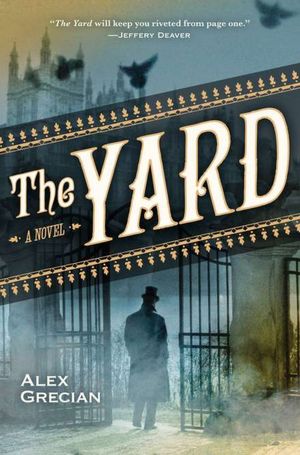
The Yard. Alex Grecian. 2012. Penguin. 432 pages.

From the prologue: Nobody noticed when Inspector Christian Little of Scotland Yard disappeared, and nobody was looking for him when he was found.

What can I say about Alex Grecian's The Yard? I was disappointed. If you're expecting a mystery where suspense builds, clues are given, and you're on the edge of your seat to find out who did it, then this one will definitely disappoint. For Grecian will reveal who did it to readers within a chapter or two. Readers will get a behind-the-scenes look at the murderer almost from the beginning. The first entry or so of this murderer his identity is still hidden, but, that doesn't remain the case for long. But Grecian doesn't just reveal the identity of one murderer, he reveals the identity of another murderer. For Scotland Yard is working on two cases during the course of the novel. One, a murderer who is killing police detectives. Two, a murderer who is killing bearded men.

The Yard has multiple narrators. Readers meet several detectives (some remain alive at the novel's end, others aren't so fortunate) throughout the novel, each contributes (to a certain degree) to solving one or the other cases. Some personal details are shared about some of the detectives. For example, readers meet Walter Day and his wife. We get a flashback to before they were married--we get to see the proposal, and, it felt to me it was a very odd proposal! We also see glimpses of their home life as she adjusts to life in London. Another detective we meet is Hammersmith (I can't recall his first name). We get flashes from him as well, including flashbacks to when he was a child. His flashbacks reveal his sensitive side and how difficult the job can be: finding the bodies of children, men, women, etc. Readers also meet Dr. Kingsley who works closely with Scotland Yard, and we meet his young daughter who helps out by sketching all the corpses. While we meet many characters, including a mystery "dancing man", I had a hard time truly connecting with any of the characters. I'll explain, while I wanted to read the book to its end, I wasn't at the edge of my seat. It wasn't that the book was super-compelling and impossible to put down. It wasn't that the book had any suspense (well, readers could perhaps wonder if Fenn would make it back home alive or if he'd end up a corpse; and if you're desperate to find more to be in suspense about I suppose you could wonder if Day's wife was ever going to tell him that she was pregnant), I finished the book because I like to finish what I start.

This one would almost have to be more of a thriller than a mystery, but, I'm not sure it's lack of suspense and uneven pacing would make it a good thriller either. Overall, I'd say the characterization wasn't the best. Some of the characters had potential, they could potentially be developed into something more, into characters that I would care about, but they weren't quite there yet. Some of the characters were incredibly flimsy and flat.

I think some of the scenes were intentionally put in there to aggravate modern readers--which worked, by the way. Having scenes where a boy goes up to a police officer (detective) and clearly states things like, help, please help me, I've been kidnapped, tied up, held prisoner, I only now just escaped, if he catches me again, I don't know what will happen, please help me find my parents. And have him respond with, move along, boy, or I'll send you to the workhouse. I suppose the intention being to highlight that women and children had no value or worth in society.

I wanted to like this one, I was even hoping to love it, but it was just okay. 

Best line: "If all men were sane, we would be blacksmiths." (87)

Read The Yard
  • If you like historical fiction set during the Victorian period
  • If you like Victorian mystery/detective/suspense stories; just don't expect Grecian to write as well as the actual Victorians, his style, his characterization, his pacing, doesn't even come close to matching. 
  • If you don't mind slightly tedious fiction, for example, he spends pages and pages each time (almost) trying to explain the concept of fingerprints. And how each fingerprint is unique, personal; how fingerprints can help establish who was at the scene of the crime, etc. 
© 2012 Becky Laney of Becky's Book Reviews

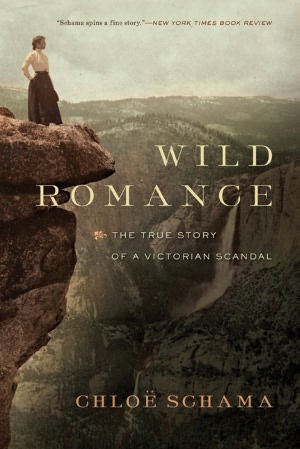
Wild Romance

Wild Romance: The True Story of a Victorian Scandal. Chloe Schama. 2010. Walker & Company. 249 pages.

Loved the first half of this nonfiction book on the life of Theresa Longworth, but, the second half which chronicles her world-travels after her oh-so-famous trials left me bored.

I picked up Wild Romance: A Victorian Story of a Marriage, a Trial, and a Self-Made Woman because I'm a fan of Victorian literature. I've read a handful of novels that fall into the "inspired-by" category. Authors whose works deal with irregular marriages--Irish, Scottish, etc. Marriages whose legitimacy was sometimes called into question. Since in some cases, just saying "We're married" with no paperwork, no witnesses, no priest or clergyman could do the job. At the time, there was definitely debate about what made a marriage or union legal or illegal.

In the case of Theresa Longworth, she "married" allegedly married on two different occasions in two different countries, a man named William Charles Yelverton. In the moment, I suppose, he was willing enough. The couple traveled together as man and wife for a short time at least. But when the two separated, I believe he was in the military, he changed his mind. He found someone new, someone with money to marry. And marry he did. Theresa finding out after a very difficult illness that "her" husband was now married to someone else...and he was claiming that they'd never, ever been married. Furthermore, he started saying that she was chasing him, had been chasing him for years and years, and that she was the one who wanted a more intimate arrangement.

The first half of this one follows their "courtship" and "marriage" leading up to a handful of trials in a handful of countries. And these court cases meant big, big, big publicity. Especially for her, she had a way of winning the public's support...but not so much anyone else. Some thought his new wife was much, much classier mainly because she stayed quiet and stayed at home.

So the book gives readers very detailed accounts of their correspondence. And in a way, the book encourages readers to make up their own minds. Was Theresa Longworth pursuing him? Was she going above and beyond what was allowed of ladies of the time? Was there something indiscreet and shameful in her letters to him? Was she ever grounded in reality? Was William Charles Yelverton a jerk? Did he ever mean to do right by Theresa? Was lying to her about being married the only way he saw of getting her into bed?

The second half of the book, for better or worse, lets readers know what happened next in her life. And what happened next is that she started traveling the world. All over the world. She wrote about her travels and had them published. (She also wrote two novels, though reviews were mixed at best.)

The book concludes by discussing how this real-life court case inspired dozens of novels of the time. 

Read Wild Romance
  • If you're a fan of Victorian literature; particularly of Wilkie Collins.
  • If you're interested in history; if you're interested in this time period
  • If you're interested in court cases and scandals and he-said, she-said dramas
  • If you're interested in travel writing, in following the chronicles of a woman traveler during this time period.
© 2012 Becky Laney of Becky's Book Reviews
The Suspicions of Mr. Whicher

The Suspicions of Mr. Whicher: A Shocking Murder and the Undoing of a Great Victorian Detective. Kate Summerscale. 2008. Walker. 360 pages.

On Sunday, 15 July 1860, Detective-Inspector Jonathan Whicher of Scotland Yard paid two shillings for a hansom cab to take him from Millbank, just west of Westminster, to Paddington station, the London terminus of the Great Western Railway. 

 The Suspicions of Mr. Whicher is such a compelling book! How many (adult) nonfiction books have you read that you can honestly say you've read in one sitting? How many have you read that are nearly impossible to put down? I've read plenty that are good--great even; I've read plenty that I've found fascinating and enjoyable, such as Becoming Queen Victoria. But this one is just as captivating and suspenseful as a mystery or detective story.

The Suspicions of Mr. Whicher is a TRUE must read, if you enjoy detective or mystery fiction. If you find sensation novels thrilling, then, this one will prove a real treat. The author even spends a great deal of time discussing how real life court cases, real life crimes were influencing the fiction of popular authors, authors like Wilkie Collins, Charles Dickens, Mary Elizabeth Braddon, etc. The author discusses the characters and plots of these novels even quoting from them at times.

The Suspicions of Mr. Whicher is a nonfiction chronicle of a horrible murder. The murder occurs at Road Hill, in the Kent home, in June 1860. Within weeks, one of England's best detectives, Mr. Whicher, is on the case. He has opinions as to who did it. He has a definite suspect in mind; unfortunately, in the week after the arrest, he is not able to find enough evidence to make a case to bring the suspect to trial, and the person is released. (I'm trying SO hard not to spoil this one by using pronouns or names!!) It's a big disappointment to Whicher who feels that he did name the right person, but, Whicher loses some of his reputation at least because public opinion has gone against him and his suspect. In fact, the case has received so much attention that there are hundreds of letters coming in from people who feel they know who really did it based on piecing together clues from the newspaper.

The Suspicions of Mr. Whicher is about:
  • Mr. Jonathan Whicher before, during, and after this case or investigation
  • The Kent family before, during, and after this murder, trial, and investigation
  • The detective-police system/procedure in Britain at this time
  • A handful of other "big" cases during the 1860s 
I definitely loved this one!!! I'd easily recommend it to people who love Jane Eyre, The Moonstone, Woman in White, Bleak House, etc.

Read The Suspicions of Mr. Whicher
  • If you love fascinating, captivating, compelling nonfiction; nonfiction that reads like a novel but is well-researched.
  • If you have an interest in the Victorian period
  • If you are interested in sensation, mystery, or detective stories

© 2012 Becky Laney of Becky's Book Reviews