Tampilkan postingan dengan label classics. Tampilkan semua postingan

The Story of the Trapp Family Singers

The Story of the Trapp Family Singers. Maria Augusta Trapp. 1949/2001. HarperCollins. 320 pages.

Somebody tapped me on the shoulder. I looked up from the workbooks of my fifth graders, which I was just correcting, into the lined, old face of a little lay sister, every wrinkle radiating kindness. "Reverend Mother Abbess expects you in her private parlor," she whispered. Before I could close my mouth, which had opened in astonishment, the door shut behind the small figure. Lay sisters were not supposed to converse with candidates for the novitiate.

This is the true story that "inspired" my favorite musical The Sound of Music. For the most part, the book is fascinating--especially the first half of the book. Readers meet the young woman sent to be governess to a retired sea captain with many children. In the book, she's to be governess only to one of his daughters, the rest either have nursemaids, attend schools, or have their own tutors. There are definitely some big differences between the book and the movie--between truth and fiction. (For example, the names of the children are different, as is the chronology of the story. The couple married years before Hitler came to power; they married in 1927!) They began singing together as a family out of love for music, yes, but also out of financial necessity.

The book chronicles:

Maria's first eight or nine months as a governess, particular attention is paid to their first Christmas
Maria's new role as wife and mother
Austria's changing economy and politics in the 1930s
The family's flight from Austria and immigration to the United States
The family's first experiences in America as they go on tour and learn English
The family's (forced) return to Europe--fortunately, only for a few months.
The family's return to the United States, their continuing tours
The family's settling down in America (a bit more about their tours, building of their house, building of their music camp)
The private life of the family (recollections of holidays, feast days, birthdays, Christmases, vacations, etc.)

The book is great on capturing the family's dependence on God, their reliance on God to deliver them and provide for them no matter the circumstance. The book is also great at capturing a specific time, place, and culture. For anyone curious about what it was like to be living in Austria in the 1920s and 1930s, this is a must read. For those interested in the immigrant experience during this time period, it is just a fascinating account! To see American culture--and language--from this outside perspective. The book was published in 1949, but it was up to date--so readers do get perspective on World War II from their perspective, also what the family tried to do to help Austria after the war was over.

I really LOVED this one!!!

Favorite quotes:
One of the greatest things in human life is the ability to make plans. Even if they never come true--the joy of anticipation is irrevocably yours. That way one can live many more than just one life. (214)
One night I tenderly consulted by private calendar, "time eaters" we had called them at school, and it showed only thirteen more days in exile. The next morning I started spring cleaning. Under my direction the maids were taking down the curtains and proceeding to brush the walls, when I saw the three youngest children knock on the door of the study. It didn't take long and out they came again. Running over to me as I stood on a ladder washing a big crystal chandelier, they yelled from afar: "Father says he doesn't know whether you like him at all!" "Why, of course, I like him," I answered, somewhat absentmindedly, because I had never washed a chandelier before. I noticed only vaguely that the children disappeared behind the study door again. That same night I was arranging flowers in several big, beautiful oriental vases. This was the last touch, and then the spring cleaning was over, and it had been really successful. When I had arrived at the last vase, the Captain came in. Stepping over to me, he stood and silently watched what I was doing with the peonies. Suddenly he said, "That was really awfully nice of you." An altogether new tone in his voice, like the deep, rich quality of a low bell, made me look up, and I met his eyes, looking at me with such warmth that I lowered mine immediately again, bewildered. Automatically I asked what was so nice of me, as I only remembered that awful letter. "Why," he said, astonished, "didn't you send word to me through the children that you accepted the offer, I mean, that you want to marry me?" Scissors and peonies fell to the floor. "That I want to--marry you?" "Well, yes. The children came to me this morning and said they had had a council among themselves, and the only way to keep you with us would be that I marry you. I said to them that I would love to, but I didn't think you liked me. They ran over to you and came back in a flash, crying that you had said, 'yes I do.' Aren't we engaged now?" Now I was out of gear. I absolutely did not know what to say or what to do; not at all. The air was full of an expectant silence, and all I knew was that in a few days I would be received into my convent, and there stood a real, live man who wanted to marry me. (57-58)
Read The Story of the Trapp Family Singers
  • If you enjoy biography and memoirs
  • If you love The Sound of Music
  • If you want to learn more about Austria/Europe in the 1920s, 1930s
© 2012 Becky Laney of Becky's Book Reviews

Lady Susan

Lady Susan. Jane Austen 1794?/1871. 64 pages.

I recently reread Jane Austen's Lady Susan. I remembered it as being a quick, light read full of gossip and scandal. Lady Susan Vernon is not a "nice" woman; she's a still-quite-beautiful widow with a near-grown daughter, Frederica, who sometimes forgets her place. After creating a mess--or scandal--she invites herself to her brother-in-law's estate. Of course, she's not completely honest about it--not admitting that it is her last resort and that she really has no interest in his company or the company of his wife, Catherine Vernon. If readers get an honest glimpse of the woman at all, it is in her letters to Alicia Johnson, but, even then I think she's not being completely honest all of the time.

Lady Susan is a tricky, manipulative woman who likes to keep her options open. The other women that readers get to know in this little novel are Catherine and Frederica. Catherine would find it difficult to say anything positive about her sister-in-law, Lady Susan. Though she could probably admit that Lady Susan is quite beautiful and charming--when she wants to be. Catherine thinks Lady Susan is a horrible mother--and she is. And Catherine thinks she is PLOTTING to get her brother, Reginald De Courcy--and she is. Reginald starts strong, but, within a day or two he's convinced that Lady Susan is THE ONE. In other words, he becomes horribly stupid. Frederica, Catherine's daughter, also falls for Reginald. Lady Susan is all about DRAMA. Gossip. Scandal. Lies. Manipulation. Tension. Lady Susan is a divisive woman--breaking apart families, the cause of endless quarrels. 

Lady Susan isn't really like Austen's other novels. Lady Susan, Catherine, and Frederica aren't really like Jane Austen's other heroines. And that is definitely true with the heroes as well. Reginald is not like Tilney, Darcy, Wentworth, or Knightley. Lady Susan is not a swoon-worthy romance. It is fun, lively, gossipy. 

Here's my first review.

My favorite quotes:
Where there is a disposition to dislike, a motive will never be wanting. (7)
In short, when a person is always to deceive, it is impossible to be consistent. (27)
Facts are such horrid things! (54)

Read Lady Susan
  • If you are looking for a classic that is a quick, lively read
  • If you like stories where what is not being said is just as important as what is being said
  • If you like not-so-nice heroines; true Lady Susan is no Moll Flanders, but, she's no Fanny Price either! She just really, really likes it when men--single or married--fall in love with her.
  • If you like Jane Austen

© 2012 Becky Laney of Becky's Book Reviews

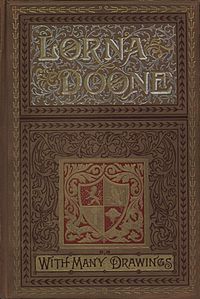
Lorna Doone

Lorna Doone. R.D. Blackmore. 1869. 658 pages.

If anybody cares to read a simple tale told simply, I, John Ridd of the parish of Oare, in the county of Somerset, yeoman and churchwarden, have seen and had a share in some doings of this neighborhood, which I will try to set down in order, God sparing my life and memory. 

Lorna Doone was a classic that I almost almost loved. However, while I didn't "love" it, I certainly liked it. What I liked best about Lorna Doone was the romance. There were a few love scenes in this one--scenes where John Ridd is wooing Lorna Doone and professing his unending love for her. And those scenes work the best of any in the novel. But those scenes make up just a fraction of the novel, and to be honest I found most of this one to be boring. Now, I enjoy a rambling novel, I do. I love Anthony Trollope, Charles Dickens, and Wilkie Collins. I don't mind an author that takes his time telling a story--so long as the asides are written in a charming, entertaining way. But I didn't feel that was the case in Lorna Doone.

This historical romance is set in Exmoor (Devon and Somerset England) in the 17th Century) during the reigns of King Charles II and James II. John Ridd falls in love with Lorna Doone, but there are a few big obstacles standing in the way of their true love. First, she is a Doone. The Doone clan murdered John's father. John himself forgives this flaw easily since Lorna is so incredibly beautiful. The rest of his family may not be eager to welcome a woman from the outlaw clan. And the Doone clan, well, they are definitely not wanting to lose "their" Lorna to John Ridd. Second, Lorna's mysterious past. She doesn't remember a time before the Doones, but, that doesn't mean there wasn't one. And this big reveal causes some to believe that John Ridd isn't good enough--worthy enough-- for her. I will not say more than that. Third, the general times in which they lived: the political mess of the battle for the kingdom between James II and the Duke of Monmouth. John is mistakenly taken for a soldier on Monmouth's side--that is not the case, but it does pose some problems. Fourth, the pure evil that is Carver Doone.

Favorite scenes:
I would have leaped into the valley of the shadow of death (as described by the late John Bunyan), only to hear her call me "John"; though Apollyon were lurking there, and Despair should lock me in.
She stole across the silent grass; but I strode hotly after her; fear was all beyond me now, except the fear of losing her. I could not but behold her manner, as she went before me, all her grace, and lovely sweetness, and her sense of what she was.
She led me to her own rich bower, which I told of once before; and if in spring it were a sight, what was it in summer glory? But although my mind had notice of its fairness and its wonder, not a heed my heart took of it, neither dwelt it in my presence more than flowing water. All that in my presence dwelt, all that in my heart was felt, was the maiden moving gently, and afraid to look at me.
For now the power of my love was abiding on her, new to her, unknown to her; not a thing to speak about, nor even to think clearly; only just to feel and wonder, with a pain of sweetness. She could look at me no more, neither could she look away, with a studied manner—only to let fall her eyes, and blush, and be put out with me, and still more with herself.
I left her quite alone; though close, though tingling to have hold of her. Even her right hand was dropped and lay among the mosses. Neither did I try to steal one glimpse below her eyelids. Life and death to me were hanging on the first glance I should win; yet I let it be so.
After long or short—I know not, yet ere I was weary, ere I yet began to think or wish for any answer—Lorna slowly raised her eyelids, with a gleam of dew below them, and looked at me doubtfully. Any look with so much in it never met my gaze before.
"Darling, do you love me?" was all that I could say to her.
"Yes, I like you very much," she answered, with her eyes gone from me, and her dark hair falling over, so as not to show me things.
"But do you love me, Lorna, Lorna; do you love me more than all the world?"
"No, to be sure not. Now why should I?"
"In truth, I know not why you should. Only I hoped that you did, Lorna. Either love me not at all, or as I love you for ever."
"John I love you very much; and I would not grieve you. You are the bravest, and the kindest, and the simplest of all men—I mean of all people—I like you very much, Master Ridd, and I think of you almost every day."
"That will not do for me, Lorna. Not almost every day I think, but every instant of my life, of you. For you I would give up my home, my love of all the world beside, my duty to my dearest ones, for you I would give up my life, and hope of life beyond it. Do you love me so?"
"Not by any means," said Lorna; "no, I like you very much, when you do not talk so wildly; and I like to see you come as if you would fill our valley up, and I like to think that even Carver would be nothing in your hands—but as to liking you like that, what should make it likely? (214-5)
and
She made for awhile as if she dreamed not of the meaning of my gaze, but tried to speak of other things, faltering now and then, and mantling with a richer damask below her long eyelashes.
"This is not what I came to know," I whispered very softly, "you know what I am come to ask."
"If you are come on purpose to ask anything, why do you delay so?" She turned away very bravely, but I saw that her lips were trembling.
"I delay so long, because I fear; because my whole life hangs in balance on a single word; because what I have near me now may never more be near me after, though more than all the world, or than a thousand worlds, to me." As I spoke these words of passion in a low soft voice, Lorna trembled more and more; but she made no answer, neither yet looked up at me.
"I have loved you long and long," I pursued, being reckless now, "when you were a little child, as a boy I worshipped you: then when I saw you a comely girl, as a stripling I adored you: now that you are a full-grown maiden all the rest I do, and more—I love you more than tongue can tell, or heart can hold in silence. I have waited long and long; and though I am so far below you I can wait no longer; but must have my answer."
"You have been very faithful, John," she murmured to the fern and moss; "I suppose I must reward you."
"That will not do for me," I said; "I will not have reluctant liking, nor assent for pity's sake; which only means endurance. I must have all love, or none, I must have your heart of hearts; even as you have mine, Lorna."
While I spoke, she glanced up shyly through her fluttering lashes, to prolong my doubt one moment, for her own delicious pride. Then she opened wide upon me all the glorious depth and softness of her loving eyes, and flung both arms around my neck, and answered with her heart on mine,—
"Darling, you have won it all. I shall never be my own again. I am yours, my own one, for ever and for ever."
I am sure I know not what I did, or what I said thereafter, being overcome with transport by her words and at her gaze. Only one thing I remember, when she raised her bright lips to me, like a child, for me to kiss, such a smile of sweet temptation met me through her flowing hair, that I almost forgot my manners, giving her no time to breathe.
"That will do," said Lorna gently, but violently blushing; "for the present that will do, John. And now remember one thing, dear. All the kindness is to be on my side; and you are to be very distant, as behoves to a young maiden; except when I invite you. But you may kiss my hand, John; oh, yes, you may kiss my hand, you know. Ah to be sure! I had forgotten; how very stupid of me!"
For by this time I had taken one sweet hand and gazed on it, with the pride of all the world to think that such a lovely thing was mine; and then I slipped my little ring upon the wedding finger; and this time Lorna kept it, and looked with fondness on its beauty, and clung to me with a flood of tears.
"Every time you cry," said I, drawing her closer to me "I shall consider it an invitation not to be too distant. There now, none shall make you weep. Darling, you shall sigh no more, but live in peace and happiness, with me to guard and cherish you: and who shall dare to vex you?" But she drew a long sad sigh, and looked at the ground with the great tears rolling, and pressed one hand upon the trouble of her pure young breast.
"It can never, never be," she murmured to herself alone: "Who am I, to dream of it? Something in my heart tells me it can be so never, never." (261-2)
Isn't the "I love you more than tongue can tell, or heart can hold in silence" lovely?

Lorna Doone isn't just a romance, however; John Ridd has a few adventures all his own, including more than a few fight/battle scenes.

Read Lorna Doone
  • If you like classics
  • If you like historical romances

© 2012 Becky Laney of Becky's Book Reviews

Clocks

Clocks. Jerome K. Jerome. 1891. 10 pages.

 There are two kinds of clocks. There is the clock that is always wrong, and that knows it is wrong, and glories in it; and there is the clock that is always right--except when you rely upon it, and then it is more wrong than you would think a clock could be in a civilized country.

This is an extremely short essay on clocks, exaggeration, keeping up appearances, and Time. It was an enjoyable read; perhaps it isn't as WONDERFUL as some of Jerome K. Jerome's other works, but, it was worth the few minutes it took to read.

The second type of clock:
The man who can live in the same house with one of these clocks, and not endanger his chance of heaven about once a month by standing up and telling it what he thinks of it, is either a dangerous rival to that old established firm, Job, or else he does not know enough bad language to make it worth his while to start saying anything at all. The great dream of its life is to lure you on into trying to catch a train by it. For weeks and weeks it will keep the most perfect time. If there were any difference in time between that clock and the sun, you would be convinced it was the sun, not the clock, that wanted seeing to. You feel that if that clock happened to get a quarter of a second fast, or the eighth of an instant slow, it would break its heart and die. It is in this spirit of child-like faith in its integrity that, one morning, you gather your family around you in the passage, kiss your children, and afterward wipe your jammy mouth, poke your finger in the baby's eye, promise not to forget to order the coals, wave at last fond adieu with the umbrella, and depart for the railway-station. I never have been quite able to decide, myself, which is the more irritating to run two miles at the top of your speed, and then to find, when you reach the station, that you are three-quarters of an hour too early; or to stroll along leisurely the whole way, and dawdle about outside the booking-office, talking to some local idiot, and then to swagger carelessly on to the platform, just in time to see the train go out!
On his own "special" clock:
But the great charm about my clock is its reliable uncertainty. It works on no method whatever; it is a pure emotionalist. One day it will be quite frolicsome, and gain three hours in the course of the morning, and think nothing of it; and the next day it will wish it were dead, and be hardly able to drag itself along, and lose two hours out of every four, and stop altogether in the afternoon, too miserable to do anything; and then, getting cheerful once more toward evening, will start off again of its own accord. I do not care to talk much about this clock; because when I tell the simple truth concerning it, people think I am exaggerating. It is very discouraging to find, when you are straining every nerve to tell the truth, that people do not believe you, and fancy that you are exaggerating. It makes you feel inclined to go and exaggerate on purpose, just to show them the difference. I know I often feel tempted to do so myself--it is my early training that saves me.

On society:
Truth and fact are old-fashioned and out-of-date, my friends, fit only for the dull and vulgar to live by. Appearance, not reality, is what the clever dog grasps at in these clever days. We spurn the dull-brown solid earth; we build our lives and homes in the fair-seeming rainbow-land of shadow and chimera.

© 2012 Becky Laney of Becky's Book Reviews

Lady Audley's Secret

Lady Audley's Secret. Mary Elizabeth Braddon. 1862/1998. Oxford World's Classic. 496 pages.  

It lay low down in a hollow, rich with find old timber and luxuriant pastures; and you came upon it through an avenue of lines, bordered on either side by meadows, over the high hedges of which the cattle looked inquisitively at you as you passed, wondering, perhaps, what you wanted; for there was no thoroughfare, and unless you were going to the Court you had no business there at all. At the end of this avenue there was an old arch and a clock-tower, with a stupid, bewildering clock, which had only one hand; and which jumped straight from one hour to the next, and was therefore always in extremes. Through this arch you walked straight into the gardens of Audley Court.

I definitely enjoyed this one! I thought it was a GREAT read. I'm not sure it is a great book, but, it offers entertainment and thrills. I personally liked the writing style of this one, I found it very suspenseful and satisfying. If possible, it's best not to know Lady Audley's "secret" before reading. I'd say avoid reading too much detail about this one. I am going to try my best not to give away any details that are best left as surprises. But I do want to introduce you to the characters...

People you'll meet:

Michael Audley, a widower with a near-grown daughter, Alicia, who falls madly, deeply in love with a younger woman, Lucy Graham, who is employed as a governess by one of his friends.

Lady Audley, a young woman with a secret; It was almost too easy for Lucy Graham to agree to become Lady Audley. He's a rich man, a man with status, and he wants HER, a nobody. Who could say no?! Especially if you don't have your heart set on marrying for love.

Alicia Audley, a young woman too close in age to Lady Audley; she is NOT happy to have a new stepmother. She is not happy that her new stepmother is oh-so-gorgeous and that men seem to see only her. She's also suspicious and distrustful. Granted, she would probably be distrustful of ANY woman in that situation. And the fact that Lady Audley does in fact have a secret shouldn't be taken as proof that she has great instincts.

Robert Audley, a nephew of Michael Audley; Alicia really, really WISHES that Robert would pay attention to her. She really is hoping that he will notice that she is all grown up and ready to be proposed to. When we first meet Robert, you might say that he completely lacks ambition and gumption. In other words, he doesn't do much at all. This doesn't remain the case.

George Talboys, a friend of Robert Audley. He is newly returned to England, he's now got some money. He could potentially have been a very very happy man if he'd found his wife and son alive and waiting for him. Unfortunately, soon after his return, he learns that his wife has died. His son is being cared for by his father-in-law. He's too shocked to really take care of the boy himself, and, he feels perhaps its best not to disturb the boy too much. After all, his mother has died, and the boy's grandfather has been a part of his life from the start.

Phoebe and Luke Marks, Phoebe serves as Lady Audley's maid, Phoebe and her husband are the first to discover her secret.

I would definitely recommend this one!!! This would make a great companion read to The Suspicions of Mr. Whicher by Kate Summerscale, but, do try to read this one FIRST. 

Read Lady Audley's Secret
  • If you want to read one of the first sensation novels
  • If you enjoy suspense and mystery and detective stories
  • If you like classics, Victorian classics
  • If you are interested in reading women writers of the nineteenth century


© 2012 Becky Laney of Becky's Book Reviews

Black Beauty

Black Beauty. Anna Sewell. 1877. 245 pages.

The first place that I can well remember was a large pleasant meadow with a pond of clear water in it. Some shady trees leaned over it, and rushes and water-lilies grew at the deep end. Over the hedge on one side we looked into a plowed field, and on the other we looked over a gate at our master's house, which stood by the roadside; at the top of the meadow was a grove of fir trees, and at the bottom a running brook overhung by a steep bank.

Black Beauty is such a GREAT book. I really LOVED, LOVED, LOVED it. Which surprises me, I must admit since I generally don't like animal stories, and I'm even more reluctant to read horse books than dog books. But. I loved it. There was something timeless and wonderful about it. I can see why it became a classic, I hope it remains a beloved classic. 

Black Beauty is a great narrator, a great character. I really came to care for this horse right from the start. I had a feeling that life wouldn't always be so easy and gentle for him. I knew that they'd be dark days and nights ahead. And that proved true. As he is sold from one owner to another to another to another to another and so on. But he's so very, very, very good and understanding and wise. There were so many times he proved himself noble and worthy. And Black Beauty wasn't the only character I loved. I loved so many of the human characters too! John Manly, for example, comes to mind, as does James Howard, Joe Green, Jerry Barker, Farmer Grey, Farmer Thoroughgood, etc. Ginger's story is touching, as well, Ginger being one of many horses Black Beauty befriends.

Black Beauty also had a LOT to say about society, about virtues and vices. It had a LOT to say in regards to how animals should be treated--with respect, kindness, understanding, with dignity. It had a LOT to say about how humans should treat one another too. I was surprised at how deep this book was, how wise.

My favorite quotes:
“There is no religion without love, and people may talk as much as they like about their religion, but if it does not teach them to be good and kind to man and beast, it is all a sham.”
“Only ignorance! only ignorance! how can you talk about only ignorance? Don't you know that it is the worst thing in the world, next to wickedness? -- and which does the most mischief heaven only knows. If people can say, `Oh! I did not know, I did not mean any harm,' they think it is all right.”
“My doctrine is this, that if we see cruelty or wrong that we have the power to stop, and do nothing, we make ourselves sharers in the guilt.”
 “If a thing is right it can be done, and if it is wrong it can be done without; and a good man will find a way.”
“We call them dumb animals, and so they are, for they cannot tell us how they feel, but they do not suffer less because they have no words.” 

Read Black Beauty

    •    If you want to read one of the best children's books ever
    •    If you're a fan of animal stories, horse stories,
    •    If you enjoy historical fiction
    •    If you enjoy classics


© 2012 Becky Laney of Becky's Book Reviews

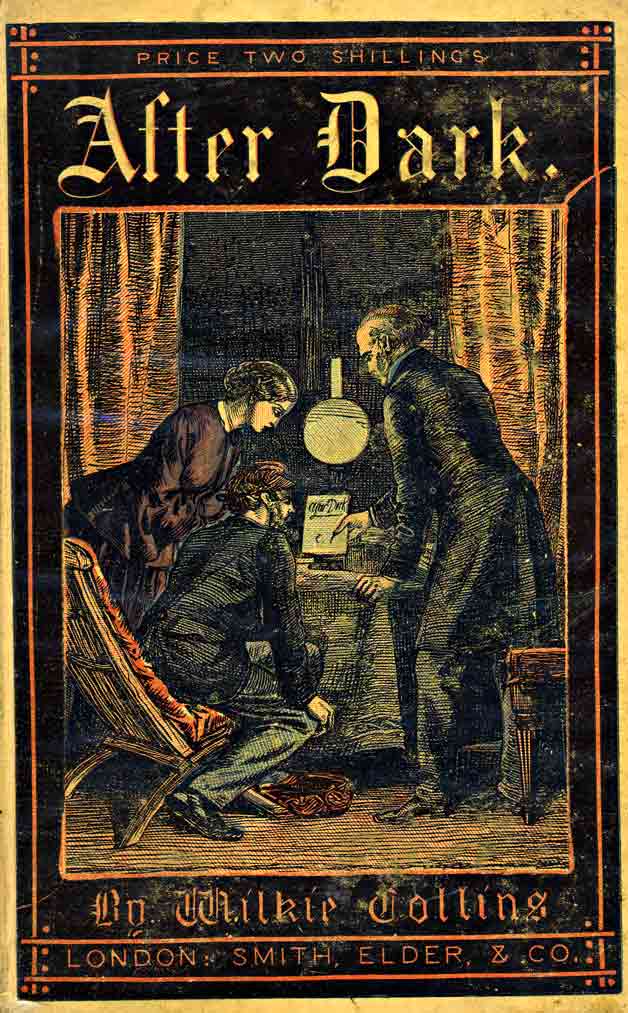
After Dark

After Dark. Wilkie Collins. 1856. 404 pages.

From "Leaves From Leah's Diary"
26th February, 1827.—The doctor has just called for the third time to examine my husband's eyes. Thank God, there is no fear at present of my poor William losing his sight, provided he can be prevailed on to attend rigidly to the medical instructions for preserving it. These instructions, which forbid him to exercise his profession for the next six months at least, are, in our case, very hard to follow. They will but too probably sentence us to poverty, perhaps to actual want; but they must be borne resignedly, and even thankfully, seeing that my husband's forced cessation from work will save him from the dreadful affliction of loss of sight. I think I can answer for my own cheerfulness and endurance, now that we know the worst. Can I answer for our children also? Surely I can, when there are only two of them. It is a sad confession to make, but now, for the first time since my marriage, I feel thankful that we have no more.
I tend to love Wilkie Collins. And I did enjoy his short story collection, After Dark. But I didn't find all six of the short stories equally compelling. And while I *loved* some of the stories in this book, I didn't love them all. I found them all worthwhile, all entertaining.

There's a framework to After Dark. A portrait-painter, William, suffers damage to his eyesight, the doctor tells him he needs LOTS of time to recuperate if he hopes to be able to see again. He can no longer count on his painting to bring in the income and take care of his family, so, the family is forced to come up with plan B. Plan B just happens to be writing and publishing a book of stories. These are stories that have been told to the painter--usually while his subject is being painted--through the years. He will now recollect the best stories he's ever heard and relate them to his wife, Leah, who will write them down each night...after dark. (That is after her long day's work is through.)

The six stories are:

  • The Traveller's Story of a Terribly Strange Bed (1852)
  • The Lawyer's Story of a Stolen Letter (1854)
  • The French Governess's Story of Sister Rose (1855)
  • The Angler's Story of The Lady of Glenwith Grange (new for After Dark)
  • The Nun's Story of Gabriel's Marriage (1853)
  • The Professor's Story of the Yellow Mask (1855)
Five of the six short stories were reprints, only one story was brand new and written especially for this book.

In my opinion, the best, best, best short story in this collection is The French Governess's Story of Sister Rose. This story has DRAMA and action. It is set during the French Revolution. And in my opinion, this story is a MUST read. Not only if you're a fan of Victorian literature OR a fan of Wilkie Collins, but if you're a fan of historical fiction set during the French Revolution, you should really consider reading this novella. (In my opinion, it is closer to a novella than a proper short story. It has parts and chapters.) So Louis Trudaine made a deathbed promise to his mother to always be there for his sister, Rose, and protect her. Rose has fallen in love with a man Louis feels is unworthy of her, a Charles Danville. The marriage does happen, though not without some unpleasant exchanges on the eve of the wedding. But he never feels quite sure of his sister's husband, and so he chooses to remain nearby even if it means passing up a job opportunity. Years pass--we learn from the narrator--and the Revolution comes. And with it danger, drama, action, betrayal, and so much more. This story is so very, very, very good. It's quite intense and I loved every minute of it.

The Traveller's Story of a Terribly Strange Bed is actually Wilkie Collins first published short story. It is quite creepy! It also happens to be set in Paris, by the way, anyway, the narrator is a young man named Faulkner. His good luck at a gambling house almost proves fatal. For a very, very friendly man convinces him that it is much too risky to leave the house at that time of night and wander the streets carrying his winnings. No, no, it would be much much safer to stay there for the night. But is that the truth? Well, his insomnia may just be a lifesaver!

The Nun's Story of Gabriel's Marriage is another story set in France during the French Revolution. While it isn't as good as The French Governess's Story of Sister Rose, in my opinion, it was interesting to get another story set in France--in Brittany--from Collins. The theme of this one is forgiveness and reconciliation. If you want a story with a couple of BIG twists, this one may prove satisfying.

The Angler's Story of The Lady of Glenwith Grange is another story with a BIG, BIG twist. Ida has promised to always, always, always take care of her younger sister, Rosamond. (Their mother died when Rosamond was a baby.) So when Rosamond marries, it's agreed that Ida will always live with them. The marriage, as you might expect, does not exactly exactly go as planned. And readers...along with Ida...learn why.

The Professor's Story of the Yellow Mask is set in Italy, I believe. It has a larger cast of characters than some of the other stories in the collection. And it has its own share of drama. It is a darker story balanced perhaps in a way by a love story with many, many obstacles. It also has lots of twists and turns and such. That being said, I wasn't thrilled with it.

The Lawyer's Story of a Stolen Letter is a detective story. It was a nice enough story, I suppose, but I wasn't wowed by it. Still, it's enjoyable enough. 


Read After Dark
  • If you're a fan of Wilkie Collins
  • If you're a fan of Victorian literature
  • If you're a fan of mystery, suspense, detective, or sensation stories
  • If you like short stories
  • If you like "shocking" stories with plenty of drama and twists and turns
© 2012 Becky Laney of Becky's Book Reviews

Idle Thoughts of an Idle Fellow

Idle Thoughts of an Idle Fellow. Jerome K. Jerome. 1889. 112 pages.
Now, this is a subject on which I flatter myself I really am au fait. The gentleman who, when I was young, bathed me at wisdom's font for nine guineas a term—no extras—used to say he never knew a boy who could do less work in more time; and I remember my poor grandmother once incidentally observing, in the course of an instruction upon the use of the Prayer-book, that it was highly improbable that I should ever do much that I ought not to do, but that she felt convinced beyond a doubt that I should leave undone pretty well everything that I ought to do.
I am afraid I have somewhat belied half the dear old lady's prophecy. Heaven help me! I have done a good many things that I ought not to have done, in spite of my laziness. But I have fully confirmed the accuracy of her judgment so far as neglecting much that I ought not to have neglected is concerned. Idling always has been my strong point. I take no credit to myself in the matter—it is a gift. Few possess it. There are plenty of lazy people and plenty of slow-coaches, but a genuine idler is a rarity. He is not a man who slouches about with his hands in his pockets. On the contrary, his most startling characteristic is that he is always intensely busy.
It is impossible to enjoy idling thoroughly unless one has plenty of work to do. There is no fun in doing nothing when you have nothing to do. Wasting time is merely an occupation then, and a most exhausting one. Idleness, like kisses, to be sweet must be stolen.
Is Idle Thoughts of an Idle Fellow worth reading? Is it as good as Three Men in a Boat? Is it as good as Diary of a Pilgrimage? I do think it's worth reading, just reading in a different way. It is not as good, in my opinion, as Three Men in a Boat or Diary of a Pilgrimage. Both Three Men in a Boat and Diary of a Pilgrimage were travel books, travel books written more to amuse and delight, perhaps, but the books had structure, they were going somewhere, they were doing something. Idle Thoughts for an Idle Fellow, well, it's a book about nothing and everything. Some essays were good--very, very good. Others not so much. But I did like this one!!!

On idling:
I like idling when I ought not to be idling; not when it is the only thing I have to do. That is my pig-headed nature. The time when I like best to stand with my back to the fire, calculating how much I owe, is when my desk is heaped highest with letters that must be answered by the next post. When I like to dawdle longest over my dinner is when I have a heavy evening's work before me. And if, for some urgent reason, I ought to be up particularly early in the morning, it is then, more than at any other time, that I love to lie an extra half-hour in bed.
On sleeping late:
Ah! how delicious it is to turn over and go to sleep again: "just for five minutes." Is there any human being, I wonder, besides the hero of a Sunday-school "tale for boys," who ever gets up willingly? 
I think myself that I could keep out of bed all right if I once got out. It is the wrenching away of the head from the pillow that I find so hard, and no amount of over-night determination makes it easier. I say to myself, after having wasted the whole evening, "Well, I won't do any more work to-night; I'll get up early to-morrow morning;" and I am thoroughly resolved to do so—then. In the morning, however, I feel less enthusiastic about the idea, and reflect that it would have been much better if I had stopped up last night.
On alarm clocks: 
artful contrivances that go off at the wrong time and alarm the wrong people
On love:
Love is like the measles; we all have to go through it. Also like the measles, we take it only once. One never need be afraid of catching it a second time.
A man's heart is a firework that once in its time flashes heavenward.
On affection:
Affection will burn cheerily when the white flame of love is flickered out. Affection is a fire that can be fed from day to day and be piled up ever higher as the wintry years draw nigh.
On blame:
But we are so blind to our own shortcomings, so wide awake to those of others. Everything that happens to us is always the other person's fault.
 On truth:
Speak truth, and right will take care of itself.
 On blogging writing:
It is a most remarkable thing. I sat down with the full intention of writing something clever and original; but for the life of me I can't think of anything clever and original—at least, not at this moment.
On cats:
As for cats, they nearly equal human beings for vanity. I have known a cat get up and walk out of the room on a remark derogatory to her species being made by a visitor, while a neatly turned compliment will set them purring for an hour.
I do like cats. They are so unconsciously amusing. There is such a comic dignity about them, such a "How dare you!" "Go away, don't touch me" sort of air. Now, there is nothing haughty about a dog. They are "Hail, fellow, well met" with every Tom, Dick, or Harry that they come across. When I meet a dog of my acquaintance I slap his head, call him opprobrious epithets, and roll him over on his back; and there he lies, gaping at me, and doesn't mind it a bit.
Fancy carrying on like that with a cat! Why, she would never speak to you again as long as you lived. No, when you want to win the approbation of a cat you must mind what you are about and work your way carefully. If you don't know the cat, you had best begin by saying, "Poor pussy." After which add "did 'ums" in a tone of soothing sympathy. You don't know what you mean any more than the cat does, but the sentiment seems to imply a proper spirit on your part, and generally touches her feelings to such an extent that if you are of good manners and passable appearance she will stick her back up and rub her nose against you. Matters having reached this stage, you may venture to chuck her under the chin and tickle the side of her head, and the intelligent creature will then stick her claws into your legs; and all is friendship and affection...
On sympathy:
It is in our faults and failings, not in our virtues, that we touch one another and find sympathy. We differ widely enough in our nobler qualities. It is in our follies that we are at one.
 On flattery:
Fill a person with love for themselves, and what runs over will be your share, says a certain witty and truthful Frenchman whose name I can't for the life of me remember. (Confound it! I never can remember names when I want to.)
On novels:
But then not one novelist in a thousand ever does tell us the real story of their hero. It is in the petty details, not in the great results, that the interest of existence lies.
On babies:
Odd little people! They are the unconscious comedians of the world's great stage. They supply the humor in life's all-too-heavy drama. Each one, a small but determined opposition to the order of things in general, is forever doing the wrong thing at the wrong time, in the wrong place and in the wrong way. Give an average baby a fair chance, and if it doesn't do something it oughtn't to a doctor should be called in at once.

© 2012 Becky Laney of Becky's Book Reviews

Lin McLean

Lin McLean. Owen Wister. 1898/1998. Forge. 230 pages.

In the old days, the happy days, when Wyoming was a Territory with a future instead of a State with a past, and the unfenced cattle grazed upon her ranges by prosperous thousands, young Lin McLean awaked early one morning in cow camp, and lay staring out of his blankets upon the world. 

It helped me tremendously to know that this was Owen Wister's first novel. (I am even tempted to say "novel" just because this book feels more like a short story collection than a cohesive novel.) Unfortunately, I didn't learn that this was his first novel until after I read it and had been disappointed. Last year, I read and LOVED, LOVED, LOVED Owen Wister's novel The Virginian. It was a complete surprise to me because I am allergic to westerns. I wanted to find another Wister novel that compared to The Virginian, and I didn't find it in Lin McLean. (Though the Virginian makes a couple of appearances in the stories within Lin McLean.) But is that fair to expect Lin McLean to be as good, as great as The Virginian? Probably not.

The stories found in Lin McLean are
  • How Lin McLean Went East
  • The Winning of the Biscuit-Shooter
  • Lin McLean's Honey-Moon
  • A Journey In Search of Christmas
  • Separ's Vigilante
  • Destiny at Drybone
  • In the After-Days (a poem, not a story)
If I had to sum up the book, sum up the stories, I would say Lin McLean was about a cowboy who was good at losing his money gambling, a man easily distracted by women and cards and booze, a man who despite his shortcomings found the love of a young boy and a good woman.

My favorite stories were, without a doubt, "Lin McLean's Honey-Moon," "Separ's Vigilante," and "Destiny at Drybone."

Read Lin McLean
  • If you like westerns
  • If you're looking to catch early glimpses of the man who would become THE VIRGINIAN
  • If you like western short stories
© 2012 Becky Laney of Becky's Book Reviews

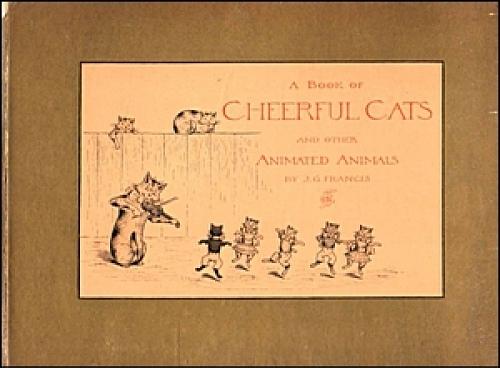
A Book of Cheerful Cats and Other Animated Animals

A Book of Cheerful Cats and Other Animated Animals. J.G. Francis. 1879/1903* Century Co. New York. 45 pages**

Some Cat-land fancies, drawn and dressed
To cheer your mind when it's depressed

I am participating in Literary Odyssey's Victorian Celebration, and I thought it would be great fun to see what types of picture books and story books would have been available at the time. This one was first published in 1879, and it went through a LOT of reprints. The edition they have online was the 1903 reprint.

A Book of Cheerful Cats and Other Animated Animals is an interesting collection of poems, drawings, stories, and sketches. While most of them feature cats, not all of them do. In fact, my particular favorite is the "Study of Hedgehog Stealing An Apple." This one does have a table of contents, by the way. To give you some idea of what to expect, here are a sample of pieces: "Some Fun With a Toy Spider," "The Tea Party," "The Giraffe Ride," "The Bicycle Ride," "The Lion in the Barber-Shop," "The Spring Curtain," "Story of the Catnip Ball," "Coasting Cats," "The Cat-o'-nine Tails."

Here are some of my favorite pages:
Bicycle Ride, page 15

"Oh, dear Papa!" three children cried.
"You promised don't you know?
That next when you should take a ride
All three of us should go."
"I Did," that father said, "You know
I never speak at random.
So get your roller-skates. We'll go
Off in a tearing tandem!" 
Study of Hedgehog Stealing Apple, page 16

 And here is my personal favorite, the one about the hedgehog and the apple!!!

I also found "Spring Curtain. A Drama In Five Acts" to be a lot of fun!!! This one is about courtship, if you will. Which tom cat will she choose? And will the rival get his revenge?


The book does exactly what it promises--it seeks to amuse, to charm, to delight. It shows cats being cats, for example.

Read this picture book of rhymes and stories online.

Read A Book of Cheerful Cats
  • If you love cats, love reading about cats, love looking at vintage drawings of cats
  • If you like historical picture books, vintage picture books
  • If you like the Victorian period

*1879, 1880, 1881, 1883, 1884, 1885, 1886, 1887, 1890, 1892, 1903
**It is really hard to say how many pages this one has. There are 45 numbered pages with illustrations and/or text. However, there are a LOT of blank pages.

© 2012 Becky Laney of Becky's Book Reviews

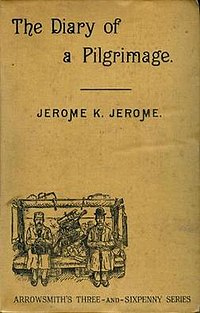
Diary of a Pilgrimage

Diary of a Pilgrimage. Jerome K. Jerome. 1891. 192 pages.

From the preface:
Said a friend of mine to me some months ago: “Well now, why don’t you write a sensible book?  I should like to see you make people think.”
“Do you believe it can be done, then?” I asked.
“Well, try,” he replied.
Accordingly, I have tried.  This is a sensible book.  I want you to understand that.  This is a book to improve your mind.  In this book I tell you all about Germany—at all events, all I know about Germany—and the Ober-Ammergau Passion Play.  I also tell you about other things.  I do not tell you all I know about all these other things, because I do not want to swamp you with knowledge.  I wish to lead you gradually.  When you have learnt this book, you can come again, and I will tell you some more.  I should only be defeating my own object did I, by making you think too much at first, give you a perhaps, lasting dislike to the exercise.  I have purposely put the matter in a light and attractive form, so that I may secure the attention of the young and the frivolous.  I do not want them to notice, as they go on, that they are being instructed; and I have, therefore, endeavoured to disguise from them, so far as is practicable, that this is either an exceptionally clever or an exceptionally useful work.  I want to do them good without their knowing it.  I want to do you all good—to improve your minds and to make you think, if I can.
What you will think after you have read the book, I do not want to know; indeed, I would rather not know.  It will be sufficient reward for me to feel that I have done my duty, and to receive a percentage on the gross sales.
I don't want to overwhelm you with quotes, but, I'm not sure I have enough will power to resist. Why? Well, Diary of a Pilgrimage is so very, very, very good!!! I just LOVED, LOVED, LOVED it. It was amusing, yes, and charming, and delightful. But it was also laugh out loud funny. And at the same time, he managed to sneak in serious asides. A phrase here and there that resonates.

I already knew I was a fan of Jerome K. Jerome, I've read Three Men In A Boat and Three Men on a Brummel. I don't know WHY I waited so long to read more Jerome. This travel book featuring the adventures of J and B is laugh out loud funny.

The book begins when his friend, B, asks him if he wants to go to the theatre, not mentioning, at first, that the theatre is in Germany and that it is no ordinary play they go to see, but a quite famous Passion Play that literally lasts all day long. J, our narrator, pauses to consider, realizes that the trip will prove quite convenient and agrees to go. The rest of the book is about all the stages of their trip beginning with what to pack and concluding with what train to take to escape from Munich. It is full of detail and description. Often humorous, but, at times serious as well. For example, though he might make a big to do about how he has nothing at all to say about the Passion Play itself, he does quite the job of it!!! And for that chapter this book does take a different tone. (I've included just one tiny quote from that section.) But. For the most part it is about two men having adventures in a handful of European countries. J pretending to know more of the language than he actually does. B worrying about which trains to take next, etc. That is when B isn't wanting to stop and see each and every cathedral along the way. It's about them enjoying the company of others (except when they don't). Descriptions of trains, ships, cathedrals, restaurants, hotels, rivers, lakes, towns, cities, etc.

I just LOVE Jerome K. Jerome's writing style. His narration is wonderful!!! 

Read The Diary of a Pilgrimage:
  • If you like to laugh
  • If you're a fan of travel books, if you are curious to read about nineteenth century Germany
  • If you are a fan of Jerome K. Jerome
  • If you enjoy Victorian fiction
  • If you DON'T think you like Victorian fiction but are willing to take a chance. This is SHORT and FUNNY.
Favorite quotes (of a short variety):
I pondered for a moment, looked at my diary, and saw that Aunt Emma was coming to spend Saturday to Wednesday next with us, calculated that if I went I should miss her, and might not see her again for years, and decided that I would go.

I always like to be prepared for work; one never knows when one may feel inclined for it.
"Oh! Take as much advice as you like; that always comes in useful to give away."
Aunt Emma came in the afternoon. She said she was so glad she had caught me. Something told her to change her mind and come on Friday instead of Saturday. It was Providence, she said. I wish Providence would mind its own business, and not interfere in my affairs; it does not understand them. She says she shall stop till I come back, as she wants to see me again before she goes. I told her I might not be back for a month. She said it didn't matter; she had plenty of time, and would wait for me. The family entreated me to hurry home. 
When men have nothing else to occupy their minds, they take to thinking.
One day she [Society] will arrive at perfect wisdom, and will pay each man according to his deserts. But do not be alarmed. This will not happen in our time. 
 Time is a shadow that will vanish with the twilight of humanity; but Silence is a part of the eternal.  All things that are true and lasting have been taught to men’s hearts by Silence.
A conscientious man who really felt that his words would carry weight and influence with them would be almost afraid to speak at all.  It is the man who knows that it will not make an ounce of difference to anyone what he says, that can grow eloquent and vehement and positive.  It will not make any difference to anybody or anything what I say about the Ober-Ammergau Passion Play.  So I shall just say what I want to.
Not by his doctrines, not even by his promises, has Christ laid hold upon the hearts of men, but by the story of his life.
Our first thoughts are the thoughts that are given to us; our second thoughts are the thoughts that we make for ourselves. I prefer to trust the former.
Favorite Long Quotes:

A Story About a Talkative Man on a Train:
There was a very talkative man in our carriage.  I never came across a man with such a fund of utterly uninteresting anecdotes.  He had a friend with him—at all events, the man was his friend when they started—and he talked to this friend incessantly, from the moment the train left Victoria until it arrived at Dover.  First of all he told him a long story about a dog.  There was no point in the story whatever.  It was simply a bald narrative of the dog’s daily doings.  The dog got up in the morning and barked at the door, and when they came down and opened the door there he was, and he stopped all day in the garden; and when his wife (not the dog’s wife, the wife of the man who was telling the story) went out in the afternoon, he was asleep on the grass, and they brought him into the house, and he played with the children, and in the evening he slept in the coal-shed, and next morning there he was again.  And so on, for about forty minutes.
A very dear chum or near relative of the dog’s might doubtless have found the account enthralling; but what possible interest a stranger—a man who evidently didn’t even know the dog—could be expected to take in the report, it was difficult to conceive.
The friend at first tried to feel excited, and murmured: “Wonderful!”  “Very strange, indeed!”  “How curious!” and helped the tale along by such ejaculations as, “No, did he though?”  “And what did you do then?” or, “Was that on the Monday or the Tuesday, then?”  But as the story progressed, he appeared to take a positive dislike to the dog, and only yawned each time that it was mentioned.
Indeed, towards the end, I think, though I trust I am mistaken, I heard him mutter, “Oh, damn the dog!”
After the dog story, we thought we were going to have a little quiet.  But we were mistaken; for, with the same breath with which he finished the dog rigmarole, our talkative companion added:
“But I can tell you a funnier thing than that—”
We all felt we could believe that assertion.  If he had boasted that he could tell a duller, more uninteresting story, we should have doubted him; but the possibility of his being able to relate something funnier, we could readily grasp.
But it was not a bit funnier, after all.  It was only longer and more involved.  It was the history of a man who grew his own celery; and then, later on, it turned out that his wife was the niece, by the mother’s side, of a man who had made an ottoman out of an old packing-case.
The friend glanced round the carriage apologetically about the middle of this story, with an expression that said:
“I’m awfully sorry, gentlemen; but it really is not my fault.  You see the position I’m in.  Don’t blame me.  Don’t make it worse for me to bear than it is.”
And we each replied with pitying, sympathetic looks that implied:
“That’s all right, my dear sir; don’t you fret about that.  We see how it is.  We only wish we could do something to help you.”
The poor fellow seemed happier and more resigned after that.

A Story About Not Sleeping On A Boat
I got a little sleep at last.  Not in the bunk I had been at such pains to secure: I would not have stopped down in that stuffy saloon, if anybody had offered me a hundred pounds for doing so.  Not that anybody did; nor that anybody seemed to want me there at all.  I gathered this from the fact that the first thing that met my eye, after I had succeeded in clawing my way down, was a boot.  The air was full of boots.  There were sixty men sleeping there—or, as regards the majority, I should say trying to sleep there—some in bunks, some on tables, and some under tables.  One man was asleep, and was snoring like a hippopotamus—like a hippopotamus that had caught a cold, and was hoarse; and the other fifty-nine were sitting up, throwing their boots at him.  It was a snore, very difficult to locate.  From which particular berth, in that dimly-lighted, evil-smelling place, it proceeded nobody was quite sure.  At one moment, it appeared to come, wailing and sobbing, from the larboard, and the next instant it thundered forth, seemingly from the starboard.  So every man who could reach a boot picked it up, and threw it promiscuously, silently praying to Providence, as he did so, to guide it aright and bring it safe to its desired haven.
J's Language Troubles
B. suggested that while we were in Belgium, where everybody spoke French, while very few indeed knew German, I should stand a better chance of being understood if I talked less German and more French.
He said:
“It will be easier for you, and less of a strain upon the natives.  You stick to French,” he continued, “as long as ever you can.  You will get along much better with French.  You will come across people now and then—smart, intelligent people—who will partially understand your French, but no human being, except a thought-reader, will ever obtain any glimmering of what you mean from your German.”
“Oh, are we in Belgium,” I replied sleepily; “I thought we were in Germany.  I didn’t know.”  And then, in a burst of confidence, I added, feeling that further deceit was useless, “I don’t know where I am, you know.”
“No, I thought you didn’t,” he replied.  “That is exactly the idea you give anybody.  I wish you’d wake up a bit.”
J's German Bed Woes
We went to bed after our wash.  To the blasé English bed-goer, accustomed all his life to the same old hackneyed style of bed night after night, there is something very pleasantly piquant about the experience of trying to sleep in a German bed.  He does not know it is a bed at first.  He thinks that someone has been going round the room, collecting all the sacks and cushions and antimacassars and such articles that he has happened to find about, and has piled them up on a wooden tray ready for moving.  He rings for the chambermaid, and explains to her that she has shown him into the wrong room.  He wanted a bedroom.
She says: “This is a bedroom.”
He says: “Where’s the bed?”
“There!” she says, pointing to the box on which the sacks and antimacassars and cushions lie piled.
“That!” he cries.  “How am I going to sleep in that?”
The chambermaid does not know how he is going to sleep there, never having seen a gentleman go to sleep anywhere, and not knowing how they set about it; but suggests that he might try lying down flat, and shutting his eyes.
“But it is not long enough,” he says.
The chambermaid thinks he will be able to manage, if he tucks his legs up.
He sees that he will not get anything better, and that he must put up with it.
“Oh, very well!” he says.  “Look sharp and get it made, then.”
She says: “It is made.”
He turns and regards the girl sternly.  Is she taking advantage of his being a lonely stranger, far from home and friends, to mock him?  He goes over to what she calls the bed, and snatching off the top-most sack from the pile and holding it up, says:
“Perhaps you’ll tell me what this is, then?”
“That,” says the girl, “that’s the bed!”
He is somewhat nonplussed at the unexpected reply.
“Oh!” he says.  “Oh! the bed, is it?  I thought it was a pincushion!  Well, if it is the bed, then what is it doing out here, on the top of everything else?  You think that because I’m only a man, I don’t understand a bed!”
“That’s the proper place for it,” responds the chambermaid.
“What! on top?”
“Yes, sir.”
“Well, then where are the clothes?”
“Underneath, sir.”
“Look here, my good girl,” he says; “you don’t understand me, or I don’t understand you, one or the other.  When I go to sleep, I lie on a bed and pull the clothes over me.  I don’t want to lie on the clothes, and cover myself with the bed.  This isn’t a comic ballet, you know!”
The girl assures him that there is no mistake about the matter at all.  There is the bed, made according to German notions of how a bed should be made.  He can make the best of it and try to go to sleep upon it, or he can be sulky and go to sleep on the floor.
He is very much surprised.  It looks to him the sort of bed that a man would make for himself on coming home late from a party.  But it is no use arguing the matter with the girl.
“All right,” he says; “bring me a pillow, and I’ll risk it!”
The chambermaid explains that there are two pillows on the bed already, indicating, as she does so, two flat cushions, each one a yard square, placed one on top of the other at one end of the mixture.
“These!” exclaims the weary traveller, beginning to feel that he does not want to go to bed at all.  “These are not pillows!  I want something to put my head on; not a thing that comes down to the middle of my back!  Don’t tell me that I’ve got to sleep on these things!”
But the girl does tell him so, and also implies that she has something else to do than to stand there all day talking bed-gossip with him.
“Well, just show me how to start,” he says, “which way you get into it, and then I won’t keep you any longer; I’ll puzzle out the rest for myself.”
She explains the trick to him and leaves, and he undresses and crawls in.
The pillows give him a good deal of worry.  He does not know whether he is meant to sit on them or merely to lean up against them.  In experimenting upon this point, he bumps his head against the top board of the bedstead.  At this, he says, “Oh!” and shoots himself down to the bottom of the bed.  Here all his ten toes simultaneously come into sharp contact with the board at the bottom.
Nothing irritates a man more than being rapped over the toes, especially if he feels that he has done nothing to deserve it.  He says, “Oh, damn!” this time, and spasmodically doubles up his legs, thus giving his knees a violent blow against the board at the side of the bed.  (The German bedstead, be it remembered, is built in the form of a shallow, open box, and the victim is thus completely surrounded by solid pieces of wood with sharp edges.  I do not know what species of wood it is that is employed.  It is extremely hard, and gives forth a curious musical sound when struck sharply with a bone.)
After this he lies perfectly still for a while, wondering where he is going to be hit next.  Finding that nothing happens, he begins to regain confidence, and ventures to gently feel around with his left leg and take stock of his position.
For clothes, he has only a very thin blanket and sheet, and beneath these he feels decidedly chilly.  The bed is warm enough, so far as it goes, but there is not enough of it.  He draws it up round his chin, and then his feet begin to freeze.  He pushes it down over his feet, and then all the top part of him shivers.
He tries to roll up into a ball, so as to get the whole of himself underneath it, but does not succeed; there is always some of him left outside in the cold.
He reflects that a “boneless wonder” or a “man serpent” would be comfortable enough in this bed, and wishes that he had been brought up as a contortionist.  If he could only tie his legs round his neck, and tuck his head in under his arm, all would yet be well.
Never having been taught to do any really useful tricks such as these, however, he has to be content to remain spread out, warming a bit of himself at a time.
It is, perhaps, foolish of him, amid so many real troubles, to allow a mere æsthetical consideration to worry him, but as he lies there on his back, looking down at himself, the sight that he presents to himself considerably annoys him.  The puffed-up bed, resting on the middle of him, gives him the appearance of a man suffering from some monstrous swelling, or else of some exceptionally well-developed frog that has been turned up the wrong way and does not know how to get on to its legs again.
Another vexation that he has to contend with is, that every time he moves a limb or breathes extra hard, the bed (which is only of down) tumbles off on to the floor.
You cannot lean out of a German bed to pick up anything off the floor, owing to its box-like formation; so he has to scramble out after it, and of course every time he does this he barks both his shins twice against the sides of the bed.
When he has performed this feat for about the tenth time, he concludes that it was madness for him, a mere raw amateur at the business, to think that he could manage a complicated, tricky bed of this sort, that must take even an experienced man all he knows to sleep in it; and gets out and camps on the floor.
 J Gets Very Philosophical on Silence
There is much help in Silence.  From its touch we gain renewed life.  Silence is to the Soul what his Mother Earth was to Briareus.  From contact with it we rise healed of our hurts and strengthened for the fight.
Amid the babel of the schools we stand bewildered and affrighted.  Silence gives us peace and hope.  Silence teaches us no creed, only that God’s arms are around the universe.
How small and unimportant seem all our fretful troubles and ambitions when we stand with them in our hand before the great calm face of Silence!  We smile at them ourselves, and are ashamed.
Silence teaches us how little we are—how great we are.  In the world’s market-places we are tinkers, tailors, apothecaries, thieves—respectable or otherwise, as the case may be—mere atoms of a mighty machine—mere insects in a vast hive.
It is only in Silence that it comes home to us that we are something much greater than this—that we are men, with all the universe and all eternity before us.
It is in Silence we hear the voice of Truth.  The temples and the marts of men echo all night and day to the clamour of lies and shams and quackeries.  But in Silence falsehood cannot live.  You cannot float a lie on Silence.  A lie has to be puffed aloft, and kept from falling by men’s breath.  Leave a lie on the bosom of Silence, and it sinks.  A truth floats there fair and stately, like some stout ship upon a deep ocean.  Silence buoys her up lovingly for all men to see.  Not until she has grown worn-out and rotten, and is no longer a truth, will the waters of Silence close over her.
Silence is the only real thing we can lay hold of in this world of passing dreams.  Time is a shadow that will vanish with the twilight of humanity; but Silence is a part of the eternal.  All things that are true and lasting have been taught to men’s hearts by Silence.
One Comedy They Witnessed On Their Way Involving a Goat:
We witnessed the opening scenes of a very amusing little comedy at one of the towns where the train drew up.  The chief characters were played by an active young goat, a small boy, an elderly man and a woman, parents of the small boy and owners of the goat, and a dog.
First we heard a yell, and then, from out a cottage opposite the station, bounded an innocent and happy goat, and gambolled around.  A long rope, one end of which was fastened to his neck, trailed behind him.  After the goat (in the double sense of the phrase) came a child.  The child tried to catch the goat by means of the rope, caught itself in the rope instead, and went down with a bump and a screech.  Whereupon a stout woman, the boy’s mother apparently, ran out from the cottage, and also made for the goat.  The goat flew down the road, and the woman flew after it.  At the first corner, the woman trod on the rope, and then she went down with a bump and a screech.  Then the goat turned and ran up the street, and, as it passed the cottage, the father ran out and tried to stop it.  He was an old man, but still seemed to have plenty of vigour in him.  He evidently guessed how his wife and child had gone down, and he endeavoured to avoid the rope and to skip over it when it came near him.  But the goat’s movements were too erratic for him.  His turn came, and he trod on the rope, and went down in the middle of the road, opposite his own door, with a thud that shook us all up against each other as we stood looking out of the carriage-window, and sat there and cursed the goat.  Then out ran a dog, barking furiously, and he went for the goat, and got the end of the rope in his teeth and held on to it like grim death.  Away went the goat, at his end of the rope, and, with him, the dog at the other end.  Between them, they kept the rope about six inches above the ground, and with it they remorselessly mowed down every living thing they came across in that once peaceful village.  In the course of less than half a minute we counted fourteen persons sitting down in the middle of the road.  Eight of them were cursing the goat, four were cursing the dog, and two of them were cursing the old man for keeping the goat, one of these two, and the more violent one, being the man’s own wife.
 J's Attempt to Order a Savoury Omelette:
I ordered the breakfast.  I thought it would be a good opportunity for me to try my German.  I ordered coffee and rolls as a groundwork.  I got over that part of my task very easily.  With the practice I had had during the last two days, I could have ordered coffee and rolls for forty.  Then I foraged round for luxuries, and ordered a green salad.  I had some difficulty at first in convincing the man that it was not a boiled cabbage that I wanted, but succeeded eventually in getting that silly notion out of his head.
I still had a little German left, even after that.  So I ordered an omelette also.
“Tell him a savoury one,” said B., “or he will be bringing us something full of hot jam and chocolate-creams.  You know their style.”
“Oh, yes,” I answered.  “Of course.  Yes.  Let me see.  What is the German for savoury?”
“Savoury?” mused B.  “Oh! ah! hum!  Bothered if I know!  Confound the thing—I can’t think of it!”
I could not think of it either.  As a matter of fact, I never knew it.  We tried the man with French.  We said:
Une omelette aux fines herbes.”
As he did not appear to understand that, we gave it him in bad English.  We twisted and turned the unfortunate word “savoury” into sounds so quaint, so sad, so unearthly, that you would have thought they might have touched the heart of a savage.  This stoical Teuton, however, remained unmoved.  Then we tried pantomime.
Pantomime is to language what marmalade, according to the label on the pot, is to butter, “an excellent (occasional) substitute.”  But its powers as an interpreter of thought are limited.  At least, in real life they are so.  As regards a ballet, it is difficult to say what is not explainable by pantomime.  I have seen the bad man in a ballet convey to the première danseuse by a subtle movement of the left leg, together with some slight assistance from the drum, the heartrending intelligence that the lady she had been brought up to believe was her mother was in reality only her aunt by marriage.  But then it must be borne in mind that the première danseuse is a lady whose quickness of perception is altogether unique.  The première danseuse knows precisely what a gentleman means when he twirls round forty-seven times on one leg, and then stands on his head.  The average foreigner would, in all probability, completely misunderstand the man.
J on his "Handy" German Dialogue/Conversation Guide:
How stupid of me not to have thought of it before.  Here had we been racking our brains and our bodies, trying to explain our wants to an uneducated German, while, all the time, there lay to our hands a book specially written and prepared to assist people out of the very difficulty into which we had fallen—a book carefully compiled with the express object of enabling English travellers who, like ourselves, only spoke German in a dilettante fashion, to make their modest requirements known throughout the Fatherland, and to get out of the country alive and uninjured.
I hastily snatched the book from my pocket, and commenced to search for dialogues dealing with the great food question.  There were none!
There were lengthy and passionate “Conversations with a laundress” about articles that I blush to remember.  Some twenty pages of the volume were devoted to silly dialogues between an extraordinarily patient shoemaker and one of the most irritating and constitutionally dissatisfied customers that an unfortunate shop-keeper could possibly be cursed with; a customer who, after twaddling for about forty minutes, and trying on, apparently, every pair of boots in the place, calmly walks out with:
“Ah! well, I shall not purchase anything to-day.  Good-morning!”
The shopkeeper’s reply, by-the-by, is not given.  It probably took the form of a boot-jack, accompanied by phrases deemed useless for the purposes of the Christian tourist.
There was really something remarkable about the exhaustiveness of this “conversation at the shoemaker’s.”  I should think the book must have been written by someone who suffered from corns.  I could have gone to a German shoemaker with this book and have talked the man’s head off.
Then there were two pages of watery chatter “on meeting a friend in the street”—“Good-morning, sir (or madam).”  “I wish you a merry Christmas.”  “How is your mother?”  As if a man who hardly knew enough German to keep body and soul together, would want to go about asking after the health of a foreign person’s mother.
There were also “conversations in the railway carriage,” conversations between travelling lunatics, apparently, and dialogues “during the passage.”  “How do you feel now?”  “Pretty well as yet; but I cannot say how long it will last.”  “Oh, what waves!  I now feel very unwell and shall go below.  Ask for a basin for me.”  Imagine a person who felt like that wanting to know the German for it.
At the end of the book were German proverbs and “Idiomatic Phrases,” by which latter would appear to be meant in all languages, “phrases for the use of idiots”:—“A sparrow in the hand is better than a pigeon on the roof.”—“Time brings roses.”—“The eagle does not catch flies.”—“One should not buy a cat in a sack,”—as if there were a large class of consumers who habitually did purchase their cats in that way, thus enabling unscrupulous dealers to palm off upon them an inferior cat, and whom it was accordingly necessary to advise against the custom.
I skimmed through all this nonsense, but not a word could I discover anywhere about a savoury omelette.  Under the head of “Eating and Drinking,” I found a short vocabulary; but it was mainly concerned with “raspberries” and “figs” and “medlars” (whatever they may be; I never heard of them myself), and “chestnuts,” and such like things that a man hardly ever wants, even when he is in his own country.  There was plenty of oil and vinegar, and pepper and salt and mustard in the list, but nothing to put them on.  I could have had a hard-boiled egg, or a slice of ham; but I did not want a hard-boiled egg, or a slice of ham.  I wanted a savoury omelette; and that was an article of diet that the authors of this “Handy Little Guide,” as they termed it in their preface, had evidently never heard of.
Since my return home, I have, out of curiosity, obtained three or four “English-German Dialogues” and “Conversation Books,” intended to assist the English traveller in his efforts to make himself understood by the German people, and I have come to the conclusion that the work I took out with me was the most sensible and practical of the lot.
J's Melancholy Experience with Cheese:
I mention that we had dinner, not because I think that the information will prove exciting to the reader, but because I wish to warn my countrymen, travelling in Germany, against undue indulgence in Liptauer cheese.
I am fond of cheese, and of trying new varieties of cheese; so that when I looked down the cheese department of the bill of fare, and came across “liptauer garnit,” an article of diet I had never before heard of, I determined to sample it.
It was not a tempting-looking cheese.  It was an unhealthy, sad-looking cheese.  It looked like a cheese that had seen trouble.  In appearance it resembled putty more than anything else.  It even tasted like putty—at least, like I should imagine putty would taste.  To this hour I am not positive that it was not putty.  The garnishing was even more remarkable than the cheese.  All the way round the plate were piled articles that I had never before seen at a dinner, and that I do not ever want to see there again.  There was a little heap of split-peas, three or four remarkably small potatoes—at least, I suppose they were potatoes; if not, they were pea-nuts boiled soft,—some caraway-seeds, a very young-looking fish, apparently of the stickleback breed, and some red paint.  It was quite a little dinner all to itself.
What the red paint was for, I could not understand.  B. thought that it was put there for suicidal purposes.  His idea was that the customer, after eating all the other things in the plate, would wish he were dead, and that the restaurant people, knowing this, had thoughtfully provided him with red paint for one, so that he could poison himself off and get out of his misery.
I thought, after swallowing the first mouthful, that I would not eat any more of this cheese.  Then it occurred to me that it was a pity to waste it after having ordered it, and, besides, I might get to like it before I had finished.  The taste for most of the good things of this world has to be acquired.  I can remember the time when I did not like beer.
So I mixed up everything on the plate all together—made a sort of salad of it, in fact—and ate it with a spoon.  A more disagreeable dish I have never tasted since the days when I used to do Willie Evans’s “dags,” by walking twice through a sewer, and was subsequently, on returning home, promptly put to bed, and made to eat brimstone and treacle.
I felt very sad after dinner.  All the things I have done in my life that I should not have done recurred to me with painful vividness.  (There seemed to be a goodish number of them, too.)  I thought of all the disappointments and reverses I had experienced during my career; of all the injustice that I had suffered, and of all the unkind things that had been said and done to me.  I thought of all the people I had known who were now dead, and whom I should never see again, of all the girls that I had loved, who were now married to other fellows, while I did not even know their present addresses.  I pondered upon our earthly existence, upon how hollow, false, and transient it is, and how full of sorrow.  I mused upon the wickedness of the world and of everybody in it, and the general cussedness of all things.
I thought how foolish it was for B. and myself to be wasting our time, gadding about Europe in this silly way.  What earthly enjoyment was there in travelling—being jolted about in stuffy trains, and overcharged at uncomfortable hotels?
B. was cheerful and frivolously inclined at the beginning of our walk (we were strolling down the Maximilian Strasse, after dinner); but as I talked to him, I was glad to notice that he gradually grew more serious and subdued.  He is not really bad, you know, only thoughtless.
B. bought some cigars and offered me one.  I did not want to smoke.  Smoking seemed to me, just then, a foolish waste of time and money.  As I said to B.:
“In a few more years, perhaps before this very month is gone, we shall be lying in the silent tomb, with the worms feeding on us.  Of what advantage will it be to us then that we smoked these cigars to-day?”
B. said:
“Well, the advantage it will be to me now is, that if you have a cigar in your mouth I shan’t get quite so much of your chatty conversation.  Take one, for my sake.”
To humour him, I lit up.
J's Impossible Bradshaw Timetable
I do believe I am the most unfortunate man at a time-table that ever was born.  I do not think it can be stupidity; for if it were mere stupidity, I should occasionally, now and then when I was feeling well, not make a mistake.  It must be fate.
If there is one train out of forty that goes on “Saturdays only” to some place I want to get to, that is the train I select to travel by on a Friday.  On Saturday morning I get up at six, swallow a hasty breakfast, and rush off to catch a return train that goes on every day in the week “except Saturdays.”
I go to London, Brighton and South Coast Railway-stations and clamour for South-Eastern trains.  On Bank Holidays I forget it is Bank Holiday, and go and sit on draughty platforms for hours, waiting for trains that do not run on Bank Holidays.
To add to my misfortunes, I am the miserable possessor of a demon time-table that I cannot get rid of, a Bradshaw for August, 1887.  Regularly, on the first of each month, I buy and bring home with me a new Bradshaw and a new A.B.C.  What becomes of them after the second of the month, I do not know.  After the second of the month, I never see either of them again.  What their fate is, I can only guess.  In their place is left, to mislead me, this wretched old 1887 corpse.
For three years I have been trying to escape from it, but it will not leave me.
I have thrown it out of the window, and it has fallen on people’s heads, and those people have picked it up and smoothed it out, and brought it back to the house, and members of my family—“friends” they call themselves—people of my own flesh and blood—have thanked them and taken it in again!
I have kicked it into a dozen pieces, and kicked the pieces all the way downstairs and out into the garden, and persons—persons, mind you, who will not sew a button on the back of my shirt to save me from madness—have collected the pieces and stitched them carefully together, and made the book look as good as new, and put it back in my study!
It has acquired the secret of perpetual youth, has this time-table.  Other time-tables that I buy become dissipated-looking wrecks in about a week.  This book looks as fresh and new and clean as it did on the day when it first lured me into purchasing it.  There is nothing about its appearance to suggest to the casual observer that it is not this month’s Bradshaw.  Its evident aim and object in life is to deceive people into the idea that it is this month’s Bradshaw.
It is undermining my moral character, this book is.  It is responsible for at least ten per cent. of the bad language that I use every year.  It leads me into drink and gambling.  I am continually finding myself with some three or four hours to wait at dismal provincial railway stations.  I read all the advertisements on both platforms, and then I get wild and reckless, and plunge into the railway hotel and play billiards with the landlord for threes of Scotch.
I intend to have that Bradshaw put into my coffin with me when I am buried, so that I can show it to the recording angel and explain matters.  I expect to obtain a discount of at least five-and-twenty per cent. off my bill of crimes for that Bradshaw.
Eating in Munich "in time" with a Military Band:
If you are within a mile of a Munich military band, and are not stone deaf, you listen to it, and do not think of much else.  It compels your attention by its mere noise; it dominates your whole being by its sheer strength.  Your mind has to follow it as the feet of the little children followed the playing of the Pied Piper.  Whatever you do, you have to do in unison with the band.  All through our meal we had to keep time with the music.
We ate our soup to slow waltz time, with the result that every spoonful was cold before we got it up to our mouth.  Just as the fish came, the band started a quick polka, and the consequence of that was that we had not time to pick out the bones.  We gulped down white wine to the “Blacksmith’s Galop,” and if the tune had lasted much longer we should both have been blind drunk.  With the advent of our steaks, the band struck up a selection from Wagner.
I know of no modern European composer so difficult to eat beefsteak to as Wagner.  That we did not choke ourselves is a miracle.  Wagner’s orchestration is most trying to follow.  We had to give up all idea of mustard.  B. tried to eat a bit of bread with his steak, and got most hopelessly out of tune.  I am afraid I was a little flat myself during the “Valkyries’ Ride.”  My steak was rather underdone, and I could not work it quickly enough.
After getting outside hard beefsteak to Wagner, putting away potato salad to the garden music out of Faust was comparatively simple.  Once or twice a slice of potato stuck in our throat during a very high note, but, on the whole, our rendering was fairly artistic.
We rattled off a sweet omelette to a symphony in G—or F, or else K; I won’t be positive as to the precise letter; but it was something in the alphabet, I know—and bolted our cheese to the ballet music from Carmen.  After which we rolled about in agonies to all the national airs of Europe.


© 2012 Becky Laney of Becky's Book Reviews

Dombey and Son

Dombey and Son. Charles Dickens. 1846-1848. 880 pages.


DOMBEY sat in the corner of the darkened room in the great arm-chair by the bedside, and Son lay tucked up warm in a little basket bedstead, carefully disposed on a low settee immediately in front of the fire and close to it, as if his constitution were analogous to that of a muffin, and it was essential to toast him brown while he was very new. Dombey was about eight-and-forty years of age. Son about eight-and-forty minutes. Dombey was rather bald, rather red, and though a handsome well-made man, too stern and pompous in appearance, to be prepossessing. Son was very bald, and very red, and though (of course) an undeniably fine infant, somewhat crushed and spotty in his general effect, as yet. On the brow of Dombey, Time and his brother Care had set some marks, as on a tree that was to come down in good time--remorseless twins they are for striding through their human forests, notching as they go--while the countenance of Son was crossed and recrossed with a thousand little creases, which the same deceitful Time would take delight in smoothing out and wearing away with the flat part of his scythe, as a preparation of the surface for his deeper operations.

I definitely enjoyed reading Charles Dickens' Dombey and Son. While I can't say that it's my new favorite Dickens novel, we had a lovely time together. Reading Dickens requires a time commitment, for the most part. While it's true that Oliver Twist is a quick and relatively easy read, the same can't exactly be said for Dickens' other novels. (Of course, excusing The Christmas Carol which is so easy to read it almost doesn't feel like a proper Dickens novel.) I don't mind committing my time, energy, effort to Dickens because I know that in the end it will prove worth it. He may take a couple of hundred pages to get going strong, but by the end, every little detail will come together and magic will happen. Such was the case with Dombey and Son.

How do I feel about Paul Dombey? If I had to choose just one word it would be infuriating. He's so proud, arrogant, narrow-minded, egotistical, pompous, cold-hearted, and cruel. He should not be allowed anywhere near women or children. It's no surprise that his first wife didn't "try" very hard to live. True, I'm speaking in jest for the most part, but Mrs. Chick, Dombey's sister, is not. The opening chapters provide ample opportunities for her to chastise her sister-in-law for dying. And Mrs. Chick does feel it was a weakness in her character that she allowed herself to die.

Dombey has a newborn son, named Paul, of course, what did you expect? He also has a daughter, Florence. It is in his relationship with Florence that the man's true weakness is revealed. For he is a horribly neglectful, sometimes cruel Father who takes great pride in the fact that his daughter is a nobody. That is in his eyes he has no daughter, a girl-child is of no conceivable use to him, so she just doesn't exist to him. He doesn't want anyone around him to act as if she exists either. She's not to be mentioned certainly, and not to be loved either, at least not in a way that's visible to him. For if he sees that someone else is loving and kind to her, it makes him who has no feelings (supposedly) feel guilty for not being a decent human being.

Florence is the heroine of this novel. She may be a little too good to be true--she's practically flawless. But she's good at providing contrast for every other character in the novel. Because without a doubt almost everyone else who plays a role in this thick novel is very flawed and very human. If Florence has a fault it is in being too kind, too forgiving, too selfless. She makes excuses for her father's defects for almost all of the novel. No matter how he treats her, no matter how heartless he is, no matter what he decrees or sets in place, she's in the background trying to make it work out. She's almost blinded by hope that one day surely she'll be loved and accepted by her father.

Florence is beloved by so many people! Her younger brother, Paul, loves and adores her until the very end. Her brother's friend, Mr. Toot, loves and adores her too. And then there's Walter Gay. He may be of a different class than Florence, but, he's THE HERO. And it's so very easy to fall in love with Walter. Walter first meets Florence when they're children. He saves her when she's lost--she'd been kidnapped--and restores her to her family. She remains ever-thankful and full of kindness for him, and not only for him but for his uncle and his friend too. (Uncle Sol, Captain Cuttle). Walter works as a lowly clerk for Mr. Dombey; he's completely beneath the notice of Mr. Dombey.

I won't go into the details of this one--it covers at least a decade if not two--but it was such a treat of a novel! It was a nice blend of light and dark; at times very serious and emotionally compelling but at other times quite comedic. The style is rambling. Readers get plenty of descriptions, details, asides, etc. I always enjoy Dickens' creative names and characterizations. He can be so very quirky!!! In other words, typical Dickens.

Read Dombey and Son
  • If you're a fan of Charles Dickens
  • If you love literature and classics
  • If you're a fan of the Victorian period
  • If you enjoy long novels
© 2012 Becky Laney of Becky's Book Reviews