Tampilkan postingan dengan label Suspense. Tampilkan semua postingan

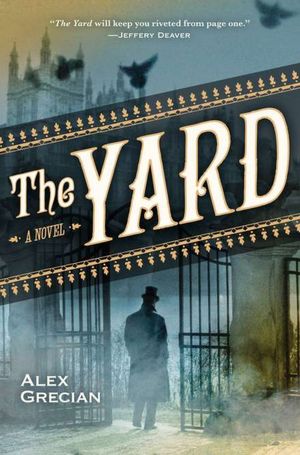
The Yard (with slight spoilers)

The Yard. Alex Grecian. 2012. Penguin. 432 pages.

From the prologue: Nobody noticed when Inspector Christian Little of Scotland Yard disappeared, and nobody was looking for him when he was found.

What can I say about Alex Grecian's The Yard? I was disappointed. If you're expecting a mystery where suspense builds, clues are given, and you're on the edge of your seat to find out who did it, then this one will definitely disappoint. For Grecian will reveal who did it to readers within a chapter or two. Readers will get a behind-the-scenes look at the murderer almost from the beginning. The first entry or so of this murderer his identity is still hidden, but, that doesn't remain the case for long. But Grecian doesn't just reveal the identity of one murderer, he reveals the identity of another murderer. For Scotland Yard is working on two cases during the course of the novel. One, a murderer who is killing police detectives. Two, a murderer who is killing bearded men.

The Yard has multiple narrators. Readers meet several detectives (some remain alive at the novel's end, others aren't so fortunate) throughout the novel, each contributes (to a certain degree) to solving one or the other cases. Some personal details are shared about some of the detectives. For example, readers meet Walter Day and his wife. We get a flashback to before they were married--we get to see the proposal, and, it felt to me it was a very odd proposal! We also see glimpses of their home life as she adjusts to life in London. Another detective we meet is Hammersmith (I can't recall his first name). We get flashes from him as well, including flashbacks to when he was a child. His flashbacks reveal his sensitive side and how difficult the job can be: finding the bodies of children, men, women, etc. Readers also meet Dr. Kingsley who works closely with Scotland Yard, and we meet his young daughter who helps out by sketching all the corpses. While we meet many characters, including a mystery "dancing man", I had a hard time truly connecting with any of the characters. I'll explain, while I wanted to read the book to its end, I wasn't at the edge of my seat. It wasn't that the book was super-compelling and impossible to put down. It wasn't that the book had any suspense (well, readers could perhaps wonder if Fenn would make it back home alive or if he'd end up a corpse; and if you're desperate to find more to be in suspense about I suppose you could wonder if Day's wife was ever going to tell him that she was pregnant), I finished the book because I like to finish what I start.

This one would almost have to be more of a thriller than a mystery, but, I'm not sure it's lack of suspense and uneven pacing would make it a good thriller either. Overall, I'd say the characterization wasn't the best. Some of the characters had potential, they could potentially be developed into something more, into characters that I would care about, but they weren't quite there yet. Some of the characters were incredibly flimsy and flat.

I think some of the scenes were intentionally put in there to aggravate modern readers--which worked, by the way. Having scenes where a boy goes up to a police officer (detective) and clearly states things like, help, please help me, I've been kidnapped, tied up, held prisoner, I only now just escaped, if he catches me again, I don't know what will happen, please help me find my parents. And have him respond with, move along, boy, or I'll send you to the workhouse. I suppose the intention being to highlight that women and children had no value or worth in society.

I wanted to like this one, I was even hoping to love it, but it was just okay. 

Best line: "If all men were sane, we would be blacksmiths." (87)

Read The Yard
  • If you like historical fiction set during the Victorian period
  • If you like Victorian mystery/detective/suspense stories; just don't expect Grecian to write as well as the actual Victorians, his style, his characterization, his pacing, doesn't even come close to matching. 
  • If you don't mind slightly tedious fiction, for example, he spends pages and pages each time (almost) trying to explain the concept of fingerprints. And how each fingerprint is unique, personal; how fingerprints can help establish who was at the scene of the crime, etc. 
© 2012 Becky Laney of Becky's Book Reviews

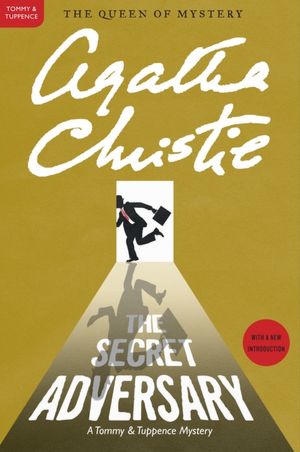
The Secret Adversary

The Secret Adversary. Agatha Christie. 1922/2012. HarperCollins. 352 pages.

 I enjoyed The Secret Adversary. I have read Agatha Christie's novels out of order, without much of a plan. So I've read many of her later novels first. This is my first Tommy and Tuppence novel, however.

I definitely liked it. It has a certain charm to it, I suppose. This first novel introduces readers to the two characters, and introduces a romance between the two. A romance that perhaps seems obvious, but, a somewhat sweet romance nonetheless.

World War I has not been over that long when the novel opens, and both Tommy and Prudence (Tuppence) are continuing to make adjustments now that the war is over and their service has ended. (She was a nurse, I believe.) These two happen to bump into one another one day. And they happen to have a conversation. Their conversation is overheard by a gentleman, a man who assumes Tommy and Tuppence know more than what they in fact do, know a BIG secret somewhat connected to the early days of the War. A secret concerning the identity of Jane Finn. When this man approaches Prudence, all of their lives are changed...

Essentially, Tuppence and Tommy team up (with a few others for help now and then) to solve a mystery, to find out about a woman's identity, to trace her, to trace some important documents. Their adventure is dangerous. Both will risk their lives to find out the truth.

I liked this one. I didn't quite love it. But I did like it.

Read The Secret Adversary
  • If you're a fan of Agatha Christie
  • If you love mystery/spy novels
  • If you want to read one of Christie's earlier novels
  • If you love mysteries with a historical feel to them

© 2012 Becky Laney of Becky's Book Reviews

The Lord is My Shepherd

The Lord is My Shepherd. (Psalm 23 Mysteries) Debbie Viguie. 2010. Abingdon Press. 320 pages.

More than anything, Cindy Preston hated Mondays. 

I was skeptical about this book, I'll be honest. I had no idea if it would be something I'd like. But I like to challenge myself to take risks...occasionally. And I am definitely glad I took a chance on Debbie Viguie's The Lord Is My Shepherd. This one is mystery-suspense-thriller. Cindy Preston, the heroine, is a church secretary who discovers--literally stumbles upon--a dead body in the sanctuary of the church one Monday morning. But it isn't just any Monday, no it's Holy Week, it's the Monday of Easter week. Her screams draw the attention of the Rabbi next door, Jeremiah Silverman. Together they meet the police detective...and so it begins.

I really, really, really enjoyed this one!!! It was so hard to put this one down. I definitely liked the heroine, Cindy Preston. I thought she was a good balance. On the one hand, she's terrified and in shock, on the other hand she's strong and strong-willed. She may be afraid--and she may have good reason to be afraid--but she isn't going to be ruled or enslaved by that fear. Not that she's careless. And as for Jeremiah Silverman, well, I loved him!!! I did. I just loved him!!!

Read The Lord Is My Shepherd
  • If you like murder mysteries OR thrillers OR suspense novels
  • If you enjoy "Christian fiction" on the light side; there is nothing heavy-handed or preachy about this one. 

© 2012 Becky Laney of Becky's Book Reviews

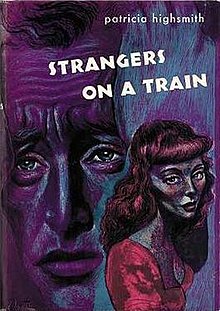
Strangers on a Train

Strangers on a Train. Patricia Highsmith. 1950. 281 pages.

The train tore along with an angry, irregular rhythm. It was having to stop at smaller and more frequent stations, where it would wait impatiently for a moment, then attack the prairie again.

Strangers on a Train was both compelling and repelling. On the one hand, I think the characterization of the "hero" (Guy Haines) and his nemesis (Charlie Bruno) was intriguing. Disturbing and super-creepy, but effectively so. I think the whole point of the novel was to show what could be lurking deep inside (or not-so-deep inside, perhaps just barely under the surface) of the person sitting next to you, the stranger.

Guy Haines is an architect taking a not-so-pleasant trip back to his small hometown in Texas. He meets a stranger on a train. The stranger--Charles Bruno--asks him to join him for dinner and a couple of drinks. Guy doesn't really want to be social. He's feeling cranky and anti-social. He's thinking about his wife, Miriam, who is carrying another man's baby, and his girlfriend, Anne, who happens to be going to Mexico on vacation. He isn't in love with his wife--they've been separated quite a while. He's anxious to get a divorce more than anything else. He's not at his emotional best though. So reluctantly, perhaps to avoid thinking or over-thinking things, he agrees to spend some time with this stranger. This was his first mistake, the mistake that would cost him almost everything in the end.
Why? Well, Bruno is all kinds of evil. And he's not even all that subtle about being evil and creepy.  I mean here is a guy that goes around muttering about how he wants to murder his father, how he has all these plans and schemes to kill his father, how he's just looking for the best way to kill his father so that he doesn't get caught. It's like he's got a one-track mind, and murder is all he can talk about. I honestly can't remember if the dialogue went from "do you want to have a drink with me?" to "do you want to kill my father for me?" in a matter of seconds, minutes, or hours. But. Guy has all the signs right in front of him that he should have been able to read properly. But. For whatever reason, he stays, he listens, he doesn't react. Somehow or other--perhaps before the murder babbling begins--Bruno learns that Guy is on a trip to see his wife. He also learns that she's pregnant. That she's been cheating on Guy for quite a while. Did Guy volunteer all this information willingly? Or did it come out piece by piece by piece by piece? Did Bruno keep pestering him with questions? Well, I'm not sure. Even if it was voluntary on his part. Even if Guy was talking about his wife, it was not with the intent that the stranger on the train should kill her. Because as Guy learns, this is where the conversation is headed. Bruno has  a plot, a plan. He would just love, love, love to kill Miriam. It would make him oh-so-happy to do this as a complete-and-total favor for his new-best-buddy, Guy. Haines was so not expecting this ultra-weird, ultra-creepy offer. And he does say, no, thank you, I don't want my wife murdered. And, I'm not the murdering type. I don't know what you think you see in me. But I'm not the guy. I'm not the one you want to kill your father. I don't want to murder anyone, anywhere. But the obsession has become all-too-firmly-planted in Bruno's mind.

Strangers on a Train is a tragic suspense, a psychological thriller. Haines' sanity is tested in the upcoming months after Bruno murders his wife, after Bruno continues to haunt him--first by letters, then in person. Wherever he goes, Bruno is there watching him, trying to talk to him, trying to coerce or bully him into murdering his father. Bruno starts pestering the people close to him too. Bruno is an obsessed stalker-blackmailer with a history of murder. Haines is worried what will happen if he doesn't murder Bruno's father.

Strangers on a Train reminded me so very much of Frankenstein by Mary Shelley. Except that the creature-figure Bruno is so not sympathetic not by any, any, any stretch of the imagination. And the Victor-Frankenstein-figure, Guy Haines, is actually sympathetic for most of the novel.

To read more of my thoughts, visit my GoodReads review.

Read Strangers on a Train
  • If you're looking to read a classic mystery/suspense/thriller novel of the 1950s
  • If you've seen the movie and are interested in now reading the book
  • If you enjoy psychological elements in your novel; Highsmith created some twisted, disturbed characters
© 2012 Becky Laney of Becky's Book Reviews

The Woman in White

The Woman in White. Wilkie Collins. 1860. 672 pages.

This is the story of what a Woman's patience can endure, and what a Man's resolution can achieve.

I loved this one. I just LOVED, LOVED, LOVED this one by Wilkie Collins. This isn't my first (mystery) novel by Wilkie Collins, and it won't be the last. Each new read makes me want more, more, more. If you're a fan of this bearded Victorian, I'd love to hear from you which of his I should try to read next. (My library has Basil, No Name, and The Dead Secret.)

The first narrator we meet is Walter Hartright. He is a drawing teacher. He is on his way to a new job--new position--in the country when he meets a strange woman on the way to London. It's the middle of the night. The woman appears from nowhere. She's acting a little peculiar. She's dressed all in white. But there is something about her that makes him sympathetic to her cause, even before he knows her story. By pure chance, so it seems, this woman happens to mention the countryside, the house, where he is to begin his new job that autumn. A fact that makes this meeting a little more memorable perhaps. Memorable enough to mention to Miss Marian Halcombe, one of the two young women he'll be teaching. The other young woman is Miss Laura Fairlie. She is oh-so-beautiful. (Miss Marian is not. Though I'd NEVER be as mean about it as Wilkie Collins.) Laura and Walter fall madly in love with another. Though he won't tell her and she won't tell him. Still. Marian sees how these two feel about one another. And she tries her best to tell Walter that that just can't be. Not because Marian is mean and cruel. But because Laura has been engaged for some time to an older man, Sir Percival Glyde. It was one of her father's wishes that the two wed. Before she fell for Walter, Laura was ready to wed without love, without hope of love. But now that she knows what it feels to love someone, she is having some major regrets about her promises. And the doubts will only grow when she's warned anonymously by letter NOT TO MARRY Sir Percival. She's warned that her husband to be is evil and then some. Marian tells Walter of this anonymous letter, and he believes--they both believe--that the woman in white may just be the writer of this one. If only she would say more, give out the reasons why. They want to know the truth, but they have so little to go on. And a gentleman's word that the letter was written by a crazy woman and that of course he's never had an evil thought in his entire life is accepted as gospel truth. Poor Laura!!!

I found it well-written. I found it suspenseful. I loved the details, the descriptions, the characterizations. I loved how the story unfolded. I loved having the story told by so many different people. Some narrators I preferred to others. But. I think they all added a little something to make this one just right.

The Woman in White was one of those books that I just know I will want to reread again and again. It's just that good.

Previous Collins: Man and Wife, Armadale, The Moonstone, Evil Genius.

© 2011 Becky Laney of Becky's Book Reviews