Tampilkan postingan dengan label 2004. Tampilkan semua postingan

Rereading The Schwa Was Here

The Schwa Was Here. Neal Shusterman. 2004. 240 pages.

I am definitely glad I chose to reread Neal Shusterman's The Schwa Was Here. I'm not exactly sure I loved it as much this second time, but, I am glad I reread it.

My reaction the first time I read this one--back in 2005--was that THIS WAS THE BEST, BEST, BEST book ever...at least of 2004. I was wowed by the characters of Schwa and Antsy. And smirked at the developing relationship between Old Man Crawley and Antsy. I thought it had heart and humor and a great narrative voice. And I still do, for the most part. I definitely think that Antsy is a GREAT narrator. The narrative voice in this one is so strong. Antsy can be very very funny in his observations--particularly in his observations about life, like how he compares life to a bad haircut, or change in life to a bad haircut. But he can also be authentic in some very tense, uncomfortable situations. In particular the tension-filled dynamics of his family. Never do readers get the idea that Antsy's life is one big joke after another. Readers see a blending of humor and pain. Which I think is authentic.

So the premise of this one is simple, Calvin Schwa is a middle schooler who, for the most part, remains invisible to teachers and students alike. They just don't see him. It's like he's not even there. Antsy does notice him, though even Antsy sometimes slips, and begins to make the Schwa a project of his. He decides to experiment to see the properties of the Schwa effect. The first few experiments are funny. Over-the-top ridiculous. But the experiments don't last forever, and the joke doesn't stay funny for long. Schwa may have enjoyed a couple of weeks of particular attention (not being taken seriously, mind you, not being seen for who he is, really is, but being the focus of a joke, a bet, a fad), but soon Antsy is his only friend. Almost. (A girl does enter into this.) How long can the Schwa go on being unseen and unheard? When will enough be enough? Can he turn his tragic non-life around?

I suppose the only thing that has changed in my rereading is that it doesn't strike me as truly being the best, best, best, best, best book ever. I still love it, I still really love it. I still seeing it as being a strong novel with a lot of heart and soul to it--a blending of emotions that make up life as we know it. I still love Antsy. I still love seeing a novel that addresses the invisibility of some kids. I still love seeing all the family drama. 

Read The Schwa Was Here
  • If you love Middle Grade Fiction
  • If you love coming-of-age stories
  • If you love stories with great narrators
  • If you have room in your heart for a grumpy old man
© 2012 Becky Laney of Becky's Book Reviews

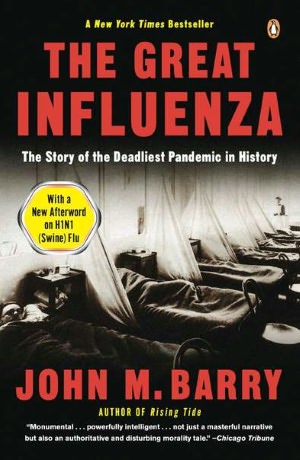
The Great Influenza

The Great Influenza. The Story of the Deadliest Pandemic in History. John M. Barry. 2004. Penguin. 546 pages. 

From the prologue: The Great War had brought Paul Lewis into the navy in 1918 as a lieutenant commander, but he never seemed quite at ease when in his uniform. It never seemed to fit quite right, or to sit quite right, and he was often flustered and failed to respond properly when sailors saluted him. Yet he was every bit a warrior, and he hunted death. When he found it, he confronted it, challenged it, tried to pin it in place like a lepidopterist pinning down a butterfly, so he could then dissect it piece by piece, analyze it, and find a way to confound it. He did so often enough that the risks he took became routine. Still, death had never appeared to him as it did now, in mid-September 1918. Row after row of men confronted him in the hospital ward, many of them bloody and dying in some new and awful way. He had been called here to solve a mystery that dumbfounded the clinicians. For Lewis was a scientist. Although a physician he had never practiced on a patient. Instead, a member of the very first generation of American medical scientists, he had spent his life in the laboratory.

While I'm not sure every reader will find The Great Influenza equally compelling, I must say that this one was quite the read for me! It was fascinating, challenging, and complex--complex in a good way. The Great Influenza is more than the story of the 1918/1919 influenza pandemic that spread around the world. It covers the background of medicine, how medicine is practiced, how doctors are trained and educated, how schools and laboratories are run, the need for excellence not just competence. (Though competence is a good place to start when there are no standards at all for who can practice medicine and call themselves a doctor.) It covers science, medicine, sociology, and even politics. Yes, The Great Influenza covers almost everything you could want to know. It follows the story of a handful of scientists in particular--exploring their personal and professional lives, presenting their theories and experiments, documenting their successes and failures. Most of this one, of course, does focus on the pandemic--tracing it throughout the spring of 1918 through most of 1919. It even follows up on how it continued to impact lives--months and even years later. How having this particular strain of influenza effected your brain and how it could continue to give you problems.

I really enjoyed this one! I found it completely fascinating. I loved all the details. 

Read The Great Influenza
  • If you are interested in World War I
  • If you are interested in science, history, sociology, politics, and medicine
  • If you are looking for compelling nonfiction; yes, this one may take almost a hundred pages to get to the influenza of 1918, but it's worth it. 
© 2012 Becky Laney of Becky's Book Reviews

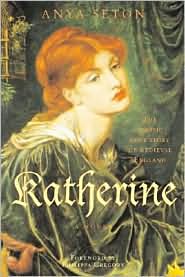
Katherine

Katherine. Anya Seton. 1954/2004. Chicago Review Press. 512 pages.

In the tender green time of April, Katherine set forth at last upon her journey with the two nuns and the royal messenger.

Katherine is the third Anya Seton novel I've read, and it is probably my favorite so far. It is the 'love story' of Katherine de Roet and John of Gaunt (Duke of Lancaster). It's definitely a 'love story' with complications!

The book opens with Katherine traveling with several nuns to visit her sister, Philippa, who is in the service of the Queen. Her arrival catches the attention of at least two guys. The most persistent being Hugh Swynford. Her sister just hopes that her sister has enough sense to know that these men are after one thing and only one thing. And Katherine does know that. But she can't protect herself from unseen dangers.

One day, Katherine takes a walk in the garden thinking that she is alone, that she is safe, only to discover that Hugh Swynford is there and he means to get his way. They struggle. And only fate in the form of John Gaunt, the Duke, saves her. He demands to know what is going on and Hugh stammers something about how he really truly means to marry the penniless girl. The Duke takes the poor woman home to his wife, Blanche, who takes pity on the girl and offers her friendship and kindness.

But within days Katherine learns her fate. She will be the wife of Hugh Swynford. For better or worse, she'll be stuck with him. But it's not like she has much of a say in her future. And a good match is a good match.

Katherine is a novel of medieval England. Readers get more than a quick and easy 'love story.' It's a novel about war and politics and social class. The novel follows the lives of Katherine and John through four decades. The 1360s through the 1390s.

There are plenty of characters to love and hate in this one. And it's a pleasant read. Not too dry, not too boring. But not completely romance either. There is history and politics and talk of war and riots, etc. If you're just looking for romance, this may not be the one for you. But if you want substance to your romance, then you should give it a try.

© 2011 Becky Laney of Becky's Book Reviews