Tampilkan postingan dengan label time travel. Tampilkan semua postingan

Tempest (YA)

Tempest. Julie Cross. 2012. St. Martin's Press. 352 pages. 


Saturday, April 11, 2009,
Okay, so it's true. I can time-travel. But it's not as exciting as it sounds. I can't go back in time and kill Hitler. I can't go to the future and see who wins the World Series in 2038. So far, the most I've ever jumped is about six hours in the past. Some superhero, right?

Tempest is a great example of why you should never judge a book by its cover. For me this cover just doesn't work, it doesn't shout out time-traveling-spies, does it? And with a premise as appealing as time travel (in general) AND featuring mysterious secret agents fighting evil-time-travelers, it should have an awesome cover.

Jackson Meyer is our time-traveling hero with a girlfriend named Holly. But within chapters, Holly's life is in danger--she's dying before his eyes--and Jackson does the only thing he can do: panic as he jumps backwards in time. Because of the traumatic events leading to the jump, Jackson does something he's never done before which traps him in the past--in the year 2007. Once there, he'll have plenty of time to find out who he is, who his father is--why his Dad is so very, very weird and out-of-touch with him, and much much more. He has tons of questions, and he wants some answers at least. Mainly: can he change the future, is there anything he can do to prevent the tragic events leading up to Holly's (alleged) death? Also: can he find a way to jump back to the future, or is he stuck in 2007? Will he have to relive two years of his life? And then there's all the super-super mysterious stuff about himself, his father, his mother, his abilities, etc.

So how does he spend his time? Well, he a) time-travels back and forth in his own past trying to piece together clues b) meets his girlfriend, Holly, years before he "really" meets her c) meets his best friend, Adam, years before he's supposed to really meet him d) confronts his Dad with some super-tough questions.

This one has dangers, thrills, mysteries, secrets, lies, spies, and time-travel. What is NOT to love?! Seriously!!! The book has a GREAT premise. Jackson is a fully developed character whom we get to know surprisingly well considering how this is an action/plot/premise-driven book. Loved the emotional range we get, not only all the scenes about Holly or with Holly, but all the scenes about his twin-sister, Courtney. There was even a great heart-to-heart with his Dad towards the end. The book has a quite a few complex relationships, and I appreciated how they were developed. I loved also the exploration of consequences. I really appreciated the ending, I thought it was just right.

Read Tempest
  • Time travel
  • Good vs. Evil
  • Secret Agents/Secret Agencies
  • Romance from a guy's perspective


© 2012 Becky Laney of Becky's Book Reviews

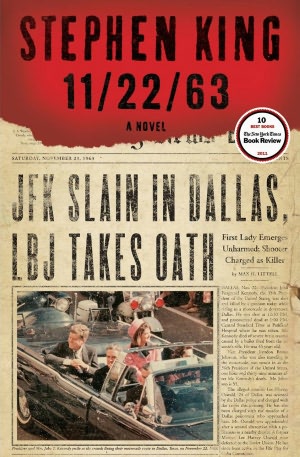
11/22/63

11/22/63. Stephen King. 2011. Scribner. 864 pages.

I have never been what you'd call a crying man. 

This is the second Stephen King novel I've read, and honestly I'm not sure how I'd compare the two I've read: Under the Dome and 11/22/63.

In Under the Dome, the violence is graphic, and the bad language proved problematic...for me. But, oh, the tension. It was such a compelling read. The pacing was amazing. It really was. It was a page-turner. I didn't like the characters particularly. I hated some of them--granted, some of them were evil incarnate. But I HAD TO KNOW what happened next. The premise, well, it was horrifying and intriguing all at the same time.

11/22/63 was in many ways a tamer novel. Less violence, less bad language (though it's still there to a certain degree. I am NOT claiming this is a clean read.) But. Well, how can I say this? For me at least it lacked tension. The premise of time travel should have been wowing me from start to finish. But it didn't. The only one that had to deal with consequences--in my opinion--was the narrator Jake Epping who time-traveled under the name George Amberson. So long as he remained alive and able to return to 2011 through the time-bubble, all other mistakes, all other consequences just didn't matter at all. Not really. Sure, they mattered to him. He, personally, felt those mistakes and had his struggles and doubts. But no one else could ever know the difference between worlds and alternate realities.

I'm not sure how I really felt about the narrator, Jake/George. On the one hand, his "good angel" intentions of playing God and determining the future and making the world a better place by preventing a handful of tragedies were understandable. I mean if you could prevent a death by time-travel, shouldn't you? Jake knew one person whose life was forever-changed one Halloween night when his drunken father came home and murdered his mother, his two brothers, and his sister. He was the only one to survive--and only because he was in the bathroom when the killing spree began. But he saw too much--much too much--and his father tried and failed to kill him too. So when Jake discovers this time-travel-bubble that automatically sends you to September 1958--almost a full month before this tragedy--he feels like he has to "fix" things. He has to test time-travel to see if he can change things...for the better.

But Jake/George's main goal, his main mission, is not to save his friend from a horrible childhood, but to save "the world" or "the nation" from experiencing the tragedy of Kennedy's assassination. A world where Kennedy continued his term (and was reelected) as president would have to be a better world than the one we now live in, right? Especially if you're tempted to think he was the best human, best leader, best politician, best president ever, ever, ever. To think that he was the best, smartest, wisest, kindest, strongest.

So that is his mission: prevent JFK from being assassinated. And, to a certain degree, King stays on task. But his idea of staying "on task" isn't the most thrilling way to spend your time. Readers are treated to five years (at least) of Jake/George living in the past. And part of the focus is on his mission, but much of it is not. Part of it is focused on his career as a teacher/mentor. Part of it is focused on his 'career' as a writer as he prepares a manuscript or two. Part of it--a large part of it--is focused on his finding his one, true love. Yes, a good part of 11/22/63 is a romance novel with focus on feelings, dancing, and secret weekend hideaways. 

While many elements of the story are nice enough in their own way, they don't necessarily add up to the most compelling, most page-turning read ever. I suppose there are several questions that could keep you reading--Will he successfully stop the assassination? (Hint: Don't look at the back cover.) Will he get to stay with his one, true love? Will he stay with her in the past? Or will she go with him to the future? Will this divorced teacher find his happily ever after? But none of those were quite enough for me.

The one area this novel worked for me--and I'm not even sure if this was the intent--was seeing this novel as a test for one man, to see how selfish or selfless one man could be. I can't say more without spoiling it. But essentially he's asked to choose between his own happiness and the greater good of the world at large.

I suppose this one also treats morality and ethics. Do two wrongs make a right? Does shooting a murderer before he's murdered anyone make your murder moral? I also saw this one as dealing with humans playing God. Here we have one man who is determined to remake the world into a "better" place. But what he didn't take into account is how tragedy shapes us. How tragedies and sorrows and struggles shape our character and develop us. I thought of so many scenes from Orson Scott Card's Worthing Saga.

Part of me really, really wishes that more time had been spent on alternate presents. The ending felt incredibly rushed and not completely believable.

Read 11/22/63
  • If you're interested in time travel, in science fiction
  • If you're interested in history, particularly history/culture of the late 1950s to early 1960s
  • If you're interested in politics and issues (Vietnam war, communism, civil rights, etc.) of the times
  • If you're interested in teachers and librarians (our hero and heroine)

© 2012 Becky Laney of Becky's Book Reviews
Blackout

Blackout. Connie Willis. 2010. Random House. 495 pages.

Colin tried the door, but it was locked. 

I thought I'd start with a word of warning. When you get to the end of Blackout, you're going to NEED to have a copy of All Clear ready to go. Because, chances are, you're going to want to pick it up right away. There is no 'real' ending in Blackout. There is no resolution. There's no peace to be had. Usually I might say that's not such a positive thing in a book, but in this case, I'm forgiving.

You might also find it helpful to know that Blackout can be read as part of a series of time travel books by Connie Willis. The books share some characters: Mr. Dunworthy is in Doomsday Book, To Say Nothing of the Dog, Blackout, and All Clear. Although he is only a main character in Doomsday Book. Badri is in Doomsday Book and Blackout. Finch is in Doomsday Book and To Say Nothing of the Dog. Colin is in Doomsday Book, Blackout, and All Clear. Verity and Kindle are in To Say Nothing of the Dog, but are mentioned (very) briefly in Blackout.

But you should also know that it's not essential that all of these books be read in order. It is definitely essential that you read Blackout and All Clear in the proper order. But you don't have to have read Doomsday Book or To Say Nothing of the Dog in order to enjoy or appreciate Blackout/All Clear.

There are three main characters--three main narrators--in Blackout. Each is a historian, a time traveler. Each has plans for multiple assignments in the twentieth century. Each is experiencing frustration as these drops are rearranged and rescheduled. The historians are Merope who is 'observing' the evacuation of children from London to the country. She 'becomes' Eileen O'Reilly and works as a nurse or maid in one of the homes. Under her care are two very, very wild children. Of course, she's responsible for more than two children. Her employer has taken in many children--over a dozen, I think? But those two are the ones that make her life more than a little unpleasant. Her assignment is for the spring of 1940. Polly "Sebastian" is a historian observing the London Blitz in the fall of 1940. Her assignment has her working in a shop on Oxford Street. She is curious in observing how the Blitz effects people. How they are able to cope with the bombs falling over their heads. How they are able to cope with the terror of it all--knowing each and every night that they could die. The third historian is Michael Davies. Since he was supposed to observe Pearl Harbor first, he's got an implant to give him an American accent. But with the shuffling of assignments, he's now observing the Dunkirk evacuation in June 1940. His research has him observing heroes. He's looking to observe the qualities that make someone brave and heroic, what makes a person risk their lives to save others.

If all went according to plan, these three would NOT have met--in the past. Their assignments in 1940 would not have overlapped in time or place. But not all went according to plan...and now these three are going to need each very, very much if they're going to survive...

Read Blackout
  • If you are a fan of historical fiction set during World War II
  • If historical details fascinate you 
  • If you are interested in the London Blitz  
  • If you are a fan of historical fiction set in Britain
  • If you are a fan of science fiction and/or time travel
  • If you are looking for an extremely compelling read
  • If you're looking for an intense read; something very dramatic
  • If you are a fan of Connie Willis
  • If you read Doomsday Book and are interested in finding out what happens to Colin when he grows up...
  • If you're looking for memorable characters 
  • If you are a fan of Agatha Christie and other mystery writers of the time 
  • If you want a book you just CAN'T put down no matter what 
I loved this one. I just LOVED it. It was so intense, so dramatic, so emotional. It just held my attention. I cared about these characters so much! And to see them in danger, well, I just couldn't stand to put this book down!!!

© 2012 Becky Laney of Becky's Book Reviews

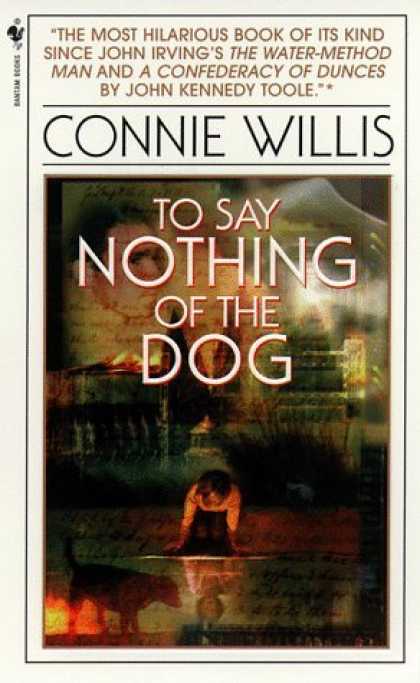
To Say Nothing of the Dog

To Say Nothing of the Dog. Connie Willis. 1998. Bantam (Random House). 495 pages.

There were five of us--Carruthers and the new recruit and myself, and Mr. Spivens and the verger. It was late afternoon on November the fifteenth, and we were in what was left of Coventry Cathedral, looking for the bishop's bird stump. Or at any rate I was. 

I gushed about To Say Nothing of the Dog the first time I read it. I did. And I'll probably gush this time too. Because some books are just that good. And if ever a book deserves to be read--if ever an author deserves to be read--it is Connie Willis and her time travel novels. Is To Say Nothing of the Dog a sequel to Doomsday Book? Well....not exactly. The two can be read separately, read in ANY order. (I read To Say Nothing of the Dog first.) Both books share the same world--the same futuristic time-traveling world. There are two characters in To Say Nothing of the Dog that were first introduced in Doomsday Book, Mr. James Dunworthy and Finch. But. For the most part, To Say Nothing of the Dog is a great standalone novel.

Ned Henry narrates the novel. And he does a great job. When we first meet him, he's suffering from time-lag. He's spent too much time--of late--jumping through time. He's not alone. There is someone doing her very, very best to drive EVERYONE in his department crazy. Lady Schrapnell is a woman on a mission--a RICH woman on a mission. And she won't take no for an answer. If Lady Schrapnell volunteers you for a job, well, you stay volunteered until the job is done to her satisfaction. And what does Lady Schrapnell want most of all? The bishop's bird stump. Her project is the rebuilding of Coventry Cathedral--a cathedral destroyed/damaged during World War II. And she HAS to know if the bishop's bird stump was still in the church during the raid. She needs to know if it should be replicated as part of the 'restoration.' So Ned Henry is just one of dozens looking IN THE PAST for the answers as to what happened to the bishop's bird stump.

But that 'mission' becomes almost secondary....when it is 'discovered' that there's been an incongruity. At first they think it's simple, it's easily fixed. One of the time travelers interfered when she shouldn't. But. They'll just send another time traveler to fix that interference, and things should go smoothly. But since the time traveler they send is Ned Henry, since he's suffering from exhaustion and time-lag, since he barely heard his instructions, since he jumped into the Net to avoid being discovered by an angry Lady Schrapnell, nothing is simple. What Ned Henry soon realizes is that his arrival in June 1888 has changed things. His arrival has kept two people from meeting (and subsequently falling in love and marrying), and that's just the start.

But he isn't the only one in the past. He isn't the only time-traveler working to restore things. Verity Kindle. The beautiful Verity Kindle has a role to play as well....

I loved this one. I did. I just LOVED it. It's very different from Doomsday Book. It's a very funny book. Almost playful in a way. It's definitely science fiction. But if you like historical fiction OR mysteries, this one may appeal to you quite a bit!!! Especially if you're a fan of Agatha Christie and Dorothy Sayers. The more you love Hercule Poirot and Lord Peter Wimsey, well, the more you'll appreciate this one.
I think that's why I loved it EVEN MORE the second time around.

With my love of the Victorian period, my love of cozy mysteries, my love of historical fiction, my love of science fiction, To Say Nothing of the Dog, was just a perfect, perfect match for me. But. I don't think you have to love *all* those things to appreciate (and love) this one. I really don't.

2 Quotes About the bishop's bird stump:

"Perhaps it was removed for safekeeping," he said, looking at the windows. "Like the east windows."
"The bishop's bird stump?" I said incredulously. "Are you joking?"
"You're right," he said. "It isn't the sort of thing you'd want to keep from being blown up. Victorian art!" He shuddered. (7)

I must be getting light-headed from lack of sleep. No one, even badly shell-shocked, would steal it. Or buy it at a jumble sale. This was the bishop's bird stump. Even the munitions scrap iron drive would turn it down. Unless of course someone recognized its potential as a psychological weapon against the Nazis. (12)

About time-lag:

One of the first symptoms of time-lag is a tendency to maudlin sentimentality, like an Irishman in his cups or a Victorian poet cold-sober. (9)

And isn't this the truth:

There is nothing more helpful than shouted instructions, particularly incomprehensible ones. (153)

Verity Kindle on mystery novels:
"Of course they're usually about murder, not robbery, but they always take place in a country house like this, and the butler did it, at least for the first hundred mystery novels or so. Everyone's a suspect, and it's always the least likely person, and after the first hundred or so, the butler wasn't anymore--the least likely person, I mean--so they had to switch to unlikely criminals. You know, the harmless old lady or the vicar's devoted wife, that sort of thing, but it didn't take the reader long to catch on to that, and they had to resort to having the detective be the murderer, and the narrator, even though that had already been done in The Moonstone. The hero did it, only he didn't know it. He was sleepwalking, in his nightshirt, which was rather racy stuff for Victorian times, and the crime was always unbelievably complicated. In mystery novels. I mean, nobody ever ever just grabs the vase and runs, or shoots somebody in a fit of temper, and at the very end, when you think you've got it all figured out, there's one last plot-twist, and the crime's always very carefully thought out, with disguises and alibis and railway timetables and they have to include a diagram of the house in the frontispiece, showing everyone's bedroom and the library, which is where the body always is, and all the connecting doors, and even then you don't have a prayer of figuring it out, which is why they have to bring in a world-famous detective--"
"Who solves it with little gray cells?" I said.
"Yes. Hercule Poirot, that's Agatha Christie's detective, and he says it isn't at all necessary to go running about measuring footprints and picking up cigarette ends to solve mysteries like Sherlock Holmes. That's Arthur Conan Doyle's detective--"
"I know who Sherlock Holmes is." (205)


Well, it wasn't exactly the ending of an Agatha Christie mystery, with Hercule Poirot gathering everyone together in the drawing room to reveal the murderer and impress everyone with his astonishing deductive powers. And it definitely wasn't a Dorothy Sayers, with the detective hero saying to his heroine sidekick, "I say, we make a jolly good detectin' team. How about makin' the partnership permanent, eh, what?" and then proposing in Latin. (431)
Verity and Ned:

She peered at me. "It isn't fair, you know."
"What isn't?" I said warily.
"Your boater. It makes you look just like Lord Peter Wimsey, especially when you tilt it forward like that." (254)

"The first time I ever saw you, I thought, he looks just like Lord Peter Wimsey. You were wearing the boater and--no, that wasn't the first time," she said accusingly. "The first time was in Mr. Dunworthy's office, and you were all covered in soot. You were still adorable, though, even if your mouth was hanging open." (254)

"Lord Peter took a nap," she said. "Harriet watched him sleep, and that's when she knew she was in love with him."
She sat up again. "Of course, I knew it from the second page of Strong Poison, but it took two more books for Harriet to figure it out. She kept telling herself it was all just detecting and deciphering codes and solving mysteries together, but I knew she was in love with him. He proposed in Latin. Under a bridge. After they solved the mystery. You can't propose till after you've solved the mystery. That's a law in detective novels."
She sighed. "It's too bad. 'Placetne, magistra?' he said when he proposed, and then she said, 'Placet.' That's a fancy Oxford don way of saying yes. I had to look it up. I hate it when people use Latin and don't tell you what they mean..." (259)
Read To Say Nothing of the Dog
  • If you like science fiction
  • If you like Victorian literature or historical books (romances, mysteries, etc.) set in Victorian England
  • If you like to laugh
  • If you like reading about time travel
  • If you like Agatha Christie and Hercule Poirot
  • If you like Dorothy L. Sayers and Lord Peter Wimsey
  • If Strong Poison and Gaudy Night are among your favorite books
  • If you like your romances on the light side
  • If you like historical fiction
  • If you like cats
  • If you like well-developed characters
  • If you're looking for a book you don't want to put down...


© 2012 Becky Laney of Becky's Book Reviews
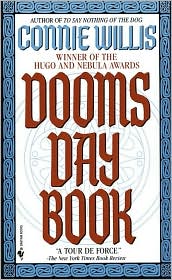
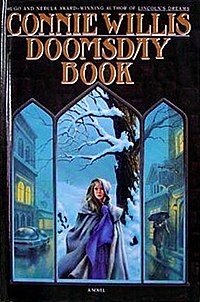
(Revisiting) Doomsday Book

Doomsday Book. Connie Willis. 1992. Random House. 592 pages.

Mr. Dunworthy opened the door to the laboratory and his spectacles promptly steamed up.
"Am I too late?" he said, yanking them off and squinting at Mary.

I first read Connie Willis' Doomsday Book last October. (You can read my first review.)  It was a book I knew I HAD to reread soon. In fact, I was tempted to reread it that very year. But. I also wanted to save it for this December because it is--in a way--a holiday book. It's not so Christmas-y that you couldn't read it in July or February. But. It feels just right to cozy up with it next to the Christmas tree.

What did you like most about the novel? (Or what did you like least...)

I loved just about everything in Doomsday Book. I liked the writing--the narrative. I liked the setting, the world-building. I liked the premise--I love reading about time travel!!! I loved the history--again, I love historical fiction. It's just a COMPELLING read with characters that I just loved. I liked how it was very serious, very dramatic. Yet it wasn't without humor or lightness.


Which storyline did you prefer? The past or the present?


I loved both stories. The one set in the 21rst century (2050s I believe) and the one set in the 14th century.
I thought both centuries were peopled with interesting characters. I thought both stories were important in telling the whole story. One story wasn't 'better' than another.

Which characters did you like best? 

Mr. Dunworthy, Kivrin, and Colin were probably my favorite characters. Although Dr. Mary Ahrens, Agnes, and Father Roche aren't too far behind. I really thought so many characters were developed well.

Where there any characters that you hated?


I wanted to boo and hiss every time Gilchrist spoke. Seriously. I HATED him so much. I did really enjoy seeing the other characters hate him too. Mrs. Gaddson is another that comes to mind. Though I didn't really hate her at all. I mean she was so good at being 'a character' that drives everyone around them crazy, so good at being a pest, that I actually liked her scenes because they provided comic relief. Like some of the characters Austen created. You wouldn't want to spend time with them yourself, but, they're fun to laugh at all the same.

Do you think the novel is more plot-driven or character-driven?


Both I think. I mean it was, for me, a fast-paced novel. It was emotional; it was compelling. Near impossible to put down. You might think that since it is a reread, there wouldn't be this urgency to it. That I could take my time. But no. I got caught up in the story and have to keep reading. I think the time-travel element--the premise--is important in a way. It will appeal to a certain type of reader. But. I also think the characters add so much to it. I mean these are very human characters. The situations in the novel are very intense, and it's hard not to CARE about them. And I think the characters are memorable.

Is this a novel you'd recommend to others? 

Yes! I still think it's a great, great book. Rereading it only helped me realize how MUCH I do love this one!!!


If you read this one with me, please leave your thoughts in the comments, or leave a link to your review. I'd love to know what you thought!

© 2011 Becky Laney of Becky's Book Reviews
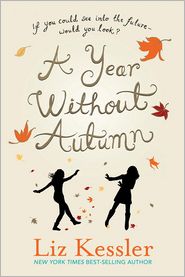
A Year Without Autumn (MG)

A Year Without Autumn. Liz Kessler. 2011. (October 11, 2011). Candlewick Press. 304 pages.

"Stop the car!"
"What?" Dad swivels around in his seat. The car swerves.
"Good grief, Tom!" Mom squeals, gripping her armrest as she pulls a wad of tissues out of her purse.
"Stop the car!" I repeat. It's going to be too late in a minute. I grab the tissues and shove them over Craig's mouth.

Time travel. Need I really say more?! For me, that was enough--more than enough--to seek out this one! Jenni is best friends with Autumn. These two friends are quite different from one another, but they have a few things in common. They both have little brothers. Jenni is big sister to Craig and Autumn is big sister to Mikey. Though the two don't attend the same school anymore, they've sworn to be best friends forever. And they mean it. Of course they mean it! What could ever come between them?! It does help that the two see each other every year the last week of August. The families vacation together at the same place, each has a time-share condo. The vacation is just getting started when IT happens...
Jenni impatiently decides to take the old elevator up to visit her best friend. She saw the owner fixing the old elevator, so she's relatively sure it's working again. But the truth is this old elevator has been out of order for many decades and it isn't really for guests' use. It takes Jenni a few hours to realize the truth of the matter...she learns it when she arrives back at her place and everyone--including herself--is a year older. Where did the year go?!

A Year Without Autumn is dramatic, very dramatic. For SOMETHING happens in that 'missing' year that changes everything. Jenni will have to put the pieces together herself--for the most part--because asking questions may not be an option. The more she tries to explain about what happened, the crazier she sounds. Can Jenni find the answers to her questions? Can she find a way to go back in time? Can she get her life back?

As I said, A Year Without Autumn is dramatic. It's a very compelling read. I think Jenni is a LOT braver than I would be in that elevator. Especially once she learns the truth of it--what it does. But she's determined and loyal and I can't help liking her for that.

© 2011 Becky Laney of Becky's Book Reviews
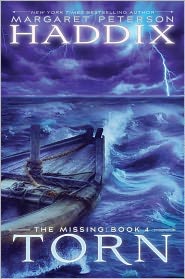
Torn (MG)

Torn. Margaret Peterson Haddix. 2011. Simon & Schuster. 352 pages.

"We didn't know what we were doing," a voice whispered near Jonah's ear. 

I really loved this fourth novel in the Missing series. I can't say that I've loved each of the novels equally. Though each has had its moments. But I can say that I've really enjoyed the series--or the idea behind the series. I love the time travel element. I love how each novel--or to be more precise, the second, third, and fourth novels--have focused on one time in particular. In the fourth novel, Jonah and his sister have been sent to 1611. They arrive on board Henry Hudson's ship just hours before a mutiny occurs. Jonah is posing as Hudson's son, and, well there is a lot depending on him. For the two have been told--and they have every reason to believe it--that time is falling apart and that they are the only two in position to repair the damage.

I would say that this is definitely a series you need to read in order. I'm not sure that Torn would be such a great read if you weren't familiar with the previous books.

If you enjoy action, adventure, history, mystery, and science fiction, then this series is definitely worth trying.

© 2011 Becky Laney of Becky's Book Reviews