Tampilkan postingan dengan label Death and Dying. Tampilkan semua postingan

Kindred Souls

Kindred Souls. Patricia MacLachlan. 2012. HarperCollins. 119 pages.

My grandfather, Billy, hears the talk of birds. He leans out the open bedroom window with his head tilted to listen in the warm prairie morning.

Kindred Souls is the kind of children's book I have come to appreciate as an adult, but, the kind of book that I would NEVER have wanted to read as a child. In other words, it's one of those books. You know, the kind, the kind that introduces you to a wonderful old man AND a dog. And you have every right to be suspicious that the end will destroy your emotional well-being.

Jake, our narrator, is ten and confident; confident that everything will stay the same, confident that life is good and will stay that way. Sure, his grandfather, Billy, is eighty-eight, sure he's moved in with them. But he will live FOREVER. Don't ask him how he knows, it's enough that he believes. The novel begins with the two going on their usual walk. Billy is talking--again--about the sod house where he was born. He is wishing--again--that it hadn't fallen into such horrible condition. He is telling Jake--again--about the old days. This time Billy seems extra-sad, so Jake asks him a simple question: "How hard is it to cut a brick of sod?" And so the idea is born that a new sod house will be built...

And then there is the arrival of Lucy, a stray dog, that seems to be the perfect companion for Billy. Billy and Lucy seem to be best, best, best friends from the very first moment they meet.

This book is about an unforgettable summer.

Read Kindred Souls
  • If you like bittersweet children's books
  • If you like emotional family stories
  • If you are a fan of Patricia MacLachlan
  • If you like dog stories
© 2012 Becky Laney of Becky's Book Reviews

Irises (YA)

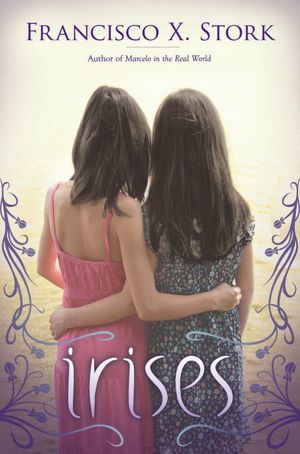
Irises. Francisco X. Stork. 2012. Scholastic. 304 pages.

From the prologue: Kate had finally agreed to pose under the willow tree.
From chapter one: Kate and her father sat in the shade of the willow tree, side by side in two wooden chairs. It was unusually hot for an April day in El Paso. 

Kate and Mary are sisters. Kate, 18, dreams of being a doctor, dreams of going away to Stanford for her college education. Mary, 16, is an artist, an artist struggling to recapture her initial joy perhaps, but a very talented, very dedicated artist nonetheless. In the first chapter of Irises, both girls receive a bit of a shock: their father, a pastor, dies. Arguably he knew the end was near for he has a great heart-to-heart with his daughter, Kate, urging her to look to her soul, mend her faith, take care of the family, etc. He tells her: "Love makes everything that is heavy light" (4). Kate, of course, not realizing the gravity of the situation, perhaps just thinking that her oh-so-strict father is just in an odd mood, quickly leaves the house and goes to study with her boyfriend, Simon. It is Mary, ever-sacrificing Mary, who is left behind to care for their Mom, who is in a vegetative state going on two years now, who discovers that her Dad has died in his sleep. While the two sisters have an aunt who lives in California, both girls know that more than likely they'll be on their own. Aunt Julia isn't exactly the most-nurturing type, after all. And Kate and Aunt Julia are like oil and water. The girls are facing at least half-a-dozen BIG, BIG decisions. And coming to agreement may not be easy...

The facts:
  • Mary and Kate have very limited funds, in part because their father's insurance is being denied; the insurance company will not make good with his insurance policy after his death.
  • Kate is having to make a decision about college; she's received a scholarship to Stanford, but taking it  will mean leaving her mother and sister behind. Is it fair to leave the care and to some extent the expense of caring for a mother in a vegetative state to a sixteen year old girl? A job that is emotionally, psychologically, financially, physically challenging for anyone.
  • Mary secretly wishes that there was a way for the family to stay together but she's afraid to disappoint Kate. 
Irises may not appeal to every reader, but, I liked it all the same. Was it too heavy or too heavy-handed? I'm not sure there is a right answer to that. Some might feel it was in-your-face with a somewhat potentially controversial (at least in some circles perhaps?) issue. The issue of when is it "right" or "ethical" to take someone off of life support. Some might feel there was too much God-talk. A few might feel there is not enough God-talk.

Irises is almost by necessity a serious-minded novel. It explores many questions while not necessarily giving ready-made answers to those questions. At least not ready-made-answers for every-single-person. What does it mean to be in a family? Who is in your family? Can you walk away from family without looking back? Is it right to ever turn your back on your family and put yourself first? What is love? How do you know you love someone? Does love always mean making sacrifices? Can you love someone and by your choices cause them hardship? Can you love someone and still love yourself more? By always putting yourself and your needs and wants first are you selfish? Is it always wrong to be selfish? What's the difference between being true to yourself and following your dreams and ambitions and being a horribly selfish self-centered person? Does being honest about how selfish you are help redeem your selfishness in any way? Does being selfish mean indulging your HUGE ego?

The rest of the review will be spoilerish, so I'll go ahead with...

Read Irises
  • If you are a fan of Francisco X. Stork
  • If you are looking for an art appreciation novel; Artistic Mary is a great narrator, and the way she uses art to help Marcus (her potential love-interest) is great. 
  • If you are looking for a YA novel that explores faith, hope, and belief
  • If you are looking for a book that addresses the complexity of what it means to be sisters
  • If you are looking for an issue book, a serious book; this one is about death, dying, grief, letting go, making sacrifices, reaching hard decisions, etc.
  • If you're looking for books with a Texas (West Texas) setting.

If you read the book jacket, you'll learn that there are three men in the picture. Two relate to Kate, one to Mary. I definitely don't want to spoil the book for anyone, but, I have to talk about one of the men: Andy.

S
P
O
I
L
E
R

Reverend "Andy" Soto was certainly charismatic in an oddly appealing and equally revolting way. When readers first meet him, he seems very dynamic, very charismatic, very friendly, very much a good guy. And yet. And yet. His true nature is revealed through the course of the novel. And he's so very, very, very slimy. There are some warning signs we can pick up on as readers--or adult readers may pick up on--but it isn't surprising that Kate doesn't quite see him clearly. 

Is he 100% evil? NO! That's NOT what I'm saying. Though his tact could use a LOT of work, (I hate to think what his bedside manner would be if visited the sick or dying or the family members of the sick or dying.) Some of his advice was actually good advice. Some of what he had to say needed to be said...by someone, by anyone.

M
O
R
E

S
P
O
I
L
E
R
S

I definitely found his EGO to be revolting. He was young, just twenty-two, and ambitious and selfish, and all ME, ME, ME, I LOVE MYSELF. And the way he behaved with Kate, well, it was a bit shocking or surprising. You would think that he'd learn somewhere along the way that inviting an eighteen year old girl, a member of your congregation, into his apartment to spend the night even if it was just "talking" or mainly talking...after his advances were halted...by her...with an apology for sending mixed signals. I do think he plays an extraordinary part in the novel. Mainly by mirroring to Kate the extremities of selfish ambition and pride and ego. His "you should totally do this without feeling guilt in any way whatsoever" attitude actually was a BIG, BIG wake-up call to Kate. I just LOVED her confrontation with him!!!! I was cheering her on!!!! Tell him, tell him, TELL HIM!

© 2012 Becky Laney of Becky's Book Reviews

Under the Mesquite (YA)

 Under the Mesquite. Guadalupe Garcia McCall. 2011. Lee & Low. 225 pages.

I am standing just inside
the doorway, watching Mami talk
to the television screen.
As the latest episode
of her favorite telenovela unfolds,
the soap opera drawing her in,
the skins from the potatoes
she is peeling
drop into her apron
like old maple leaves...

Lupita is the heroine of Guadalupe Garcia McCall's verse novel Under the Mesquite. It's an emotional coming of age story. Lupita struggles with the ordinary things of growing up, it's true, but she does it all the while watching her mother die of cancer. She does it while trying to be both mother and father to her younger sisters and brothers. She becomes an adult all too soon as she tries to cope with the devastating news--the diagnosis, the treatment, and the cure that just didn't last long enough. Where does she find the strength to face the day? How does she hold it all together? How does she keep things together enough with her family? Well, it's a mystery to her too. But taking those drama classes sure does seem to be helping. And her coach wonders why she can cry on demand...

If you're looking for an emotional 'cancer' book that is more than just a cancer book, then Under the Mesquite may be just what you're looking for.

Read Under the Mesquite
  • If you're looking for a good multicultural read
  • If you're looking for an emotional book with very human characters
  • If you're looking for a good verse novel

© 2012 Becky Laney of Becky's Book Reviews

The Fault In Our Stars (YA)

The Fault In Our Stars. John Green. 2012. Penguin. 336 pages.

Late in the winter of my seventeenth year, my mother decided I was depressed, presumably because I rarely left the house, spent quite a lot of time in bed, read the same book over and over, ate infrequently, and devoted quite a bit of my abundant free time to thinking about death. 
Whenever you read a cancer booklet or website or whatever, they always list depression among the side effects of cancer. But, in fact, depression is not a side effect of cancer. Depression is a side effect of dying. (Cancer is also a side effect of dying. Almost everything is, really.) 

Hazel, our heroine, is dying of cancer. When she ever-so-reluctantly attends a cancer support group, she meets Augustus Waters. After these two meet, well, both have reason to want to live. Augustus definitely loves her and wants to be with her. She's slightly more reluctant because she gets caught up thinking about the future, how there can be no future, since she could end up dying in a matter of weeks, months, whatever. She would rather hurt him now--by refusing to be with him--than hurt him later by her death. But a few things happen to change her mind, to cause her to open her heart and mind to living life in the present.

It's a bittersweet romance. But bittersweet in a good way. Much of the novel does deal with serious subjects--like death, dying, questioning the 'meaning' of life, the 'point' of it all. But it's not without its lighter moments--like the lonely swing set. It's a sad novel, to be sure, but it's not without hope.

I liked this one. I'm not sure that I LOVED it. (Peter Van Houten annoyed me greatly even when he wasn't being super-cranky. I didn't find his book, his writing, oh-so-wonderful like Hazel does. I thought he was obnoxious from the start.) But I definitely found this one worth reading. The book is very well-written. And the dialogue between these two was great.

Read The Fault In Our Stars:
  • If you love John Green, if you've enjoyed his previous books
  • If you are looking for a bittersweet all-too-realistic, all-too-heartbreaking romance
  • If you are looking for a good YA book with plenty of heart (don't mistake heart for cute and sweet though)
Two of my favorite quotes:
"I'm in love with you," he said quietly.
"Augustus," I said.
"I am," he said. He was staring at me, and I could see the corners of his eyes crinkling. "I'm in love with you, and I'm not in the business of denying myself the simple pleasure of saying true things. I'm in love with you, and I know that love is just a shout into the void, and that oblivion is inevitable, and that we're all doomed and that there will come a day when all our labor has been returned to dust, and I know the sun will swallow the only earth we'll ever have, and I am in love with you."
"Augustus," I said again, not knowing what else to say. (153)

"What am I at war with? My cancer. And what is my cancer? My cancer is me. The tumors are made of me. They're made of me as surely as my brain and my heart are made of me. It is a civil war, Hazel Grace, with a predetermined winner." (216)


© 2012 Becky Laney of Becky's Book Reviews