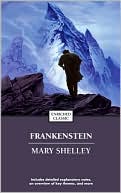
Frankenstein. Mary Shelley. 1818. Oxford World's Classics. 250 pages.
I am happy today to be reviewing Mary Shelley's Frankenstein for October's
Classic Circuit Tour on
Gothic Lit. Frankenstein just happens to be one of my favorite novels--though that hasn't always been the case. If you want to
read a long ramble about how this short little novel became a favorite of mind, you may read my first review published in 2007. My second review of the
novel was in 2009. If you want to read
my thoughts on the graphic novel, I reviewed it just last year.
I'll be honest. If you have NOT read Frankenstein, then this discussion probably isn't for you. I don't know how to talk about Frankenstein without talking spoilers.
Before I read Frankenstein (this time), I happened to read two young adult novels:
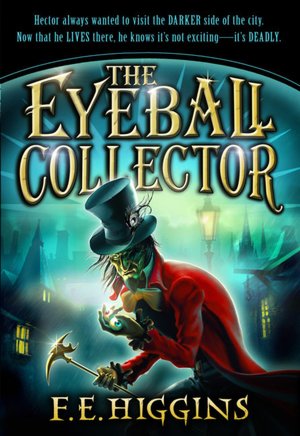
Mister Creecher by Chris Priestly and
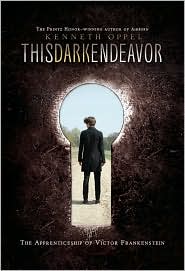
This Dark Endeavour by Kenneth Oppel. Both novels challenged me to rethink the original novel. Mister Creecher urged me to examine excuses. And This Dark Endeavour showed me just how much we don't know about some of the characters. Specifically, how much we DON'T know about Henry (Clerval) and Elizabeth. I wouldn't say reading these two books exactly guided me in this rereading. I, of course, noticed a few things on my own.
Frankenstein is a great little novel. Readers meet two fully developed characters in Victor Frankenstein and the creature (or monster, if you must see him in that way). I've always been so caught up in their story--the dual narration--that I've never really noticed how undeveloped other characters are. What do we know of Elizabeth? She's sweet. She's beautiful. She's pure. What do we know of Henry? He's Frankenstein's best friend. The man who shows up when Frankenstein is in great need. But does he have much of a personality? Do we ever get a glimpse of who he is apart from the faithful friend? Elizabeth and Henry are the two people nearest and dearest to Victor. Because he's close to these two, the creature is able to use them to get to Victor. Then there is Robert Walton. His letters provide the framework for the novel. Walton himself is experiencing some loneliness and anxiety. He WANTS to be successful as an explorer. He wants to be the one to discover the Northwest Passage. It's a dream that is all risk. If he's successful, of course, it would all be worth it. But if he's not, well, at best that means disappointment and frustration, at worst, death. He LISTENS to the story--this incredible story. He's found Victor Frankenstein on the ice, he's sick and mad. He's not exactly a picture of mental health. And physically, he's in terrible shape. As Walton spends time--a LOT of time with Frankenstein, he records his story. Readers do get to know a little about Walton. We know he's determined, ambitious, curious. We know he's got some stubbornness to him. Some pride. Some desire for fame. But we also know that he has feelings. That he feels lonely and isolated. That he wants more than anything to find a friend, a true friend. He wants to be understood. He wants companionship. So there are THREE characters that Shelley
really explores in her novel.
This Dark Endeavor was an interesting prequel to Frankenstein for many reasons. I won't mention all of them, don't worry. But what intrigued me most was the characterization of Elizabeth. Oppel's Elizabeth was strong, resilient, brave, and very smart. And Shelley's Elizabeth, well, she was oh-so-passively good and pure and sweet. Readers do know she loves Victor. Readers do know that she loves her Uncle and her cousins. We do know that she is a compassionate person because she pities Justine to the very end. But I still can't help seeing her existing just so she can be the ultimate victim.
Mister Creecher like John Kessel's short novellette, "
Pride and Prometheus," is an expansion of Mary Shelley's original novel. Both are set in the waiting period. Victor Frankenstein has promised his creation, his creature, a mate. He travels to England--to London, to Oxford, etc.--and eventually Scotland with his friend Clerval. All the while struggling with his promise. Should he repeat his mistake? Do two wrongs make a right? Can Frankenstein take his creature at his word? Can Frankenstein take for granted that the creature can predict (and/or control) his potential mate? Can he play with fate like that? If the first creation turned his life upside down and ruined him completely, can the creation of a second really change that? undo it?

So Mister Creecher introduces a friend. A young teen boy named Billy. A thief. Billy himself is an outcast of sorts. He's dirty, despised, looked down upon, chased away. People judge him all the time too. The truth is, if he died no one would miss him. Not at all. He has no one in the world to look out for him, no one to call friend. He's a nobody too. So the two do potentially have some things in common. But Billy CANNOT stand how pitiful the creature is, how full of excuses. He hears Mr. Creecher go on and on and on and on and on about his sad and lonely and miserable existence. How friendless he is. How hopeless he is. How he is rejected by one and all. Mr. Creecher may LOOK different from others, but his story isn't all that unique. He's not the only one to EVER feel so dejected, lonely, and depressed.
'Shut up!' Billy snapped. 'Why do you have to be such a...'
He snarled and kicked a moss-covered branch and sent it tumbling into the darkness. Without the coachlights, the moon provided the only illumination to the scene.
'You see how it is for me,' said Creecher. 'I try to help and--'
'It's always about you, isn't it?' said Billy. 'Oh, poor me--I'm ugly and no one likes me. Boo hoo, boo hoo. Well, life ain't a bowl of cherries for the rest of us neither!'
'But you can live among them...'
Billy fumed for a few moments, unable to express his feelings. The truth was he had never felt part of 'them.' He had never belonged.
'Oh yeah. I can get treated like filth,' he replied. 'I can starve or steal. I can hang. If you want someone to feel sorry for you, you've come to the wrong place.' (191)
So when I read Frankenstein this time, I began noticing that this was more than a little true. The creature does complain a lot, and he does have an exceedingly long list of excuses. He blames Victor for everything. He sees each one of his crimes as being Victor's fault. "Victor made me do it. Victor created me. Victor's responsible for every (bad) decision I make. Yes, I knew it was wrong. But he made me. He made me with these big, strong hands. It couldn't possibly be my fault that I use them to kill. I couldn't hurt anyone at all if I didn't exist." And then there's "If only Victor had loved me..." "If only Victor had taken time to teach me, nurture me, show me how to be a good 'little' monster...I wouldn't have possibly strayed from the straight and narrow." When the creature is not blaming Victor, he's blaming the victims, or blaming the rest of humanity. He never really takes responsibility for his crimes. He does confess. I'm not saying he doesn't admit to being a killer. But he has excuses. He would rather be the victim--the "real" victim--than a killer, a murderer. He wants Victor to be the bigger bad guy, the
ultimate bad guy.
It's hard not to pity the creature. It's really, really hard not to feel compassion for him. Especially at the beginning as his story unfolds. It is easy to see his point. It is easy to see that Victor's rejection of him wounded him deeply and warped him a bit. Each rejection just pushes him a little closer to the edge. The more education he receives--through observation, through reading, etc--the more difficult it is for him to just be. He learns of love, of family, of friendship, of joy, of happiness, of laughter. These ideas haunt him because they are unattainable. He'll never feel any of these 'lighter' emotions, he'll feel--and plenty--but he turns to anger, frustration, bitterness, revenge, hate. He gives himself over to hate and revenge. And once he goes bad, pity may remain but it's not exactly a healthy compassion. The truth remains. Did the creature have a choice? Did he know right from wrong and knowingly choose to commit wrong time and time again? The creature felt that becoming a murderer was his only choice, that there was no other choice he could have made. But is that true?
I do think that the creature was acting like an immature child. Maybe a well-read immature child. But I do think he was acting out to get Victor's attention. Victor is a character, on the other hand, that is troublesome almost from the start. It is easy to relate to the creature's loneliness, his outcast state, his wanting a friend. It is harder to relate to Victor's mad obsession to create life, to play at being a god, to gain too much control over the natural world, to venture too far into the unknown, to act without ANY thought at all, to be completely reckless and foolish. Victor seems like a tragically flawed character who couldn't have known any other destiny. And readers really don't know WHY Victor made the decisions he made. Not really. (At least this reader can't fathom.)
So Frankenstein is an emotional read--very powerful, very haunting.
You may also find these books helpful:
Frankenstein's Monster by Susan Heyboer O'Keere.
The Casebook of Victor Frankenstein by Peter Ackroyd.
A Monster's Notes by Laurie Sheck.
Mister Creecher by Chris Priestly
This Dark Endeavour by Kenneth Oppel
"
Pride and Prometheus" by John Kessel
AngelMonster by Veronica Bennett.
Wildly Romantic by Catherine M. Andronik.
© 2011 Becky Laney of
Becky's Book Reviews