Tampilkan postingan dengan label Historical. Tampilkan semua postingan

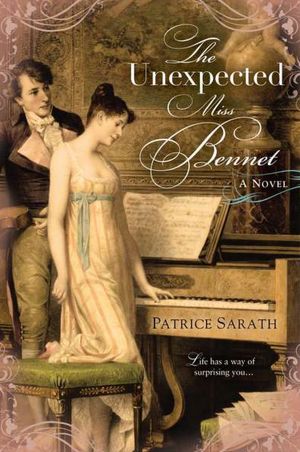
The Unexpected Miss Bennet

The Unexpected Miss Bennet. Patrice Sarath. 2011. Penguin. 304 pages.

It is a comforting belief among much of society, that a plain girl with a small fortune must have no more interest in matrimony than matrimony has in her. 

I loved this one. I just LOVED, LOVED, LOVED it. Set several years perhaps after the events of Pride and Prejudice, this novel shows the transformation of Mary Bennet. And the transformation is both believable and giddy-making. 

One day at a Lucas party, Mary is playing the piano. A young gentleman asks her to dance with him, before she can even start a reply someone cuts in and tells him that she is just Mary, she just plays the piano so others can dance, she isn't there to dance. Mary is puzzled at how this makes her feel. The fact that a man noticed her and wanted to dance with her, the fact that everyone assumed that Mary wouldn't want his attention or to dance, the fact that he took this answer and left to dance with someone else. Mary realizes that everyone has an idea of WHO Mary is and WHAT Mary does, and the ideas are very fixed. Mary wants to change that--one of the first things she does is to give up playing or practicing the piano. She starts taking more walks, she starts reflecting more on who she is and what she wants.

Around this same time, Jane starts worrying about her younger sister, Mary. She's already invited Kitty to spend some time with her and Bingley, so while she's not able to entertain her sister at this time, she's hoping that Elizabeth will be able to invite Mary to Pemberley.

At first, Mary accepts the invitation because she thinks Elizabeth is homesick and in need of one of her sisters, and she's happy to do her duty. But it doesn't take long for Mary to realize that Elizabeth is very happy indeed. For the first time, Mary sees what it would be like to live away from Mr. and Mrs. Bennet. For the first time, Mary reads a novel--or two or three. For the first time, Mary is happy. So when she gets a second opportunity with a certain gentleman who just happens to be an acquaintance of Mr. Darcy, she knows she'll dance. Of course, that's only a hint of what this one is about...

I enjoyed this one. I enjoyed what Sarath did with all the characters! Including Mr. and Mrs. Collins, Catherine de Bourgh and her daughter, Anne, etc. I definitely liked Mr. Aikens, the love interest of Mary, and I thought their courtship was just about right.

Read The Unexpected Miss Bennet
  • If you enjoy Jane Austen
  • If you love Pride and Prejudice
  • If you want Mary Bennet to have a happily ever after
  • If you like clean, historical romance 

© 2012 Becky Laney of Becky's Book Reviews

To Die For

To Die For: A Novel of Anne Boleyn. Sandra Byrd. 2011. Howard Books. 332 pages.

There are many ways to arrive at the Tower of London, though there are few ways out. 

Sandra Byrd's To Die For is an excellent historical romance novel. The narrator is Meg Wyatt, sister to Thomas Wyatt; she is best friends with Anne Boleyn. While I've read plenty of historical fiction set during this time period, it's rare for Anne Boleyn to be presented so sympathetically. I really came to care for both Meg and Anne. The novel begins in 1518 and ends soon after Anne's death. While the focus is definitely on life in the court of Henry VIII, one can also see it as a novel about the English Reformation. It highlights that while for some the Reformation was a convenient way for the King to get his own way all the time, that there were many, many people in England who were true Reformers, and genuinely believed in the Reformation and were eager to get their hands on an English Bible and read the Scriptures for themselves.

In addition to the "romance" between Anne Boleyn and Henry VIII (he is not presented sympathetically), the novel tells Meg's story. Her life being as good an example as any as to what a woman might expect from life at this time.

This historical romance was very enjoyable. Loved the writing, loved the characterization, loved the setting. It felt very personal, in a way, getting a glimpse of the close friendship between two women. For example, Meg being there for her during the birth of her daughter, Elizabeth, and for her two miscarriages. This was a very emotional novel for me, and I definitely wasn't expecting to feel such a strong connection with the heroines.

Read To Die For
  • If you are interested in the Tudors; in Henry VIII and his six wives
  • If you enjoy historical fiction/historical romance
© 2012 Becky Laney of Becky's Book Reviews

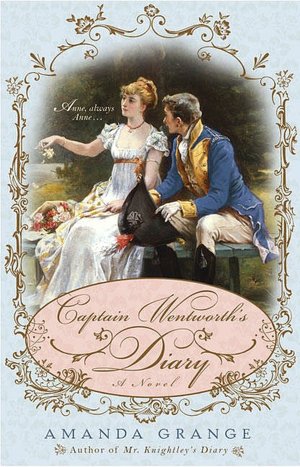
Captain Wentworth's Diary

Captain Wentworth's Diary. Amanda Grange. 2007. Penguin. 304 pages.

Thursday 5 June
At last I am on my way to Somerset!

I do like Amanda Grange's series, and, sometimes I really LOVE her books. But I didn't quite love Captain Wentworth's Diary. Persuasion is one of my favorite books, and definitely my favorite Jane Austen novel. I think I prefer the story from Anne's perspective.

Captain Wentworth's diary begins before he first meets Anne Elliot. The book portrays the courtship of the two, the sweet proposal, the bitter disappointment after she changes her mind. The novel then jumps ahead to Wentworth's successful return. Readers then see the events and scenes of Persuasion through Wentworth's eyes, for the most part. Though it's just a fraction of the story.

I liked this one. I felt Grange got the characters right, for the most part. And it was interesting to see their first meeting. Their first conversation was something. But. It just wasn't as amazing as Austen's original.

Read Captain Wentworth's Diary
  • If you're a fan of Amanda Grange 
  • If you're a fan of Jane Austen
  • If you like historical romances told in diary format 

© 2012 Becky Laney of Becky's Book Reviews
Pride and Pyramids

Pride and Pyramids: Mr. Darcy in Egypt. Amanda Grange and Jacqueline Webb. 2012. Sourcebooks. 320 pages.

Elizabeth Bennet ran down the stairs of the Darcys' London home with a lightness that belied her thirty-five years. 

You may enjoy Pride & Pyramids more than I did. (I was a bit disappointed in the end.) In this Austen-and-Egypt inspired novel, Mr. Edward Fitzwilliam's enthusiasm for a trip to Egypt inspires the whole Darcy family to join in the fun, excitement, and danger of the adventure. Not just Mr. and Mrs. Darcy, but all of their children--and they have oh-so-many children. Also along for the trip is Sophie Lucas, Charlotte's younger sister who is recovering from a broken heart. The family has also hired Mr. Inkworthy, an artist, to paint, sketch, and draw for the trip.

The book has an interesting premise. What if the Darcy family became interested in Egyptology, what if they were adventurous to want to go to an archaeological dig themselves, what if they were in search of a previously-undiscovered tomb full of treasure, etc. But for me this remained an almost book. It had some potential, but it never wowed.

Read Pride & Pyramids
  • If you are a fan of Amanda Grange and/or Jacqueline Webb
  • If you are interested in Egypt and archaeology of the nineteenth century 
  • If you like Pride and Prejudice and can't get enough of adaptations, retellings, sequels, etc. This one is unique. 
  • If you want a little supernatural mixed in  

© 2012 Becky Laney of Becky's Book Reviews

Mansfield Park Revisited

Mansfield Park Revisited. Joan Aiken. 1985/2005. Sourcebooks. 201 pages.

The sudden and unexpected death of Sir Thomas Bertram, while abroad engaged on business relating to his various properties in the West Indies, could be a cause of nothing but sorrow, dismay, and consternation to the baronet's friends in England.

I just LOVE, LOVE, LOVE Joan Aiken's Mansfield Park Revisited. I do. I love the characters, the story, and most of all the redemption. Susan Price, Fanny's younger sister, is the heroine of Joan Aiken's Mansfield Park Revisited. When the novel opens, Edmund and Fanny are on their way to the West Indies with their youngest child.
Susan's day are soon brightened up by the arrival of two people to the neighborhood. A sadder-but-wiser, Mary Crawford, whose health is in decline, and her ever-faithful brother, Henry. Though Susan never knew either Crawford personally, she can't help but be drawn to them--particularly Mary. She knows the two have history with those she loves best--Fanny, Edward, Tom, etc., but she can't help believing that these two have changed for the better through the years. These two are not seeking society in the neighborhood, just a quiet, peaceful place to simply be.

Aiken is great at relationships, and I definitely enjoyed seeing Susan interact with Mary Crawford, Henry Crawford, Tom Bertram, Lady Bertram, Julia Yates, etc. Readers don't know much about Susan from Austen's novel, but, Aiken did a great job giving her life in this sequel. While readers do know more about Mary and Henry Crawford from Austen's Mansfield Park, I can't help believing that Henry Crawford has been misunderstood until Aiken set the story straight. (I do LOVE Henry Crawford.) Mary's redemption was a beautiful thing as well. Aiken did not rewrite the past--or try to justify it exactly--but she has through circumstance after circumstance brought Mary to a reflective, repentant place and given her an opportunity to blossom into a sensitive, perceptive, loving person. 

I loved every page of this one. I loved spending time with these characters. It was just a wonderful treat.

My first review

Read Mansfield Park Revisited
  • If you love Mansfield Park, if you like Mansfield Park; even if you were bored with it, you may just find something to love in this historical romance
  • If you love Jane Austen
  • If you like historical romance

© 2012 Becky Laney of Becky's Book Reviews

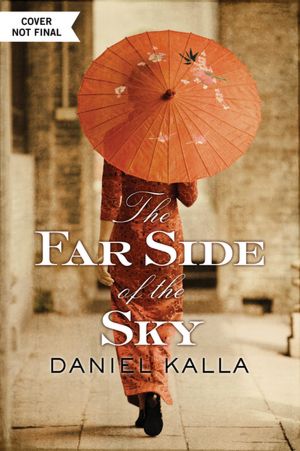
The Far Side of the Sky

The Far Side of the Sky. Daniel Kalla. 2012. Tom Doherty Associates. 464 pages.

The shadow still swayed over the pavement. Franz Adler tried to blink away the memory of his brother's dangling corpse and the silhouette it cast across the sidewalk, but the image looped over and over in his head.

The Far Side of the Sky provides a unique look at World War II. Franz Adler is able to flee Vienna, Austria, after Kristallnacht with his young daughter, Hannah, and his sister-in-law, Esther. Also accompanying them is an artist Ernst Muhler who fears persecution as well. (He joins them at the very last minute when his boyfriend decides to join the Nazis.) Their destination is Shanghai, one of the few places welcoming Jewish refugees.

The Far Side of the Sky is about the Jewish refugee community in Shanghai. Readers get glimpses of refugee life in 1938-9, 1940, 1941, 1942. (For example, the narrative might cover one or two months in a given year, and then jump to the next year.)

The main characters are:

Franz Adler, a Jewish doctor who divides his time between two hospitals in Shanghai, one of the hospitals is for Jewish refugees.

Soon Yi Mah (Sunny) a biracial (American/Chinese) nurse who divides her time between two hospitals. Her father was a doctor, and, she too has a gift for doctoring. But Dr. Reuben, one of the surgeons at the other hospital absolutely hates her and feels she doesn't know her place. She's intelligent, resourceful, courageous.

Of course there are dozens and dozens of minor characters of many ethnicities. 

The story was very fascinating. The author note reveals that much is based on fact, that he spent a great deal of time researching the Jewish refugee experience in Shanghai. And since this was the first I've heard of it, it was definitely fascinating to me. However. I was disappointed in the distant characters. Though readers follow the stories of these characters, I personally never felt connected with them. I knew enough about them to care about their fates, what happened next, etc. But I never felt like I knew them.

I'm not sure this book did a good job with relationships between characters either. For example, readers know that Franz is a father, but, except for two or three scenes, we don't really see Hannah interacting with Franz. We know that Hannah provides motivation for Franz--that his concern for Hannah moves the plot forward, but as for knowing Hannah, that just doesn't happen. We don't get the details of his personal life outside the hospital very often. Again, we know that Franz is taking care of Esther, his sister-in-law, but as for his sister-in-law having any character of her own, I just don't see it. There are a handful of scenes now and then. But even in those scenes she seems one-dimensional and just there. So many of the characters seem one-dimensional. The story itself is fascinating enough--the action, the danger, the uncertainty--but the characters just don't seem to match that.

The setting is unique and interesting. The story is fascinating and compelling. The characters, well, they disappointed me. But. I think there is enough to enjoy this one that I'd definitely still recommend it.

Read The Far Side of the Sky
  • If you are interested in the 1930s and 1940s, particularly the war years
  • If you are interested in reading books set in Shanghai, in China
  • If you are interested in reading a Jewish refugee book in a very different setting
  • If you are interested in doctors, nurses, surgeons, hospitals, etc. 

© 2012 Becky Laney of Becky's Book Reviews
Lorna Doone

Lorna Doone. R.D. Blackmore. 1869. 658 pages.

If anybody cares to read a simple tale told simply, I, John Ridd of the parish of Oare, in the county of Somerset, yeoman and churchwarden, have seen and had a share in some doings of this neighborhood, which I will try to set down in order, God sparing my life and memory. 

Lorna Doone was a classic that I almost almost loved. However, while I didn't "love" it, I certainly liked it. What I liked best about Lorna Doone was the romance. There were a few love scenes in this one--scenes where John Ridd is wooing Lorna Doone and professing his unending love for her. And those scenes work the best of any in the novel. But those scenes make up just a fraction of the novel, and to be honest I found most of this one to be boring. Now, I enjoy a rambling novel, I do. I love Anthony Trollope, Charles Dickens, and Wilkie Collins. I don't mind an author that takes his time telling a story--so long as the asides are written in a charming, entertaining way. But I didn't feel that was the case in Lorna Doone.

This historical romance is set in Exmoor (Devon and Somerset England) in the 17th Century) during the reigns of King Charles II and James II. John Ridd falls in love with Lorna Doone, but there are a few big obstacles standing in the way of their true love. First, she is a Doone. The Doone clan murdered John's father. John himself forgives this flaw easily since Lorna is so incredibly beautiful. The rest of his family may not be eager to welcome a woman from the outlaw clan. And the Doone clan, well, they are definitely not wanting to lose "their" Lorna to John Ridd. Second, Lorna's mysterious past. She doesn't remember a time before the Doones, but, that doesn't mean there wasn't one. And this big reveal causes some to believe that John Ridd isn't good enough--worthy enough-- for her. I will not say more than that. Third, the general times in which they lived: the political mess of the battle for the kingdom between James II and the Duke of Monmouth. John is mistakenly taken for a soldier on Monmouth's side--that is not the case, but it does pose some problems. Fourth, the pure evil that is Carver Doone.

Favorite scenes:
I would have leaped into the valley of the shadow of death (as described by the late John Bunyan), only to hear her call me "John"; though Apollyon were lurking there, and Despair should lock me in.
She stole across the silent grass; but I strode hotly after her; fear was all beyond me now, except the fear of losing her. I could not but behold her manner, as she went before me, all her grace, and lovely sweetness, and her sense of what she was.
She led me to her own rich bower, which I told of once before; and if in spring it were a sight, what was it in summer glory? But although my mind had notice of its fairness and its wonder, not a heed my heart took of it, neither dwelt it in my presence more than flowing water. All that in my presence dwelt, all that in my heart was felt, was the maiden moving gently, and afraid to look at me.
For now the power of my love was abiding on her, new to her, unknown to her; not a thing to speak about, nor even to think clearly; only just to feel and wonder, with a pain of sweetness. She could look at me no more, neither could she look away, with a studied manner—only to let fall her eyes, and blush, and be put out with me, and still more with herself.
I left her quite alone; though close, though tingling to have hold of her. Even her right hand was dropped and lay among the mosses. Neither did I try to steal one glimpse below her eyelids. Life and death to me were hanging on the first glance I should win; yet I let it be so.
After long or short—I know not, yet ere I was weary, ere I yet began to think or wish for any answer—Lorna slowly raised her eyelids, with a gleam of dew below them, and looked at me doubtfully. Any look with so much in it never met my gaze before.
"Darling, do you love me?" was all that I could say to her.
"Yes, I like you very much," she answered, with her eyes gone from me, and her dark hair falling over, so as not to show me things.
"But do you love me, Lorna, Lorna; do you love me more than all the world?"
"No, to be sure not. Now why should I?"
"In truth, I know not why you should. Only I hoped that you did, Lorna. Either love me not at all, or as I love you for ever."
"John I love you very much; and I would not grieve you. You are the bravest, and the kindest, and the simplest of all men—I mean of all people—I like you very much, Master Ridd, and I think of you almost every day."
"That will not do for me, Lorna. Not almost every day I think, but every instant of my life, of you. For you I would give up my home, my love of all the world beside, my duty to my dearest ones, for you I would give up my life, and hope of life beyond it. Do you love me so?"
"Not by any means," said Lorna; "no, I like you very much, when you do not talk so wildly; and I like to see you come as if you would fill our valley up, and I like to think that even Carver would be nothing in your hands—but as to liking you like that, what should make it likely? (214-5)
and
She made for awhile as if she dreamed not of the meaning of my gaze, but tried to speak of other things, faltering now and then, and mantling with a richer damask below her long eyelashes.
"This is not what I came to know," I whispered very softly, "you know what I am come to ask."
"If you are come on purpose to ask anything, why do you delay so?" She turned away very bravely, but I saw that her lips were trembling.
"I delay so long, because I fear; because my whole life hangs in balance on a single word; because what I have near me now may never more be near me after, though more than all the world, or than a thousand worlds, to me." As I spoke these words of passion in a low soft voice, Lorna trembled more and more; but she made no answer, neither yet looked up at me.
"I have loved you long and long," I pursued, being reckless now, "when you were a little child, as a boy I worshipped you: then when I saw you a comely girl, as a stripling I adored you: now that you are a full-grown maiden all the rest I do, and more—I love you more than tongue can tell, or heart can hold in silence. I have waited long and long; and though I am so far below you I can wait no longer; but must have my answer."
"You have been very faithful, John," she murmured to the fern and moss; "I suppose I must reward you."
"That will not do for me," I said; "I will not have reluctant liking, nor assent for pity's sake; which only means endurance. I must have all love, or none, I must have your heart of hearts; even as you have mine, Lorna."
While I spoke, she glanced up shyly through her fluttering lashes, to prolong my doubt one moment, for her own delicious pride. Then she opened wide upon me all the glorious depth and softness of her loving eyes, and flung both arms around my neck, and answered with her heart on mine,—
"Darling, you have won it all. I shall never be my own again. I am yours, my own one, for ever and for ever."
I am sure I know not what I did, or what I said thereafter, being overcome with transport by her words and at her gaze. Only one thing I remember, when she raised her bright lips to me, like a child, for me to kiss, such a smile of sweet temptation met me through her flowing hair, that I almost forgot my manners, giving her no time to breathe.
"That will do," said Lorna gently, but violently blushing; "for the present that will do, John. And now remember one thing, dear. All the kindness is to be on my side; and you are to be very distant, as behoves to a young maiden; except when I invite you. But you may kiss my hand, John; oh, yes, you may kiss my hand, you know. Ah to be sure! I had forgotten; how very stupid of me!"
For by this time I had taken one sweet hand and gazed on it, with the pride of all the world to think that such a lovely thing was mine; and then I slipped my little ring upon the wedding finger; and this time Lorna kept it, and looked with fondness on its beauty, and clung to me with a flood of tears.
"Every time you cry," said I, drawing her closer to me "I shall consider it an invitation not to be too distant. There now, none shall make you weep. Darling, you shall sigh no more, but live in peace and happiness, with me to guard and cherish you: and who shall dare to vex you?" But she drew a long sad sigh, and looked at the ground with the great tears rolling, and pressed one hand upon the trouble of her pure young breast.
"It can never, never be," she murmured to herself alone: "Who am I, to dream of it? Something in my heart tells me it can be so never, never." (261-2)
Isn't the "I love you more than tongue can tell, or heart can hold in silence" lovely?

Lorna Doone isn't just a romance, however; John Ridd has a few adventures all his own, including more than a few fight/battle scenes.

Read Lorna Doone
  • If you like classics
  • If you like historical romances

© 2012 Becky Laney of Becky's Book Reviews
The Yard (with slight spoilers)

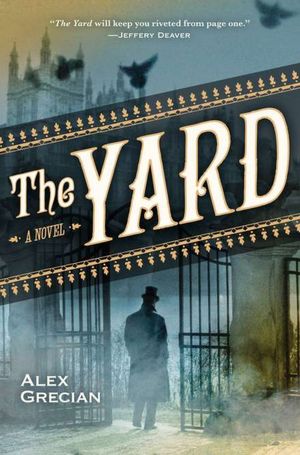
The Yard. Alex Grecian. 2012. Penguin. 432 pages.

From the prologue: Nobody noticed when Inspector Christian Little of Scotland Yard disappeared, and nobody was looking for him when he was found.

What can I say about Alex Grecian's The Yard? I was disappointed. If you're expecting a mystery where suspense builds, clues are given, and you're on the edge of your seat to find out who did it, then this one will definitely disappoint. For Grecian will reveal who did it to readers within a chapter or two. Readers will get a behind-the-scenes look at the murderer almost from the beginning. The first entry or so of this murderer his identity is still hidden, but, that doesn't remain the case for long. But Grecian doesn't just reveal the identity of one murderer, he reveals the identity of another murderer. For Scotland Yard is working on two cases during the course of the novel. One, a murderer who is killing police detectives. Two, a murderer who is killing bearded men.

The Yard has multiple narrators. Readers meet several detectives (some remain alive at the novel's end, others aren't so fortunate) throughout the novel, each contributes (to a certain degree) to solving one or the other cases. Some personal details are shared about some of the detectives. For example, readers meet Walter Day and his wife. We get a flashback to before they were married--we get to see the proposal, and, it felt to me it was a very odd proposal! We also see glimpses of their home life as she adjusts to life in London. Another detective we meet is Hammersmith (I can't recall his first name). We get flashes from him as well, including flashbacks to when he was a child. His flashbacks reveal his sensitive side and how difficult the job can be: finding the bodies of children, men, women, etc. Readers also meet Dr. Kingsley who works closely with Scotland Yard, and we meet his young daughter who helps out by sketching all the corpses. While we meet many characters, including a mystery "dancing man", I had a hard time truly connecting with any of the characters. I'll explain, while I wanted to read the book to its end, I wasn't at the edge of my seat. It wasn't that the book was super-compelling and impossible to put down. It wasn't that the book had any suspense (well, readers could perhaps wonder if Fenn would make it back home alive or if he'd end up a corpse; and if you're desperate to find more to be in suspense about I suppose you could wonder if Day's wife was ever going to tell him that she was pregnant), I finished the book because I like to finish what I start.

This one would almost have to be more of a thriller than a mystery, but, I'm not sure it's lack of suspense and uneven pacing would make it a good thriller either. Overall, I'd say the characterization wasn't the best. Some of the characters had potential, they could potentially be developed into something more, into characters that I would care about, but they weren't quite there yet. Some of the characters were incredibly flimsy and flat.

I think some of the scenes were intentionally put in there to aggravate modern readers--which worked, by the way. Having scenes where a boy goes up to a police officer (detective) and clearly states things like, help, please help me, I've been kidnapped, tied up, held prisoner, I only now just escaped, if he catches me again, I don't know what will happen, please help me find my parents. And have him respond with, move along, boy, or I'll send you to the workhouse. I suppose the intention being to highlight that women and children had no value or worth in society.

I wanted to like this one, I was even hoping to love it, but it was just okay. 

Best line: "If all men were sane, we would be blacksmiths." (87)

Read The Yard
  • If you like historical fiction set during the Victorian period
  • If you like Victorian mystery/detective/suspense stories; just don't expect Grecian to write as well as the actual Victorians, his style, his characterization, his pacing, doesn't even come close to matching. 
  • If you don't mind slightly tedious fiction, for example, he spends pages and pages each time (almost) trying to explain the concept of fingerprints. And how each fingerprint is unique, personal; how fingerprints can help establish who was at the scene of the crime, etc. 
© 2012 Becky Laney of Becky's Book Reviews
Short-Straw Bride

Short-Straw Bride. Karen Witemeyer. 2012. Bethany House. 368 pages.

From the prologue: Ten-year-old Meredith Hayes balled her hands into fists as she faced her tormentor, "Hiram Ellis! Give me back my lunch bucket this instant!"

From chapter one: "I don't think I can do it, Cass." Meredith peered up at her cousin through the reflection in the vanity mirror. Cassandra pulled the hairpin from her mouth and secured another section of Meredith's braided chignon. "Do what?" "Marry a man who wants me only for the land I can bring him." 

This isn't my first Karen Witemeyer book; however, it is the first Karen Witemeyer book that I absolutely LOVED, LOVED, LOVED. Short-Straw Bride is a Christian historical romance; it is set in Palestine, Texas in the 1880s.

In the prologue, Travis Archer saves the then-ten-year-old Meredith, her leg having gotten trapped in a hunting trap. The incident stays with her, as you might imagine. First, because she can't forget Travis Archer, he is forever her hero, the stuff of her dreams, despite the fact that that isolated incident is the only time she's seen him. Second, because it left a scar on her leg and the damage to the bone prevented it from growing as it should; one leg being slightly longer than the other.

The novel opens with Meredith all grown up and living with her aunt and uncle who are her guardians. They have arranged a marriage for her with an up-and-coming businessman, Roy Mitchell. Meredith prays for a sign, an indication one way or another if she should marry the man her guardians have chosen for her, or, if she should be stubborn and refuse their choice. And the sign, when it comes, is definite: she not only overhears him calling her a cripple, she overhears him making unethical arrangements to acquire land. He WANTS the Archer land, and since the Archer brothers won't sell, won't negotiate, won't budge, he's decided that if he burns their barn down, it will be a good first step to getting what he wants.

So what's a woman to do? Well, she does try going to the sheriff--or the deputy?--but when she's not taken seriously, when she's instead ridiculed for being a silly woman with a vivid imagination, she does what she must: she rides out to the Archer land herself to warn them. The problem? She doesn't have the time to ride out there and back before nightfall. And she wasn't counting on her cousin giving into the pressure of revealing her whereabouts. So her heroic ride to warn them just in time turns into a compromising reputation-killer. Her uncle demanding that one of the four Archer brothers step forward to marry her....

I admit this one could sound a bit silly to some readers, but, oh how I loved it!!!! I loved Meredith! I loved Travis! I loved their relationship, their marriage, their courtship-coming-after-marriage. I loved seeing how Meredith's presence on the Archer farm transforms the place, transforms the brothers. I loved just about everything in this one!!! There were quite a few giddy-making scenes!

Will Short-Straw Bride appeal to every reader? I doubt it. It's definitely for those that love Christian fiction, those that love Christian historical romance. I could see it having some appeal to non-Christians who love and seek out clean romance novels (smut-free romance novels).

Read Short-Straw Bride
  • If you enjoy Christian fiction
  • If you enjoy Christian historical romance
  • If you enjoy clean romance novels
  • If you are looking for historical romance set in Texas
© 2012 Becky Laney of Becky's Book Reviews

The Lost Wife

The Lost Wife. Alyson Richman. 2011. Penguin. 352 pages.

New York City
2000
He dressed deliberately for the occasion, his suit pressed and his shoes shined. While shaving, he turned each cheek carefully to the mirror to ensure he hadn't missed a single whisker. 

The Lost Wife, at least at first glance, does not appear to be your traditional Holocaust novel. True, both hero and heroine are Jewish. True, over half of the novel is about what happened to them as a result of the Nazis invading their country and bringing the war all too close to home. But the way this story is told sets it a bit apart. For one, the framework of the story is NOT chronological. It begins and ends on the very same day, it begins with a reunion decades in the making. It begins with the grandfather of the groom meeting the grandmother of the bride and realizing their shared past. Their tragically-brief past.

Lenka, the heroine, perhaps has the greater task. Her narrative focuses on the past, for the most part. From her childhood to her teen years to her relationship with a young man, Josef. It covers the happy years, the anxious years, the joyful moments, the heartbreaking moments. Her time with Josef does seem brief--their marriage consisting of mere weeks when it was meant to last a lifetime. But war has a way of wrecking things.

Josef, the hero, balances out Lenka's story. His role in the novel is to relate to readers the post-war present. The focus is on his life in America. The war has cost him much, much, much more than just a wife. And so he does have to find a way to go on, and that includes marrying someone (another broken person forever changed and haunted by war, by what might have been, what should have been) and having a family. We catch glimpses of his home life through the decades. We see him as a husband, a father, a grandfather, a friend. He has never forgotten Lenka. Never.

Though the novel does jump around in time, I didn't find it confusing. I cared about both stories, though, I perhaps cared about hers a bit more. Both Josef and Lenka endured losses--great losses--and both witnessed things that were traumatic, I think her story is more compelling because of the duration. We see Lenka in two concentration camps. And we endure with Lenka. Or at least that is how it felt to me.

The way this story is told does take a good bit of suspense out of it, but I didn't mind because to me it was all about the journey. 

Read The Lost Wife
  • If you want to read an amazing, heartbreaking-yet-hopeful love story
  • If you are interested in reading about the Holocaust
  • If you are interested in Terezin and Auschwitz 
  • If you want a little art appreciation; this one has a definite art theme to it.
  • If you're looking for a compelling read that's almost impossible to put down

© 2012 Becky Laney of Becky's Book Reviews

Born and Bred in the Great Depression

Born and Bred in the Great Depression. Jonah Winter. Illustrated by Kimberly Bulcken Root. 2011. Random House. 40 pages.

Where you grew up, on the edge of town,
next to the tracks,
you could hear the trains going by
at night.


East Texas,
the 1930s--
the Great Depression.

Set in Texas in the 1930s, Born and Bred in the Great Depression is based on the stories Jonah Winter heard about his father and his childhood during the Depression. The storytelling is simple--poetic, even. I found the text to be engaging as well. It's as if he's writing--or speaking--directly to his father. I think that keeps things interesting. I found the text to be well written. It was simple--yet beautiful. It felt honest. Like a celebration of love and family.

I also enjoyed the illustrations by Kimberly Bulcken Root. I felt they matched the text well. Beautiful, detailed, yet simple and sweet.

Read Born and Bred in the Great Depression
  • If you like family stories
  • If you like historical picture books
  • If you like honest, beautiful, yet simple, stories of the heart

© 2012 Becky Laney of Becky's Book Reviews