Tampilkan postingan dengan label 1956. Tampilkan semua postingan

The Wide Horizon (MG)

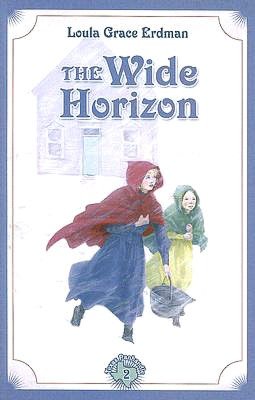
The Wide Horizon. Loula Grace Erdman. 1956/2007. Bethlehem Books. 279 pages.

Katie Pierce was sure she must be the luckiest girl in the whole Panhandle of Texas. Luckier even than her older sister Melinda who, after five years of waiting, was going to marry Dennis Kennedy in June and go with him to live in Amarillo. Dennis was a real doctor now, driving around the town and the surrounding country, looking after sick folks. 

The Wide Horizon is my favorite, favorite, favorite book in Loula Grace Erdman's Texas Panhandle trilogy. (It might have something to do with the fact that I read it a dozen times as a child. I never got a chance to read the first or last book in this series.)

The narrator is Katie Pierce. She's excited because she's not only going to be singing at her sister's wedding, she'll be a bridesmaid too. And then that fall, she'll be going back to East Texas to live with her grandmother and attend a fancy academy for young ladies. But except for the singing, nothing quite goes like plan. For on the day of a wedding, a stranger-soon-not-to-be-a-stranger, Bryan Cartwright, interrupts bringing Dr. Kennedy urgent news. He must leave the wedding ceremony so he can see one of his patients. (The ceremony continues when he returns.) The other unexpected news of the summer is that Katie won't be going away after all. Her grandmother has fallen and broken her hip. Katie's mom will be going to nurse her back to health. Katie is needed right where she is. She'll need to take care of her brothers and younger sister. Katie will have to learn fast how to fill her mother's place on the farm! And it's quite a learning experience. The chapter on cooking beans was hilarious!

There were so many things I loved about this one!

Read The Wide Horizon
  • If you enjoy historical fiction, if you enjoy pioneer stories with a "Little House" feel
  • If you like stories with blizzards in them! (Katie finds herself responsible for caring for the children left behind at the school)
  • If you like coming-of-age stories
© 2012 Becky Laney of Becky's Book Reviews

The Stars My Destination

The Stars My Destination. Alfred Bester. 1956. My edition, published in 1996, has an introduction by Neil Gaiman. Knopf Doubleday. 272 pages.

This was a Golden Age, a time of high adventure, rich living, and hard dying...but nobody thought so. This was a future of fortune and theft, pillage and rapine, culture and vice...but nobody admitted it. This was an age of extremes, a fascinating century of freaks...but nobody loved it. All of the habitable worlds of the solar system were occupied. Three planets and eight satellites and eleven million million people swarmed in one of the most exciting ages ever known, yet minds still yearned for other times, as always. The solar system seethed with activity...fighting, feeding, and breeding, learning the new technologies that spewed forth almost before the old had been mastered, girding itself for the first exploration of the far stars in deep space; but--


The Stars My Destination has a great beginning. The opening had me hooked. After reading The Demolished Man, I knew I wanted to read more Bester, but reading the opening paragraphs of The Stars My Destination made me want to read more Bester now. Unfortunately, for me, by the end of the novel, my excitement had lessened. For me, The Stars My Destination just wasn't as magical, as perfect, a read for me as The Demolished Man. It might be for you though.

The Stars My Destination begs the question how far would you be willing to go for revenge?! The narrator of The Stars My Destination is Gully Foyle. He was the sole survivor of a horrible accident in space. He's trapped in a small compartment of the spaceship for days, weeks, months. When he catches a glimpse of another ship, when he dares to try to catch their attention, he sees that ship purposefully pass him by. He sees a ship that could help him, could save him, willfully leave him there...something in him snaps. His whole life becomes about revenge, about tracking down the men and women on that ship, of learning who gave the order to not help him, of learning everything he can about its crew, its mission. He has to know WHO is to blame, he wants to know WHY they did what they did. So Gully Foyle is a man on a mission, he desperately wants answers.

Gully Foyle isn't exactly a nice guy, a comfortable-to-be-around narrator. His actions are more than a little questionable, ethically speaking. Which makes sense, in a way. Because others haven't treated him all that well either. And there are definitely more than a handful of guys in this novel that are out to get him as much as he's out to get them. So it's mutual--this chasing, this hating, this struggle.

One of the interesting aspects of this science fiction novel was the idea of teleportation. In Demolished Man the focus was on telepathy, on how being able to read people's minds could shape a society, could change the rules up. In The Stars My Destination the idea is about teleporting--the ability to jaunte, to move yourself--by forceful thinking--from one place to another. Some can jaunte fifty miles, others can jaunte a thousand miles. But it's something that is being taught to almost everyone. And this is reshaping society, changing the rules, upsetting things. Not for better or worse exactly. Just making things differently. One of things Bester mentions, for example, is how this effects the social classes. First, the rich cling to their superiority by choosing not to jaunte. The wealthier a person is, the slower their mode of transportation. A truly wealthy person might choose to travel by horse and buggy. Second, this effects security. You don't necessarily want just anyone teleporting themselves into your house or office. Third, and I'm not quite sure why this is, it effects women's place in society. Dramatically. Men lock their women away in doorless, windowless rooms--rooms that only they know how to jaunte to--whether this is to "protect" women from intruders or because they want to have ultimate control over them is debatable.

The Stars My Destination is an intriguing novel. And I am glad I read it. But I didn't exactly feel a personal connection with it.

Read The Stars My Destination
  • If you want to read classic or vintage science fiction from the 1950s
  • If you're a fan of The Demolished Man
  • If you're a fan of science fiction
  • If you like stories about power struggles, politics, wars, and refugees
  • If you like stories about revenge and hate
  • If you don't mind if your narrator is unethical/immoral

© 2012 Becky Laney of Becky's Book Reviews

Time for the Stars

Time for the Stars. Robert A. Heinlein. 1956. Tor. 244 pages.

According to their biographies, Destiny's favored children usually had their lives planned out from scratch. Napoleon was figuring on how to rule France when he was a barefoot boy in Corsica, Alexander the Great much the same, and Einstein was muttering equations in his cradle. 
Maybe so. Me, I just muddled along. 

At last, I have a FAVORITE Robert Heinlein novel. There have been a handful of novels that have been almost-love for me. Novels that I've enjoyed for the most part, and in places even loved. But for me, Time for the Stars is the BEST. I just love, love, love this one. It had everything I wanted. And nothing I didn't! The premise of this one is simple and it works well for the most part.

Earth is sending out a dozen spaceships to explore the galaxy, to find potential planets to colonize. Each spaceship has a dozen or so mind-readers/telepaths on board. Almost all of the telepaths are twins. One twin stays on Earth and receives transmissions from the ship, from his or her partner; the other twin goes into space, has the adventure, and sends all the messages to Earth. Almost all the telepathic pairs are young adults or children--they have to be because they know that aging will be an issue. (One twin will stay young, one will age normally.)

The hero of Time for the Stars is Tom Bartlett. His twin is Pat. Used to being bullied--or bossed around--by his twin, Tom never thought he'd be the one to go on the ship Lewis and Clark, or "Elsie". But when his brother has a skiing accident, the twins switch places...for better or worse.

So. This novel is all space adventure. But I think for the first time, perhaps, Heinlein's characters were ones that I really, really CARED about. It was the first time I recognized Heinlein of having the ability to create interesting, well-developed characters. So this book was more than a premise. It actually had substance too.

Read Time for the Stars
  • If you've been disappointed by Heinlein in the past and are looking for a book that satisfies
  • If you're looking to try Heinlein for the first time
  • If you're interested in a science fiction book with young(er) characters/narrators
  • If you're a fan of science fiction, particularly science fiction that focuses on space exploration and colonization
  • If you're looking for some adventure with your science fiction


© 2012 Becky Laney of Becky's Book Reviews
Double Star

Double Star. Robert A. Heinlein. 1956. Del Rey. 245 pages.

If a man walks in dressed like a hick and acting as if he owned the place, he's a spaceman. It is a logical necessity. His profession makes him feel like boss of all creation; when he sets foot dirtside he is slumming among the peasants. As for his sartorial inelegance, a man who is in uniform nine-tenths of the time and is more used to deep space than to civilization can hardly be expected to know how to dress properly. He is a sucker for the alleged tailors who swarm around every spaceport peddling "ground outfits."

"The Great Lorenzo" has been hired to impersonate a prominent politician--a Mr. John Joseph Bonforte. This job will take him to Mars and beyond. When he accepts the job, he doesn't really know all the facts. He doesn't know what the job will require--beyond an impersonation at a public/social event. And he doesn't know how long the job will last. He hopes not too long, since he doesn't really like politics, and he doesn't really like the political viewpoints of the person he'll be playing. Even if he asked before leaving Earth, I doubt he'd been told the truth.

So. I'm not quite sure what to think of Double Star. On the one hand, it was relatively clean. (I stopped reading the last two Heinlein novels I picked up from the library because they were, well, perhaps Vir says it best: "That's...that's quite all right, I get the idea. I don't really need to know more than you've told me. In fact, I wouldn't have been upset to know less." The titles of those two were Friday and I Will Fear No Evil.)

And Double Star wasn't exactly boring...it just wasn't thrilling. It was one of those books were the beginning is better than the middle and the end. I'm not sure if that's because of my expectations or his writing. (Is it wrong for me to expect science fiction novels to have developed characters?)

Read Double Star
  • If you're a fan of Robert A. Heinlein
  • If you're a fan of vintage science fiction
  • If you're interested in reading Hugo winners
  • If you're interested in politics
  • If you're interested in space travel

© 2012 Becky Laney of Becky's Book Reviews