Tampilkan postingan dengan label Adult Science Fiction. Tampilkan semua postingan

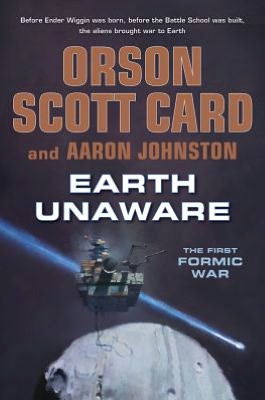
Earth Unaware: The First Formic War

Earth Unaware. Orson Scott Card and Aaron Johnston. The First Formic War. 2012.  Tor. 368 pages.

Victor didn't go to the airlock to see Alejandra leave the family forever, to marry into the Italian clan.

Earth Unaware is an experience. Orson Scott Card is as wonderful as always. In fact, I'd say this may just be my most favorite Card novel of recent years. His characters are so incredibly human, so very, very flawed. Because of their complex relationships with one another, there is a genuineness to them. That doesn't mean readers will connect with each and every character. In fact, this novel has a character I loathe more than any other Card creation: Lem Jukes. Since this novel rotates narrators (or main characters), every Jukes chapter was painful. I was just SO VERY VERY VERY ANGRY at him. I reacted very strongly to him. But that isn't really a big surprise. I reacted strongly to so many characters in this one. Major and minor characters that I just CARED for. Which made almost every loss something to be FELT.

There are essentially "three" big stories being told in Earth Unaware. Two of the stories happen in space. El Calvador is an asteroid mining ship--a family-owned free mining ship. Victor's story, for the most part, occurs on El Calvador. This is the ship that first spots the Formics; well, they are the first to notice that an alien ship is heading towards Earth at faster than light speed. Lem Jukes is captain of a corporation ship. His interest in asteroids isn't quite like El Calvador's. Jukes is working on an invention with a lot of potential--something having to do with a gravity laser. After a successful test or two, he's ready to try the glaser on a bigger object. The object he has in mind happens to be the asteroid that El Calvador is mining at the moment. He decides to "bump" them--destroying their laserline communications--long range communicator--in the process.

The third story is, in a way, the lesser of the three stories. It is set on Earth and involves the military. It centers on a man, Wit O'Toole, forming a special military unit, Mobile Operations Police. One of the recruits is Mazer Rackham. But this isn't his story just yet. He's still undergoing testing, at this point. And the war has not begun. So while he will be very important in the other books in this series, this isn't his time just yet.

Earth Unaware is an exciting, suspenseful science fiction novel. I found the pacing to be just right. (True, some of the chapters seemed like a bit of an interruption, especially close to the end, but for the most part, the book was incredibly INTENSE, painfully INTENSE.) Readers learn about the ship who first spotted the Formic ship--the alien ship. Readers witness the destruction of the first encounter between humans and Formics. And anxiously readers wait and hope that one of the ships who know about the coming aliens will be able to send news to Earth.

This was an incredible reading experience--very emotional. It's a novel to be felt as well as read. The characterization was great. The storytelling and pacing was great too. I just loved it. This is one I'll definitely want to reread. 

Read Earth Unaware
  • If you're a fan of Orson Scott Card
  • If you're a fan of Ender's Game--even if you're not a fan of the other books in the series
  • If you enjoy science fiction
© 2012 Becky Laney of Becky's Book Reviews

Fahrenheit 451

Fahrenheit 451. Ray Bradbury. 1953/2003. Random House. 190 pages.

It was a pleasure to burn. 

Fahrenheit 451 is so wonderful, so beautiful, so amazing that it almost leaves me speechless. It is a haunting story of a bleak future. Our hero, Guy Montag, is in a loveless marriage with his wife, Mildred. He meets a young, vibrant girl, Clarisse, and they talk--talk of nothing and everything. She dares to think, to ask questions, to be curious, to be full of wonder and life, to have a spark of something that has almost been lost in society and civilization. But, her tragic end helps focus Montag's perspective. It has been coming for a while now, perhaps ever since meeting that old man, Faber, in the park, but Montag knows that he can no longer live the lie. He no longer wants to burn books, to burn houses of people who love books. He no longer wants to be a fireman. He wants to read books; he wants to learn; he wants to know what it is like to LIVE again, to think, to think critically, to think about things even if it means being sad or sorrowful or anxious and worried. He doesn't want to be mindlessly entertained by "the family" on three of his walls or a seashell in his ears. Even if there is a scary war coming. He wants to stand against the majority and face reality.

I think this is a book everyone needs to read...at least once. I could easily read it once a year! It's just a wonderful novel!!!

Favorite quotes:
Who knows who might be the target of the well-read man? Me? I won't stomach them for a minute...Remember, Montag, we're the happiness boys. We stand against the small tide of those who want to make everyone unhappy with conflicting theory and thought. (50-1)  
 We've started and won two atomic wars since 1990! Is it because we're having so much fun at home we've forgotten the world? Is it because we're so rich and the rest of the world's so poor and we just don't care if they are? Is that why we're hated so much? Do you know why? I don't, that's sure! Maybe the books can get us half out of the cave. God, Millie, don't you see? An hour a day, two hours, with these books, and maybe... (62)
Good God, it isn't as simple as just picking up a book you laid down half a century ago. Remember, the firemen are rarely necessary. The public itself stopped reading of its own accord. (78)
 It’s been a long time. I’m not a religious man. But it’s been a long time.’ Faber turned the pages, stopping here and there to read. ‘It’s as good as I remember. Lord, how they’ve changed it in our parlors these days. Christ is one of the family now. I often wonder if God recognizes His own son the way we’ve dressed him up, or is it dressed him down? He’s a regular peppermint stick now, all sugar-crystal and saccharine when he isn’t making veiled references to certain commercial products that every worshiper absolutely needs.’ (81)
Do you know why books such as this are so important? Because they have quality. And what does the word quality mean? To me it means texture. This book has pores. It has features. This book can go under the microscope. You'd find life under the glass, streaming past in infinite profusion. The more pores, the more truthfully recorded details of life per square inch you can get on a sheet of paper, the more 'literary' you are. That's my definition, anyway. Telling detail. Fresh detail. The good writers touch life often. the mediocre ones run a quick hand over her. The bad ones rape her and leave her for the flies. So now do you see why books are hated and feared? They show the pores in the face of life. The comfortable people want only wax moon faces, poreless, hairless, expressionless. we are living in a time when flowers are trying to live on flowers, instead of growing on good rain and black loam. (83)
There is a richness in Fahrenheit 451, a depth that most books don't have perhaps. There's just something about it that makes it timeless and memorable and thought-provoking.

Read Fahrenheit 451
  • If you like to read books
  • If you find intellectual freedom important
  • If you enjoy science fiction, particularly vintage science fiction
  • If you are looking for a timeless classic
  • If you enjoy dystopias 

© 2012 Becky Laney of Becky's Book Reviews

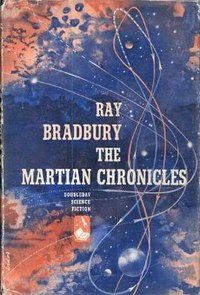
The Martian Chronicles (YA/Adult)

1997, edition of The Martian Chronicles
Martian Chronicles. Ray Bradbury. HarperCollins. 1997 edition. 288 pages.
One minute it was Ohio winter, with doors closed, windows locked, the panes blind with frost, icicles fringing every roof, children skiing on slopes, housewives lumbering like great black bears in their furs, along the icy streets.
And then a long wave of warmth crossed the small town. A flooding sea of hart air; it seemed as if someone had left a bakery door open. The heat pulsed among the cottages and bushes and children. The icicles dropped, shattering, to melt. The doors flew open. The windows flew up. The children worked off their wool clothes. The housewives shed their bear disguises. The snow dissolved and showed last summer's ancient green lawns.
Rocket summer. The words passed among the people in the open, airing houses. Rocket summer. The warm desert air changing the frost patterns on the windows, erasing the art work. The skis and sleds suddenly useless. The snow, falling from the cold sky upon the town, turned to a hot rain before it touched the ground. Rocket summer. People leaned from their dripping porches and watched the reddening sky. (1)
The 2012 Mass Paperback of The Martian Chronicles
I LOVE, LOVE, LOVE Ray Bradbury's The Martian Chronicles. This is the second or third time I've read this one. And each time I read it, I end up loving it even more. It's like each time I'm surprised by how much I love it. Like in between readings I forget how engaging and compelling it is. I settle into thinking that it was just me exaggerating things (again). That it couldn't possibly be that good. But no. It is that good.

The edition I read this time had twenty-seven stories; some of these 'stories' are just vignettes, or short preludes, transition pieces of a paragraph or two. But many are full-length stories. There are some great stories in this one.
  • January 2030 Rocket Summer
  • February 2030 Ylla
  • August 2030 The Summer Night
  • August 2030 The Earth Men
  • March 2031 The Taxpayer
  • April 2031 The Third Expedition
  • June 2032 --And the Moon Be Still as Bright
  • August 2032 The Settlers
  • December 2032 The Green Morning
  • February 2033 The Locusts
  • August 2033 Night Meeting
  • October 2033 The Shore
  • November 2033 The Fire Balloons
  • February 2034 Interim
  • April 2034 The Musicians
  • May 2034 The Wilderness
  • 2035-2036 The Naming of Names
  • April 2036 Usher II
  • August 2030 The Old Ones
  • September 2036 The Martian
  • November 2036 The Luggage Store
  • November 2036 The Off Season
  • November 2036 The Watchers
  • December 2036 The Silent Towns
  • April 2057 The Long Years
  • August 2057 There Will Come Soft Rains
  • October 2057 The Million Year Picnic
1950 edition of The Martian Chronicles
I wasn't aware that there were different editions of this one, and that the stories could vary depending on the edition. Also the dates have been modified (by thirty years) in some editions, like the edition I read this time around. The very, very newest edition has the original dates, 1999-2026. This newest edition does not have "The Fire Balloons." Also, instead of "The Wilderness" it has "Way in the Middle of the Air."

My thoughts on individual stories, and, first sentences from the stories

"Ylla"
They had a house of crystal pillars on the planet Mars by the edge of an empty sea, and every morning you could see Mrs. K eating the golden fruits that grew from the crystal walls, or cleaning the house with handfuls of magnetic dust which, taking all dirt with it, blew away on the hot wind.
A story told solely from the perspective of the Martians, in this case, a husband and wife. A husband has a very definite reaction to his wife's strange dreams. She dreams of a man, Nathaniel York, coming in a ship, in a rocket, and landing. The dream even tells her where and when. But her controlling and perhaps jealous husband has a way of dealing--for once and for all--with his wife's dreams.

"The Earth Men"
Whoever was knocking at the door didn't want to stop. Mrs. Ttt threw the door open. "Well?"
The story of the second expedition. Let's just say that the welcoming committee wasn't quite what they expected! First, NO ONE wanted to bother with them, then they were greeted by a strange assortment of Martians all claiming to be from Earth. And then....well, that wouldn't be polite of me to spoil it!


"The Third Expedition" (aka Mars is Heaven)
The ship came down from space. It came from the stars and the black velocities, and the shining movements, and the silent gulfs of space. It was a new ship; it had fire in its body and men in its metal cells, and it moved with a clean silence, fiery and warm. In it were seventeen men, including a captain. 
This one is a classic short story that you may have stumbled across in another context from The Martian Chronicles. (I've heard two radio adaptations, for example.) And the title is self-explanatory. It is the story of what happens when the third expedition lands. It is the story of what they see and  WHO they see. It is a story that stretches you, perhaps. But it's a good one!

"--And the Moon Be Still As Bright"
It was so cold when they first came from the rocket into the night that Spender began to gather the dry Martian wood and build a small fire. He didn't say anything about a celebration; he merely gathered the wood, set fire to it, and watched it burn.
And now we're on to the fourth expedition, the fourth rocket ship to successfully land on Mars. This time they manage to stay alive past the initial day or two or three. This is the story of what happens when one of the crew members, Spender, goes off on his own to learn the Martian culture, to explore the ruins, to explore the cities, to examine the artifacts and remnants of a culture that is gone with the wind. What happens next...well....there are a million reasons why readers shouldn't sympathize with Spender, but, like Captain Wilder, they may feel the pull all the same.

"The Settlers"
The men of Earth came to Mars. They came because they were afraid or unafraid, because they were happy or unhappy, because they felt like Pilgrims or did not feel like Pilgrims. There was a reason for each man. They were leaving bad wives or bad jobs or bad towns; they were coming to find something or leave something or get something, to dig up something or bury something or leave something alone. They were coming with small dreams or large dreams or none at all.
One of my favorite vignettes. For some reason it reminds me of John Steinbeck.

"Night Meeting"
Before going on up into the blue hills, Tomas Gomez stopped for gasoline at the lonely station.
There is something haunting and fantastical about this short story of a human and Martian meeting and not exactly seeing the same reality.

"The Fire Balloons"
Fire exploded over summer night lawns. 
 I first read "The Fire Balloons" in another collection of Ray Bradbury stories. I didn't, at the time, see it as being part of The Martian Chronicles. (And, in fact, it wasn't part of the edition I first read.) But now it is one of my favorite stories! In it two priests go to Mars as missionaries. One at least was expecting, was hoping, to meet Martians, to actually BE a missionary TO Martians, to an alien species. So when given the opportunity of going out into the hills and trying to communicate with blue balloon-like hovering creatures OR ministering to humans who have migrated to Mars, the answer is clear to Father Peregrine. But do the Martians need his church? This story has one of my favorite quotes:
"Father Peregrine, won't you ever be serious?"
"Not until the good Lord is. Oh, don't look so terribly shocked, please. The Lord is not serious. In fact, it is a little hard to know just what else He is except loving. And love has to do with humor, doesn't it? For you cannot love someone unless you put up with him, can you? And you cannot put up with someone constantly unless you can laugh at him. Isn't that true? And certainly we are ridiculous little animals wallowing in the fudge bowl, and God must love us all the more because we appeal to His humor."
 "The Wilderness"
Oh, the Good Time has come at last--
It was twilight and Janice and Leonora packed steadily in their summer house, singing songs, eating little, and holding to each other when necessary. But they never glanced at the window where the night gathered deep and the stars came out bright and cold.
This is another story that I ended up loving. And it was new-to-me too, it not being part of the original. But in this story we meet two women who are about to travel to Mars to get married and settle down. (The men having gone first.) The story likens exploring and settling Mars to exploring and settling the Old West (places like Wyoming, California, Oregon, etc.) It is about how the two handle their last night on Earth.
Is this how it was over a century ago, she wondered, when the women, the night before, lay ready for sleep, or not ready, in the small towns of the East, and heard the sound of horses in the night and the creak of the Conestoga wagons ready to go, and the brooding of oxen under the trees, and the cry of children already lonely before their time?...Is this then how it was so long ago? On the rim of the precipice, on the edge of the cliff of stars. In their time the smell of buffalo, and in our time the smell of the Rocket. Is then then how it was? And she decided, as sleep assumed the dreaming for her, that yes, yes indeed, very much so, irrevocably, this was as it had always been and would forever continue to be. 
"Usher II" (aka Carnival of Madness)
"During the whole of a dull, dark and soundless day in the autumn of the year, when the clouds hung oppressively low in the heavens, I had been passing alone on horseback, through a singularly dreary tract of country, and at length found myself, as the shades of evening drew on, within view of the melancholy House of Usher..." Mr. William Stendahl paused in his quotation. There, upon a low black hill, stood the house, its cornerstone bearing the inscription: 2036 A.D.
I remembered this as being one of the stories in A PLEASURE TO BURN, a Ray Bradbury collection celebrating the creative stories leading up to the writing/publishing of Fahrenheit 451. And it was first published as "Carnival of Madness." But it was also part of Ray Bradbury's book, The Martian Chronicles. And it is perhaps one of the most memorable of the collection. It is a true must read for anyone who loves Fahrenheit 451, for it continues on some of the same themes. I don't want to say too much about it really, because it shouldn't be spoiled at all if you want to get the full enjoyment of it!

"The Martian"
The blue mountains lifted into the rain and the rain fell down into the long canals and old LaFarge and his wife came out of their house to watch. 
An elderly couple have come to Mars and one night they are surprised by the appearance of their "son" (who died and was buried back on Earth). Their "son" doesn't want to leave the house, and is enjoying his family too much to risk getting "trapped" by going into the city and interacting with others. This story is creepy.

"The Luggage Store," "The Off Season," "The Watchers," "The Silent Towns," "The Long Years," "There Will Come Soft Rains," and "The Million Year Picnic."

These stories, I feel, work best as a sequence showing what happens both on Earth and Mars when the worst happens--atomic war on Earth. In "The Luggage Store," one speculates that his business will improve greatly if the war happens, if the worst happens. He feels that everyone will want to go back home to Earth to be with their loved ones, to find out if their loved ones are okay, to try to piece their society and civilization back together. In "The Off Season" readers learn that the war has started and the destruction has begun. There is nothing truly comical about it, but, it does happen to be told from the point of view of a man who has just opened a hot dog stand. "The Watchers" shows the people leaving Mars to return to Earth--for better or worse. "The Silent Towns" and "The Long Years" are two stories set on Mars. The first, "The Silent Towns" is told from the point of view of a man who chose to stay behind. He's lonely, but not THAT lonely it turns out. He does meet one woman who stayed behind, but, he decides that his own company is enough after all. "The Long Years" sees the return of Captain Wilder, I believe, who discovers a man and his family. There is a twist, however, which prevents this one from being a happy story. "There Will Come Soft Rains" is a very, very, very lonely story where we get a glimpse--just a small glimpse perhaps--of the desolation and destruction of life as we know it in at least one human city. We see the ending of an era, perhaps. There are no human characters in this one. "The Million Year Picnic" resonates even more when seen back-to-back with "There Will Come Soft Rains." In this story, readers meet a family: parents and sons who have come to Mars on their own private Rocket--a rocket that has been hidden away for many years, a rocket that has been saved for a true emergency. We meet a father who has prepared for THE END in a big, big way.

Read The Martian Chronicles
  • If you love science fiction
  • If you like science fiction
  • If you enjoy short stories; if you don't enjoy short stories
  • If you are a fan of Ray Bradbury
  • If you are a fan of the Twilight Zone

© 2012 Becky Laney of Becky's Book Reviews

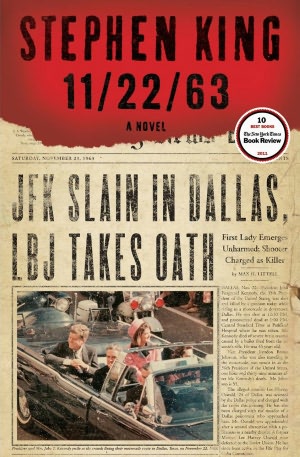
11/22/63

11/22/63. Stephen King. 2011. Scribner. 864 pages.

I have never been what you'd call a crying man. 

This is the second Stephen King novel I've read, and honestly I'm not sure how I'd compare the two I've read: Under the Dome and 11/22/63.

In Under the Dome, the violence is graphic, and the bad language proved problematic...for me. But, oh, the tension. It was such a compelling read. The pacing was amazing. It really was. It was a page-turner. I didn't like the characters particularly. I hated some of them--granted, some of them were evil incarnate. But I HAD TO KNOW what happened next. The premise, well, it was horrifying and intriguing all at the same time.

11/22/63 was in many ways a tamer novel. Less violence, less bad language (though it's still there to a certain degree. I am NOT claiming this is a clean read.) But. Well, how can I say this? For me at least it lacked tension. The premise of time travel should have been wowing me from start to finish. But it didn't. The only one that had to deal with consequences--in my opinion--was the narrator Jake Epping who time-traveled under the name George Amberson. So long as he remained alive and able to return to 2011 through the time-bubble, all other mistakes, all other consequences just didn't matter at all. Not really. Sure, they mattered to him. He, personally, felt those mistakes and had his struggles and doubts. But no one else could ever know the difference between worlds and alternate realities.

I'm not sure how I really felt about the narrator, Jake/George. On the one hand, his "good angel" intentions of playing God and determining the future and making the world a better place by preventing a handful of tragedies were understandable. I mean if you could prevent a death by time-travel, shouldn't you? Jake knew one person whose life was forever-changed one Halloween night when his drunken father came home and murdered his mother, his two brothers, and his sister. He was the only one to survive--and only because he was in the bathroom when the killing spree began. But he saw too much--much too much--and his father tried and failed to kill him too. So when Jake discovers this time-travel-bubble that automatically sends you to September 1958--almost a full month before this tragedy--he feels like he has to "fix" things. He has to test time-travel to see if he can change things...for the better.

But Jake/George's main goal, his main mission, is not to save his friend from a horrible childhood, but to save "the world" or "the nation" from experiencing the tragedy of Kennedy's assassination. A world where Kennedy continued his term (and was reelected) as president would have to be a better world than the one we now live in, right? Especially if you're tempted to think he was the best human, best leader, best politician, best president ever, ever, ever. To think that he was the best, smartest, wisest, kindest, strongest.

So that is his mission: prevent JFK from being assassinated. And, to a certain degree, King stays on task. But his idea of staying "on task" isn't the most thrilling way to spend your time. Readers are treated to five years (at least) of Jake/George living in the past. And part of the focus is on his mission, but much of it is not. Part of it is focused on his career as a teacher/mentor. Part of it is focused on his 'career' as a writer as he prepares a manuscript or two. Part of it--a large part of it--is focused on his finding his one, true love. Yes, a good part of 11/22/63 is a romance novel with focus on feelings, dancing, and secret weekend hideaways. 

While many elements of the story are nice enough in their own way, they don't necessarily add up to the most compelling, most page-turning read ever. I suppose there are several questions that could keep you reading--Will he successfully stop the assassination? (Hint: Don't look at the back cover.) Will he get to stay with his one, true love? Will he stay with her in the past? Or will she go with him to the future? Will this divorced teacher find his happily ever after? But none of those were quite enough for me.

The one area this novel worked for me--and I'm not even sure if this was the intent--was seeing this novel as a test for one man, to see how selfish or selfless one man could be. I can't say more without spoiling it. But essentially he's asked to choose between his own happiness and the greater good of the world at large.

I suppose this one also treats morality and ethics. Do two wrongs make a right? Does shooting a murderer before he's murdered anyone make your murder moral? I also saw this one as dealing with humans playing God. Here we have one man who is determined to remake the world into a "better" place. But what he didn't take into account is how tragedy shapes us. How tragedies and sorrows and struggles shape our character and develop us. I thought of so many scenes from Orson Scott Card's Worthing Saga.

Part of me really, really wishes that more time had been spent on alternate presents. The ending felt incredibly rushed and not completely believable.

Read 11/22/63
  • If you're interested in time travel, in science fiction
  • If you're interested in history, particularly history/culture of the late 1950s to early 1960s
  • If you're interested in politics and issues (Vietnam war, communism, civil rights, etc.) of the times
  • If you're interested in teachers and librarians (our hero and heroine)

© 2012 Becky Laney of Becky's Book Reviews
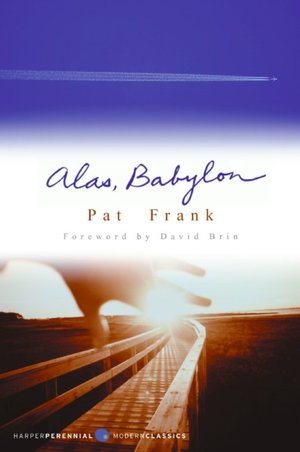
Alas, Babylon

Alas, Babylon. Pat Frank. 1959/1999. HarperCollins. 325 pages.

In Fort Repose, a river town in Central Florida, it was said that sending a message by Western Union was the same as broadcasting it over the combined networks. This was not entirely true. It was true that Florence Wechek, the manager, gossiped. Yet she judiciously classified the personal intelligence that flowed under her plump fingers, and maintained a prudent censorship over her tongue. The scandalous and the embarrassing she excised from her conversation. Sprightly, trivial, and harmless items she passed on to friends, thus enhancing her status and relieving the tedium of spinsterhood. If your sister was in trouble, and wired for money, the secret was safe with Florence Wechek. But if your sister bore a legitimate baby, its sex and weight would soon be known all over town.

Alas, Babylon was an apocalyptic novel written in 1959 during the Cold War. It imagines the ultimate what-if of the time. What if the USSR used nuclear warfare and took out all our bases and major cities?

Mark Bragg is in the know. He's received just enough warning to send his wife, Helen, his son, Ben Franklin, and his daughter, Peyton, to his brother, Randy, in Fort Repose, Florida. Of course, he doesn't know for sure that Fort Repose will be safe enough, but it has to be safer than Omaha. He knows his own fate all too well. His will be among the first hit--or targeted. This isn't Mark's story. And readers only catch a glimpse of his story through his brief conversation with Randy--and through what Randy chooses to reveal about him. 

Randy Bragg is the hero of Alas, Babylon. He is our narrator. He receives a telegram from his brother that reads "Alas, Babylon" and he knows it's just a matter of time. Will it be today? Will it be tomorrow? How soon is 'the end'? He learns that his brother is sending his family to him, that he is to protect them to the best of his ability. But how do you really, truly prepare for something like this? How can you know exactly what you'll need? He does go to the store, he does go shopping, he does try, but he's just not able to comprehend what the loss of most (if not all) major cities in Florida will mean.  (The loss of electricity, no gasoline deliveries, no food deliveries, no mail, no radio, no television, no newspapers, no way to learn what is happening on any street but you're own). And of course, it's not just Florida. Other states, other cities, will be effected as well.

For an apocalyptic novel, Alas, Babylon is rich in hope. I'm not saying that it's not a serious novel with a serious subject. I'm not saying that it's not bleak either. Bad things do happen. And life does change...seemingly forever. There are no easy answers on what to do next. I'm reminded of a scene from Babylon 5, season two, "Confessions and Lamentations" in which Delenn and Lennier learn that "faith manages." But there is much to admire in Randy Bragg and the other men and women we meet in Pat Frank's Alas, Babylon. Like their courage, their resourcefulness, their determination, etc.

While part of the novel is spent on politics--the right and wrongs of it--and war--the right and wrongs of it--much of the novel is focused on surviving, on moving forward. Part of the novel also has to do with race relations as well. Randy was not elected before "the day" because he was too open-minded and not quite Southern enough. In other words, he was not a racist. In other words, he didn't think integration was the work of the devil. (Half of the characters in Alas, Babylon are black. And I don't think it's unfair to conclude that without the help of his black neighbors, Randy Bragg wouldn't have managed as well).

There were many, many memorable scenes in Alas, Babylon. My personal favorite may just be this commentary from librarian.
Alone of all the people in Fort Repose, Alice continued with her regular work. Every morning she left the Wechek house at seven. Often, ignoring the unpredictable dangers of the road, she did not return until dark. Since The Day, the demand for her services had multiplied. They slowed when they overtook her, shouted a greeting, and waved. She waved back and pedaled on, a small, brave, and busy figure. Watching the car chuff past,  Alice reminded herself that this evening she must bring back new books for Ben Franklin and Peyton. It was a surprise, and a delight, to see children devour books. Without ever knowing it, they were receiving an education. Alice would never admit it aloud, but for the first time in her thirty years as librarian of Fort Repose she felt fulfilled, even important.
It had not been easy or remunerative to persist as librarian in Fort Repose. She recalled how every year for eight years the town council had turned down her annual request for air conditioning. An expensive frill, they'd said. But without air conditioning, how could a library compete? Drugstores, bars, restaurants, movies, the St. Johns Country Club in San Marco, the lobby of the Riverside Inn, theaters, and most homes were air conditioned. You couldn't expect people to sit in a hot library during the humid Florida summer, which began in April and didn't end until October, when they could be sitting in an air-conditioned living room coolly and painlessly absorbing visual pablum on television. Alice had installed a Coke machine and begged old electric fans but it had been a losing battle.
In thirty years her book budget had been raised ten percent but the cost of books had doubled. Her magazine budget was unchanged, but the cost of magazines had tripled. So while Fort Repose grew in population, book borrowings dwindled. There had been so many new distractions, drive-in theaters, dashing off to springs and beaches over the weekends, the mass hypnosis of the young every evening, and finally the craze for boating and water-skiing. Now all this was ended. All entertainment, all amusements, all escape, all information again centered in the library. The fact that the library had no air conditioning made no difference now. There were not enough chairs to accommodate her readers. They sat on the front steps, in the windows, on the floor with backs against walls or stacks. They read everything, even the classics. And the children came to her, when they were free of their chores, and she guided them. And there was useful research to do. Randy and Doctor Gunn didn't know it, but as a result of her research they might eat better thereafter. It was strange, she thought, pedaling steadily, that it should require a holocaust to make her own life worth living. (187-188)

Read Alas, Babylon
  • If you're a fan of apocalyptic fiction
  • If you're a fan of science fiction and are looking for a classic 
  • If you're a fan of survival stories
  • If you're a fan of compelling thrillers
  • If you want to know the fate of armadillos in Florida
© 2012 Becky Laney of Becky's Book Reviews

The Stars My Destination

The Stars My Destination. Alfred Bester. 1956. My edition, published in 1996, has an introduction by Neil Gaiman. Knopf Doubleday. 272 pages.

This was a Golden Age, a time of high adventure, rich living, and hard dying...but nobody thought so. This was a future of fortune and theft, pillage and rapine, culture and vice...but nobody admitted it. This was an age of extremes, a fascinating century of freaks...but nobody loved it. All of the habitable worlds of the solar system were occupied. Three planets and eight satellites and eleven million million people swarmed in one of the most exciting ages ever known, yet minds still yearned for other times, as always. The solar system seethed with activity...fighting, feeding, and breeding, learning the new technologies that spewed forth almost before the old had been mastered, girding itself for the first exploration of the far stars in deep space; but--


The Stars My Destination has a great beginning. The opening had me hooked. After reading The Demolished Man, I knew I wanted to read more Bester, but reading the opening paragraphs of The Stars My Destination made me want to read more Bester now. Unfortunately, for me, by the end of the novel, my excitement had lessened. For me, The Stars My Destination just wasn't as magical, as perfect, a read for me as The Demolished Man. It might be for you though.

The Stars My Destination begs the question how far would you be willing to go for revenge?! The narrator of The Stars My Destination is Gully Foyle. He was the sole survivor of a horrible accident in space. He's trapped in a small compartment of the spaceship for days, weeks, months. When he catches a glimpse of another ship, when he dares to try to catch their attention, he sees that ship purposefully pass him by. He sees a ship that could help him, could save him, willfully leave him there...something in him snaps. His whole life becomes about revenge, about tracking down the men and women on that ship, of learning who gave the order to not help him, of learning everything he can about its crew, its mission. He has to know WHO is to blame, he wants to know WHY they did what they did. So Gully Foyle is a man on a mission, he desperately wants answers.

Gully Foyle isn't exactly a nice guy, a comfortable-to-be-around narrator. His actions are more than a little questionable, ethically speaking. Which makes sense, in a way. Because others haven't treated him all that well either. And there are definitely more than a handful of guys in this novel that are out to get him as much as he's out to get them. So it's mutual--this chasing, this hating, this struggle.

One of the interesting aspects of this science fiction novel was the idea of teleportation. In Demolished Man the focus was on telepathy, on how being able to read people's minds could shape a society, could change the rules up. In The Stars My Destination the idea is about teleporting--the ability to jaunte, to move yourself--by forceful thinking--from one place to another. Some can jaunte fifty miles, others can jaunte a thousand miles. But it's something that is being taught to almost everyone. And this is reshaping society, changing the rules, upsetting things. Not for better or worse exactly. Just making things differently. One of things Bester mentions, for example, is how this effects the social classes. First, the rich cling to their superiority by choosing not to jaunte. The wealthier a person is, the slower their mode of transportation. A truly wealthy person might choose to travel by horse and buggy. Second, this effects security. You don't necessarily want just anyone teleporting themselves into your house or office. Third, and I'm not quite sure why this is, it effects women's place in society. Dramatically. Men lock their women away in doorless, windowless rooms--rooms that only they know how to jaunte to--whether this is to "protect" women from intruders or because they want to have ultimate control over them is debatable.

The Stars My Destination is an intriguing novel. And I am glad I read it. But I didn't exactly feel a personal connection with it.

Read The Stars My Destination
  • If you want to read classic or vintage science fiction from the 1950s
  • If you're a fan of The Demolished Man
  • If you're a fan of science fiction
  • If you like stories about power struggles, politics, wars, and refugees
  • If you like stories about revenge and hate
  • If you don't mind if your narrator is unethical/immoral

© 2012 Becky Laney of Becky's Book Reviews

The Worthing Saga

The Worthing Saga. Orson Scott Card. 1990. Tor. 465 pages.

In many places in the Peopled Worlds, the pain came suddenly in the midst of the day's labor. It was as if an ancient and comfortable presence left them, one that they had never noticed until it was gone, and no one knew what to make of it at first, though all knew at once that something had changed deep at the heart of the world. 

The Worthing Saga is one of my favorite, favorite, favorite books. It's one of the few books that I actually crave. I don't always indulge in a reread, after all it isn't fair to all the other books out there. I can't just read and reread Worthing Saga every time I think of it, every time I remember just how much I love it. I have to show some restraint after all. But it has been a few years since my last reread, and I had to save something truly special for Carl's sci-fi experience, didn't I?

So what do I love about The Worthing Saga? I love the stories, the storytelling, the framework. I love the characters. I LOVE the characterization. Even if I don't exactly "love" (have warm, cozy feelings about) each individual character. I think Card did an amazing job with The Worthing Saga in creating good, memorable characters. These are characters that--at least for me--stay with me always. Characters like Hoom, for example. Each chapter is like an old friend. Well, almost all chapters. There are two or perhaps three stories that I could do without completely. The lifeloop acting chapter, for example, I could do without completely!!!! But I think what I love most about The Worthing Saga is the layering, how it has depth and substance. How it has a definite message, but instead of being annoying, it somehow works all the same. This science fiction book is thought-provoking, challenging. It encourages you to think about deep things, to explore questions like why is there pain? why is there suffering? would the world be a better place without pain, without suffering? Is pain a necessary evil? Do we only feel joy and happiness because we know about pain and sorrow? what makes life beautiful? do we become better people through our struggles with life?

The Worthing Saga is a science fiction novel. It is a novel with a framework. Readers first meet a young boy, Lared, and his sister, Sala, on the day of pain, the day when this planet, this society, first experiences an awareness of pain, suffering, grief. From that day on, pain and death become all-too-real possibilities...for the young and old. From that day on, actions have consequences. Soon after 'the day of pain' two strangers come into their lives, come to their parents inn, Jason and Justice. These two choose Lared to be their scribe, to share with the world, their story. A story that spans many, many, many centuries.

The Worthing Saga is a GREAT book that I just LOVE AND ADORE.

Read The Worthing Saga
  • If you love science fiction
  • If you love science fiction set on multiple planets, science fiction with space travel, science fiction with colonization, science fiction with ethical dilemmas
  • If you love books with great characterization and powerful storytelling
  • If you love books that deal with larger issues in life

© 2012 Becky Laney of Becky's Book Reviews

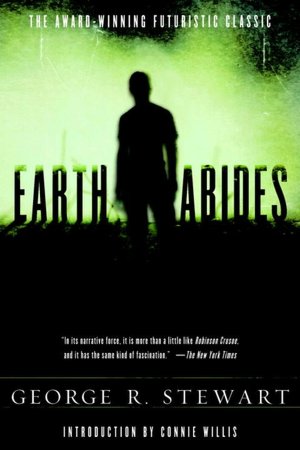
Earth Abides

Earth Abides. George R. Stewart. 1949/2006. (Introduction to this edition by Connie Willis!) Random House. 368 pages.

Just as he pulled himself up to the rock ledge, he heard a sudden rattle, and felt a prick of fangs.

Earth Abides almost leaves me speechless. I almost don't know what I could say about this one. I am definitely glad I read it.

Did I find it thrilling and compelling and wonderful? Sometimes. Maybe not as thrilling as you might expect a futuristic apocalyptic novel to be. Think more along the lines of Robinson Crusoe. Slow and steady with some adventuresome scenes. But mainly a more thoughtful novel.

Ish Williams, our hero, was bitten by a rattle snake. He makes it to his cabin before the sickness completely overwhelms him, and he does what he can to try to survive the snake bite. But nothing is certain, and he knows it. What he didn't expect, what he couldn't possibly have imagined, is that while he's been off camping, off having his nature-inspired adventures, his own brush with death via snake bite, the whole world has changed. The earth's population has dropped to almost nothing. In fact, it takes Ish a couple of chapters, at least, to find another survivor. And several more chapters to find a survivor sober enough, rational enough to want to spend any amount of time with. But Ish is determined and intellectual, a real thinker. He will find some way to go on with life, find some way to build a little pocket of society again.

The novel is broken into several sections. Some sections cover a few months, a few years, and other sections cover twenty or thirty years. Some sections are very detailed, very focused on individuals, others not so much. Some characters are definitely developed well, others not so much. Ish is definitely one of the most developed characters, most introspective and reflective characters that I've encountered in science fiction. (Perhaps not more than Ender or Andrew Wiggin in his Speaker of the Dead status.) That doesn't mean I love him necessarily, but it may mean I remember him.

Earth Abides isn't as emotional as it might have been or could have been. Ish just isn't a show-your-emotions type of guy. He is reflective and intellectual. He's resourceful. He knows a little bit about everything. He's a handy guy to have around. But he's not going to go on and on and on about his feelings. He's not going to weep or go crazy. He's not going to lose it just because the world as he knows it has ended. He's disconnected, in a way, yet his detachment may enable him to survive in this new world.

Read Earth Abides
  • If you're looking to read vintage science fiction, a classic apocalyptic, post-apocalyptic novel
  • If you're interested in survival stories
  • If you're interested in a generational story

© 2012 Becky Laney of Becky's Book Reviews

We

We. Yevgeny Zamyatin. Translated by Mirra Ginsburg. 1921/1972*. HarperCollins. 233 pages.

I shall simply copy, word for word, the proclamation that appeared today in the One State Gazette... 

We is a dystopian novel. I've been wanting to read it for almost as long as I've been blogging.

What did I think of We?

I found the novel interesting but not necessarily comprehensible. I struggled to make sense of this one. (I think I followed about a third of it.) I'm sure I missed much of what was going on simply because I was trying to make sense of this world, this society. Could the problem--for me--be this society's emphasis on math and logic?

The narrator of We is a state mathematician named D-503. (I did figure out that men have a consonant and an odd number; women have a vowel and an even number). Everything is calculated and precise and governed or regulated. Even intimate relationships. D-503 has two registered partners--O-90 and I330. O-90 desperately wants a child, a dream that isn't likely to come true. And I330 is a big, big tease who manipulates men in oh-so-many ways. Perhaps because D-503 cannot understand her at all, cannot predict anything about her, she fascinates him, enslaves him.

So one of D-503's projects is working on the spaceship, Integral. One State has plans to conquer the universe. Perhaps because of what he does, I-330 sees an opportunity to use him to get what she wants...
A human being is like a novel: until the last page you don't know how it will end. Or it wouldn't be worth reading... (162)

Read We
  • If you are looking for a literary quality to your science fiction
  • If you enjoy a challenge as you read; if you enjoy complexity
  • If you are looking to read a science fiction classic
  • If you are interested in Russian literature from this time period
*It was first translated into English (according to Wikipedia) in 1924, this translation by Mirra Ginsburg was done in 1972. 

© 2012 Becky Laney of Becky's Book Reviews

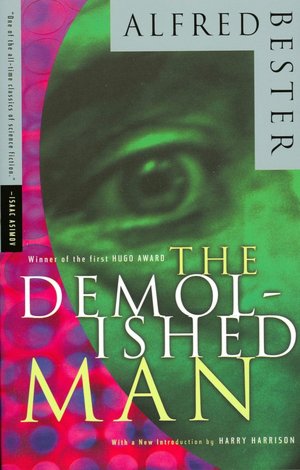
The Demolished Man

The Demolished Man. Alfred Bester. 1951. Random House. 245 pages.

Explosion! Concussion! The vault doors burst open. And deep inside, the money is racked ready for pillage, rapine, loot. Who's that? Who's inside the vault? Oh God! The Man With No Face! Looking. Looming. Silent. Horrible. Run....Run...

The Demolished Man is the winner of the first Hugo Award. I am not sure it's an absolute must-read. But. If you're a fan of science fiction, I think you should definitely consider reading this one! Depending on your expectations, of course, you might just find yourself surprised at how clever and literary well written it is.

The mystery elements of The Demolished Man made it a great read for me. The novel stars two characters. One, Ben Reich, who is determined to murder his business rival, Craye D'Courtney. With (future) society being what it is, murder is unheard of because telepaths (espers) always, always are able to read the minds of the would-be murderers and stop them before the crime is committed. But Reich plans to bribe a few high(er) level telepaths to help him cover his tracks, AND he plans on using a catchy song to distract other mind-readers in the area, to keep them from peeping his intentions.

Eight, sir; seven, sir;
Six, sir; five, sir;
Four, sir; three, sir;
two, sir; one!
'Tenser' said the Tensor.
'Tenser,' said the Tensor.
'Tension, apprehension,
And dissension have begun.' 

The second main character is Lincoln Powell, the detective on the case. (The murder is successful.) Both characters narrate this one. So readers get the view points of both the detective and the criminal. I wasn't sure how I felt about this--at first. But I think it works well, for the most part!

Have you read this one? What did you think? What did you think of the ending? Of what happens to criminals... And what did you think of the "romance"?!

This one surprised me. It did. I really liked it so much more than I thought I would. In fact, I think I may even love it. I couldn't help thinking of this Alfred Bester when I read it.

Read The Demolished Man
  • If you're a fan of classic science fiction
  • If you want to read the FIRST Hugo Winner
  • If you're interested in reading science fiction with a focus on telepaths
  • If you're a fan of mysteries and detective fiction

© 2012 Becky Laney of Becky's Book Reviews

Time for the Stars

Time for the Stars. Robert A. Heinlein. 1956. Tor. 244 pages.

According to their biographies, Destiny's favored children usually had their lives planned out from scratch. Napoleon was figuring on how to rule France when he was a barefoot boy in Corsica, Alexander the Great much the same, and Einstein was muttering equations in his cradle. 
Maybe so. Me, I just muddled along. 

At last, I have a FAVORITE Robert Heinlein novel. There have been a handful of novels that have been almost-love for me. Novels that I've enjoyed for the most part, and in places even loved. But for me, Time for the Stars is the BEST. I just love, love, love this one. It had everything I wanted. And nothing I didn't! The premise of this one is simple and it works well for the most part.

Earth is sending out a dozen spaceships to explore the galaxy, to find potential planets to colonize. Each spaceship has a dozen or so mind-readers/telepaths on board. Almost all of the telepaths are twins. One twin stays on Earth and receives transmissions from the ship, from his or her partner; the other twin goes into space, has the adventure, and sends all the messages to Earth. Almost all the telepathic pairs are young adults or children--they have to be because they know that aging will be an issue. (One twin will stay young, one will age normally.)

The hero of Time for the Stars is Tom Bartlett. His twin is Pat. Used to being bullied--or bossed around--by his twin, Tom never thought he'd be the one to go on the ship Lewis and Clark, or "Elsie". But when his brother has a skiing accident, the twins switch places...for better or worse.

So. This novel is all space adventure. But I think for the first time, perhaps, Heinlein's characters were ones that I really, really CARED about. It was the first time I recognized Heinlein of having the ability to create interesting, well-developed characters. So this book was more than a premise. It actually had substance too.

Read Time for the Stars
  • If you've been disappointed by Heinlein in the past and are looking for a book that satisfies
  • If you're looking to try Heinlein for the first time
  • If you're interested in a science fiction book with young(er) characters/narrators
  • If you're a fan of science fiction, particularly science fiction that focuses on space exploration and colonization
  • If you're looking for some adventure with your science fiction


© 2012 Becky Laney of Becky's Book Reviews

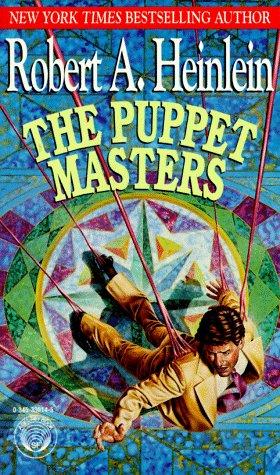
The Puppet Masters

The Puppet Masters. Robert A. Heinlein. 1951. Del Rey. 340 pages.

Were they truly intelligent? By themselves, that is? I don't know and I don't know how we can ever find out. I'm not a lab man; I'm an operator. 

I honestly don't know which Heinlein is my favorite, but it would definitely be either The Puppet Masters or The Door Into Summer. At least of the ones I've read so far. The Door Into Summer is about cold sleep and time travel. The Puppet Masters is about an alien invasion--where the aliens are parasites that take on human hosts. Both books are good--really, really good. Though if you hate science fiction, I doubt either would change your mind. (Connie Willis might change your mind though!)

So. The Puppet Masters is a novel that I think you should definitely try. I am SO SO glad I bought myself a copy.

The narrator of The Puppet Masters is an agent named "Sam." (His real name is revealed, but most people do call him Sam, so that's what I'll call him too.) When the novel opens, he's getting a new assignment. He'll be working with two other agents--his Old Man, and his "sister" "Mary" (that's not her real name either) to investigate the landing of a flying saucer in a small town in Iowa. What they discover changes everything...but it may take some convincing to be believed.

Read The Puppet Masters
  • If you're a fan of classic or vintage science fiction
  • If you're a fan of alien-invasion novels
  • If you're a fan of Robert Heinlein
  • If you like reading about how different authors have envisioned the future. (The novel is set in 2007, I believe).

© 2012 Becky Laney of Becky's Book Reviews
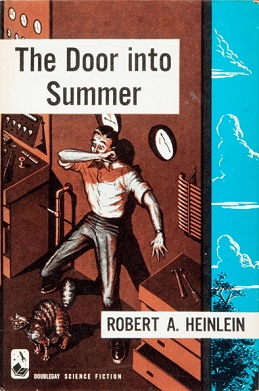
The Door Into Summer

The Door Into Summer. Robert A. Heinlein. 1957. Del Rey. 300 pages.

One winter shortly before the Six Weeks War my tomcat, Petronius the Arbiter, and I lived in an old farmhouse in Connecticut.

There were many, many things I really just loved about this science fiction novel by Robert A. Heinlein. I loved the opening--the first few pages--which introduce the concept of a "door into summer." If you like/love cats, I think you'll appreciate it!
While still a kitten, all fluff and buzzes, Pete had worked out a simple philosophy. I was in charge of quarters, rations, and weather; he was in charge of everything else. But he held me especially responsible for weather. (2)
I found it interesting to see TWO visions of the future. Written in 1957, Robert Heinlein has primarily imagined two years: 1970 and 2001.

The hero of The Door Into Summer, Daniel Boone Davis, is an engineer who is down on his luck. He has been cheated in love and business. And it's the business loss that seems most traumatic. He wants justice; he wants revenge. But at the same time he just wants to escape the mess his life has become. So which does he want more? To escape the pain and stress and confusion of his current life, he considers entering the cold sleep. (In fact, he completes the paperwork.) Thirty years may be just long enough to sleep. The world will have to be better in 2000 than it is in 1970, right? But the choice of revenge or escape may be taken out of his hands--after an encounter with the two people who did him wrong. (He's having second thoughts at the time.)

When D.B. Davis wakes up in December 2000, he learns just how much has changed...some of these changes are good. But there are a couple of things that just don't make sense. Things that don't have any easy answers...unless time travel IS possible.

The Door Into Summer is an interesting read with a fun premise. I definitely enjoyed it. I think it may be one of my favorite Heinlein novels so far.

Read The Door Into Summer
  • If you are a fan of science fiction with a particular interest in vintage or classic science fiction
  • If you are a fan of Robert Heinlein, or if you're looking for a good introduction to Robert Heinlein
  • If you enjoy reading about how different people envisioned the future
  • If you are a fan of time travel
  • If you like cats
  • If you don't mind slightly creepy 'romantic' endings
Have you read this one?! What did you think? What did you think of the ending? Of the "romance" in this one? Did you find it merely slightly creepy or is it very creepy?


© 2012 Becky Laney of Becky's Book Reviews

Double Star

Double Star. Robert A. Heinlein. 1956. Del Rey. 245 pages.

If a man walks in dressed like a hick and acting as if he owned the place, he's a spaceman. It is a logical necessity. His profession makes him feel like boss of all creation; when he sets foot dirtside he is slumming among the peasants. As for his sartorial inelegance, a man who is in uniform nine-tenths of the time and is more used to deep space than to civilization can hardly be expected to know how to dress properly. He is a sucker for the alleged tailors who swarm around every spaceport peddling "ground outfits."

"The Great Lorenzo" has been hired to impersonate a prominent politician--a Mr. John Joseph Bonforte. This job will take him to Mars and beyond. When he accepts the job, he doesn't really know all the facts. He doesn't know what the job will require--beyond an impersonation at a public/social event. And he doesn't know how long the job will last. He hopes not too long, since he doesn't really like politics, and he doesn't really like the political viewpoints of the person he'll be playing. Even if he asked before leaving Earth, I doubt he'd been told the truth.

So. I'm not quite sure what to think of Double Star. On the one hand, it was relatively clean. (I stopped reading the last two Heinlein novels I picked up from the library because they were, well, perhaps Vir says it best: "That's...that's quite all right, I get the idea. I don't really need to know more than you've told me. In fact, I wouldn't have been upset to know less." The titles of those two were Friday and I Will Fear No Evil.)

And Double Star wasn't exactly boring...it just wasn't thrilling. It was one of those books were the beginning is better than the middle and the end. I'm not sure if that's because of my expectations or his writing. (Is it wrong for me to expect science fiction novels to have developed characters?)

Read Double Star
  • If you're a fan of Robert A. Heinlein
  • If you're a fan of vintage science fiction
  • If you're interested in reading Hugo winners
  • If you're interested in politics
  • If you're interested in space travel

© 2012 Becky Laney of Becky's Book Reviews

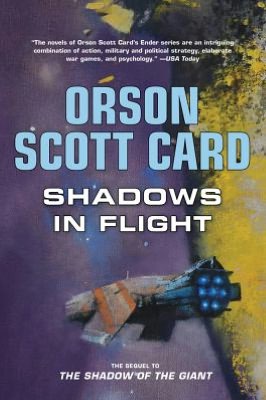
Shadows in Flight

Shadows in Flight. Orson Scott Card. 2012. TOR. 240 pages.


The starship Herodotus left Earth in 2210 with four passengers. It accelerated nearly to lightspeed as quickly as it could, and then stayed at that speed, letting relativity do its work. On Herodotus, just over five years had passed; it had been 421 years on Earth. On Herodotus, the three thirteen-month old babies had turned into six-year-olds, and the Giant had outlived his life expectancy by two years. On Earth, starships had been launched to found ninety-three colonies, beginning with the worlds once colonized by the Formics and spreading to other habitable planets as soon as they were found. 

I may not have loved Shadows In Flight, but I am glad I kept reading because by the end it was starting to grow on me. Shadows in Flight is a novel that essentially only has four characters. The character that fans know as "Bean" is "The Giant" to his three young children. Readers meet his three children that share his genetic fate. (Genius giants with very short life spans.) His daughter, Carlotta, his son, Andrew "Ender", and his son, Cincinnatus "Sergeant." These three may bring to mind another family of siblings: Peter, Valentine, and Ender. When readers first meet these three, they may be surprised that a six-year-old is plotting to kill his father--supposedly to their benefit claiming that his giant body is consuming more than a fair share of the ships resources and supplies. Ender does not really believe that for a moment. And he does put a stop to the nonsense.

So. This novel was not thrilling me for the first half. But then they discover another ship, a strange ship, and a planet that may just be habitable. And from there things improve considerably. For the aliens encountered--are remnants from the Formics. And this novel does examine that race once again. In a new way.

Read Shadows in Flight
  • If you're a fan of Orson Scott Card
  • If you're a fan of the Ender/Bean series. BUT. Don't expect this one to be about politics and war. Other titles in the Bean series have been about politics and war strategies. They've also had some thriller elements to them. Not this one. 
  • If reading about the family dynamics of Ender, Valentine and Peter so thrilled you that you just have to have a repeat
  • If you're a fan of novels set in space, novels that star aliens

© 2012 Becky Laney of Becky's Book Reviews

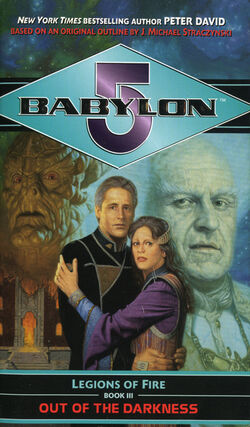
Out of the Darkness

Babylon 5: Legions of Fire: Out of the Darkness. Peter David. 2000. Del Rey. 266 pages.

Prologue: Hiller of the planet Mipas had always been an enthusiast about Earth history.
Chapter one: It is with some degree of shock and personal disappointment that I must conclude that I am losing my mind. I know this because, for the first time in...well...ever, I must admit...I actually felt sorry for Mariel.

Out of the Darkness concludes the Legions of Fire trilogy. And it answers so many questions fans may have about the characters. Including the prophecies and visions of the future hinted at in "War Without End" parts one and two, and "Point of No Return" in season three. Not to mention "Objects at Rest" from season five.

So, Vir has become a strong leader. A behind-the-scenes leader, perhaps, since his movement is oh-so-secretive. If he was known to be the leader of these 'terrorists' sabotaging Centauri's plans, well, he'd pay for it with his life. But the time to act is coming...and soon. And Londo knows this as well. As does G'Kar. All the pieces are coming together for the oh-so-dramatic, oh-so-tragic conclusion. Is it a tragedy with redeeming qualities? Yes. I think so.

It was definitely a compelling read! Very emotional. Especially if you LOVE the characters. This trilogy is definitely a must read. I'm so glad I read it! It made me love certain characters even more. And it gave me a new appreciation for some other characters. Characters that we just barely saw a glimpse of in the series. (Like Londo's wives from "Soul Mates".) And it also fit very nicely (as it should) with In The Beginning.

Read Out of the Darkness
  • If you want to see a more personal, more behind-the-scenes look at the fate of Londo and G'Kar as seen in "War Without End." 
  • If you want to know what happens to your favorite Babylon 5 characters (Londo, G'Kar, John, Delenn, their son, David, Garibaldi, Vir, etc.)
  • If you want to know the fate of Timov and Mariel. (I was definitely surprised by Mariel in the past two novels! I think you might be too.)
  • If you love science fiction with a little drama, a little romance.

© 2012 Becky Laney of Becky's Book Reviews

Armies of Light and Dark

Babylon 5: Legions of Fire: Armies of Light and Dark. Peter David. 2000. Del Rey. 255 pages.

Prologue: My 'masters' are pleased with me this day.

Chapter one: Vir stood before the giant, crackling energy gate. The ground around him was littered with bodies.

Armies of Light and Dark is the second in the Legions of Fire trilogy. It is definitely a must read! Once you've read The Long Night of Centauri Prime, you're going to want to continue the story. Trust me. So Vir is learning more and more about the darkness surrounding Centauri Prime, learning more about what--or should that be who--the Shadows left behind. He's learning more about the plans--the grand plans--being set in motion. And he's got a little help. True the 'help' is a bit cranky at times, and oh-so-mysterious. (He may NEVER understand technomages.) But Vir is determined--for better or worse--to battle the darkness, the evil forces that no one quite wants to acknowledge just yet.

Read Armies of Light and Dark
  • If you're a fan of Babylon 5, if you just have to know what the future holds for all our characters--well, most of our characters
  • If you're a fan of science fiction with a focus on politics, ethics, good and evil
  • If you're a fan of Vir, if you want to see him transformed into a hero, if you want to see him make tough, tough choices
  • If you're a fan of Londo, if you want to see what happens to him during his reign as emperor
  • If you're a fan of Senna, if you want to see how her character grows and develops 
And now for the quotes,

Vir on the craziness of life:

For the men he passed in the settlement town of K0643, it seemed, the line between truth and fiction, between the easily understood and the incomprehensible, had become blurred. For Vir himself, the line had long ago been completely erased. Anything was capable of happening to him. He felt that this was the only possible mind-set for him to maintain, since anything--more or less-generally did have the habit of happening to him. (14)

Vir and Rem Lamas:

Vir quickly put up his hands and forced a grin. "That's...that's quite all right, I get the idea. I don't really need to know more than you've told me. In fact, I wouldn't have been upset to know less." He cleared his throat, and then said, "So you were going to tell me about..." (16)

Vir being profound:

That was the trouble with knowing what lurks within the shadows, he realized. One can't figure out where to look anymore. If you gaze into the shadows, you blanch at whatever may be in there looking back at you, and you jump as the shadows move. If you look into the light, not only are you blinded by its intensity, but also it serves to remind you that you should be doing everything you can to expunge the darkness. Light does not allow for excuses. (24)

And now a word from Londo:

It is not fit, or meet, or responsible for Centauri to rejoice in the misfortune of others. Throughout our history, we have dealt with other races with compassion, always with compassion. Granted, there have been races that did not see that compassion for what it was, and rebelled. The Narn, naturally, come to mind. In dealing with them, however--in dealing with any who operated in a manner contrary to the interests of the great Centauri Republic--we did exactly what we had to do. No more and no less. (68)

Londo to Senna:

"There are battles that can and should be fought, and there are battles that should not be. In the case of the former, let nothing stop you. In the case of the latter, let nothing start you." (85)

Galen to Vir:

"For every action, however, there is an equal and opposite reaction. That is an immutable rule of the universe. You are to be the opposite reaction." (98)

Londo and G'Kar

"You," Londo said, "are the single most irritating individual I have ever met."
"You see?" G'Kar replied."What could be more proof of friendship than that? Who but a friend could be anywhere near as irritating as I am?" (196)


© 2012 Becky Laney of Becky's Book Reviews

The Long Night of Centauri Prime

Babylon 5: Legions of Fire: The Long Night of Centauri Prime. Peter David. 1999.

Prologue: The Drakh felt sorry for him. Londo Mollari would have been surprised to learn that such considerations went through the Drakh's mind. Had the Drakh's sentiments been relayed to him, he would have been even more surprised to learn precisely why the Drakh felt sorry for him. 


Chapter one: When Londo saw the creature emerging from the chest of the Drakh, it was all he could do not to scream.

The Long Night of Centauri Prime is the first in a must-read trilogy of books for Babylon 5 fans. For this trilogy answers so many questions! This trilogy addresses so many prophecies and visions seen in the show! Because it is a continuation of the story, the drama, I feel it is a must read for anyone who watched the show from start to finish.

Is this book all about Londo? Yes and no. It is about what happens to him after he becomes emperor of Centauri Prime. It is from his perspective--for the most part. But to say it is all about him, well, that just wouldn't be the case. It features characters we've met before (Vir, Timov, Mariel, etc.) and introduces new characters (Shiv'kala, Durla, Senna, etc.) It also reintroduces the technomages.

Centauri Prime is in very bad condition. And what they need is a good leader, a strong leader, a leader not under the influence.

I loved so many things about this one. I did. I loved how Peter David captured the characters just right. Especially in how he depicts Londo and Vir. Their separate scenes are good, some are even great, but to see these two together again, well, there's just something wonderful about it all. My favorite new character was Senna. 

Read The Long Night of Centauri Prime
  • If you're a fan of Babylon 5
  • If you're a fan of science fiction
  • If you're a fan of science fiction focusing on politics and war, good and evil
  • If you want to know what happens to Londo after he becomes emperor, after his nightmarish reign begins,
  • If you want to know what happened to Londo's wives
  • If you want to know what happens to Vir.  If you LOVE Vir, this book will make you LOVE, LOVE, LOVE him.
  • If you want to see the long-term effects of the Shadow War
And now to share some quotes:

When Londo first meets Senna...

"She simply uses words now, not stones. It is a funny thing about words. They cannot harm you unless you allow them to...unlike rocks, which tend to act as they wish." (35)

Londo and Vir speaking about Durla:

"Well, here's a late development. I do not like him, Londo. This Durla. Not one bit." Vir was speaking in a whisper, albeit an angry one.
"Durla? What is wrong with Durla?" Londo sounded almost shocked.
"Look, don't take this wrong, but...in some ways, he reminds me of you. That is, the way you used to be."
"He doesn't remind me of me at all."
"Are you kidding? All those things he was saying about what he wants us to be? Doesn't that sound like something you might have said once?"
"No. I never would have said any such thing."
Vir rolled his eyes in annoyance as Londo guided him down one of the large corridors. "Where are we going?" he asked.
"On a tour. Much work has been down on the palace since you were last here." He glanced at Vir. His vision appeared a bit bleary. "So let me understand this: you say that Durla reminds you of me, and on that basis you don't like him. I suppose I should be insulted, no?" (89)

Vir on lying:

As Zack checked through the computers, Vir's mind was racing. Lying simply was not his strong suit. He felt tremendously uncomfortable and very exposed whenever he was trying to do it. One would have thought that, working with Londo for so long as he had, he would have acquired a knack for it. The one thing he had going for him was that he tended to babble to the point where people would accept whatever he was saying, just to shut him up. With one lie, he was ineffective. With an avalanche of lies, he could squeak by. (101)

Yet another starring Vir!

"Nervous?" laughed Vir. "Why would you say that?"
"Well, when you're nervous about something, you tend to flap your hands about a bit...kind of like you're doing right now."
"What? Oh, this. No, no...I'm just having some minor circulation problems, so I'm trying to get the blood flowing." He flailed his hands for a moment, then said, "Well, that seems to have done it," and folded his arms tightly across his chest. (105)

And another...

Time flies when you're having fun. Or when you're having...well...whatever it is that I have. (214)

Mariel and Vir:

"You made me laugh. It's not always easy for a man to get a woman to laugh, but you managed it so easily. You had a charming facade you created back then, although I could see through it rather easily, of course."
"What...facade would that be?"
"An air of barely controlled panic."
"Ah. Well," and he laughed uncomfortably, "you saw right through that, I guess. Clever you." (217)


© 2012 Becky Laney of Becky's Book Reviews

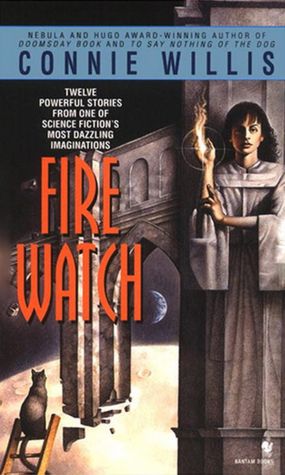
Fire watch

Firewatch. Connie Willis. 1985. Bantam Books. 271 pages.

Firewatch by Connie Willis is the FIRST short story collection I've read for the 2012 Short Story Reading Challenge.

I am SO GLAD this was not my first introduction to Connie Willis. I've discovered that I enjoy her novels so much more than her short stories.

With one little exception, the title story "Fire Watch."

Fire Watch is the FIRST story set in the world of Doomsday Book, To Say Nothing of the Dog, Blackout and All Clear. It introduces readers to the alternate-world where time travel is the way historians LEARN their subject. Readers meet Mr. Dunworthy and Kivrin, though the narrator is another historian, one who is accidentally going to St. Paul's during the London Blitz of 1940. His original assignment had him traveling WITH St. Paul! Quite a difference! This novella is great. It won both a Hugo Award and Nebula Award. And I would recommend this story to just about anyone who likes science fiction and time travel.
There are no guidelines for historians, and no restrictions either. I could tell everyone I'm from the future if I thought they would believe me. I could murder Hitler if I could get to Germany. Or could I? Time paradox talk abounds in the history department, and the graduate students back from their practica don't say a word one way or the other. Is there a tough, immutable past? Or is there a new past every day and do we, the historians, make it? And what are the consequences of what we do, if there are consequences? And how do we dare do anything without knowing them? Must we interfere boldly, hoping we do not bring about all our downfalls? Or must we do nothing at all, not interfere, stand by and watch St. Paul's burn to the ground if need be so that we don't change the future? All those are fine questions for a late-night study session. They do not matter here. I could no more let St. Paul's burn down than I could kill Hitler. No, that is not true. I found that out yesterday in the Whispering Gallery. I could kill Hitler if I caught him setting fire to St. Paul's. (12-13)
You may read the novelette online.

Other stories in the collection include:
  • Service for the Burial of the Dead
  • Lost and Found
  • All My Darling Daughters
  • The Father of the Bride
  • A Letter From the Clearys
  • And Come from Miles Around
  • The Sidon in the Mirror
  • Daisy, in the Sun
  • Mail-Order Clone
  • Samaritan
  • Blued Moon
My second favorite story was The Father of the Bride. This short story is a fairy-tale retelling. It is the Sleeping Beauty story from the father's perspective. It was very enjoyable! Definitely one of the highlights of the book for me. 

I would say that most of the other stories just weren't me. Service for the Burial of the Dead, Lost and Found, A Letter from the Clearys, and And Comes from Miles Around while not quite wowing me had some enjoyable qualities to them.

My least favorite has to be All My Darling Daughters.

Read Fire Watch
  • If you're a fan of Connie Willis
  • If you're a fan of short stories in the science fiction and fantasy genres
  • If you're wanting to read the first Willis time-travel story

© 2012 Becky Laney of Becky's Book Reviews
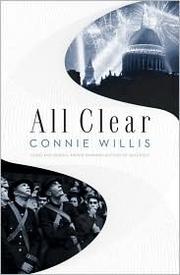
All Clear

All Clear. Connie Willis. 2010. Random House. 645 pages.

By noon Michael and Merope still hadn't returned from Stepney, and Polly was beginning to get really worried. Stepney was less than an hour away by train. There was no way it could take Merope and Michael--correction, Eileen and Mike; she had to remember to call them by their cover names--no way it could take them six hours to go fetch Eileen's belongings from Mrs. Willett's and come back to Oxford Street. 

All Clear is the sequel to Connie Willis' Blackout. And as I mentioned yesterday, you are going to want to read these two books as if they were one. (There's a good reason these two books were the combined winner for the 2011 Hugo Awards. And the Nebula Awards. Doomsday Book also won both the Hugo and Nebula. To Say Nothing of the Dog just won the Hugo Award. I think it says quite a lot that each of Connie Willis' time travel books has won an award!!!)

So how much is it safe to say in a review of All Clear? Since even talking about the first few chapters of All Clear will spoil the drama of Blackout?! I was thinking about that yesterday as I wrote the review. Would that one review 'do' for both books? What more would I say about the second book? And essentially the only thing I thought of was that All Clear was even better, even more intense. If Blackout was dramatic and exciting, then All Clear is unbelievably dramatic and incredibly fast-paced. Almost dangerously so. In that, I was so WORRIED about the characters, about what was going to happen next, about what it all meant, about where it was all going, that I RUSHED, RUSHED, RUSHED through the chapters. I read a 645 page novel in one day. (Not to mention that it was the same day I finished Blackout.)

Together Blackout and All Clear were an amazing, amazing read. Just incredible. The characterization is great. There were just SO MANY characters I loved. The premise is interesting. And the intensity, the pace, the drama of it, well, few books can match it.

For those that may not have seen my review of Blackout, let me just keep it simple. Three historians (time travelers) have gone back in time to 1940. Each historian is researching or observing something different. Different locations--in England. Different months in 1940. But when SOMETHING happens that 'traps' them in that time period, well, they have to learn how to really live in that time period. Their research stops being research, and it becomes all about surviving.

Read All Clear
  • If you've read Blackout and just HAVE to know what happens next
  • If you're a fan of Connie Willis' other time travel books (Doomsday Book, To Say Nothing of the Dog, Blackout. Just be sure you've read Blackout first. I've also just learned that there is a short story, Fire Watch, available to read here.)
  • If you're a fan of time travel novels
  • If you're a science fiction fan
  • If you're looking to read an award-winning book (Hugo, Nebula, Locus)
  • If you're looking for a novel with GREAT characterization
  • If you're looking for an intense, fast-paced plot
  • If you're a fan of Agatha Christie and mysteries from the time period
  • If you're a fan of historical fiction set in World War II
  • If you're interested in the details and drama of the war
  • If you're a fan of Shakespeare and the theatre

© 2012 Becky Laney of Becky's Book Reviews