Tampilkan postingan dengan label YA Historical. Tampilkan semua postingan

Code Name Verity (YA/Adult)

Code Name Verity. Elizabeth Wein. 2012. Hyperion. 352 pages.

I am a coward. I wanted to be heroic and I pretended I was. I have always been good at pretending. I spent the first twelve years of my life playing at the Battle of Stirling Bridge with my five big brothers--and even though I am a girl, they let me be William Wallace, who is supposed to be one of our ancestors, because I did the most rousing battle speeches. 

So many people have gushed about reviewed Code Name Verity by Elizabeth Wein. And so many have just LOVED it and found it amazing. I have been meaning to read this one for a few months now, but, I personally found the novel difficult to get into. It just wasn't working for me...at all. I found the framework of the story to be frustrating and confusing. The jumping back and forth between first person and third person, etc. And the main character, the narrator, I found her difficult to connect with. But I really didn't want to return this one to the library unread...again. So I decided to read it no matter what. And after two hundred pages, this one finally started working for me. And by the end, it definitely worked for me. By the end, I could see why people did love it. But it took reading the whole novel--seeing the big picture--for me to be able to appreciate it.

Code Name Verity is about two women serving their country during World War II. One woman is a spy; the other woman is a pilot. One fateful night, the two are together in a plane over France. One woman is captured several days later, and interrogated. This novel is her "cooperation" with the enemy. Through this written account--an account where she both speaks directly to her captors and relates events of the past (these are written in third person omniscient), readers come to know both women...

Read Code Name Verity
  • If you are interested in World War II, 
  • If you are interested in pilots and spies and secret operations
  • If you are interested in reading about strong, brave women
© 2012 Becky Laney of Becky's Book Reviews

Gilt (YA)

Gilt. Katherine Longshore. 2012. Penguin. 416 pages.

"You're not going to steal anything." I left the question--Are you?--off the end of the sentence. But Cat heard it anyway. 

I'm not quite sure how I feel about this book cover. Would you be able to tell from the cover that this is historical fiction? That this book is in fact about Catherine Howard, one of the doomed wives of Henry VIII?

Gilt is told from the perspective of one of Catherine's companions, Kitty Tylney. (Catherine is "Cat", she is "Kitty.") Their relationship--friendship--isn't quite one-sided, but, Cat definitely is the boss, and there is some manipulation going on, I believe. It's a toxic friendship, in a way. It isn't exactly in Kitty's best interest to be best, best, best friends with Catherine Howard. Sure, it means that when Catherine Howard marries the King of England, that there is an invitation to go to court and be one of her maids, but she's not a lady, and her tasks are servants' tasks, in a way. And even before Cat married the Henry VIII, she wasn't easy to counsel, if Cat wants something, she wants it, won't be talked out of it. As you might have guessed, I had a hard time liking Catherine Howard. At least as she is portrayed in this novel! How did I feel about Kitty? Well, I pitied her to a certain degree. Kitty isn't always the wisest person in the world, but, she was truly in a horrible place. On the one hand, Kitty knows Cat is stupid and making HUGE mistakes with her life. Kitty is being asked to cover up her friend's mistakes, and, that makes Kitty very unhappy. She knows that if she talks, Cat, will die. That if the truth is uncovered, no matter who uncovers it, Cat will die. She may feel used, in a way, by her friend, but, she doesn't wish her friend harm. What Kitty learns is that court life isn't all that glamorous and charming. That many unpleasant things go on at court, that wearing fancy clothes may not be worth the emotional stress of court life.

Did I love it? Probably not. Did I like it? Yes, I liked it well enough. I have read a handful of books set during this time period, quite a few focusing on Catherine Howard. It isn't my new favorite, but, it's an interesting book.

Read Gilt
  • If you're a fan of historical fiction 
  • If you like a little political intrigue, a little romance with your historical fiction
  • If you are interested in Henry VIII and his wives

© 2012 Becky Laney of Becky's Book Reviews

The Gathering Storm (YA)

The Gathering Storm. Robin Bridges. 2012. Random House. 386 pages.

An afternoon spent solving quadratic equations would have been infinitely more pleasant. 

 The Gathering Storm is a paranormal fantasy that almost-almost worked for me. It is a paranormal novel starring necromancers, werewolves, vampires, and zombies set in 1880s Russia; the characters are aristocratic and often royal. Our heroine is a young woman named Katerina Alexandrovna, Duchess of Oldenburg. She's making her debut in society, and she's caught the attention of two men. One is the middle son of the tsar, his name is George Alexandrovich, at first Katerina is not impressed with him. The second is the crown prince of Montenegro, Prince Danilo, her first impression of him is much stronger. Then again, it could be because he's a vampire who has mesmerized her.

Is there a single character in this one that doesn't have at least one secret? And most of the main characters--the five or six 'main' characters--have DOZENS of secrets between them. This was truly a case of the main character not knowing WHO to trust. Could she have made better guesses at who to trust? Perhaps. Did the reader have a little more information? Not really. Sure, readers can make their own guesses as to who's telling the truth, who's lying, and who's being the MOST manipulative. What kept me from making predictions--or sticking with the predictions that I made early on--was the fact that you never do know for sure if/when authors are going to put in twists and turns and surprise you.

Did I care about the characters? Well, I almost cared about Katerina. And I did care about George Alexandrovich. I did like Katerina's father. The rest of the characters? Well, I almost-almost cared about some of them, but, some of them not even that much. There were SO VERY MANY characters, usually these characters were related to one another. And I could never remember who was who, who liked each other, who hated each other, who got along, etc. The politics did get confusing at times.

I think I would have liked this one more if it hadn't felt so modern. At times the historical setting worked for me, but other times I just didn't believe it. Katerina has ONE BIG DREAM, to go to medical school and become a doctor. But the universities in Russia do not accept women in their medical programs, and, her parents aren't quite willing to send their daughter away to another European university. But Katerina's dream to have a career remains strong. She hasn't decided against marriage, she hasn't embraced the single life. No, she wants a very open-minded husband who will celebrate her decision to work outside the home and have a career as a doctor. And Katerina seems genuinely surprised when the CROWN PRINCE frowns on her demands to be a working woman. Every time I see Katerina interact with the doctors in the hospital (or in private homes, for that matter), I was thrown out of the story a bit. I don't know how modern, how advanced, how scientific and research-oriented the medical field was in 1880s Russia, but, I do know that at this time in other parts of the world, it was not very. That the field of medicine was very different than modern medicine.

Does it work as a paranormal fantasy? Probably. This isn't my favorite genre, but, it has potential. Does it work as a romance? Well, it has potential. A little more time focused on romance would probably have been a good thing. But, what we do get of George was nice.

Read The Gathering Storm
  • If you enjoy paranormal fantasies with light romance (love triangle of sorts)
  • If you enjoy historical fantasy with some paranormal elements (vampires, zombies, werewolves)
  • If you enjoy books set in Russia in the nineteenth century
© 2012 Becky Laney of Becky's Book Reviews

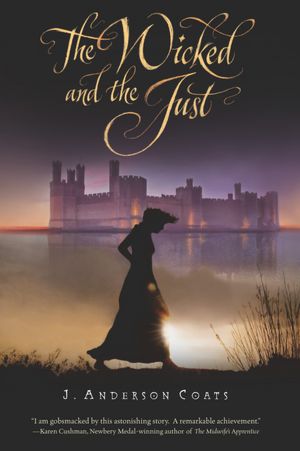
The Wicked and The Just (YA)

The Wicked and The Just. J. Anderson Coats. 2012. Houghton Mifflin Harcourt. 352 pages. 


Tonight at supper, over capon and relish, my father ruined my life. He smiled big, scrubbed his lips with the end of his cloak, and said, "We're moving house." 

I think there is a good chance you will like The Wicked and the Just more than I did. I seem to be in the minority on this one. Apparently I liked all the wrong characters, disliked all the wrong characters, and got my sympathies misplaced. If you happen to believe that there is one right way to read a novel. (I'm not saying that I do, just that some do.)

The Wicked and the Just is set in Wales in 1294. One of our narrators is Cecily, who provides the "English" perspective; the other narrator is Gwenhwyfar, who provides the Welsh perspective. I think I might be the only reader who sympathized more with Cecily and preferred her narrative. Did I love Cecily? No, not exactly. Did I like her? A little. Do I find her perfect and without fault? Hardly! How did I feel about Gwen? Well, I'm in the minority, but I did NOT like her at all, not even a little bit. I really, really, really did not like her narrative. Especially towards the end, after IT happens. I really HATED her. I did.

The King is encouraging the English to move to Wales and settle it. Cecily's father feels his chances are better in Wales than England--he can live cheaper, have better status and opportunity, etc. (He does not have his own estate to inherit or manage because he is a younger son.) The Welsh are not happy to be "managed" or "governed" by the English. They do not "enjoy" the rules and regulations the English put in place. They do not like the added-burden of having the English around. The past few years have been hard ones--famine, I believe--and having the English around telling them how to sell and trade, when to sell and trade, and deciding what is "fair" is too much. The English have the first and last word on what justice looks like, and there are differences depending on if you're Welsh or English. The English are treated preferentially. No doubt about it.

S
P
O
I
L
E
R

The novel is working towards a VIOLENT response to the injustice. There will be blood spilled. A LOT of blood. For the Welsh "rebels" will band together, form an uprising, and slaughter the English. Yes, slaughter. There will be bodies everywhere. Not just a few of the leaders, not just the government, not just the men. But of everyone. Why did they have to die? Because they were there, because they were English. Did it matter how they lived? What kind of person they were? No. Of course not. Everyone must die. The English must be "taught" a lesson. Cecily witnesses the violent slaughter of her father. It is horrific. And by my reckoning, that was not JUSTICE. The slaughter of a whole town is NOT JUSTICE. It is murder. How do two wrongs make a right? Ever?!  So what does this mean for Cecily? Don't expect mercy or compassion from the so-called heroine, Gwen. You won't find it. 

The character I happened to like best of all--better than Cecily, better than Gwen--is Gruffydd.

Read The Wicked and the Just
  • If you enjoy historical fiction set in medieval times
  • If you enjoy reading about peasant revolutions and uprisings
  • If you are looking for fiction set in Wales
© 2012 Becky Laney of Becky's Book Reviews

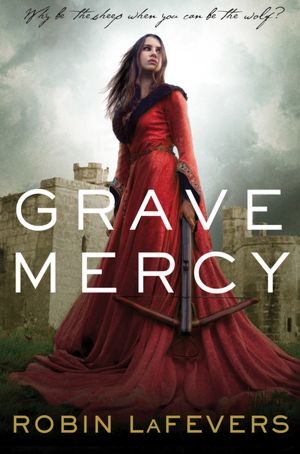
Grave Mercy (YA/Adult)

Grave Mercy. Robin LaFevers. 2012. Houghton Mifflin Harcourt. 560 pages.
Brittany 1485
I bear a deep red stain that runs from my left shoulder down to my right hip, a trail left by the herbwitch’s poison that my mother used to try to expel me from her womb. That I survived, according to the herbwitch, is no miracle but a sign I have been sired by the god of death himself.
I am told my father flew into a rage and raised his hand to my mother even as she lay weak and bleeding on the birthing bed. Until the herbwitch pointed out to him that if my mother had lain with the god of death, surely He would not stand idly by while my father beat her.
I risk a glance up at my husband-to-be, Guillo, and wonder if my father has told him of my lineage. I am guessing not, for who would pay three silver coins for what I am? Besides, Guillo looks far too placid to know of my true nature. If my father has tricked him, it will not bode well for our union. That we are being married in Guillo’s cottage rather than a church further adds to my unease.
I feel my father’s heavy gaze upon me and look up. The triumph in his eyes frightens me, for if he has triumphed, then I have surely lost in some way I do not yet understand. Even so, I smile, wanting to convince him I am happy—for there is nothing that upsets him more than my happiness.
Wow. If you're looking for two words: assassin nuns. Of course, our heroine, Ismae isn't a nun in the Catholic church. No, she's in a special nunnery, the nuns live to serve Death whom they call St. Mortain, and she's received very special training. They've taught her to kill, to be an assassin. The nuns are loyal to the Duchess of Brittany, and the victims are often her political enemies--foreign or domestic--those that pose the greatest threat to Brittany's independence.

While we do see her first few jobs carried out, most of the novel focuses on one job in particular. The abbess wants her to team up with Duval, the Duchess' older brother and her most trusted friend and advisor. She's to pose as his mistress, and travel with him to the Duchess' household. There she will "help him" find any possible traitors. He doesn't exactly trust her, he knows exactly what she's capable of, and who she serves. He knows that if given orders, she'd kill him to please her Lord. She doesn't exactly trust him either. Though the marque hasn't appeared on him yet--the special sign or symbol that she sees on her victims before they're killed--she knows that he could be lying to her, that his loyalty to the Duchess could be an act. But both know that it is of the utmost importance to protect the Duchess, and to find any traitors and uncover any conspiracies, if that means working together, so be it. Of course, this means spending a LOT of time with one another...

...the time will come when Ismae must choose who to trust and who to believe...

Politics. Romance. Drama. Dysfunctional Families. Poison. Murder. Betrayal. Mystery. Suspense.

This one probably won't please every reader. Some may not be able to get past the premise of old or ancient religions continuing to exist under the guise of Christianity. And this one isn't squeaky clean. For those that have no tolerance whatsoever when it comes to sensuality. (I would consider it mild up until the very end when their relationship changes.) But. For those that can, well, this is one COMPELLING read. My favorite character happens to be Duval. I just LOVED him. I did. He was such a swoon-worthy hero!!! And our heroine, Ismae, is quite strong and resourceful. I loved the drama. I loved the history. I loved seeing the court life and family drama play out. I enjoyed the setting, the characters, the writing. It worked really well for me.

Favorite quotes:
"Are you drunk?" I try to put as much scorn into my words as he did.
"No. Yes. Perhaps a little. Definitely not enough." The bleakness is back and he turns to stare into the flames.
I am torn between wanting to leave him to wallow in his despair and wanting to rush to his side and chase that look from his eyes. That I long to do this appalls me, sets panic fluttering against my ribs.
"I suggest you return to your room," Duval says, his gaze still fixed woodenly on the fire. "Unless you have come to practice your lessons of seduction on me?" His mouth twists in bitter amusement. "That could well entertain me till sunrise."
I jerk my head back as if I have been slapped. "No, milord. I had thought only to pray for your soul if Madame Hivern had seen fit to poison you. Nothing more." And with that, I turn and flee the room, then bolt the door against the disturbing glimpse of both his soul and mine. Whatever games are being played here, he is master at them, and I will do well to remember that. (155)
"What is my fair assassin so afraid of? I wonder."
"I'm not afraid."
Duval tilts his head to the side. "No?" He studies me a long moment, then rises out of his chair. I hold my breath as he crosses to my bed. "Are you afraid I will draw closer, perhaps?" His voice is pitched low, little more than a purr. My breath catches in my throat, trapped by something I long to call fear but that doesn't feel like fear at all. (174)
His smile flashes, quick and surprising in the darkness. "When one consorts with assassins, one must expect to dance along the edge of a knife once or twice. I bid you good night." (218)
Read Grave Mercy
  • If you're a fan of Robin LaFevers
  • If you're a fan of historical romance, with a fantasy feel to it (mythology/supernatural)
  • Also if you're a fan of mystery/suspense/political thrillers

© 2012 Becky Laney of Becky's Book Reviews