Tampilkan postingan dengan label school. Tampilkan semua postingan

Love From Your Friend, Hannah

Love From Your Friend, Hannah. Mindy Warshaw Skolsky. 1998. DK. 246 pages.

September 27, 1937
Dear Edward,
I got your name and address from a piece of paper I picked out of a box that says Pen Pals on a corner of my teacher's desk. I've never done this before and I don't know exactly what to say. So I'll just pretend I'm talking. 

Hannah Diamond is the heroine of Mindy Warshaw Skolsky's Love From Your Friend, Hannah, a historical novel set in Grand View, New York in the 1930s. What should you know about Hannah? Well, she's a young girl who is missing her best friend, Aggie, who moved away. She's part of her classroom's pen pal program, but, she has DRAWN THE NAME OF A BOY! And since the teacher saw her draw his name, she can't put that piece of paper back to draw another name--no matter how much she wants to. Since her first letter to him is a total disaster, she decides to focus her energy on writing letters to other people. Surely she'll be able to find someone who wants to be friends...

Here is the disastrous reply from Edward:
Dear Hannah,
I haven't got a mountain.
I have a cow.
Edward Winchley
P.S. I don't like to read books. I don't like to write letters either. My teacher made me put my name on that piece of paper.
So who does Hannah decide to write? Well, her grandma, her aunt Becky, her best friend Aggie, and the President of the United States--Franklin D. Roosevelt, for starters...

The novel is composed of her letters to other people, and the letters she receives from other people.

I loved this one. I just LOVED, LOVED, LOVED it. I loved Hannah so very, very much!!! And I ended up just LOVING Edward!!!!

Hannah on reading:
My favorite thing in the world to do is read a book. I read Heidi, which I love, then I read another book, then I read Heidi again. If I stopped reading Heidi in between the other books, I'd be able to read twice as many books, but the thing is I like reading Heidi. So I do. (93)
Edward on reading:
Guess what I read for the second book the teacher said I had to read? Don't laugh. I read that one that you said you like so much. Heidi. Even though Heidi was a girl, you said there was a boy in it too. Peter. But you know what boy I liked the best? He wasn't a boy anymore. He was a grandfather--Heidi's grandfather. I would like to have Heidi's grandfather for a grandfather. I don't think he would bother me about talking or reading--or anything. (161)
Hannah on writing a book report:
Now, about the book report. I can't write it for you because your teacher would know just like you couldn't do my arithmetic because then my teacher would know. Teachers are like mothers--they always know!
But I can help give you some tips...
Tell the name of the book. Tell the name of the author. The Wizard of Oz was written by L. Frank Baum. Tell if you think he's a good writer. Tell the names of all the characters in the book. Tell what they did. Tell where they went. Tell who they were looking for. Tell what they finally found. Tell how they treated one another. Tell about their feelings. Tell that you read some to your sister. Tell that she liked it. Read some to a friend. Then you can even tell that your friend liked it. By that time, Edward, you'll have so many lines your teacher will leave you alone. (113)
Hannah to her Aunt Becky:
About finding me a present to make up for missing the movie, that was very nice of you. My mother said it'll be a consolation prize. But you don't have to bother knitting me any clothes because I already have so many clothes you knitted me. I have sweaters, jackets, scarves, and mittens. I even still have the red-and-white stocking cap that matches Skippy's jacket and that I wore up to the top of the mountain the time we had the big snow. And when my one galosh came off and I couldn't find it under the snow, I walked down the mountain with your stocking cap on my foot.
One thing about your knitting, Aunt Becky, it never wears out, so you see, you don't really have to knit me anything new. (74)
Read Love From Your Friend, Hannah
  • If you like historical fiction set in the 1930s
  • If you're looking for a great book set during the Depression
  • If you're looking for a book-loving heroine
  • If you're looking for a book about friendship, about pen pals, about school
  • If you're looking for a family-friendly children's book 

© 2012 Becky Laney of Becky's Book Reviews

The Great Cake Mystery

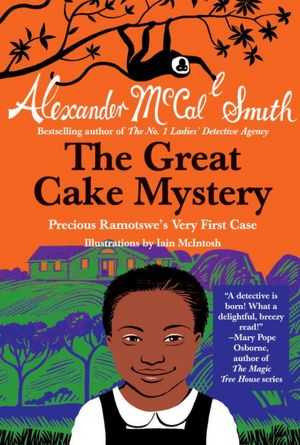
The Great Cake Mystery. Alexander McCall Smith. Random House. 96 pages. 

Have you ever said to yourself, "Wouldn't it be nice to be a detective? Most of us will never have the chance to make that dream come true. Detectives, you see, are born that way. Right from the beginning they just know that this is what they want to be. And right from the beginning they show that solving mysteries is something they can do rather well. This is the story about a girl who became a detective. Her name was Precious.

I liked this one. I definitely liked it. To clarify things I'll just mention that I have not read the book, No. 1 Ladies' Detective Agency, which stars Precious Ramotswe. This children's chapter book is the famous detective's first case. So if I like this one it isn't necessarily because I love the adult mystery series, I may or may not. (I do plan on reading the first book this summer, if all goes to plan.) I do find it tricky as an adult to judge early readers and chapter books because often the plots are not thrilling at all, the text can be tiresome OR predictable OR condescending OR preachy. And it's hard to know--as an adult--exactly what books are going to appeal, truly appeal, to those aged six, seven or eight. That being said, I liked this one. Why? Well. I liked the writing, the storytelling. I liked the narrator. I liked how the narrator sometimes addressed the reader. And I liked the pacing. I liked how we get to know Precious BEFORE the actual mystery begins. I liked how we get to know something of Precious and her relationship with her father. I did like her father telling a story about the lion! I *know* it has nothing to do with the main mystery in this one, I *know* that it wouldn't fit neatly into an outline of what this story is about, but I feel it does reveal something about the characters and the setting. It gives us a feel for the story, perhaps. It gives us time to get settled into the story before the "real" action begins. (And dare I say it, I almost liked this side story more than the actual mystery?) Going back to the pacing, I liked how the chapters flowed together. Yes, there was really no reason to break where they did each time, but, for me it kept me wanting to turn the page. Now turning to the mystery itself, this one has a not-so-subtle message about how you shouldn't judge people and make accusations without proof and hard evidence. You shouldn't just accuse a classmate of stealing from you just because he's overweight and in the habit of eating candy and sweets.
Accusing people of doing something wrong--lying, stealing, cheating, whatever--is serious and it's not a joke. So we learn a good, moral, common-sense lesson in how to treat others. Precious knows that there is a thief stealing things from the school from her classmates, but while other kids are quick to judge WHO is doing the stealing, Precious is slow to judge or accuse. She knows that there has to be a rational explanation for the disappearances of these sticky buns, cakes, etc. But that doesn't mean it has to be a classmate or friend. Precious determines to outwit the thief and catch him in the act...

The very things I liked about it, may not work for other people. 

Read The Great Cake Mystery
  • If you're a fan of Alexander McCall Smith
  • If you're a fan of mysteries for young readers
  • If you're looking for an interesting chapter book

© 2012 Becky Laney of Becky's Book Reviews
The List (YA)

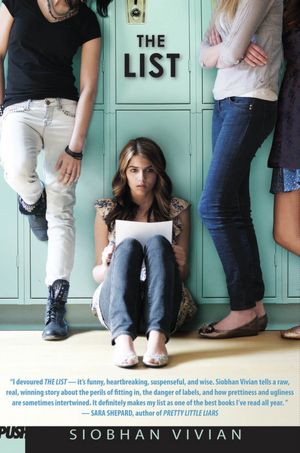
The List. Siobhan Vivian. 2012. Scholastic. 336 pages.

From the prologue: For as long as anyone can remember, the students of Mount Washington High have arrived at school on the last Monday in September to find a list naming the prettiest and the ugliest girl in each grade. This year will be no different.

The List has an interesting enough premise. It is a novel with eight narrators. The prettiest freshman, ugliest freshman, prettiest sophomore, ugliest sophomore, prettiest junior, ugliest junior, prettiest senior, ugliest senior. Each girl, of course, has a name, but at least at first, names and personalities don't matter oh-so-much. The focus is on the label, the judgment. It is a question-driven novel, in a way.

How do others see me? Is that how I see myself? Do I care what everyone else thinks? Who is this 'everyone' else anyway? Do I feel prettier or uglier than I did the day before the list was posted? Am I going to let the list change me? Am I going to let myself be defined and objectified by others?

One of the strengths of the novel is showing that every single person on the list is a human being. No matter the appearance, no matter the popularity ranking. A pretty girl can have just as many problems and issues going on in her life as the next person. Being pretty doesn't mean living life problem-free without a concern or care in the world. The prettiest junior girl, for example, has an eating disorder. This problem popped up over the summer. And others may see her as beautiful, as pretty, as having everything she could possibly want or need. But all she knows is that food is the enemy, that fat is the enemy, that eating means that she will no longer be beautiful. She cannot accept herself or see herself as she truly is. She doesn't love herself. Her daily life is a torment to her in many ways. Yet she is supposed to be thrilled, happy, ecstatic that she is the most beautiful girl in her class.

I think at least five or six of these characterizations would have been strong enough to carry an entire novel. With eight narrators, little justice can be done to each story. So at times it was all a little too much.

The ending. I didn't really like this ending at all. I thought the last fifty or so pages of this one was a mess. Yes, books can have tricks; twists or turns that you aren't supposed to see coming. But. I felt that the ending would ruin any rereading of the novel. (Of course, I haven't tried it myself.) It's just that the semi-big-reveal doesn't feel right to me. It doesn't feel natural to how the character was presented up until that point. If it had just been a story or conflict between these two characters--the prettiest senior and the ugliest senior--if the whole novel had been about these two, then I think it might have worked better. It could have shown the necessary depth. These two were friends--close friends--in junior high. But before the start of high school, the prettiest dumped the ugliest. This relationship--past and present--could have been explored more. I think that just enough was revealed to create a spark of interest, but then it all ends right there.

Have you read this one? What did you think?

Read The List
  • If you like high school dramas set during Homecoming Week
  • If you like realistic YA
  • If you like books about mean girls and/or bullies
  • If you are looking for 'issue' books (bullying, eating disorders, etc.)
© 2012 Becky Laney of Becky's Book Reviews
The Name of the Star (YA)

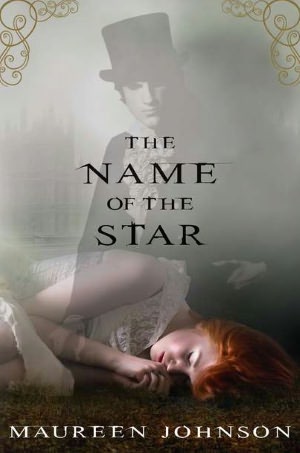
The Name of the Star. Maureen Johnson. 2011. Penguin. 384 pages.

The eyes of London were watching Claire Jenkins. She didn't notice them, of course. No one paid attention to the cameras. It was an accepted fact that London has one of the most extensive CCTV systems in the world. 

Considering the genre, I was pleasantly surprised by how much I liked this one. I wouldn't necessarily say I loved it. But. If you judge a book based on your need to finish it, then it was well worth it!

The heroine of The Name of the Star is Rory, a teen girl from Louisiana, who decides to give an English boarding school a try when her parents get an offer to go to Bristol for a year to teach American law. Rory chooses a London boarding school. She never could have predicted--who would have?!--the danger she'll face in that particular neighborhood. For around the time she arrives, there are a series of murders in the style of Jack the Ripper. The murderer is obviously duplicating almost every little thing about the murders, and so the murders follow a certain pattern, a certain schedule. But that doesn't make the neighborhood any "safer." As Rory learns when she catches a glimpse of the killer.

So The Name of the Star isn't quite my genre. It's a paranormal horror novel! And I still am not a fan of the genre. I'm not. It's just not the way I like to spend my time. But this novel kept me reading.

Read The Name of the Star
  • If you love ghost stories, OR I-can-speak-to-ghost stories
  • If you love horror novels or thrillers. This one isn't so much a mystery--although I suppose it has mystery in it--but it's more of a chasing novel where the heroine is at risk of becoming a victim than a detective novel with a mystery to solve. I prefer mysteries.
  • If you are interested in anything/everything Jack the Ripper
  • If you like stories with a boarding school setting


© 2012 Becky Laney of Becky's Book Reviews
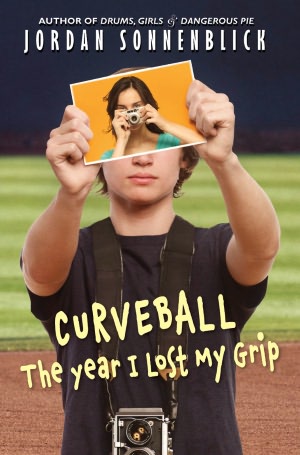
Curveball: The Year I Lost My Grip (MG/YA)

Curveball: The Year I Lost My Grip. Jordan Sonnenblick. 2012.  Scholastic. 304 pages.

The first picture is a wide-angle shot, taken through the chain-link fence of the backstop behind home plate. There's a boy standing on a pitcher's mound in full uniform: green and gold. His cap is pulled low over his eyes, and his unruly black hair sticks out below the brim in all directions. He leans in toward home plate, his throwing arm dangling loose at his side. He must be looking in to get his sign from the catcher.

I expected Curveball: The Year I Lost My Grip to be good--really good. Why? Well, Jordan Sonnenblick rarely--if ever--disappoints. He's an amazing writer; he's great at writing characters that I just love. His stories tend to be emotional and compelling. Though almost always they have a lightness to them as well. Curveball The Year I Lost My Grip did not disappoint. While I'm not sure that it is my favorite, favorite Sonnenblick novel--he's written so many that I just love!!! It is easy to recommend this one.

The hero of Curveball is Peter Friedman. The summer before his freshman year in high school, he plays his last baseball game. The injury in his arm is so severe that doctors tell him he'll never, ever be able to play the game he loves so much. So who is he if he's not a great pitcher and catcher? Who is he if he's not a great athlete? Well. He'll have plenty of time to figure that all out.

One of the main characters in Curveball is Peter's grandfather. I just LOVED him. I think there aren't enough--could never be enough--YA books that highlight the special relationship between grandparent and grandchild. Inter-generational stories make me happy, very happy. Even when they're sad. Even when they're bittersweet. Peter and his grandfather are incredibly close. And so it's not all that surprising that Peter's interest in photography becomes all that much stronger. (His grandfather was a professional.)

So Peter's interest in photography leads him to take a class where he meets a girl that wows him...

This YA book has it all. Great characters, good storytelling. It's just an enjoyable read!

Read Curveball The Year I Lost My Grip
  • If you're interested in baseball
  • If you're interested in photography
  • If you like realistic romances
  • If you're a fan of Jordan Sonnenblick
  • If you like coming-of-age stories with a strong emphasis on friendship

© 2012 Becky Laney of Becky's Book Reviews
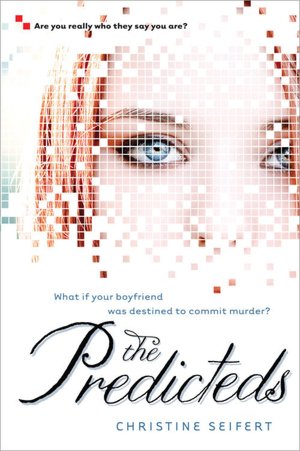
The Predicteds (YA)

The Predicteds. Christine Seifert. 2011. Sourcebooks. 352 pages.

From the prologue: The rose-patterned carpet of the room reminds me of the guest room in my grandmother's house. When I was a kid there, I used to hop from petal to petal. If I landed on white space or a leaf, I had to start over again. 

Even though I found this one a bit predictable, it was such an entertaining read, I didn't mind that I guessed who the 'bad guy' was so early on.

Daphne Wright, our heroine, has recently moved with her mother to Quiet, Oklahoma. What she doesn't know--at the beginning--is that Quiet is a test town for Profile, a project that her mother worked on and developed for several years. Her mother didn't like the direction the project was taking, and left it behind her. Or so it seems. But after a school shooting--the only fatality being the shooter, the rest were just injuries--things begin to change. Officials at the school decide to release the results of Profile--the names of individuals that certain tests have "shown" to be future offenders. These fall generally into two categories: potentially violent (rape, murder, etc.) and self-destructive (teen pregnancies, drug addictions, alcoholism, gambling addictions, etc.) Many "believe" that if Profile has predicted such a fate--then your failure is just a matter of time. You may not be a criminal today, but next year? five years from now? ten years from now? It's all a matter of time. As you might have guessed, once these results are made public, NO ONE wants to be near a Predicted. And the adults agree deciding that it just isn't right that Predicteds share a classroom with everyone else. They shouldn't even be in the same building. All contact between the two groups should stop. These people are designated too dangerous to know.

So. Our heroine, Daphne, has some issues with what is going on because her love interest, Jesse, turns out being one of those on the list. Her so-called "friends" urge her to dump him immediately. (Don't get me started on her "friends.") And she does let doubt stop her from using common sense there for a couple of chapters, but in the end when everything is-oh-so-obvious she regrets that she missed her chance with him and asks him to forgive her and give her another chance.

I liked this one. I did. I may not love it. But I thought it was an interesting read on an interesting topic: profiling, segregation, and discrimination. If future crimes could be "predicted" at an early age--between fourteen or eighteen, for example--would that effect how they are treated by people--not just their peers, but by everyone? Is knowing the result of a test validation to judge someone for something they haven't done...at least not yet? And wouldn't telling someone that they were going to grow up to be a certain way be a dangerous self-fulfilling prophecy? So it was a thoughtful dystopia novel with a school setting.

Read The Predicteds
  • If you're a fan of science fiction and dystopia
  • If you like books with a school setting 
  • If you like your YA with a little drama and romance
  • If you're a fan of Scored

© 2012 Becky Laney of Becky's Book Reviews
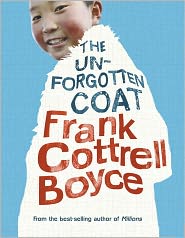
The Unforgotten Coat

The Unforgotten Coat. Frank Cottrell Boyce. Photographs by Carl Hunter and Clare Heney. 2011. Candlewick. 112 pages.

I hadn't seen this photograph since the day it was taken, until now. Even so, I can tell you anything you want to know about it. 

Julie, our narrator, remembers two Mongolian boys who joined her class the second week of summer term. The novel has a reflective feel to it. She remembers their strangeness at first. Their coats. Who wears coats in summer?! But there is something fascinating about their strangeness, their newness too. And the two ask Julie to be their good guide.

These two boys act really strange. They do. Julie does try to understand their culture, their country, their beliefs, their customs. But it's a strange new world, in a way. For example, like the time they invite themselves over to her house, and beg Julie's mom to let them do an emergency baking so they can bake a dough boy to trick the demon that is after them. (They want to trick this demon into eating the dough boy instead of one of them.) And that isn't the only unusual incident.

I can't tell you exactly what happens next, if these two "vanish" as they fear they might or not. But I can say that it is a one weird story about (illegal) immigration.

Honestly, this one left me confused. I almost feel silly for being so confused. But if this one was supposed to wow me or charm me, I just didn't get it. The use of photographs was nice, but I'm not sure exactly what story they're telling. How they fit in with the whole story.

I did like the author's note, for the most part. And I wanted to like this one more than I did.

© 2011 Becky Laney of Becky's Book Reviews
Darth Paper Strikes Back (MG)

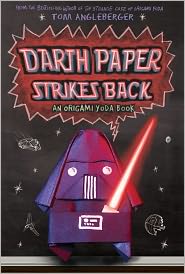
Darth Paper Strikes Back. Tom Angleberger. 2011. Harry N. Abrams. 176 pages.

It is a dark time at McQuarrie Middle School...when did it start? I can tell you exactly when it started.
The first day of school. The very first day of seventh grade. We didn't even get one good day. We got, like, five minutes.

Darth Paper Strikes Back is the sequel to The Strange Case of Origami Yoda. Sixth grade is over, seventh grade is just beginning. And it seems the wisdom of everyone's favorite origami Yoda isn't as revered or respected as in previous days. Teachers and administrators aren't so fond of the "disruptions" made by Dwight and his paper puppet. And there are some in the class who are oh-so-tired of it all. Or at least tired of Dwight getting all the attention. Harvey a student who can be a little mean at times--but isn't quite a complete bully at heart--comes to school with Darth Paper. And thus a NEW saga begins.

So the novel begins with bad news. Dwight has been kicked out of school. He may or may not be allowed to return after a few weeks. His case has to come before the school board. His friends want to help him, of course. And so they set about writing this casebook as to why Dwight and his origami Yoda are positive influences on the school, on the class. They're defending their friend.

So the book has multiple narrators. And there are many stories to tell. If you liked the first book, then you'll definitely want to read this one! It's an entertaining read!

© 2011 Becky Laney of Becky's Book Reviews