Tampilkan postingan dengan label adult mystery. Tampilkan semua postingan

Lady Audley's Secret

Lady Audley's Secret. Mary Elizabeth Braddon. 1862/1998. Oxford World's Classic. 496 pages.  

It lay low down in a hollow, rich with find old timber and luxuriant pastures; and you came upon it through an avenue of lines, bordered on either side by meadows, over the high hedges of which the cattle looked inquisitively at you as you passed, wondering, perhaps, what you wanted; for there was no thoroughfare, and unless you were going to the Court you had no business there at all. At the end of this avenue there was an old arch and a clock-tower, with a stupid, bewildering clock, which had only one hand; and which jumped straight from one hour to the next, and was therefore always in extremes. Through this arch you walked straight into the gardens of Audley Court.

I definitely enjoyed this one! I thought it was a GREAT read. I'm not sure it is a great book, but, it offers entertainment and thrills. I personally liked the writing style of this one, I found it very suspenseful and satisfying. If possible, it's best not to know Lady Audley's "secret" before reading. I'd say avoid reading too much detail about this one. I am going to try my best not to give away any details that are best left as surprises. But I do want to introduce you to the characters...

People you'll meet:

Michael Audley, a widower with a near-grown daughter, Alicia, who falls madly, deeply in love with a younger woman, Lucy Graham, who is employed as a governess by one of his friends.

Lady Audley, a young woman with a secret; It was almost too easy for Lucy Graham to agree to become Lady Audley. He's a rich man, a man with status, and he wants HER, a nobody. Who could say no?! Especially if you don't have your heart set on marrying for love.

Alicia Audley, a young woman too close in age to Lady Audley; she is NOT happy to have a new stepmother. She is not happy that her new stepmother is oh-so-gorgeous and that men seem to see only her. She's also suspicious and distrustful. Granted, she would probably be distrustful of ANY woman in that situation. And the fact that Lady Audley does in fact have a secret shouldn't be taken as proof that she has great instincts.

Robert Audley, a nephew of Michael Audley; Alicia really, really WISHES that Robert would pay attention to her. She really is hoping that he will notice that she is all grown up and ready to be proposed to. When we first meet Robert, you might say that he completely lacks ambition and gumption. In other words, he doesn't do much at all. This doesn't remain the case.

George Talboys, a friend of Robert Audley. He is newly returned to England, he's now got some money. He could potentially have been a very very happy man if he'd found his wife and son alive and waiting for him. Unfortunately, soon after his return, he learns that his wife has died. His son is being cared for by his father-in-law. He's too shocked to really take care of the boy himself, and, he feels perhaps its best not to disturb the boy too much. After all, his mother has died, and the boy's grandfather has been a part of his life from the start.

Phoebe and Luke Marks, Phoebe serves as Lady Audley's maid, Phoebe and her husband are the first to discover her secret.

I would definitely recommend this one!!! This would make a great companion read to The Suspicions of Mr. Whicher by Kate Summerscale, but, do try to read this one FIRST. 

Read Lady Audley's Secret
  • If you want to read one of the first sensation novels
  • If you enjoy suspense and mystery and detective stories
  • If you like classics, Victorian classics
  • If you are interested in reading women writers of the nineteenth century


© 2012 Becky Laney of Becky's Book Reviews

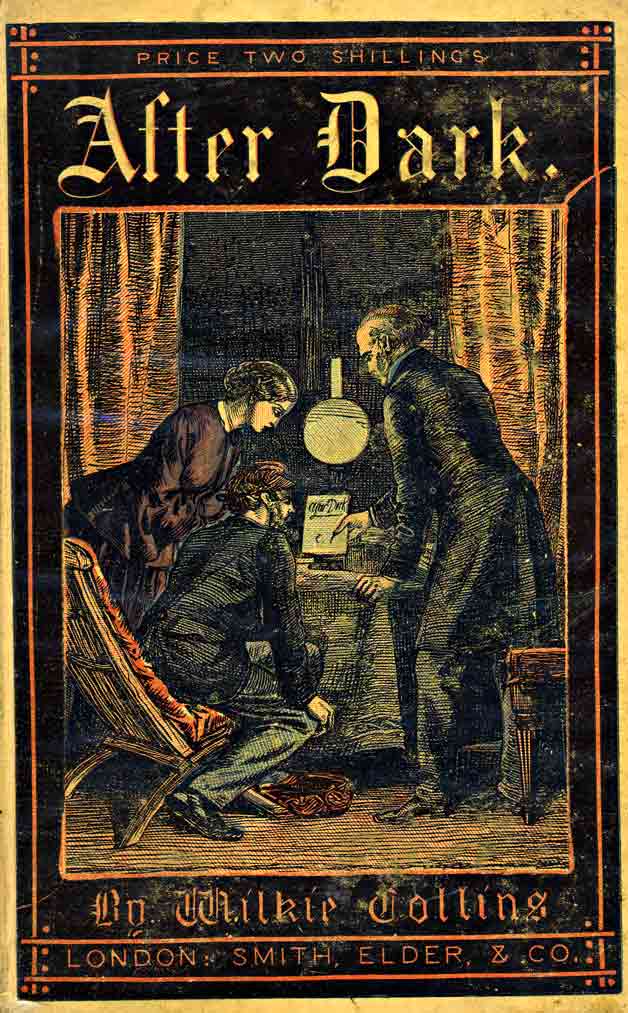
After Dark

After Dark. Wilkie Collins. 1856. 404 pages.

From "Leaves From Leah's Diary"
26th February, 1827.—The doctor has just called for the third time to examine my husband's eyes. Thank God, there is no fear at present of my poor William losing his sight, provided he can be prevailed on to attend rigidly to the medical instructions for preserving it. These instructions, which forbid him to exercise his profession for the next six months at least, are, in our case, very hard to follow. They will but too probably sentence us to poverty, perhaps to actual want; but they must be borne resignedly, and even thankfully, seeing that my husband's forced cessation from work will save him from the dreadful affliction of loss of sight. I think I can answer for my own cheerfulness and endurance, now that we know the worst. Can I answer for our children also? Surely I can, when there are only two of them. It is a sad confession to make, but now, for the first time since my marriage, I feel thankful that we have no more.
I tend to love Wilkie Collins. And I did enjoy his short story collection, After Dark. But I didn't find all six of the short stories equally compelling. And while I *loved* some of the stories in this book, I didn't love them all. I found them all worthwhile, all entertaining.

There's a framework to After Dark. A portrait-painter, William, suffers damage to his eyesight, the doctor tells him he needs LOTS of time to recuperate if he hopes to be able to see again. He can no longer count on his painting to bring in the income and take care of his family, so, the family is forced to come up with plan B. Plan B just happens to be writing and publishing a book of stories. These are stories that have been told to the painter--usually while his subject is being painted--through the years. He will now recollect the best stories he's ever heard and relate them to his wife, Leah, who will write them down each night...after dark. (That is after her long day's work is through.)

The six stories are:

  • The Traveller's Story of a Terribly Strange Bed (1852)
  • The Lawyer's Story of a Stolen Letter (1854)
  • The French Governess's Story of Sister Rose (1855)
  • The Angler's Story of The Lady of Glenwith Grange (new for After Dark)
  • The Nun's Story of Gabriel's Marriage (1853)
  • The Professor's Story of the Yellow Mask (1855)
Five of the six short stories were reprints, only one story was brand new and written especially for this book.

In my opinion, the best, best, best short story in this collection is The French Governess's Story of Sister Rose. This story has DRAMA and action. It is set during the French Revolution. And in my opinion, this story is a MUST read. Not only if you're a fan of Victorian literature OR a fan of Wilkie Collins, but if you're a fan of historical fiction set during the French Revolution, you should really consider reading this novella. (In my opinion, it is closer to a novella than a proper short story. It has parts and chapters.) So Louis Trudaine made a deathbed promise to his mother to always be there for his sister, Rose, and protect her. Rose has fallen in love with a man Louis feels is unworthy of her, a Charles Danville. The marriage does happen, though not without some unpleasant exchanges on the eve of the wedding. But he never feels quite sure of his sister's husband, and so he chooses to remain nearby even if it means passing up a job opportunity. Years pass--we learn from the narrator--and the Revolution comes. And with it danger, drama, action, betrayal, and so much more. This story is so very, very, very good. It's quite intense and I loved every minute of it.

The Traveller's Story of a Terribly Strange Bed is actually Wilkie Collins first published short story. It is quite creepy! It also happens to be set in Paris, by the way, anyway, the narrator is a young man named Faulkner. His good luck at a gambling house almost proves fatal. For a very, very friendly man convinces him that it is much too risky to leave the house at that time of night and wander the streets carrying his winnings. No, no, it would be much much safer to stay there for the night. But is that the truth? Well, his insomnia may just be a lifesaver!

The Nun's Story of Gabriel's Marriage is another story set in France during the French Revolution. While it isn't as good as The French Governess's Story of Sister Rose, in my opinion, it was interesting to get another story set in France--in Brittany--from Collins. The theme of this one is forgiveness and reconciliation. If you want a story with a couple of BIG twists, this one may prove satisfying.

The Angler's Story of The Lady of Glenwith Grange is another story with a BIG, BIG twist. Ida has promised to always, always, always take care of her younger sister, Rosamond. (Their mother died when Rosamond was a baby.) So when Rosamond marries, it's agreed that Ida will always live with them. The marriage, as you might expect, does not exactly exactly go as planned. And readers...along with Ida...learn why.

The Professor's Story of the Yellow Mask is set in Italy, I believe. It has a larger cast of characters than some of the other stories in the collection. And it has its own share of drama. It is a darker story balanced perhaps in a way by a love story with many, many obstacles. It also has lots of twists and turns and such. That being said, I wasn't thrilled with it.

The Lawyer's Story of a Stolen Letter is a detective story. It was a nice enough story, I suppose, but I wasn't wowed by it. Still, it's enjoyable enough. 


Read After Dark
  • If you're a fan of Wilkie Collins
  • If you're a fan of Victorian literature
  • If you're a fan of mystery, suspense, detective, or sensation stories
  • If you like short stories
  • If you like "shocking" stories with plenty of drama and twists and turns
© 2012 Becky Laney of Becky's Book Reviews
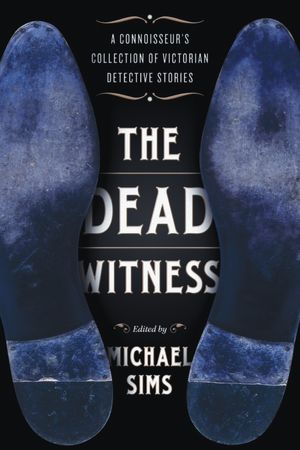
The Dead Witness

The Dead Witness: A Connoisseur's Collection of Victorian Detective Stories. Edited by Michael Sims. 2011. Walker & Company. (Late December 2011). 608 pages.

The Dead Witness is a short story collection that I absolutely LOVE, LOVE, LOVE. Now I am not usually a short story person, I feel it's important for everyone to know that. There are a couple of authors whose short fiction I enjoy, but, for the most part I like my novels.  But. I just LOVED this collection. I think it is a real MUST-READ.

Readers are introduced to twenty-two authors and twenty-two short stories. Each introduction was written by Michael Sims who did a fabulous job. There's just enough in each introduction to make you curious and eager to read their work, some of the introductions tease more than others. For example, they mention other stories, other novels, etc. The introductions are anything but boring! The authors presented are English, American, Canadian, Australian, and French. The collection includes men and women authors and men and women detectives! Some were narrated by a man or woman who just 'accidentally' got involved in the case, who just happened to put the clues together to solve the mystery. Others were narrated by amateur and professional detectives. (For example, The Diary of Anne Rodway is narrated by someone who just happens to become involved in this mystery. Her good friend, her roommate, is killed. She feels it was murder and has a clue or two to go by.)
  • The Secret Cell by William E. Burton
  • The Murders in the Rue Morgue by Edgar Allen Poe
  • On Duty With Inspector Field by Charles Dickens
  • The Diary of Anne Rodway by Wilkie Collins
  • You Are Not Human, Monsieur d'Artagnan by Alexandre Dumas, pere
  • Arrested on Suspicion by Andrew Forrester Jr.
  • The Dead Witness, or, The Bush Waterhole by W.W. (Mary Fortune)
  • The Mysterious Human Leg by James McGovan (William Crawford Honeyman)
  • The Little Old Man of Batignolles by Emile Gaboriau
  • The Science of Deduction by Arthur Conan Doyle
  • The Whitechapel Mystery by Anonymous
  • The Assassin's Natal Autograph by Mark Twain
  • The Murder at Troyte's Hill by C.L. Pirkis
  • The Haverstock Hill Murder by George R. Sims
  • The Stolen Cigar-Case by Bret Harte
  • The Absent-Minded Coterie by Robert Barr
  • The Hammer of God by G.K. Chesterton
  • The Angel of the Lord by Melville Davisson Post
  • The Crime at Big Tree Portage by Ernest Bramah
  • The Case of Padages Palmer by Harvey O'Higgins
  • An Intangible Clue by Anna Katherine Greene
 Chances are you're familiar with some of these authors. But some of these will probably be as new to you as they were to me.


My favorite favorite story was "The Diary of Anne Rodway," which I just LOVED and ADORED. True, I was already familiar with his work, but, even if I hadn't been, I think I would have loved this piece. The short story is a series of diary entries by a young woman, a poor woman. She's good friends with another young woman, Mary Mallinson. The two are in similar situations--in a way--both poor, both working hard to survive, both in love but facing obstacles to their happiness. But when Mary is murdered, Anne Rodway takes it upon herself to try to solve the mystery and discover the identity of the man who killed her friend.

I also enjoyed "The Secret Cell" by William E. Burton first published in 1837--several years before Edgar Allen Poe's oh-so-famous detective story, "The Murders in the Rue Morgue." I personally preferred The Secret Cell. I read that this is the first time it is being republished since its initial publication which I thought was nice! The Secret Cell is the story of a missing woman. The narrator had a laundress who had a daughter. The daughter of the laundress became a companion to a wealthy woman, the wealthy woman favors her companion in her will, and when the daughter inherits a fortune, well, it's not long before she turns up missing. It is a very interesting story!

Other favorites include, "The Murder at Troyte's Hill" by C.L. Pirkis, "The Angel of the Lord," by Melville Davisson Post, "The Stolen Cigar Case" by Bret Harte, and "An Intangible Clue" by Anna Katherine Greene.

Read The Dead Witness
  • If you enjoy detective fiction, mysteries, casebooks, etc.
  • If you enjoy Victorian literature
  • If you enjoy short stories
© 2012 Becky Laney of Becky's Book Reviews
The Yard (with slight spoilers)

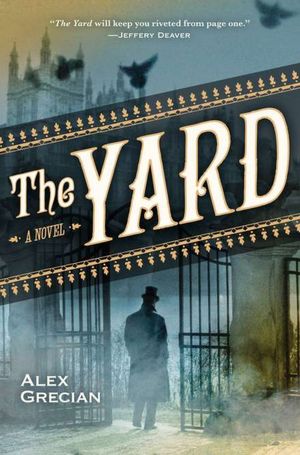
The Yard. Alex Grecian. 2012. Penguin. 432 pages.

From the prologue: Nobody noticed when Inspector Christian Little of Scotland Yard disappeared, and nobody was looking for him when he was found.

What can I say about Alex Grecian's The Yard? I was disappointed. If you're expecting a mystery where suspense builds, clues are given, and you're on the edge of your seat to find out who did it, then this one will definitely disappoint. For Grecian will reveal who did it to readers within a chapter or two. Readers will get a behind-the-scenes look at the murderer almost from the beginning. The first entry or so of this murderer his identity is still hidden, but, that doesn't remain the case for long. But Grecian doesn't just reveal the identity of one murderer, he reveals the identity of another murderer. For Scotland Yard is working on two cases during the course of the novel. One, a murderer who is killing police detectives. Two, a murderer who is killing bearded men.

The Yard has multiple narrators. Readers meet several detectives (some remain alive at the novel's end, others aren't so fortunate) throughout the novel, each contributes (to a certain degree) to solving one or the other cases. Some personal details are shared about some of the detectives. For example, readers meet Walter Day and his wife. We get a flashback to before they were married--we get to see the proposal, and, it felt to me it was a very odd proposal! We also see glimpses of their home life as she adjusts to life in London. Another detective we meet is Hammersmith (I can't recall his first name). We get flashes from him as well, including flashbacks to when he was a child. His flashbacks reveal his sensitive side and how difficult the job can be: finding the bodies of children, men, women, etc. Readers also meet Dr. Kingsley who works closely with Scotland Yard, and we meet his young daughter who helps out by sketching all the corpses. While we meet many characters, including a mystery "dancing man", I had a hard time truly connecting with any of the characters. I'll explain, while I wanted to read the book to its end, I wasn't at the edge of my seat. It wasn't that the book was super-compelling and impossible to put down. It wasn't that the book had any suspense (well, readers could perhaps wonder if Fenn would make it back home alive or if he'd end up a corpse; and if you're desperate to find more to be in suspense about I suppose you could wonder if Day's wife was ever going to tell him that she was pregnant), I finished the book because I like to finish what I start.

This one would almost have to be more of a thriller than a mystery, but, I'm not sure it's lack of suspense and uneven pacing would make it a good thriller either. Overall, I'd say the characterization wasn't the best. Some of the characters had potential, they could potentially be developed into something more, into characters that I would care about, but they weren't quite there yet. Some of the characters were incredibly flimsy and flat.

I think some of the scenes were intentionally put in there to aggravate modern readers--which worked, by the way. Having scenes where a boy goes up to a police officer (detective) and clearly states things like, help, please help me, I've been kidnapped, tied up, held prisoner, I only now just escaped, if he catches me again, I don't know what will happen, please help me find my parents. And have him respond with, move along, boy, or I'll send you to the workhouse. I suppose the intention being to highlight that women and children had no value or worth in society.

I wanted to like this one, I was even hoping to love it, but it was just okay. 

Best line: "If all men were sane, we would be blacksmiths." (87)

Read The Yard
  • If you like historical fiction set during the Victorian period
  • If you like Victorian mystery/detective/suspense stories; just don't expect Grecian to write as well as the actual Victorians, his style, his characterization, his pacing, doesn't even come close to matching. 
  • If you don't mind slightly tedious fiction, for example, he spends pages and pages each time (almost) trying to explain the concept of fingerprints. And how each fingerprint is unique, personal; how fingerprints can help establish who was at the scene of the crime, etc. 
© 2012 Becky Laney of Becky's Book Reviews
Poirot Investigates

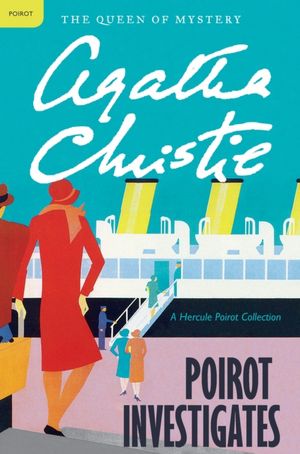
Poirot Investigates. Agatha Christie. 1924/2011. HarperCollins. 256 pages.

I loved Poirot Investigates. Perhaps because I had low expectations? This was my first experience reading Christie's short stories. And since I'm not generally a fan of short stories, I didn't have great expectations for enjoying these fourteen stories. Each story is narrated by Captain Hastings. And he is a character that I tend to love and adore. I've found that Hercule Poirot needs a little help either from Hastings or Ariadne Oliver to help tame his arrogance. I have definitely come to love Hercule Poirot through the mysteries I've read, but, it was a long road for me. It wasn't instantaneous like it was with Miss Marple.

This collection of short stories was originally published in 1925. So it is "early" Poirot. The short stories in this collection are:

The Adventure of the Western Star
The Tragedy at Marsdon Manor
The Adventure of the Cheap Flat
The Mystery of Hunter's Lodge
The Million Dollar Bond Robbery
The Adventure of the Egyptian Tomb
The Jewel Robbery at the Grand Metropolitan
The Kidnapped Prime Minister
The Disappearance of Mr. Davenheim
The Adventure of the Italian Nobleman
The Case of the Missing Will
The Veiled Lady
The Lost Mine
The Chocolate Box

It's not that any one story is amazing or incredible. That's not why I loved this collection. For me it is all about the relationship between Poirot and Hastings. Their conversations. Their friendship. Seeing these two together. There is just something DELIGHTFUL about spending time in their company. 

© 2012 Becky Laney of Becky's Book Reviews
Murder in The First-Class Carriage

Murder in the First-Class Carriage. The First Victorian Railway Killing. Kate Colquhoun. 2011. Overlook Press. 352 pages. 

 Murder in the First-Class Carriage is a nonfiction account of "the first Victorian railway killing." The murder occurred in July of 1864. The victim, Mr. Briggs, was found after the discovery of the hat and all the blood. (His body was found on the railway tracks). The railway car--he'd been supposedly alone in the car--was covered in blood, and one of the only clues was a hat that didn't belong to the victim. It wasn't the only clue--a watch chain, I believe, was missing as well.

Money was offered as a reward for information, and many, many, many people came to share information. But most turned out to be false information or irrelevant information. But. Eventually the detectives were satisfied with a suspect, they chose to follow a particular lead ignoring all others that didn't quite match up. This took them on a little chase across the Atlantic. The alleged murderer having bought passage on a ship to the United States. So the detectives followed him, and arrested him in America. And this story captured attention in America as well even after the suspect returned to England to await his trial.

For me the most interesting aspect of the novel was the trial itself, the book focuses on the three days of trial and the oh-so-short jury deliberation. Readers get to view the legal system of the time, and get a unique perspective on the court system. Readers can "hear" the prosecutor and defense attorney make their cases and arguments. Readers can "hear" the witnesses on the stand. The last chapter or perhaps the last two chapters focus on the pros and cons of capital punishment, or at the very least the pros and cons of public execution versus private execution.

While this one did prove compelling--in places--I wouldn't say that it was that fascinating or compelling throughout the whole book. It worked, in places, but in other places it dragged a bit.

Read Murder in The First-Class Carriage
  • If you're a fan of mystery novels
  • If you're interested in true crime, true court cases, etc.
  • If you're interested in this time period--the Victorian era, the 1860s
  • If you're a fan of nonfiction

© 2012 Becky Laney of Becky's Book Reviews

The Mystery of the Blue Train

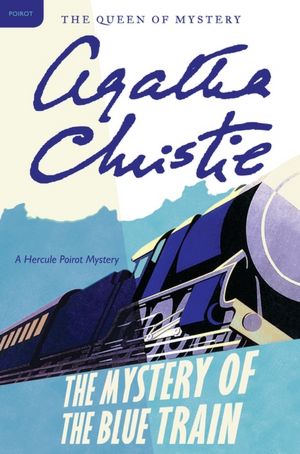
The Mystery of the Blue Train. Agatha Christie. 1928/2011. HarperCollins. 320 pages.

I have gradually come to appreciate--dare I say even love?--Hercule Poirot. Even so, this one took three or four chapters to take to this one. At first I thought I couldn't even finish it, I just didn't like the flow of the first few chapters, introducing all these people (often nameless), the focus on a piece of jewelry, all this big build-up before introducing the main characters, etc. The story was oh-so-slow to start. But then at one point, everything started to click, started to move, and the novel became much better.

So what is this one about? Well, let's start with the victim, Ruth Kettering. She's in a very unhappy marriage. She's in love with someone else, her husband is in lust with someone else. (Well, to be fair, I think she's in lust with someone else too. Except I think she honestly thinks that that lust is love, while I think the husband, Derek, is more realistic and realizes it is what it is.) Her affair being somewhat mostly private and out of the public's eyes, his not so much, he's "in lust" with an exotic dancer. Ruth's father is an American millionaire, and he is pressuring her to divorce her husband and start over. When the novel really opens, he's gifting her with some very, very, very expensive and oh-so-rare jewels, rubies. These are gems with a PAST and then some. Several weeks, if not several months, go by, and the novel next opens with a train trip. Ruth is on her way to meet her lover, her husband and his mistress just happen to be on the same train, and yet supposedly no one knows this. But perhaps it isn't right to start with the victim? Since the main character, the main character besides Poirot, is a young woman who's just recently inherited money. Katherine. This is truly more her story. For she's on the train as well, and she met Ruth just hours before her death. The two took a liking to one another, and Ruth confided in her a good deal. Even told Katherine how uneasy she felt about this trip, like something horrible was going to happen to her.

It was easy to see why Katherine was so likable. It really was. This Agatha Christie novel was good. I wouldn't say that it's one of the best, best, best mystery novels ever. Christie wrote so many, so many GREAT novels, that it would be hard for this one to make the top five or top ten, but it is definitely a good novel. I liked it!!!

Read The Mystery of the Blue Train
  • If you're a fan of Agatha Christie
  • If you're a fan of Hercule Poirot
  • If you're a fan of British mysteries, especially British mysteries set on a train 

© 2012 Becky Laney of Becky's Book Reviews

Mrs. McGinty's Dead

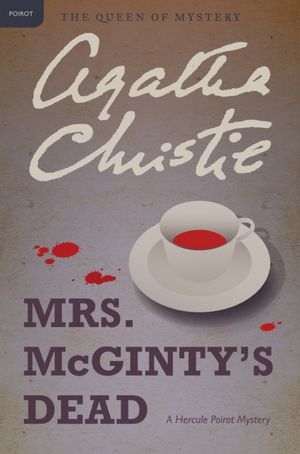
Mrs. McGinty's Dead. Agatha Christie. 1952/2011. HarperCollins. 272 pages. 

I definitely LOVED Mrs. McGinty's Dead. I really, really, really LOVED the surprise appearance of Ariadne Oliver. But, of course, the main star of this one is Hercule Poirot. The novel starts off rather unpleasantly with Poirot thinking to himself how wonderful he is, how marvelous he is, and how much he needs someone to talk to so he can show off how wonderful he is. So when he receives an unexpected visit from Superintendent Spence who is asking him to take on a closed case, well, he can't resist. Spence was one of the men who helped convict James Bentley of murder, but, he's having doubts, strong doubts. He believes that if Bentley is executed, well, they'll be executing an innocent man. He's not sure who killed Mrs. McGinty, but he knows that Poirot can solve this case better than anyone else. So Poirot travels to the village of the crime and he learns what only he can learn...

I LOVED this one!!! Loved hearing Mrs. Oliver talk about her writing, loved seeing her "work with" someone who is adapting her character, her main detective, into a play. Loved hearing her grumble and complain about her Finn detective.

This one is a great mystery, and, it was just so much fun to spend time with Christie's characters.

Read Mrs. McGinty's Dead
  • If you're a fan of Agatha Christie, Hercule Poirot, or Mrs. Oliver
  • If you're a mystery lover
© 2012 Becky Laney of Becky's Book Reviews
The Man in the Brown Suit

The Man in the Brown Suit. Agatha Christie. 1924/2012. HarperCollins. 320 pages.

While I'm not sure it's exactly fair to say that this is one of my least favorite Christie novels, I'm tempted to say it anyway. Because I just didn't care for this one. The narration was a bit strange to me. Most of the novel is narrated by a young woman whose father has just died, Anne Beddingfeld. She's left with practically nothing except her good looks and charm. There's just something about her that makes everyone want to take care of her and trust her. She by chance witnesses an accident, and the "doctor" on the scene of the accident puzzles her greatly though it took her a few hours to figure out just why. A little while later (either that day, or the next) a woman's body is discovered in a house. The house was for sale or for rent, and she had dropped by to see it. There are very few reasons why anyone would connect the two cases together, but, our narrator Anne does. And she takes it upon herself to solve this mystery and discover the identity of the "man in the brown suit." This mystery leads her to a ship bound for South Africa. And it's a trip with danger and risk for both on the ship and off, a number of attempts are made on her life. Along the way, she seems to make a new best friend and fall in love. I didn't exactly like the diary chapters provided by Sir Eustace Pedler. I'm not sure how helpful they were in adding to the story, they proved more distracting than anything else, which I think was the point. The ending, however, is what disappoints me most. The statements the narrator makes about the murderer almost infuriate me. 

Read The Man in the Brown Suit
  • If you're a big, big, big fan of Agatha Christie and want to read every mystery she wrote
  • If you're expectations are low and you're looking for just something--anything--to read to pass the time

© 2012 Becky Laney of Becky's Book Reviews

One, Two Buckle My Shoe

One, Two Buckle My Shoe. Agatha Christie. 1940/2011. HarperCollins. 240 pages. 

I have such a hard time rating Agatha Christie novels. Do I rate it based on how it compares to just any book? Or do I just rate it based on how it compares to other mysteries? Or do I just rate it based on how it compares to other Agatha Christie mysteries? Or do I rate it based on how it compares just among the Marple mysteries or the Poirot mysteries as the case may be?

The truth is, I find Christie incredibly readable. I pick up one of her mystery novels, and, I'm almost always hooked. True, some mysteries may take two or three days instead of just one. Depending on so many factors. But. It's oh-so-easy to read Christie's mysteries in just one sitting. To just DELIGHT yourself in the experience of reading a good mystery.

Was One, Two, Buckle My Shoe the best, best, best mystery I've ever read? No, not really. This isn't by any stretch my favorite-favorite Agatha Christie mystery. It isn't even my favorite Hercule Poirot mystery. (And, yes, I do LOVE Poirot, just not as much as Miss Marple.) Yet. When I consider how unwilling I was to put it down, how much I enjoyed reading it while I was reading it, then I can definitely say it was a good book, a good mystery. Even a not-quite-the-best Christie mystery is better than many books...

Hercule Poirot visits the dentist in One, Two, Buckle My Shoe. Hours after his appointment, he receives a call from the Inspector. His dentist, Mr. Morley, is dead. At first, they weren't quite positive if it was murder or suicide. Poirot knew that it was murder--his instinct said it was. But others aren't ready to go that route--they feel suicide is a reasonable conclusion based on the evidence. But Poirot can't fathom why his dentist would do such a thing in such a way?

So Poirot conducts his own investigation, interviews all the patients that were there that day, etc.

This one may not be the best introduction to Agatha Christie or Hercule Poirot, but it is definitely worth a read. 

© 2012 Becky Laney of Becky's Book Reviews
The Seven Dials Mystery

The Seven Dials Mystery. Agatha Christie. 1929/2012. HarperCollins. 304 pages.

That amiable youth, Jimmy Thesiger, came racing down the big staircase at Chimneys two steps at a time. So precipitate was his descent that he collided with Tredwell, the stately butler, just as the latter was crossing the hall bearing a fresh supply of hot coffee. Owing to the marvelous presence of mind and masterly agility of Tredwell, no casualty occurred.

 Oh, how I LOVED The Seven Dials Mystery!!!! It was such a great book. I loved the tone of this one--the tongue-in-cheek-ness of it. It was just one of those books where you could almost open it to any page and find something to smile about. The characters. The characters' names. The dialogue. Some of the situations. The Seven Dials Mystery is one of those rare books that combines comedy or humor with drama and suspense. There is danger and suspense. There are murder victims. The murderer does manage to avoid detection, for most of the novel. And the reader knows that the murderer could strike again. So the threat is real, but, at the same time The Seven Dials Mystery does not read like a horror novel. It's not weird enough, creepy enough, scary enough. I don't think the point of this one is to scare you, I think it is all about entertaining you.

This Agatha Christie novel features several characters that I loved. The inspector from Scotland Yard is Superintendent Battle. And I definitely enjoyed him. Not quite as much as I enjoyed Eileen "Bundle" Brent. But still, I was glad to meet him. Bundle was one of a handful of young people who involve themselves in this case. They are working with Battle to solve the case. And there is a tiny bit of romance going on behind the scenes in this one.

The setting of this one, for the most part, is Chimneys. The novel opens with a houseguest being murdered. Well, that's not exactly true. The novel begins with all the other houseguests making fun of the would-be-victim's bad habit of sleeping way too late. Their teasing even takes it the next level--a big practical joke is planned and plotted for the next day. But the victim of the joke becomes the victim of a murderer. Who killed Gerry Wade? Was it one of the other houseguests?

Read The Seven Dials Mystery
  • If you're a fan of Agatha Christie
  • If you're interested in reading Christie's earlier works
  • If you enjoy mystery/suspense novels
  • If you enjoy a little comedy with your mystery/thriller
  • If you want to smile 
© 2012 Becky Laney of Becky's Book Reviews
The Secret Adversary

The Secret Adversary. Agatha Christie. 1922/2012. HarperCollins. 352 pages.

 I enjoyed The Secret Adversary. I have read Agatha Christie's novels out of order, without much of a plan. So I've read many of her later novels first. This is my first Tommy and Tuppence novel, however.

I definitely liked it. It has a certain charm to it, I suppose. This first novel introduces readers to the two characters, and introduces a romance between the two. A romance that perhaps seems obvious, but, a somewhat sweet romance nonetheless.

World War I has not been over that long when the novel opens, and both Tommy and Prudence (Tuppence) are continuing to make adjustments now that the war is over and their service has ended. (She was a nurse, I believe.) These two happen to bump into one another one day. And they happen to have a conversation. Their conversation is overheard by a gentleman, a man who assumes Tommy and Tuppence know more than what they in fact do, know a BIG secret somewhat connected to the early days of the War. A secret concerning the identity of Jane Finn. When this man approaches Prudence, all of their lives are changed...

Essentially, Tuppence and Tommy team up (with a few others for help now and then) to solve a mystery, to find out about a woman's identity, to trace her, to trace some important documents. Their adventure is dangerous. Both will risk their lives to find out the truth.

I liked this one. I didn't quite love it. But I did like it.

Read The Secret Adversary
  • If you're a fan of Agatha Christie
  • If you love mystery/spy novels
  • If you want to read one of Christie's earlier novels
  • If you love mysteries with a historical feel to them

© 2012 Becky Laney of Becky's Book Reviews
The Lord is My Shepherd

The Lord is My Shepherd. (Psalm 23 Mysteries) Debbie Viguie. 2010. Abingdon Press. 320 pages.

More than anything, Cindy Preston hated Mondays. 

I was skeptical about this book, I'll be honest. I had no idea if it would be something I'd like. But I like to challenge myself to take risks...occasionally. And I am definitely glad I took a chance on Debbie Viguie's The Lord Is My Shepherd. This one is mystery-suspense-thriller. Cindy Preston, the heroine, is a church secretary who discovers--literally stumbles upon--a dead body in the sanctuary of the church one Monday morning. But it isn't just any Monday, no it's Holy Week, it's the Monday of Easter week. Her screams draw the attention of the Rabbi next door, Jeremiah Silverman. Together they meet the police detective...and so it begins.

I really, really, really enjoyed this one!!! It was so hard to put this one down. I definitely liked the heroine, Cindy Preston. I thought she was a good balance. On the one hand, she's terrified and in shock, on the other hand she's strong and strong-willed. She may be afraid--and she may have good reason to be afraid--but she isn't going to be ruled or enslaved by that fear. Not that she's careless. And as for Jeremiah Silverman, well, I loved him!!! I did. I just loved him!!!

Read The Lord Is My Shepherd
  • If you like murder mysteries OR thrillers OR suspense novels
  • If you enjoy "Christian fiction" on the light side; there is nothing heavy-handed or preachy about this one. 

© 2012 Becky Laney of Becky's Book Reviews
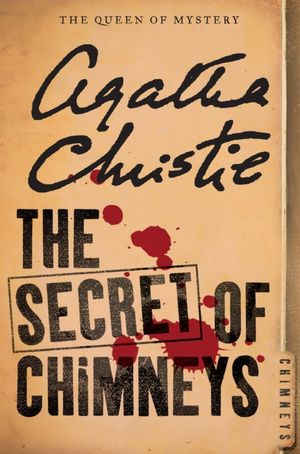
The Secret of Chimneys

The Secret of Chimneys. Agatha Christie. 1925/2012. HarperCollins. 336.

I definitely enjoyed The Secret of Chimneys. I picked this one up because I accidentally read The Seven Dials Mystery first. When I learned that Seven Dials Mystery starred so many characters first introduced in The Secret of Chimneys, I knew I would have to read this one right away!!! If I loved Seven Dials so, so, much, I knew I would probably love this one too. And I did enjoy it. And I definitely loved the characters, I probably would have loved them anyway even if I hadn't already known them, so I would definitely recommend these two books--and to recommend them in the proper order. Read Secret of Chimneys first.

The Secret of Chimneys is a bit over-the-top, I won't lie. I suppose you could call it a silly book that isn't exactly meant to be taken seriously. But it was a fun book, for the most part. I probably loved Seven Dials Mystery more than this one. But still, I liked it.

Anthony Cade travels to England as a favor for a friend. If he delivers a certain manuscript--a memoir--by a certain person (recently deceased) living in exile to a particular publisher by a certain day, he receives a good sum of money. Money that will be divided between them (Anthony and Jimmy). But that isn't the only package he's taking with him, he's also got a bundle of letters from a married woman to her lover. Jimmy has told him that these letters have been used (in the past) to blackmail the woman. He's gotten a hold of the letters, and he doesn't want to blackmail her, he wants to see them returned safely to her. Will his mission succeed? Well, it sounds easy enough, in a way, until you factor in all the different political factions that want to see him fail and the manuscript be destroyed.

The setting of this one is an estate called Chimneys. And we do meet many, many lovely characters. Including Eileen (Bundle) Brent, Superintendent Battle, Lord Caterham, George Lomax, Bill Eversleigh, Virginia Revel, Anthony Cade.

Read The Secret of Chimneys 
  • If you love Agatha Christie
  • If you love British mysteries, classic mysteries
  • If you like a little humor/sarcasm with your mystery/suspense
 

© 2012 Becky Laney of Becky's Book Reviews
Too Many Women

Too Many Women. Rex Stout. 1947/1985. Bantam Books. 176 pages.

It was the same old rigmarole. Sometimes I found it amusing; sometimes it only bored me; sometimes it gave me a pronounced pain, especially when I had had more of Wolfe than was good for either of us.  

With Rex Stout, it's merely a matter of determining if I liked a book or loved a book. There was never a question of if I would like it at all. For I've never read a Nero Wolfe mystery that I didn't at least like. There's just something enjoyable and wonderful about the detective team of Nero Wolfe and Archie Goodwin. I love and adore both characters. In Too Many Women, Archie is the dominant character. While Wolfe is present in the novel, to a certain degree, it is Archie who is doing most of the work. (Now Archie would probably be the first to point out that he's always the one doing all of the work.) Too Many Women sees Archie Goodwin going undercover (well, at least at the start) at a company. He's been hired to investigate a death. One of the company's employees was killed in a hit and run accident. A few fellow employees at least feel that this was intentional and no accident. So Archie's job is to talk with just about all the employees--well, the ones who had dealings with the victim--and find out if it was murder, to catch the murderer if he is to be found. (The premise of this one reminded me of Murder Must Advertise by Dorothy Sayers, in that mystery the detective, Lord Peter Wimsey goes undercover at an agency to find a murderer.)

Was it enjoyable? Yes. Definitely. I never regret spending time with Nero and Archie.

Was it the best, best, best Wolfe mystery ever? Not really. I mean it was a good book, a good mystery. I think for those who like to see Archie flirt with women--he does have a way with women--this one will appeal, or not. (I did find it a little odd that so many women were begging for Archie's favors.) For those looking for great banter between Nero Wolfe and Archie Goodwin, well, this one isn't as good as some of the other novels I've read. In fact, it's probably my least favorite of the Stout novels I've read.
I don't regret reading this one. Perhaps because I would LOVE to read each and every Nero Wolfe novel, novella, short story ever published.

Read Too Many Women
  • If you're a big fan of Nero Wolfe and Archie Goodwin. If you already love the characters and are just looking to spend more time with them. This wouldn't be my first choice for a first introduction to Nero and Archie.
  • If you're a fan of mysteries and are looking for an office/company setting.
  • If you're not bothered by the stereotypical representations of women--especially secretaries.

© 2012 Becky Laney of Becky's Book Reviews

Champagne for One

Champagne for One. Rex Stout. 1958/1995. Random House. 224 pages.

If it hadn't been raining and blowing that raw Tuesday morning in March I would have been out, walking to the bank to deposit a couple of checks, when Austin Byne phoned me, and he might have tried somebody else. But more likely not. He would probably have rung again later, so I can't blame all this on the weather. As it was, I was there in the office, oiling the typewriter and the two Marley .38's for which we had permits, from the same can of oil, when the phone rang and I lifted it and spoke. 

 Last year I discovered mysteries, and I also discovered that I LOVE, LOVE, LOVE Nero Wolfe and Archie Goodwin. While I haven't spent as much time in the mystery genre this year as I did last year, I do plan on reading some this year. I have got plenty of Rex Stout mysteries that I just can't wait to read!!!

Reading Champagne for One was an interesting experience for me since I had already seen the adaptation of it. (I LOVE, LOVE, LOVE the Nero Wolfe series--that show ended much too soon!!!) To read a mystery when you have a vague remembering of the details--the clues--is a different type of experience. Not a bad one necessarily. Just different.

In Champagne for One, Archie Goodwin attends a party in the home of one of Wolfe's former clients, Mrs. Robilotti. The dinner party is to "benefit" four single unwed mothers that had (in the past year) been helped by the charity (Grantham House) started by the woman's first husband, Mr. Grantham. Four gentlemen are invited to entertain the four young "unfortunate" women. Archie Goodwin was substituting at the last minute. Dinner and dancing. That's what is supposed to happen. Unfortunately, this year it is dinner, dancing, and murder. Of course, Archie Goodwin is the only one that KNOWS it was murder and not suicide. Why? Well. He was warned by one of the ladies that Faith Usher had a bottle of cyanide in her purse, so he keeps his eyes on that purse throughout the evening. Faith never goes near it. Yet, she still ends up dead--poisoned.

Who is the murderer? Can Goodwin and Wolfe outwit the murderer?

I loved this one. I think this is a GREAT Nero Wolfe mystery. It would be a great choice if you're new to the series. (The series can be read in any order, for the most part, I've been told there is a trilogy that go together, but the rest do stand alone.)

Read Champagne for One
  • If you're a mystery fan
  • If you're looking for mysteries set in the U.S. (as opposed to all the BRILLIANT British mysteries written by Agatha Christie and Dorothy Sayers)
  • If you're a fan of Rex Stout, Nero Wolfe, and Archie Goodwin
  • If you're a fan of books set in the 1950s
  • If you like some comedy (banter) in your mysteries
© 2012 Becky Laney of Becky's Book Reviews
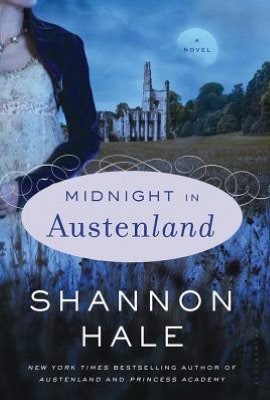
Midnight in Austenland

Midnight in Austenland. Shannon Hale. 2012. Bloomsbury. 288 pages.

No one who knew Charlotte Constance Kinder since her youth would suppose her born to be a heroine.

While I didn't love this one, I certainly liked it. Charlotte Kinder ("Mrs. Cordial") is a divorced mom of two. She's got a very successful business, but her husband left her for another woman, a woman named Justice, and her two children just don't appreciate her at all. Especially her fourteen-year-old daughter. Her personal life is anything but successful. She's even resorted to stalking her daughter's boyfriend because she doesn't trust him not to break her daughter's heart. So a two-week vacation could be just what she needs to gain a little perspective on her life...
And vacationing Austen style, well, it may change her life completely. By adding in some unexpected thrills. She expected a phony romance, a suitor all her own, a Regency gentleman, who knows all the ways to flatter a woman and make her feel giddy. But what she didn't expect was an all-too-real dead body in a secret room. What she didn't expect was to fall in all-too-real love with her "brother," the actor posing as her brother, that is!

I liked this one. It is equal parts romance and mystery. It is definitely seeking to pay tribute to Northanger Abbey. But this modern romance doesn't really have a proper Mr. Henry Tilney, a giddy-making, witty, oh-so-charming, just-can't-help-but-loving-him hero.

Read Midnight in Austenland
  • If you are a fan of Shannon Hale, particularly Austenland
  • If you are a fan of Jane Austen
  • If you are a fan of mysteries with a touch of romance
© 2012 Becky Laney of Becky's Book Reviews

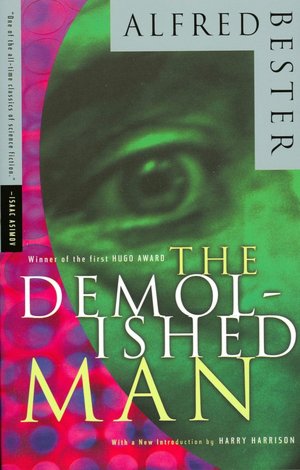
The Demolished Man

The Demolished Man. Alfred Bester. 1951. Random House. 245 pages.

Explosion! Concussion! The vault doors burst open. And deep inside, the money is racked ready for pillage, rapine, loot. Who's that? Who's inside the vault? Oh God! The Man With No Face! Looking. Looming. Silent. Horrible. Run....Run...

The Demolished Man is the winner of the first Hugo Award. I am not sure it's an absolute must-read. But. If you're a fan of science fiction, I think you should definitely consider reading this one! Depending on your expectations, of course, you might just find yourself surprised at how clever and literary well written it is.

The mystery elements of The Demolished Man made it a great read for me. The novel stars two characters. One, Ben Reich, who is determined to murder his business rival, Craye D'Courtney. With (future) society being what it is, murder is unheard of because telepaths (espers) always, always are able to read the minds of the would-be murderers and stop them before the crime is committed. But Reich plans to bribe a few high(er) level telepaths to help him cover his tracks, AND he plans on using a catchy song to distract other mind-readers in the area, to keep them from peeping his intentions.

Eight, sir; seven, sir;
Six, sir; five, sir;
Four, sir; three, sir;
two, sir; one!
'Tenser' said the Tensor.
'Tenser,' said the Tensor.
'Tension, apprehension,
And dissension have begun.' 

The second main character is Lincoln Powell, the detective on the case. (The murder is successful.) Both characters narrate this one. So readers get the view points of both the detective and the criminal. I wasn't sure how I felt about this--at first. But I think it works well, for the most part!

Have you read this one? What did you think? What did you think of the ending? Of what happens to criminals... And what did you think of the "romance"?!

This one surprised me. It did. I really liked it so much more than I thought I would. In fact, I think I may even love it. I couldn't help thinking of this Alfred Bester when I read it.

Read The Demolished Man
  • If you're a fan of classic science fiction
  • If you want to read the FIRST Hugo Winner
  • If you're interested in reading science fiction with a focus on telepaths
  • If you're a fan of mysteries and detective fiction

© 2012 Becky Laney of Becky's Book Reviews

Death At Wentwater Court

Death at Wentwater Court. Carola Dunn. 1994. Kensington. 254 pages.

"He'll come to a bad end, mark my words, and she won't lift a finger to stop him. It's the little ones I'm worried about." The stout lady heaved a sigh, her old-fashioned mantle, a hideous yellowish green, billowing about her. "Four already and another due any day now."
Daisy Dalrymple was constantly amazed at the way total strangers insisted on regaling her with their life stories, their marital misfortunes, or their children's misdeeds. Not that she objected. One day she was going to write a novel, and then every hint of human experience might come in handy.

I found Death at Wentwater Court a pleasantly cozy read. Was it the best mystery ever? Probably not. But it was an enjoyable way to spend an afternoon. What I liked best about this mystery was the heroine. I just really enjoyed getting to know Daisy Dalrymple. And this novel--the first in a series--made me want to spend more time with her. I liked her personality, her character. And I also liked her love interest, Alec Fletcher, the inspector of the crime(s). Their conversations were quite fun! For those that like the lightest touches of romance with their mysteries, I think this one won't disappoint. I also enjoyed the setting of this one--England in the 1920s.

So Daisy Dalrymple is a journalist and photographer. She has come to Wentwater Court to write an article and take some lovely photographs. She is just getting to know the family--for better or worse, just beginning to make some observations about their personal lives--their troubles--when the worst happens. One of their guests is murdered. The murder isn't obvious, the body is found in such a way that it looks like an accident. But Daisy and her camera discover the truth....that a crime has been committed. What isn't obvious--to Daisy--is who did it.

Can Alec and Daisy solve this one?

Read Death at Wentwater Court
  • If you enjoy cozy mysteries
  • If you enjoy mysteries set in Britain
  • If you enjoy reading Dorothy Sayers and Agatha Christie
  • If you enjoy historical mysteries
  • If you're looking for a very light, very quick read

© 2012 Becky Laney of Becky's Book Reviews
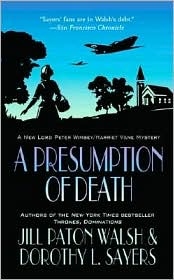
Presumption of Death

A Presumption of Death by Jill Paton Walsh & Dorothy Sayers. 2002. St. Martin's Press. 384 pages.

'Whoever, for example, Lady Peter,' said Miss Agnes Twitterton, 'is that?"
'You do have a point, my dear,' said Mrs. Goodacre, the vicar's wife, who was standing with the two women behind a trestle table at one end of the Village Hall, pouring out Miss Twitterton's parsnip wine into rows of assorted sherry glasses. 'There was a time, as you say, and not so long ago, when we would have known everybody we could possibly meet here--when any stranger was a seven-day-wonder--and now here we are organizing a village hop, and we don't know half the people here. They could be anybody, indeed I expect they are.' 

A Presumption of Death is set in 1940. Lord Peter and Bunter are in Europe on a secret-mission. Lady Harriet is in the country at Talboys with the children. Her and Peter have two small sons, Bredon and Paul, and she's also taken Charles and Mary's three children, Charlie, Mary, and Harriet. Harriet is not the only woman thinking of the safety of her children, no, many families are trying to send their children to the country for safety. The villagers are opening their homes, and, are willing to their duty for the war. The village IS preparing for war. They've been working on air raid shelters and organizing themselves to prepare for the worst. It is during the rehearsal of an air raid that a murder is committed! A woman is found dead. Almost everyone was accounted for in one of the two shelters. But someone murdered the young woman...can the local police with a little aid from Lady Harriet solve this crime?

I liked this one. I can't really say too much about it. It is a mystery after all. And the less you know, the better it will be! But I enjoyed it. I think Jill Paton Walsh has done a good job with the characters, keeping them true to the originals, yet giving readers more of what they love.

© 2011 Becky Laney of Becky's Book Reviews