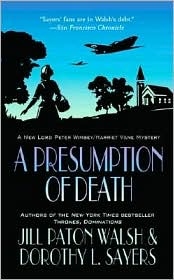
A Presumption of Death by Jill Paton Walsh & Dorothy Sayers. 2002. St. Martin's Press. 384 pages.
'Whoever, for example, Lady Peter,' said Miss Agnes Twitterton, 'is that?"
'You do have a point, my dear,' said Mrs. Goodacre, the vicar's wife, who was standing with the two women behind a trestle table at one end of the Village Hall, pouring out Miss Twitterton's parsnip wine into rows of assorted sherry glasses. 'There was a time, as you say, and not so long ago, when we would have known everybody we could possibly meet here--when any stranger was a seven-day-wonder--and now here we are organizing a village hop, and we don't know half the people here. They could be anybody, indeed I expect they are.'
A Presumption of Death is set in 1940. Lord Peter and Bunter are in Europe on a secret-mission. Lady Harriet is in the country at Talboys with the children. Her and Peter have two small sons, Bredon and Paul, and she's also taken Charles and Mary's three children, Charlie, Mary, and Harriet. Harriet is not the only woman thinking of the safety of her children, no, many families are trying to send their children to the country for safety. The villagers are opening their homes, and, are willing to their duty for the war. The village IS preparing for war. They've been working on air raid shelters and organizing themselves to prepare for the worst. It is during the rehearsal of an air raid that a murder is committed! A woman is found dead. Almost everyone was accounted for in one of the two shelters. But someone murdered the young woman...can the local police with a little aid from Lady Harriet solve this crime?
I liked this one. I can't really say too much about it. It is a mystery after all. And the less you know, the better it will be! But I enjoyed it. I think Jill Paton Walsh has done a good job with the characters, keeping them true to the originals, yet giving readers more of what they love.
© 2011 Becky Laney of Becky's Book Reviews
Tampilkan postingan dengan label Lord Peter Wimsey. Tampilkan semua postingan
Presumption of Death
Diposting oleh
Unknown
on Rabu, 28 Desember 2011
Label:
2002,
adult fiction,
adult mystery,
library book,
Lord Peter Wimsey,
mystery
/
Thrones, Dominations
Diposting oleh
Unknown
on Selasa, 27 Desember 2011
Label:
1998,
adult fiction,
adult mystery,
library book,
Lord Peter Wimsey,
mystery,
St. Martin's Press
/
Thrones, Dominations. Dorothy L. Sayers and Jill Paton Walsh. 1998. St. Martin's Press. 312 pages.
'I do not,' said Monsieur Theophile Daumier, 'understand the English.'
'Nor does anybody,' replied Mr Paul Delagardie, 'themselves least of all.'
Lord Peter Wimsey and Harriet return to London after their honeymoon, Harriet hasn't been unconditionally accepted by all of Peter's family--at least not yet. And let's be honest, she may never be welcomed by Peter's sister-in-law, Helen. But she is happy as a new wife. Though she'd admit it feels strange to not have to write detective stories anymore. She still wants to write, but her writing is not prompted by absolute necessity. And so she's still trying to figure out what that means to her writing, how to get focused on her work--or should I say stay focused on her work. She's being introduced to new people all the time. Some of these new acquaintances she welcomes, some are more forced upon her. The Harwell couple, for example. Neither Lord Peter or Harriet "enjoy" spending time with Laurence Harwell and his wife, Rosamund Harwell; and it should be said that Laurence Harwell and Rosamund Harwell don't truly "enjoy" spending time with them either. But. Society is society and the connection may prove useful at some point.
Thrones, Dominations provides an intimate (not that kind of intimate) look at two marriages. Peter and Harriet and Laurence and Rosamund. The two marriages do share certain similarities. Husbands who at some point in the past 'rescued' their wives. The husbands being of higher social class than their wives. But a closer examination proves the differences outweigh any similarities. For it becomes clear that Lord Peter and Harried LOVE each other truly--with a forever-kind-of-love. And for Rosamund and Laurence, what love might have existed is buried under disinterest, neglect, and manipulative games. She wants her husband to be jealous of her, possessive of her, to want her to be his and his alone. And he just doesn't care who she talks to, who she dines with, who she goes about with in town, etc.
Halfway through the novel, once the reader gets a chance to know both couples and the society they share, the mystery begins. Lord Peter is once again called upon to solve the mystery and find the murderer.
I enjoyed this one. I did. I particularly liked seeing Harriet and Peter together. I thought she did a great job with their dialogue and the development of their relationship. I would recommend this one to those that can't get enough of this couple!
Harriet and Lady Severn
Harriet to Mr. Amery:
Lord Peter and Harriet:
Lord Peter to Inspector Parker
Lord Peter and Harriet
© 2011 Becky Laney of Becky's Book Reviews
'I do not,' said Monsieur Theophile Daumier, 'understand the English.'
'Nor does anybody,' replied Mr Paul Delagardie, 'themselves least of all.'
Lord Peter Wimsey and Harriet return to London after their honeymoon, Harriet hasn't been unconditionally accepted by all of Peter's family--at least not yet. And let's be honest, she may never be welcomed by Peter's sister-in-law, Helen. But she is happy as a new wife. Though she'd admit it feels strange to not have to write detective stories anymore. She still wants to write, but her writing is not prompted by absolute necessity. And so she's still trying to figure out what that means to her writing, how to get focused on her work--or should I say stay focused on her work. She's being introduced to new people all the time. Some of these new acquaintances she welcomes, some are more forced upon her. The Harwell couple, for example. Neither Lord Peter or Harriet "enjoy" spending time with Laurence Harwell and his wife, Rosamund Harwell; and it should be said that Laurence Harwell and Rosamund Harwell don't truly "enjoy" spending time with them either. But. Society is society and the connection may prove useful at some point.
Thrones, Dominations provides an intimate (not that kind of intimate) look at two marriages. Peter and Harriet and Laurence and Rosamund. The two marriages do share certain similarities. Husbands who at some point in the past 'rescued' their wives. The husbands being of higher social class than their wives. But a closer examination proves the differences outweigh any similarities. For it becomes clear that Lord Peter and Harried LOVE each other truly--with a forever-kind-of-love. And for Rosamund and Laurence, what love might have existed is buried under disinterest, neglect, and manipulative games. She wants her husband to be jealous of her, possessive of her, to want her to be his and his alone. And he just doesn't care who she talks to, who she dines with, who she goes about with in town, etc.
Halfway through the novel, once the reader gets a chance to know both couples and the society they share, the mystery begins. Lord Peter is once again called upon to solve the mystery and find the murderer.
I enjoyed this one. I did. I particularly liked seeing Harriet and Peter together. I thought she did a great job with their dialogue and the development of their relationship. I would recommend this one to those that can't get enough of this couple!
Harriet and Lady Severn
"Well, how do you like it?"Lord Peter to Harriet on her writing:
"Like what, Lady Severn?"
"Being part of the Wimsey Estate."
"Peter doesn't treat me as part of the estate."
"I suppose not. He always had good manners. An excellent bedside manner, too, or so they tell me."
Harriet said gravely, "I don't think they ought to have told."
In spite of herself, the corners of her mouth twitched and the vulture chuckled again.
"You're quite right, my dear, they oughtn't. You won't tell, I can see. Never tell me anything; I always repeat it. Are you in love with him?"
"Yes. I don't mind having that repeated."
"Then why didn't you marry him sooner?"
"Obstinacy," said Harriet, and this time she grinned openly.
"Humph! You're probably the first woman that ever kept him waiting. What do you do with him, now you've got him, hey? Lick his toes, or make him sit up and beg?"
"What do you advise?"
"Honest dealing," said the old lady, sharply. "A man's none the better for being fretted to fiddle-strings. You're going to amuse me. Most of these young women are very dull. They either take offence or think I'm a scream. What do you think?"
"I think," said Harriet, feeling she might as well be hanged for a sheep as a lamb, "you are behaving like a character in a book. And I think you are doing it on purpose."
"That's rather shrewd of you," said the vulture.
"When I put you in a book," pursued Harriet, "I shall make that aspect of your psychology quite clear."
"All right," said Lady Severn. "I'll take six copies. And I'll promise to live till it's published." (41-42)
"How I envy you your capacity to take facts or leave them," said Peter. (51)
Harriet to Mr. Amery:
"You should never say thank you for a good review," said Harriet. "That would imply that one had done a favour to the author, whereas one has simply done justice to the book." (101)
Lord Peter and Harriet:
"It is perfectly possible, I suppose," said Lord Peter to his wife, over breakfast, "for someone to be murdered while doing something she does not usually do, or behaving in a way unaccustomed to her. But it is an affront to the natural feelings of a criminologist, all the same."
"It has a feeling of lightning striking twice in the same spot, you mean?"
"It does rather. I would greatly prefer it if in every tiny break in precedent was in some way connected to the crime. And therefore could be constructed as a clue by a brainy enough person."
"Well, if this were a work of fiction, one would certainly make sure that was the case," said Harriet. "But in real life, Peter, don't people usually do unusual things? Aren't they always going to places for the first time, mildly surprising their friends by little switches in behavior, suddenly getting bored, or headachy, and dashing out to parties, or going early to bed, or buying a red dress instead of a blue one, or suddenly marrying, at the age of forty-five, a highly unsuitable person?"
"Do you mean that unpredictable behavior may simply reveal the secret truth of someone's inner man or woman?"
"In a novel, of course, it would. Things have to be connected or the reader would not believe them."
"It's odd, that, isn't it?" said Peter. "If unconnected and spur-of-the-moment things keep happening in the real world, why shouldn't they be plausible in novels? Shouldn't the most plausible picture of life be a portrait of reality in all its bizarre and incoherent confusion?"
"I think a novel has to deal in a different kind of truth," said Harriet. "For example, if poor Rosamund's death were in a novel, readers would know at once that the Sunbury attacker who so alarmed Laurence Harwell could not have done it. If a wholly unconnected stranger arrived in a story just in time to commit the crime and disappear, there would be no plot."
"But in real life random things occur, and there may actually be no plot, in that sense of the word," said Wimsey, thoughtfully. (137-38)
Lord Peter to Inspector Parker
"I wish you wouldn't get so obsessed by motives, Charles. Motives are ten a penny. There's always a motive for anybody doing anything. Just find out who had the opportunity, and you can make up the motive."
"I don't really agree with you," said Charles. "Juries like motives, you know." (141)
Lord Peter and Harriet
"Frivolity can give a good deal of pleasure," he said, mildly. "But I don't like to hear you call detective stories frivolous."Dowager Duchess in a letter:
"But aren't they? Compare to the real thing?"
"What do you call the real thing?"
"Great literature; Paradise Lost; novels like Great Expectations, or Crime and Punishment or War and Peace. Or on the other hand real detection, dealing with real crimes."
"You seem not to appreciate the importance of your special form," he said. "Detective stories contain a dream of justice. They project a vision of a world in which wrongs are righted, and villains are betrayed by clues that they did not know they were leaving. A world in which murderers are caught and hanged, and innocent victims are avenged, and future murder is deterred."
"But it is just a vision, Peter. The world we live in is not like that."
"It sometimes is," he said. "Besides, hasn't it occurred to you that to be beneficent, a vision does not have to be true?"
"What benefits could be conferred by falsehood?" she asked.
"Not falsehood, Harriet; idealism. Detective stories keep alive a view of the world which ought to be true. Of course people read them for fun, for diversion, as they do crossword puzzles. But underneath they feed a hunger for justice, and heaven help us if ordinary people cease to feel that." (151)
Sent Franklin to Hatchards for copy of War and Peace, thinking today good time to start long book...Silly woman came back with Anna Karenina, saying it was the nearest thing she could find. Got as far as first sentence, then stopped to think. "All happy families resemble one another, but each unhappy family is unhappy in its own way." Great author has got that the wrong way round. I think unhappiness is much the same whatever the reasons for it, and happiness is a quirky odd sort of thing... (312)
© 2011 Becky Laney of Becky's Book Reviews
Busman's Holiday
Diposting oleh
Unknown
on Rabu, 21 Desember 2011
Label:
1937,
adult fiction,
adult mystery,
Dorothy Sayers,
library book,
Lord Peter Wimsey
/
Busman's Honeymoon. Dorothy L. Sayers. 1937. HarperCollins. 403 pages.
My dear Honoria,
So Peter is really married: I have ordered willow-wreaths for half my acquaintance...
There were parts of this mystery novel that I just LOVED. I mean there were scenes that made me giddy, absolutely giddy. (So many Harriet and Peter scenes!!!) And scenes that had me smiling! (I love Peter and Bunter, and we were introduced to a lovely Chief Superintendent, Mr. Kirk, his scenes with Peter were quite fun!) So I would definitely recommend this one to anyone who loves Lord Peter Wimsey, to those excited to read about his marriage to Harriet. The writing, as always, was great. And their is something almost magical about the way Sayers does dialogue...
Anyway, this novel is about their busy honeymoon. They've only been married a brief time--maybe two days?--when they discover a body in the basement of their new home, the home they've chosen to honeymoon in. And the case isn't an easy one to solve....
I really can't begin to express how much I LOVE, LOVE, LOVE Peter Wimsey. And how much this whole series has meant to me. These books are so good, so wonderful, so worth reading!!!
Harriet:
Lord Peter:
Lord Peter:
Lord Peter, Harriet, and Mr. Kirk:
Mr. Kirk:
Lord Peter:
Lord Peter and Harriet:
This is the eleventh novel featuring Lord Peter Wimsey.
Others in the series:
© 2011 Becky Laney of Becky's Book Reviews

My dear Honoria,
So Peter is really married: I have ordered willow-wreaths for half my acquaintance...
There were parts of this mystery novel that I just LOVED. I mean there were scenes that made me giddy, absolutely giddy. (So many Harriet and Peter scenes!!!) And scenes that had me smiling! (I love Peter and Bunter, and we were introduced to a lovely Chief Superintendent, Mr. Kirk, his scenes with Peter were quite fun!) So I would definitely recommend this one to anyone who loves Lord Peter Wimsey, to those excited to read about his marriage to Harriet. The writing, as always, was great. And their is something almost magical about the way Sayers does dialogue...
Anyway, this novel is about their busy honeymoon. They've only been married a brief time--maybe two days?--when they discover a body in the basement of their new home, the home they've chosen to honeymoon in. And the case isn't an easy one to solve....
I really can't begin to express how much I LOVE, LOVE, LOVE Peter Wimsey. And how much this whole series has meant to me. These books are so good, so wonderful, so worth reading!!!
Harriet:
Whatever fantastic pictures she had from time to time conjured up of married life with Peter, none of them had ever included attendance at village concerts. But of course they would go. She understood now why it was that with all his masking attitudes, all his cosmopolitan self-adaptations, all his odd spiritual reticences and escapes, he yet carried about with him that permanent atmosphere of security. He belonged to an ordered society, and this was sit. More than any of the friends in her own world, he spoke the familiar language of her childhood. In London, anybody, at any moment, might do or become anything. But in a village--no matter what village--they were all immutably themselves; parson, organist, sweep, duke's son, and doctor's daughter, moving like chessmen upon their allotted squares. She was curiously excited. She thought, "I have married England." (98)
Lord Peter:
"When I'm investigating a murder, I hate to have too much sympathy with the corpse. Personal feelings cramp the style." (130)
Lord Peter:
"Murders go to my head like drink. I simply can't keep them off." (130)
Lord Peter, Harriet, and Mr. Kirk:
"Enter the obvious suspect," said Peter, lightly.
"The obvious suspect is always innocent," said Harriet in the same tone.
"In books, my lady," said Mr. Kirk, with a little indulgent bow towards her, as who should say, 'The ladies. God bless them!'" (143)
Mr. Kirk:
"Reckon there's several kinds of truth, my lord. There's truth as far as you know it; and there's truth as far as you're asked for it. But they don't represent the whole truth--not necessarily. (170)
Lord Peter:
"I don't know what to think. The fact is, we've got dashed little material for thinking with. It's probably too early for thinking." (231)Lord Peter:
"I am always trying to say something too silly to be believed; but I never manage it." (256)
Lord Peter and Harriet:
"How can I find words? Poets have taken them all, and left me with nothing to say or do--"
"Except to teach me for the first time what they meant."
He found it hard to believe.
"Have I done that?"
"Oh Peter--" Somehow she must make him believe it, because it mattered so much that he should. "All my life I have been wandering in the dark--but now I have found your heart--and am satisfied."
"And what do all the great words come to in the end, but that?--I love you--I am at rest with you--I have come home." (293)
This is the eleventh novel featuring Lord Peter Wimsey.
Others in the series:
- Whose Body (1923)
- Clouds of Witness (1926)
- Unnatural Death (1927)
- The Unpleasantness at the Bellona Club (1928)
- Strong Poison (1931)
- Five Red Herrings (1931)
- Have His Carcase (1932)
- Murder Must Advertise (1933)
- Nine Tailors (1934)
- Gaudy Night (1935)
© 2011 Becky Laney of Becky's Book Reviews
The Nine Tailors
Diposting oleh
Unknown
on Selasa, 06 Desember 2011
Label:
1934,
adult fiction,
adult mystery,
book I bought,
Dorothy Sayers,
Lord Peter Wimsey
/
The Nine Tailors. Dorothy L. Sayers. 1934. 312 pages.
"That's torn it!" said Lord Peter Wimsey.
While I enjoyed The Nine Tailors--in some places really loved it--I can't say that The Nine Tailors is my favorite Lord Peter mystery by Dorothy L. Sayers. I do love the series. I have enjoyed the time I've spent in each and every book. And I definitely see myself rereading these in the future. But. This one, for me, had such a slow start!
Last year before I "discovered" how much I love mysteries--vintage mysteries, cozy mysteries--I tried The Nine Tailors. But the slow start didn't quite work for me. I decided I should start at the beginning of the series. Which ended up being THE BEST decision I could have made.
So Lord Peter Wimsey (and Bunter) have a small car accident over winter holidays that leaves them stranded in the country. They're taken in by the vicar, I believe, who is just delighted with the company. (Who wouldn't be?! It's LORD PETER WIMSEY!) His accident is providential because he can ring one of the bells in the church tower for an oh-so-special service or observation. (All the bell-ringing, well, it BORED me. That could be just me. And I am not saying you'll be bored by the focus of this one.) Of course, that's just the beginning of this one.
It will be months before the real action begins, months before Lord Peter Wimsey's real services are needed. For it is in this quiet country community that a body is discovered in a grave. An extra body is discovered in a grave that is. Who was he?
There are actually a few mysteries for Lord Peter to solve in this novel, and once the body is discovered, well, this book just keeps getting better and better and better. When Lord Peter is busy on a case, well, he's irresistible.
So there is much to love in this one....after the first fifty pages. It is possible that this one will improve upon rereading. Because I am guessing that if you read it knowing how it all comes together, it may prove interesting...
Lord Peter to Bunter:
About the bells...
Lord Peter to Hilary:
Lord Peter on Uncle Edward...
Lord Peter on gossip...
Mr. Blundell on his witnesses...
Lord Peter being Lord Peter...
A good example Sayer's writing style:
Others in the series:
© 2011 Becky Laney of Becky's Book Reviews
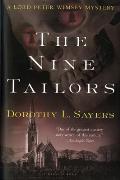
"That's torn it!" said Lord Peter Wimsey.
While I enjoyed The Nine Tailors--in some places really loved it--I can't say that The Nine Tailors is my favorite Lord Peter mystery by Dorothy L. Sayers. I do love the series. I have enjoyed the time I've spent in each and every book. And I definitely see myself rereading these in the future. But. This one, for me, had such a slow start!
Last year before I "discovered" how much I love mysteries--vintage mysteries, cozy mysteries--I tried The Nine Tailors. But the slow start didn't quite work for me. I decided I should start at the beginning of the series. Which ended up being THE BEST decision I could have made.
So Lord Peter Wimsey (and Bunter) have a small car accident over winter holidays that leaves them stranded in the country. They're taken in by the vicar, I believe, who is just delighted with the company. (Who wouldn't be?! It's LORD PETER WIMSEY!) His accident is providential because he can ring one of the bells in the church tower for an oh-so-special service or observation. (All the bell-ringing, well, it BORED me. That could be just me. And I am not saying you'll be bored by the focus of this one.) Of course, that's just the beginning of this one.
It will be months before the real action begins, months before Lord Peter Wimsey's real services are needed. For it is in this quiet country community that a body is discovered in a grave. An extra body is discovered in a grave that is. Who was he?
There are actually a few mysteries for Lord Peter to solve in this novel, and once the body is discovered, well, this book just keeps getting better and better and better. When Lord Peter is busy on a case, well, he's irresistible.
So there is much to love in this one....after the first fifty pages. It is possible that this one will improve upon rereading. Because I am guessing that if you read it knowing how it all comes together, it may prove interesting...
Lord Peter to Bunter:
"I am always so delighted to find that there are things you cannot do." (15)
About the bells...
The art of change-ringing is peculiar to the English, and, like most English peculiarities, unintelligible to the rest of the world. (17)
Lord Peter to Hilary:
"If that's the way your mind works, you'll be a writer one day."
"Do you think so? How funny! That's what I want to be. But why?"
"Because you have the creative imagination, which works outwards, till finally you will be able to stand outside your own experience and see it as something you have made existing independently of yourself. You're lucky."
"Do you really think so?" Hiilary looked excited.
"Yes--but your luck will come more at the end of life than at the beginning, because the other sort of people won't understand the way your mind works. They will start by thinking you dreamy and romantic, and then they'll be surprised to discover that you are really hard and heartless. They'll be quite wrong both times--but they won't ever know it, and you won't know it at first, and it'll worry you."
"But that's just what the girls say at school. How did you know?...Though they're all idiots--mostly that is."
"Most people are," said Wimsey, gravely "but it isn't kind to tell them so. I expect you do tell them so. Have a heart; they can't help it." (106)
Lord Peter on Uncle Edward...
"Frightful blithering ass. Handy thing to be, sometimes. Easily cultivated. Five minutes' practice before the glass every day, and you will soon acquire that vacant look so desirable for all rogues, detectives, and Government officials." (121)
Lord Peter on gossip...
"In a quiet place like this, if one doesn't talk about one's neighbors, what is there to talk about?" (140)
Mr. Blundell on his witnesses...
"I don't like witnesses to be so damned particular about exact truth. They get away with it as often as not, and then where are you?"
Lord Peter being Lord Peter...
"My family," observed Lord Peter, "have frequently accused me of being unrestrained and wanting in self-control. They little know me. Instead of opening this letter at once, I reserve it for Superintendent Blundell. Instead of rushing off at once to Superintendent Blundell, I remain quietly at Walbeach and eat roast mutton. It is true that the good Blundell is not at Leamholt today, so that nothing would be gained if I did rush back, but still, it just shows you. (153)
A good example Sayer's writing style:
There are harder jobs in detective work than searching a couple of French departments for a village ending in "y," containing a farmer's wife whose first name is Suzanne, whose children are Pierre, aged nine, Marie and a baby of unknown age and sex, whose husband is an Englishman. All the villages in the Marne district end, indeed, in "y," and Suzanne, Pierre and Marie are all common names enough, but a foreign husband is rarer. (161)
Others in the series:
- Whose Body (1923)
- Clouds of Witness (1926)
- Unnatural Death (1927)
- The Unpleasantness at the Bellona Club (1928)
- Strong Poison (1931)
- Five Red Herrings (1931)
- Have His Carcase (1932)
- Murder Must Advertise (1933)
- Gaudy Night (1935)
© 2011 Becky Laney of Becky's Book Reviews
Murder Must Advertise
Diposting oleh
Unknown
on Selasa, 15 November 2011
Label:
1933,
adult fiction,
adult mystery,
book I bought,
Dorothy Sayers,
Lord Peter Wimsey
/
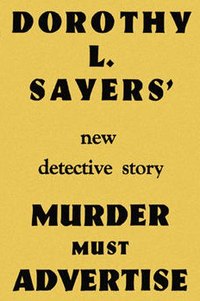
Murder Must Advertise. Dorothy L. Sayers. 1933. Harper & Row. 323 pages.
"And by the way," said Mr. Hankin, arresting Miss Rossiter as she rose to go, "there is a new copy-writer coming in today."
I love and adore Lord Peter Wimsey. I do. Dorothy Sayers' mysteries had me at hello. In fact, after the first one, I knew I just HAD to read the entire series. So in this Lord Peter adventure, he is going undercover to solve a murder. He has been hired as a copy-writer for an advertising agency. The man he is replacing had a horrid accident on the stairs. Was it really an accident? Or did he have some enemies? Did those enemies come from within the agency? Or was he just hanging out with the wrong crowds after hours?
It took more than a few chapters for Lord Peter to reveal himself to readers. For the first third of the novel, readers just know him as the new employee. Yes, this new employee is asking questions here, there, and everywhere. And, of course, I was a little suspicious and a lot hopeful that he would turn out to be Lord Peter.
Did I like this one? Of course!!! It's Lord Peter! What's not to love? I'm not sure it's my favorite or best. But with the exception of one little chapter, I found it satisfying and just about perfect. Lord Peter can definitely make me giddy!
I still need to read:
© 2011 Becky Laney of Becky's Book Reviews
"And by the way," said Mr. Hankin, arresting Miss Rossiter as she rose to go, "there is a new copy-writer coming in today."
I love and adore Lord Peter Wimsey. I do. Dorothy Sayers' mysteries had me at hello. In fact, after the first one, I knew I just HAD to read the entire series. So in this Lord Peter adventure, he is going undercover to solve a murder. He has been hired as a copy-writer for an advertising agency. The man he is replacing had a horrid accident on the stairs. Was it really an accident? Or did he have some enemies? Did those enemies come from within the agency? Or was he just hanging out with the wrong crowds after hours?
It took more than a few chapters for Lord Peter to reveal himself to readers. For the first third of the novel, readers just know him as the new employee. Yes, this new employee is asking questions here, there, and everywhere. And, of course, I was a little suspicious and a lot hopeful that he would turn out to be Lord Peter.
Did I like this one? Of course!!! It's Lord Peter! What's not to love? I'm not sure it's my favorite or best. But with the exception of one little chapter, I found it satisfying and just about perfect. Lord Peter can definitely make me giddy!
"Truth in advertising is like leaven, which a woman hid in three measures of meal. It proves a suitable quantity of gas, with which to blow out a mass of crude misrepresentation into a form that the public can swallow." (68)Others in the series:
- Whose Body (1923)
- Clouds of Witness (1926)
- Unnatural Death (1927)
- The Unpleasantness at the Bellona Club (1928)
- Strong Poison (1931)
- Five Red Herrings (1931)
- Have His Carcase (1932)
- Gaudy Night (1935)
I still need to read:
- The Nine Tailors (1934)
- Busman's Honeymoon (1937)
- Complete Stories of Lord Peter (1972)
- Thrones, Dominations (Dorothy Sayers and Jill Paton Walsh) (1998)
- A Presumption of Death (Jill Paton Walsh) (2002)
- The Attenbury Emeralds (Jill Paton Walsh) (2010)
© 2011 Becky Laney of Becky's Book Reviews
The Five Red Herrings
Diposting oleh
Unknown
on Selasa, 06 September 2011
Label:
1931,
adult fiction,
adult mystery,
book I bought,
Dorothy Sayers,
Lord Peter Wimsey,
mystery
/
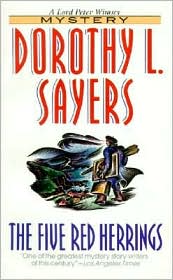
The Five Red Herrings. Dorothy L. Sayers. 1931. HarperCollins. 325 pages.
If one lives in Galloway, one either fishes or paints. "Either" is perhaps misleading, for most of the painters are fishers also in their spare time. To be neither of these things is considered odd and almost eccentric.
The Five Red Herrings is the seventh mystery starring Lord Peter Wimsey. Lord Peter is a character that I just love and adore. He's just one of my favorite, favorite, favorite characters ever. So I was so happy to read another mystery in this series.
In The Five Red Herrings, Lord Peter Wimsey is on vacation in Scotland. Though he neither paints or fishes, he is accepted--for the most part--by the community. It's hard to not like him, after all! Early in the novel--though I'm not sure if it's early in his holiday--a murder is committed. The "victim" is someone EVERYONE hates; threats against this guy were so common that they were hardly worth taking seriously. I mean Campbell, the victim, was just impossible to get along with. But now that he's dead, it is up to the police (the constables and detectives, etc.) to solve the crime. And since Lord Peter just happens to be very, very good at detecting, he offers to help them out.
There are six suspects--all artists. Hugh Farren, Henry Strachan, Matthew Gowan, Jock Graham, Michael Waters, and Ferguson. All had motive, all had opportunity. All of them are lying, all of them are hiding things from the police. Since there are so many suspects, since they all appear equally capable of committing the crime, it's just a matter of discerning the truth. Which theory--which plausible theory--is the truth? Which is most likely? Which uses all the clues that have been left behind?
Five Red Herrings is set in Scotland. And, for me, it was a delightful mystery.
Lord Peter Wimsey:
© 2011 Becky Laney of Becky's Book Reviews
If one lives in Galloway, one either fishes or paints. "Either" is perhaps misleading, for most of the painters are fishers also in their spare time. To be neither of these things is considered odd and almost eccentric.
The Five Red Herrings is the seventh mystery starring Lord Peter Wimsey. Lord Peter is a character that I just love and adore. He's just one of my favorite, favorite, favorite characters ever. So I was so happy to read another mystery in this series.
In The Five Red Herrings, Lord Peter Wimsey is on vacation in Scotland. Though he neither paints or fishes, he is accepted--for the most part--by the community. It's hard to not like him, after all! Early in the novel--though I'm not sure if it's early in his holiday--a murder is committed. The "victim" is someone EVERYONE hates; threats against this guy were so common that they were hardly worth taking seriously. I mean Campbell, the victim, was just impossible to get along with. But now that he's dead, it is up to the police (the constables and detectives, etc.) to solve the crime. And since Lord Peter just happens to be very, very good at detecting, he offers to help them out.
There are six suspects--all artists. Hugh Farren, Henry Strachan, Matthew Gowan, Jock Graham, Michael Waters, and Ferguson. All had motive, all had opportunity. All of them are lying, all of them are hiding things from the police. Since there are so many suspects, since they all appear equally capable of committing the crime, it's just a matter of discerning the truth. Which theory--which plausible theory--is the truth? Which is most likely? Which uses all the clues that have been left behind?
Five Red Herrings is set in Scotland. And, for me, it was a delightful mystery.
Lord Peter Wimsey:
I was born looking foolish and every day in every way I am getting foolisher and foolisher. (52)
One of these days I shall write a book in which two men are seen to walk down a cul-de-sac, and there is a shot and one man is found murdered and the other runs away with a gun in his hand, and after twenty chapters stinking with red herrings, it turns out that the man with the gun did it after all. (114)
The essence of detection is secrecy. It has no business to be spectacular. But you can watch me if you like. (218)
© 2011 Becky Laney of Becky's Book Reviews