Tampilkan postingan dengan label international literature. Tampilkan semua postingan

The Far Side of the Sky

The Far Side of the Sky. Daniel Kalla. 2012. Tom Doherty Associates. 464 pages.

The shadow still swayed over the pavement. Franz Adler tried to blink away the memory of his brother's dangling corpse and the silhouette it cast across the sidewalk, but the image looped over and over in his head.

The Far Side of the Sky provides a unique look at World War II. Franz Adler is able to flee Vienna, Austria, after Kristallnacht with his young daughter, Hannah, and his sister-in-law, Esther. Also accompanying them is an artist Ernst Muhler who fears persecution as well. (He joins them at the very last minute when his boyfriend decides to join the Nazis.) Their destination is Shanghai, one of the few places welcoming Jewish refugees.

The Far Side of the Sky is about the Jewish refugee community in Shanghai. Readers get glimpses of refugee life in 1938-9, 1940, 1941, 1942. (For example, the narrative might cover one or two months in a given year, and then jump to the next year.)

The main characters are:

Franz Adler, a Jewish doctor who divides his time between two hospitals in Shanghai, one of the hospitals is for Jewish refugees.

Soon Yi Mah (Sunny) a biracial (American/Chinese) nurse who divides her time between two hospitals. Her father was a doctor, and, she too has a gift for doctoring. But Dr. Reuben, one of the surgeons at the other hospital absolutely hates her and feels she doesn't know her place. She's intelligent, resourceful, courageous.

Of course there are dozens and dozens of minor characters of many ethnicities. 

The story was very fascinating. The author note reveals that much is based on fact, that he spent a great deal of time researching the Jewish refugee experience in Shanghai. And since this was the first I've heard of it, it was definitely fascinating to me. However. I was disappointed in the distant characters. Though readers follow the stories of these characters, I personally never felt connected with them. I knew enough about them to care about their fates, what happened next, etc. But I never felt like I knew them.

I'm not sure this book did a good job with relationships between characters either. For example, readers know that Franz is a father, but, except for two or three scenes, we don't really see Hannah interacting with Franz. We know that Hannah provides motivation for Franz--that his concern for Hannah moves the plot forward, but as for knowing Hannah, that just doesn't happen. We don't get the details of his personal life outside the hospital very often. Again, we know that Franz is taking care of Esther, his sister-in-law, but as for his sister-in-law having any character of her own, I just don't see it. There are a handful of scenes now and then. But even in those scenes she seems one-dimensional and just there. So many of the characters seem one-dimensional. The story itself is fascinating enough--the action, the danger, the uncertainty--but the characters just don't seem to match that.

The setting is unique and interesting. The story is fascinating and compelling. The characters, well, they disappointed me. But. I think there is enough to enjoy this one that I'd definitely still recommend it.

Read The Far Side of the Sky
  • If you are interested in the 1930s and 1940s, particularly the war years
  • If you are interested in reading books set in Shanghai, in China
  • If you are interested in reading a Jewish refugee book in a very different setting
  • If you are interested in doctors, nurses, surgeons, hospitals, etc. 

© 2012 Becky Laney of Becky's Book Reviews

Two 2012 Picture Books

A Hen For Izzy Pippik. Aubrey Davis. Illustrated by Marie Lafrance. 2012. Kids Can Press. 32 pages.

Shaina perched on the porch with her eyes shut and listened. Mama's sewing machine chattered in the kitchen. Baby Pinkus pounded a pot. Grandpa whistled an old-time tune. In the market across the road, a nanny goat bleated. A truck puttered past. A cuckoo cooed from Mr. Fine's clock shop. Shaina wished she could still dust for Mr. Fine. She wished she could help the other merchants, too. But people had little to spend these days. There were few shoppers in the market and fewer jobs to do. Times were tough. 

 Can a chicken bring a whole town good luck? It can if it is Izzy Pippik's chicken. One day a crate falls from a truck, a hen is inside. Shaina, our heroine, knows the hen doesn't belong to her, it has an owner already. But she knows that she can take care of it for Izzy Pippik in the meantime. She knows that he will be back for it sooner or later. But taking care of a hen isn't that easy, not when the hen keeps having chicks, who keep having chicks, who keep having chicks. Because these chicks belong to a hen who belongs to someone else, all these new chicks belong to Izzy Pippik too. Soon it takes a whole town to "care" for the chicks/chickens. (Some people in town which Shaina was a little less bossy in insisting that these chickens are not to be eaten.) And soon this flock of chickens is gaining attention for the whole town, people are coming to look and see for themselves. Will Izzy Pippik ever come back to town?

I definitely liked this one! 

Read A Hen for Izzy Pippik
  • If you like folk tales
  • If you like (quaint) small towns
  • If you like a good lesson or two in your picture books
  • If you like determined, responsible heroines
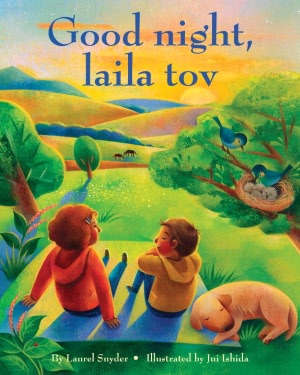
Good Night, Laila Tov. Lauren Snyder. Illustrated by Jui Ishida. 2012. Random House. 32 pages.

The sun was up. The day was bright!
It filled our room with yellow light.
It woke us both, so right away...
We grabbed our things, were on our way.

Nature is celebrated in a family camping trip in Laurel Snyder's newest book, Good night, laila tov. (Laila tov means good night in Hebrew.) The first night of camping sees this family at the beach and loving it. Laurel Snyder's rhymes capture the enthusiasm of the trip so well:
The sand was hot. The waves were wide.
Tall grassed swayed. The salty air
Was soft and still and everywhere.
And the waves whispered...
Good night, laila tov...
The second night of camping sees the family setting up in a field (or meadow). Here readers see the family planting trees together. Again the love of nature is evident. We see a joyful family together living and loving nature, thankful for the beauty around them. The illustrations complement the text quite well, for they are beautiful.

Read Good Night, laila tov
  • If you're looking for a book that celebrates the beauty of nature, of the natural world
  • If you're looking for a camping book
  • If you're looking for a family book 
© 2012 Becky Laney of Becky's Book Reviews

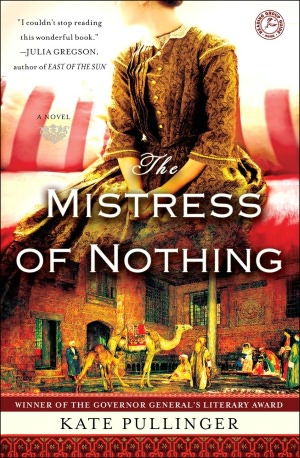
The Mistress of Nothing

The Mistress of Nothing. Kate Pullinger. 2011. Simon & Schuster. 272 pages.

The truth is that, to her, I was not fully human.

I found The Mistress of Nothing to be a fascinating historical novel. The narrator, a 'spinster' named Sally, serves as lady's maid to Lady Duff Gordon. Lady Duff is dying, but the doctors feel a change in climate might postpone the end a few years at least. So Lady Duff separates herself from her family, her friends, her society--she LOVES to be the center of it all--and heads to Egypt with her maid, Sally Naldrett.

Set, for the most part, in Egypt during Victoria's reign (1860s), this novel is so very, very fascinating. It tells the story of how two English women adapted to Egypt--to a new culture, society, way of life. One of the first things they do is hire a dragoman, Omar. These three become very, very close. But even in their 'close' moments, there is a very real distinction between servant and mistress. Lady Duff may act friendly, but she is above them both. They are her paid servants. They owe their loyalty to her. They almost belong to her--as far as she sees it. Sally forgets this for a time. But she'll have months--if not years--to see the truth of the matter.

So, this novel is about what happens when these two 'servants' fall in love with each other. One a seemingly proper English woman, the other an Egyptian man...

This novel was such a good, quick read. I'm not sure I loved it. But I sure found it hard to put down!

Read The Mistress of Nothing
  • If you love historical fiction
  • If you love novels based on true people and events
  • If you have an interest in Egypt--past or present
  • If you enjoy novels set during the Victorian time period
  • If you enjoy bittersweet romance

© 2012 Becky Laney of Becky's Book Reviews
All Our Worldly Goods

All Our Worldly Goods. Irene Nemirovsky. 1947/2008. Vintage Books. Translated from the French by Sandra Smith. (French title: Les Biens de ce Monde.) 265 pages.

They were together, so they were happy.  

What All Our Worldly Goods lacks in characterization, it more than makes up for in beautiful writing. Nemirovsky's novel has great atmosphere: a rich, detailed setting. The characters are more simple than complex human beings, but, I think there are enough presented to get a flavor of what life was like across the generations in the troubled decades between the start of World War I and the beginning of World War II. They're more sketched than developed.

The novel begins with the love story of Agnes and Pierre. These two aren't exactly from the same class. And his mother has arranged his marriage with someone else, a young, rich woman named Simone. But Pierre and Agnes are deeply in love, and Pierre chooses to go against his family's wishes and marry for love not money.

A few years later--after their new family has grown to include a baby boy, Guy--war is declared. Pierre becomes a soldier, and Agnes along with his family must learn to deal with the new reality. The first third of the novel, at least, deals with the first world war. We get to see the war from multiple viewpoints. There were many great scenes--including scenes from Pierre's parents' perspectives--about the war. Pierre does survive the war. Though like many soldiers, many people touched by the war, he's not quite the same innocent as before.

The rest of the novel takes us from the end of the first world war through the beginning of the second world war. When the novel ends, part of France is occupied. These chapters are sketches. Good sketches, for the most part, of how families change, villages change, how life goes on. Readers see Pierre and Agnes' children all grown up. (They also have a daughter, Colette). Part of the novel focuses on the late 1930s and captures the uncertainty of it all. Will there be another war? Can peace be maintained? Can diplomacy stop a war before it begins? Is the war inevitable?

Pierre may be too old to go to war a second time, but his son, Guy, is not. And war once again is changing everything.

My favorite quotes:

It was the very beginning of the war, when the heart bleeds for everyone who dies, when tears are shed for each man sent to fight. Sadly as time goes on, people get used to it all. They think only of one soldier, theirs. But at the start of a war the heart is still tender; it hasn't hardened yet. (55)

The other one...the other war...People said these words in a stunned tone of voice: it was a new phrase. Another war...Twice in one lifetime, it was too much. But everyone was bowed beneath the same destiny, and courage was born out of their communal ordeal. (202)
The war was already trying to create its own legend. It was understood that the women had to prove themselves worthy of the soldiers through their calmness, their courage, their blind confidence that fate would smile on them. For Agnes it was easier; she had played the role before. For four years she had lowered her head, waited, fought back her tears in silence, smiled at young and old; she had hoped. But for the younger women it was all much harder. Stubborn, anxious, passionate, they had believed until now that it was easy to control their destiny. (206) 
The author's story is interesting--though tragic. Irene Nemirovsky was a French novelist of Russian and Jewish heritage who did not survive Auschwitz. I cannot imagine writing this novel at such a time. Can you?


Read All Our Worldly Goods
  • If you are a fan of historical fiction
  • If you are a fan of love stories (though this isn't exactly a traditional romance novel)
  • If you are interested in World War I and/or World War II
  • If you are interested in French village life
  • If you are interested in multigenerational stories or family sagas
  • If you like literary fiction
This was the second book I read for the War Through the Generations reading challenge.

© 2012 Becky Laney of Becky's Book Reviews
My Family for the War (YA)

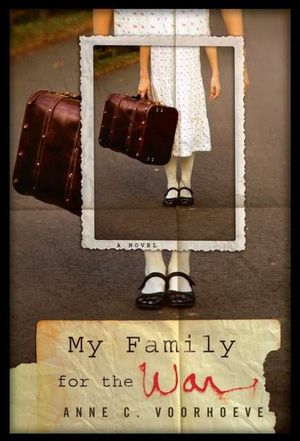
My Family for the War. Anne C. Voorhoeve. Translated by Tammi Reichel. 2012. February 2012. Penguin. 412 pages. 

I would never find another friend like Rebekka Liebich. she crouched on the narrow windowsill, one hand holding tight to the frame, and held the other hand stretched out in front of her, as if that would somehow shorten the distance of almost five feet between her and the trunk of the birch tree. I stood in the courtyard three floors below and would have liked to close my eyes, but I couldn't even manage that. I stared up at her, hypnotized. 

I just LOVED, LOVED, LOVED My Family for the War. I just loved it. It is beautifully written and stars unforgettable characters. I loved the heroine, Franziska Mangold. (Her nickname, in Germany, is Ziska. When she travels to England, she's renamed Frances.) I loved her narrative voice. I found it compelling and haunting. The events of the novel can be dramatic--here and there--but I never felt it was too much. I felt it was done very realistically. It made me think, but more importantly it made me feel.

So. My Family For the War opens with Ziska and her best friend, Bekka, working on their survival plans. The year is 1938. The setting is Berlin, Germany. Bekka and Ziska are Jews. Though I believe both are Christian, their families having converted to the Christian faith several generations previously. But Hitler and his Nazis don't care what a person believes, any one with even a trace of Jewish blood in their family--no matter how past, no matter how distant--is considered Jewish. And to be Jewish in Nazi Germany is a dangerous thing. It is a matter of life and death. Which is why their parents are doing anything and everything to get out of the country--filling out applications to migrate to any country still accepting Jews. Which is why their children don't exactly play. They make plans on how to survive attacks from bullies. Mapping out places to hide, mapping out different ways to get home, always wanting to find places they can disappear. They are not always successful. Ziska comes home beaten and bruised a time or two at least. But it isn't easy to "escape" Germany--not even in 1938. (Though perhaps it is easier in 1938 than it would be after the war officially starts).

One day Bekka tells Ziska about the kindertransports. There is hope for Jewish children under the age of sixteen. England is accepting Jewish children and placing them with foster parents. This option won't save entire families, but it will save some of the children at least. And some adults realize just what this could mean. That this means life, this means a future, for their child. At first, Ziska is angry that her mother would even consider--for half a minute--sending her away to strangers, sending her alone to a strange country where she doesn't speak the language. But Ziska is one of the children who finds herself being rescued through the kindertransports. Bekka is not. At least not yet...the two had hoped to go at the same time, but that didn't work out.

Most of the book follows her life...as Frances. As the young girl who grows into a young woman...in England. She's settled with an Orthodox family. The novel is about her experiences with her foster mom and dad, with her new brother, Gary. The novel is about what it's like to start a new life while being so very unsure about the old one. She is able to communicate with her mother...until the war starts. But then everything changes. Especially when the Germans start bombing England.

As I said, I just LOVED, LOVED, LOVED My Family for the War. I absolutely loved the characters. I really just loved them all. I loved Frances. I loved Gary. (I just loved him, thought he was a GREAT brother. And just the right person to start the healing process for Frances.) I loved Amanda, the foster mom. I just felt for her so much. And to see these two grow together, well, it was magical. And her foster Dad was great as well. And then there are the friends she meets--including one from the kindertransport, Walter. There was so much to love about him as well!!! This novel is just so wonderful, so well-written.

Read My Family for the War
  • If you are looking for a great YA book
  • If you are looking for a great historical novel 
  • If you are looking for a compelling story set during World War II
  • If you are looking to read more about the London Blitz
  • If you are interested in reading Jewish books
  • If you are looking for an emotional, unforgettable read
  • If you are looking to read books in translation, this one was published in Germany in 2007

*All quotes are taken from an ARC. They may not match the final, printed version of the novel.

© 2012 Becky Laney of Becky's Book Reviews

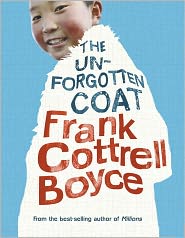
The Unforgotten Coat

The Unforgotten Coat. Frank Cottrell Boyce. Photographs by Carl Hunter and Clare Heney. 2011. Candlewick. 112 pages.

I hadn't seen this photograph since the day it was taken, until now. Even so, I can tell you anything you want to know about it. 

Julie, our narrator, remembers two Mongolian boys who joined her class the second week of summer term. The novel has a reflective feel to it. She remembers their strangeness at first. Their coats. Who wears coats in summer?! But there is something fascinating about their strangeness, their newness too. And the two ask Julie to be their good guide.

These two boys act really strange. They do. Julie does try to understand their culture, their country, their beliefs, their customs. But it's a strange new world, in a way. For example, like the time they invite themselves over to her house, and beg Julie's mom to let them do an emergency baking so they can bake a dough boy to trick the demon that is after them. (They want to trick this demon into eating the dough boy instead of one of them.) And that isn't the only unusual incident.

I can't tell you exactly what happens next, if these two "vanish" as they fear they might or not. But I can say that it is a one weird story about (illegal) immigration.

Honestly, this one left me confused. I almost feel silly for being so confused. But if this one was supposed to wow me or charm me, I just didn't get it. The use of photographs was nice, but I'm not sure exactly what story they're telling. How they fit in with the whole story.

I did like the author's note, for the most part. And I wanted to like this one more than I did.

© 2011 Becky Laney of Becky's Book Reviews
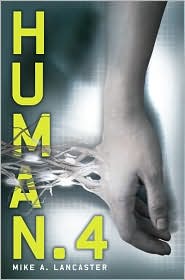
Human.4 (YA)

Human.4 Mike A. Lancaster. 2011. Egmont USA. 240 pages.

When Danny Birnie told us that he had hypnotized his sister we all though he was mad. Or lying. Or both.

Our narrator, Kyle Straker, is living in a strange, strange world where he and three others have suddenly become irrelevant. It started when he volunteered at a local talent show to be hypnotized. It wasn't that he wanted to volunteer, just that in a moment of weakness he had pity on Danny while he was doing his act. His former girlfriend, Lilly, also happened to volunteer just about the same time he did. Two adults, Mrs. O'Donnell and Mr. Peterson, also volunteered. All were hypnotized. All woke up in this strange, strange new reality.

This book is part science fiction, part horror, and part mystery. It was a quick read! I liked it. I wouldn't say I loved it. But for a quick premise-driven read, it was a good choice.

© 2011 Becky Laney of Becky's Book Reviews