Tampilkan postingan dengan label YA Science Fiction. Tampilkan semua postingan

Mothership (YA)

Mothership: Book One of the Ever-Expanding Universe. Martin Leicht and Isla Neal. 2012. Simon & Schuster. 320 pages.

As far as scientists have been able to determine, the primary function of the human coccyx, or tailbone, is to remind us that once upon a time we were all monkeys or something. But I happen to know that it can still serve a useful purpose. Say, for example, that a pregnant teenager three weeks from her due date, who weighs, oh, approximately 145 pounds (lay off, all right? The baby loves ice cream), were shoved down forcefully on a Treadtrack in gym class by a bitchy cheerleader. 

 Our heroine, Elvie Nara, is one of many students attending a special high school for pregnant teens. The school is in space--a space cruiser in Earth's orbit. When her father enrolled her, she had no idea that Britta McVicker would also be there. The hate is mutual. Their due dates are only weeks apart--and for better or worse--their babies will be siblings. Of course, Elvie isn't sure if Britta is aware of that little fact. The thought repulses Elvie actually. Despite the opening paragraph, Elvie rarely thinks in terms of carrying 'a baby.' An "it" or "goober" at best. Elvie definitely has no intention at all of ever, ever, ever feeling maternal.

On the day of the incident when Elvie is alone and eating ice cream, the ship--cruiser--is attacked by another ship. And thus the scare begins, Elvie racing to join the other girls--hoping to stay ahead of the mysterious gunned invaders. She meets a few other girls on the way, and convinces them to join her in her flight. But what she witnesses next...well...it's almost unbelievable. For she witnesses her teachers drowning her classmates. And then one of the invaders tells her that her teachers were in fact evil aliens. And he should know, because, he is an alien too....

Is there any part of Mothership that isn't over-the-top? I'm not sure that there is. I would say that this one should please fans of Bumped and/or Beauty Queens. The narrator, Elvie, is full of snark. (For those that require clean reads--look elsewhere.) And the book is about as believable as Earth Girls Are Easy. The novel is set in the future--2074.

The story is revealed in alternating chapters--jumping between the present (on board the spaceship) and the past (in the months and weeks leading up to her pregnancy). Ducky, her best, best friend is a big part of these flashbacks.

Read for Presenting Lenore's Dystopian August.  

Read Mothership
  • If you like silly, over-the-top, funny adventures that require a suspension of disbelief
  • If you like snarky narrators
  • If you're looking for aliens in your YA

© 2012 Becky Laney of Becky's Book Reviews

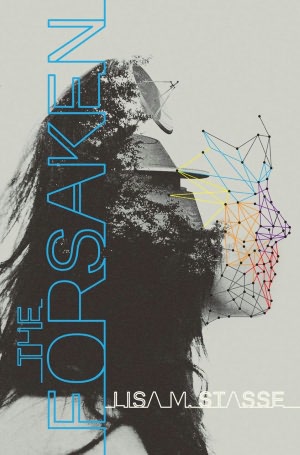
The Forsaken

The Forsaken. Lisa M. Stasse. 2012. Simon & Schuster. 375 pages.

At first I think the hammering sound is the noise of waves crashing down on white sand.

Alenna has "failed" her GPPT (Government Personality Profile Test) and has been sent to Prison Island Alpha. She's heard about the island, obviously, in the past few years, everyone has. She's even seen some of the violence from the island on screen, with the image of one boy, in particular, staying with her in the day or so leading up to her own "test." She never thought she'd be one to fail the test, she never thought she'd test positive for being violent, out of control, a potential danger to others. But she woke up on the island, and though she knows it has to be a mistake, how, do you survive long enough to prove that?

Soon after she wakes up on the island, she meets David, another "mistake" of sorts. He seems so very sane! The two work together--especially at first--trying to survive their first day or two. But they're just beginning to trust one another when they are claimed by different factions on the island. David is taken by the Drones on the "Monk" side of the island, Alenna is taken by the other side. She's given a truth serum, and trained to be a warrior. She makes a couple of friends and finds her place. Liam and Gadya are perhaps the two closest to her.

The book is obviously a thriller with plenty of secrets, secrets, and more secrets.

I enjoyed this one. Is it the best dystopian ever? No. But for those wanting another series like James Dashner's Maze Runner, for those that don't mind more-of-the-same from their dystopias, then this one could satisfy. The world-building isn't amazing. The characters aren't that well-developed. The relationships between the characters aren't fully explored. Is there a love triangle? I don't think so. Not really. True, the main character TALKS to two guys. (She talks to more than two guys.) But the fact that she talks to David and tries to listen and understand him does not mean that she sees him in that way, and there is not proof that he has those kinds of feelings for her either. 


Read for Presenting Lenore's Dystopian August.  


Read The Forsaken
  • If you're in the mood for a YA dystopia
  • If you don't mind a familiar feel to your dystopia
  • If you are looking for something fast-paced and action-driven

© 2012 Becky Laney of Becky's Book Reviews

For Darkness Shows the Stars (MG/YA)

For Darkness Shows the Stars. Diana Peterfreund. 2012. HarperCollins. 416 pages.

Elliot North raced across the pasture, leaving a scar of green in the silver, dew-encrusted grass. Jef followed, tripping a bit as his feet slid inside his too-big shoes. 

I really enjoyed Diana Peterfreund's For Darkness Shows the Stars. Did I enjoy it because it was a futuristic dystopia, OR, because it was a retelling of Jane Austen's Persuasion? A bit of both. For those expecting Captain Malakai Wentforth to be as swoon-worthy as Captain Wentworth, well, you might be disappointed. Might. For Kai's romance with Elliot North doesn't exactly mirror that of Wentworth and Anne Elliot. Peterfreund has definitely made this story her own.

For Darkness Shows the Stars is definitely a novel about social class or status. There are three "types" of people in this futuristic world: the Luddites, those with the highest status and wealth, the elite, those that have estates and titles, those that MATTER; the Reduced, those with slave status, essentially, they are thought to be mindless sub-humans, incapable of thought and feelings, definitely thought to be genetically inferior; the POST-Reductionists, the children of the Reduced who happen to be smart enough to function with more independence in the world, they have skills and abilities that make them worth something, they are not thought to be mindless and incapable, but, they're "socially" inferior to the Luddites. No matter how smart or brilliant a POST is, no matter how much money they acquire, they will never be on equal status with the Luddites.

Kai and Elliot grew up together; they share a birthday in fact. (Actually, there are three that share an exact birthday: Kai (Post), Elliot (Luddite), and Ro (Reduced).) But their friendship always had to be a secret, for if Elliot's father or older sister, Tatiana, found out, then everyone would get in trouble. Elliot enjoyed Kai's company, enjoyed spending time with him in the barn, enjoyed watching him fix things--he's a mechanic, the son of a mechanic. But when Elliot chose not to run away with Kai when they were fourteen (or possibly fifteen?), the friendship was broken. He chose to leave the estate, to risk everything in hopes of finding a better future. Elliot hasn't heard from him since the day he left, and he still matters to her. She chose to stay not because she didn't love him, but, because she needed to be responsible, because she was the ONLY one capable of being responsible on the estate, the only one who cared for the welfare of the Reduced, and also respected the Posts.

Meanwhile, Elliot's life has been as unpleasant as ever. Her father and sister are heartless and selfish and at times cruel. The novel opens with her father destroying his daughter's wheat field--weeks before harvest. That wheat could have helped feed the Reduced, it could have been sold for a profit, as well, to help the estate. But her father's "need" for a race track was more important. He's unwilling to see that the estate is struggling financially that they have a responsibility to the Reduced and the Posts that work their land/manage the estate. Elliot doesn't even bother protesting; true, the damage is already done and nothing can bring her wheat back, but, she also has a secret of her own. That wheat was her wheat--her special experimental seed. And Luddites do NOT under any circumstances experiment.

So in an effort to help finances, Elliot decides to rent out the estate to Cloud Fleet....and one of the guests is Captain Malakai Wentforth. Of course, there are plenty of other guests as well.

I enjoyed meeting the different characters in For Darkness Shows the Stars. Since this is a retelling, there is always a chance that the characters could have been weak, shallow copies of the original. For the most part, that was not the case.

I also enjoyed the story; there were just enough twists in the story that it really worked as an original story. The dystopian setting was interesting to me. I didn't have all my questions answered--at least not right away--and this futuristic society definitely added something to the story. 

Read for Presenting Lenore's Dystopian August

Read For Darkness Shows the Stars
  • If you enjoy science fiction, dystopias, post-apocalyptic fiction
  • If you enjoy futuristic stories 
  • If you are interested in a new retelling of Jane Austen's Persuasion
  • If you enjoy a little romance in your science fiction

© 2012 Becky Laney of Becky's Book Reviews

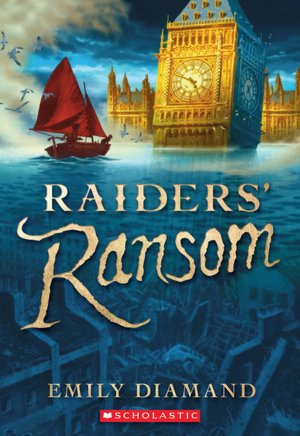
Raider's Ransom (MG)

Raider's Ransom. Emily Diamand. 2009. Scholastic. 368 pages.

Cat puts up his nose to sniff the breath of wind barely filling the sail, and opens his small pink mouth to speak.

Knowing that I could never quite do justice to Raider's Ransom in my review, let me encourage you to just pick up this one and give it a try. I can't promise that you'll love it. But. You just may. It's that kind of book. The kind that actually delivers what it promises.
If you like action/adventure quests, I think you'll really, really appreciate Raider's Ransom. I think you'll enjoy the world Diamand created in the novel. I think there will be scenes that stay with you. I think you'll enjoy not only her world-building but her characterization and storytelling too.

The heroine of Raider's Ransom is a young girl, Lilly. She may be young, but she's a fisherman with a small (very small) boat of her own. And to the dismay of some, she's the owner of a cat, a sea cat. Not something to be taken lightly in her community of survivors. When she's at home, on land, she stays with her grandmother. But. Readers don't get a chance to see a more relaxed Lilly. For the novel opens with Lilly discovering the tragic truth: when she was out sailing her vessel, out fishing, the raiders (or should that be Raiders?) attacked her village. They were looking for something specific, the attack wasn't just random. I don't know if that makes things better or worse for Lilly since one of the things they were looking for was her cat. The Raiders kill Lilly's grandmother, and kidnap the Prime Minister's daughter. One might think that they kidnapped her for a nice ransom, but, they had something even more in mind. They return without their sought-after object, a particular jewel. And that's only the beginning. The problem? Well, I can't talk about this one without revealing too much. I think this is one of those that is best discovered all on your own. Trust me.

So. I won't go into details. But I will say we get another narrator. And that proves most interesting indeed! For I certainly wasn't expecting it at all.

This one went above and beyond all my expectations. It really did. It surprised me in a good way.

Read Raider's Ransom
  • If you like survival stories or starting over stories; 
  • If you like action/adventure stories with a quest, a journey, a mission
  • If you like action stories with battles and close escapes
  • If you like dystopias, novels set in the future with a society quite unlike our own
  • If you like good storytelling

© 2012 Becky Laney of Becky's Book Reviews

Tempest (YA)

Tempest. Julie Cross. 2012. St. Martin's Press. 352 pages. 


Saturday, April 11, 2009,
Okay, so it's true. I can time-travel. But it's not as exciting as it sounds. I can't go back in time and kill Hitler. I can't go to the future and see who wins the World Series in 2038. So far, the most I've ever jumped is about six hours in the past. Some superhero, right?

Tempest is a great example of why you should never judge a book by its cover. For me this cover just doesn't work, it doesn't shout out time-traveling-spies, does it? And with a premise as appealing as time travel (in general) AND featuring mysterious secret agents fighting evil-time-travelers, it should have an awesome cover.

Jackson Meyer is our time-traveling hero with a girlfriend named Holly. But within chapters, Holly's life is in danger--she's dying before his eyes--and Jackson does the only thing he can do: panic as he jumps backwards in time. Because of the traumatic events leading to the jump, Jackson does something he's never done before which traps him in the past--in the year 2007. Once there, he'll have plenty of time to find out who he is, who his father is--why his Dad is so very, very weird and out-of-touch with him, and much much more. He has tons of questions, and he wants some answers at least. Mainly: can he change the future, is there anything he can do to prevent the tragic events leading up to Holly's (alleged) death? Also: can he find a way to jump back to the future, or is he stuck in 2007? Will he have to relive two years of his life? And then there's all the super-super mysterious stuff about himself, his father, his mother, his abilities, etc.

So how does he spend his time? Well, he a) time-travels back and forth in his own past trying to piece together clues b) meets his girlfriend, Holly, years before he "really" meets her c) meets his best friend, Adam, years before he's supposed to really meet him d) confronts his Dad with some super-tough questions.

This one has dangers, thrills, mysteries, secrets, lies, spies, and time-travel. What is NOT to love?! Seriously!!! The book has a GREAT premise. Jackson is a fully developed character whom we get to know surprisingly well considering how this is an action/plot/premise-driven book. Loved the emotional range we get, not only all the scenes about Holly or with Holly, but all the scenes about his twin-sister, Courtney. There was even a great heart-to-heart with his Dad towards the end. The book has a quite a few complex relationships, and I appreciated how they were developed. I loved also the exploration of consequences. I really appreciated the ending, I thought it was just right.

Read Tempest
  • Time travel
  • Good vs. Evil
  • Secret Agents/Secret Agencies
  • Romance from a guy's perspective


© 2012 Becky Laney of Becky's Book Reviews

Fahrenheit 451

Fahrenheit 451. Ray Bradbury. 1953/2003. Random House. 190 pages.

It was a pleasure to burn. 

Fahrenheit 451 is so wonderful, so beautiful, so amazing that it almost leaves me speechless. It is a haunting story of a bleak future. Our hero, Guy Montag, is in a loveless marriage with his wife, Mildred. He meets a young, vibrant girl, Clarisse, and they talk--talk of nothing and everything. She dares to think, to ask questions, to be curious, to be full of wonder and life, to have a spark of something that has almost been lost in society and civilization. But, her tragic end helps focus Montag's perspective. It has been coming for a while now, perhaps ever since meeting that old man, Faber, in the park, but Montag knows that he can no longer live the lie. He no longer wants to burn books, to burn houses of people who love books. He no longer wants to be a fireman. He wants to read books; he wants to learn; he wants to know what it is like to LIVE again, to think, to think critically, to think about things even if it means being sad or sorrowful or anxious and worried. He doesn't want to be mindlessly entertained by "the family" on three of his walls or a seashell in his ears. Even if there is a scary war coming. He wants to stand against the majority and face reality.

I think this is a book everyone needs to read...at least once. I could easily read it once a year! It's just a wonderful novel!!!

Favorite quotes:
Who knows who might be the target of the well-read man? Me? I won't stomach them for a minute...Remember, Montag, we're the happiness boys. We stand against the small tide of those who want to make everyone unhappy with conflicting theory and thought. (50-1)  
 We've started and won two atomic wars since 1990! Is it because we're having so much fun at home we've forgotten the world? Is it because we're so rich and the rest of the world's so poor and we just don't care if they are? Is that why we're hated so much? Do you know why? I don't, that's sure! Maybe the books can get us half out of the cave. God, Millie, don't you see? An hour a day, two hours, with these books, and maybe... (62)
Good God, it isn't as simple as just picking up a book you laid down half a century ago. Remember, the firemen are rarely necessary. The public itself stopped reading of its own accord. (78)
 It’s been a long time. I’m not a religious man. But it’s been a long time.’ Faber turned the pages, stopping here and there to read. ‘It’s as good as I remember. Lord, how they’ve changed it in our parlors these days. Christ is one of the family now. I often wonder if God recognizes His own son the way we’ve dressed him up, or is it dressed him down? He’s a regular peppermint stick now, all sugar-crystal and saccharine when he isn’t making veiled references to certain commercial products that every worshiper absolutely needs.’ (81)
Do you know why books such as this are so important? Because they have quality. And what does the word quality mean? To me it means texture. This book has pores. It has features. This book can go under the microscope. You'd find life under the glass, streaming past in infinite profusion. The more pores, the more truthfully recorded details of life per square inch you can get on a sheet of paper, the more 'literary' you are. That's my definition, anyway. Telling detail. Fresh detail. The good writers touch life often. the mediocre ones run a quick hand over her. The bad ones rape her and leave her for the flies. So now do you see why books are hated and feared? They show the pores in the face of life. The comfortable people want only wax moon faces, poreless, hairless, expressionless. we are living in a time when flowers are trying to live on flowers, instead of growing on good rain and black loam. (83)
There is a richness in Fahrenheit 451, a depth that most books don't have perhaps. There's just something about it that makes it timeless and memorable and thought-provoking.

Read Fahrenheit 451
  • If you like to read books
  • If you find intellectual freedom important
  • If you enjoy science fiction, particularly vintage science fiction
  • If you are looking for a timeless classic
  • If you enjoy dystopias 

© 2012 Becky Laney of Becky's Book Reviews

The Martian Chronicles (YA/Adult)

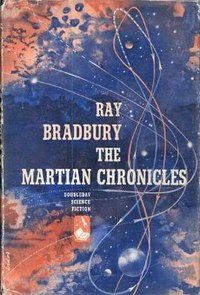
1997, edition of The Martian Chronicles
Martian Chronicles. Ray Bradbury. HarperCollins. 1997 edition. 288 pages.
One minute it was Ohio winter, with doors closed, windows locked, the panes blind with frost, icicles fringing every roof, children skiing on slopes, housewives lumbering like great black bears in their furs, along the icy streets.
And then a long wave of warmth crossed the small town. A flooding sea of hart air; it seemed as if someone had left a bakery door open. The heat pulsed among the cottages and bushes and children. The icicles dropped, shattering, to melt. The doors flew open. The windows flew up. The children worked off their wool clothes. The housewives shed their bear disguises. The snow dissolved and showed last summer's ancient green lawns.
Rocket summer. The words passed among the people in the open, airing houses. Rocket summer. The warm desert air changing the frost patterns on the windows, erasing the art work. The skis and sleds suddenly useless. The snow, falling from the cold sky upon the town, turned to a hot rain before it touched the ground. Rocket summer. People leaned from their dripping porches and watched the reddening sky. (1)
The 2012 Mass Paperback of The Martian Chronicles
I LOVE, LOVE, LOVE Ray Bradbury's The Martian Chronicles. This is the second or third time I've read this one. And each time I read it, I end up loving it even more. It's like each time I'm surprised by how much I love it. Like in between readings I forget how engaging and compelling it is. I settle into thinking that it was just me exaggerating things (again). That it couldn't possibly be that good. But no. It is that good.

The edition I read this time had twenty-seven stories; some of these 'stories' are just vignettes, or short preludes, transition pieces of a paragraph or two. But many are full-length stories. There are some great stories in this one.
  • January 2030 Rocket Summer
  • February 2030 Ylla
  • August 2030 The Summer Night
  • August 2030 The Earth Men
  • March 2031 The Taxpayer
  • April 2031 The Third Expedition
  • June 2032 --And the Moon Be Still as Bright
  • August 2032 The Settlers
  • December 2032 The Green Morning
  • February 2033 The Locusts
  • August 2033 Night Meeting
  • October 2033 The Shore
  • November 2033 The Fire Balloons
  • February 2034 Interim
  • April 2034 The Musicians
  • May 2034 The Wilderness
  • 2035-2036 The Naming of Names
  • April 2036 Usher II
  • August 2030 The Old Ones
  • September 2036 The Martian
  • November 2036 The Luggage Store
  • November 2036 The Off Season
  • November 2036 The Watchers
  • December 2036 The Silent Towns
  • April 2057 The Long Years
  • August 2057 There Will Come Soft Rains
  • October 2057 The Million Year Picnic
1950 edition of The Martian Chronicles
I wasn't aware that there were different editions of this one, and that the stories could vary depending on the edition. Also the dates have been modified (by thirty years) in some editions, like the edition I read this time around. The very, very newest edition has the original dates, 1999-2026. This newest edition does not have "The Fire Balloons." Also, instead of "The Wilderness" it has "Way in the Middle of the Air."

My thoughts on individual stories, and, first sentences from the stories

"Ylla"
They had a house of crystal pillars on the planet Mars by the edge of an empty sea, and every morning you could see Mrs. K eating the golden fruits that grew from the crystal walls, or cleaning the house with handfuls of magnetic dust which, taking all dirt with it, blew away on the hot wind.
A story told solely from the perspective of the Martians, in this case, a husband and wife. A husband has a very definite reaction to his wife's strange dreams. She dreams of a man, Nathaniel York, coming in a ship, in a rocket, and landing. The dream even tells her where and when. But her controlling and perhaps jealous husband has a way of dealing--for once and for all--with his wife's dreams.

"The Earth Men"
Whoever was knocking at the door didn't want to stop. Mrs. Ttt threw the door open. "Well?"
The story of the second expedition. Let's just say that the welcoming committee wasn't quite what they expected! First, NO ONE wanted to bother with them, then they were greeted by a strange assortment of Martians all claiming to be from Earth. And then....well, that wouldn't be polite of me to spoil it!


"The Third Expedition" (aka Mars is Heaven)
The ship came down from space. It came from the stars and the black velocities, and the shining movements, and the silent gulfs of space. It was a new ship; it had fire in its body and men in its metal cells, and it moved with a clean silence, fiery and warm. In it were seventeen men, including a captain. 
This one is a classic short story that you may have stumbled across in another context from The Martian Chronicles. (I've heard two radio adaptations, for example.) And the title is self-explanatory. It is the story of what happens when the third expedition lands. It is the story of what they see and  WHO they see. It is a story that stretches you, perhaps. But it's a good one!

"--And the Moon Be Still As Bright"
It was so cold when they first came from the rocket into the night that Spender began to gather the dry Martian wood and build a small fire. He didn't say anything about a celebration; he merely gathered the wood, set fire to it, and watched it burn.
And now we're on to the fourth expedition, the fourth rocket ship to successfully land on Mars. This time they manage to stay alive past the initial day or two or three. This is the story of what happens when one of the crew members, Spender, goes off on his own to learn the Martian culture, to explore the ruins, to explore the cities, to examine the artifacts and remnants of a culture that is gone with the wind. What happens next...well....there are a million reasons why readers shouldn't sympathize with Spender, but, like Captain Wilder, they may feel the pull all the same.

"The Settlers"
The men of Earth came to Mars. They came because they were afraid or unafraid, because they were happy or unhappy, because they felt like Pilgrims or did not feel like Pilgrims. There was a reason for each man. They were leaving bad wives or bad jobs or bad towns; they were coming to find something or leave something or get something, to dig up something or bury something or leave something alone. They were coming with small dreams or large dreams or none at all.
One of my favorite vignettes. For some reason it reminds me of John Steinbeck.

"Night Meeting"
Before going on up into the blue hills, Tomas Gomez stopped for gasoline at the lonely station.
There is something haunting and fantastical about this short story of a human and Martian meeting and not exactly seeing the same reality.

"The Fire Balloons"
Fire exploded over summer night lawns. 
 I first read "The Fire Balloons" in another collection of Ray Bradbury stories. I didn't, at the time, see it as being part of The Martian Chronicles. (And, in fact, it wasn't part of the edition I first read.) But now it is one of my favorite stories! In it two priests go to Mars as missionaries. One at least was expecting, was hoping, to meet Martians, to actually BE a missionary TO Martians, to an alien species. So when given the opportunity of going out into the hills and trying to communicate with blue balloon-like hovering creatures OR ministering to humans who have migrated to Mars, the answer is clear to Father Peregrine. But do the Martians need his church? This story has one of my favorite quotes:
"Father Peregrine, won't you ever be serious?"
"Not until the good Lord is. Oh, don't look so terribly shocked, please. The Lord is not serious. In fact, it is a little hard to know just what else He is except loving. And love has to do with humor, doesn't it? For you cannot love someone unless you put up with him, can you? And you cannot put up with someone constantly unless you can laugh at him. Isn't that true? And certainly we are ridiculous little animals wallowing in the fudge bowl, and God must love us all the more because we appeal to His humor."
 "The Wilderness"
Oh, the Good Time has come at last--
It was twilight and Janice and Leonora packed steadily in their summer house, singing songs, eating little, and holding to each other when necessary. But they never glanced at the window where the night gathered deep and the stars came out bright and cold.
This is another story that I ended up loving. And it was new-to-me too, it not being part of the original. But in this story we meet two women who are about to travel to Mars to get married and settle down. (The men having gone first.) The story likens exploring and settling Mars to exploring and settling the Old West (places like Wyoming, California, Oregon, etc.) It is about how the two handle their last night on Earth.
Is this how it was over a century ago, she wondered, when the women, the night before, lay ready for sleep, or not ready, in the small towns of the East, and heard the sound of horses in the night and the creak of the Conestoga wagons ready to go, and the brooding of oxen under the trees, and the cry of children already lonely before their time?...Is this then how it was so long ago? On the rim of the precipice, on the edge of the cliff of stars. In their time the smell of buffalo, and in our time the smell of the Rocket. Is then then how it was? And she decided, as sleep assumed the dreaming for her, that yes, yes indeed, very much so, irrevocably, this was as it had always been and would forever continue to be. 
"Usher II" (aka Carnival of Madness)
"During the whole of a dull, dark and soundless day in the autumn of the year, when the clouds hung oppressively low in the heavens, I had been passing alone on horseback, through a singularly dreary tract of country, and at length found myself, as the shades of evening drew on, within view of the melancholy House of Usher..." Mr. William Stendahl paused in his quotation. There, upon a low black hill, stood the house, its cornerstone bearing the inscription: 2036 A.D.
I remembered this as being one of the stories in A PLEASURE TO BURN, a Ray Bradbury collection celebrating the creative stories leading up to the writing/publishing of Fahrenheit 451. And it was first published as "Carnival of Madness." But it was also part of Ray Bradbury's book, The Martian Chronicles. And it is perhaps one of the most memorable of the collection. It is a true must read for anyone who loves Fahrenheit 451, for it continues on some of the same themes. I don't want to say too much about it really, because it shouldn't be spoiled at all if you want to get the full enjoyment of it!

"The Martian"
The blue mountains lifted into the rain and the rain fell down into the long canals and old LaFarge and his wife came out of their house to watch. 
An elderly couple have come to Mars and one night they are surprised by the appearance of their "son" (who died and was buried back on Earth). Their "son" doesn't want to leave the house, and is enjoying his family too much to risk getting "trapped" by going into the city and interacting with others. This story is creepy.

"The Luggage Store," "The Off Season," "The Watchers," "The Silent Towns," "The Long Years," "There Will Come Soft Rains," and "The Million Year Picnic."

These stories, I feel, work best as a sequence showing what happens both on Earth and Mars when the worst happens--atomic war on Earth. In "The Luggage Store," one speculates that his business will improve greatly if the war happens, if the worst happens. He feels that everyone will want to go back home to Earth to be with their loved ones, to find out if their loved ones are okay, to try to piece their society and civilization back together. In "The Off Season" readers learn that the war has started and the destruction has begun. There is nothing truly comical about it, but, it does happen to be told from the point of view of a man who has just opened a hot dog stand. "The Watchers" shows the people leaving Mars to return to Earth--for better or worse. "The Silent Towns" and "The Long Years" are two stories set on Mars. The first, "The Silent Towns" is told from the point of view of a man who chose to stay behind. He's lonely, but not THAT lonely it turns out. He does meet one woman who stayed behind, but, he decides that his own company is enough after all. "The Long Years" sees the return of Captain Wilder, I believe, who discovers a man and his family. There is a twist, however, which prevents this one from being a happy story. "There Will Come Soft Rains" is a very, very, very lonely story where we get a glimpse--just a small glimpse perhaps--of the desolation and destruction of life as we know it in at least one human city. We see the ending of an era, perhaps. There are no human characters in this one. "The Million Year Picnic" resonates even more when seen back-to-back with "There Will Come Soft Rains." In this story, readers meet a family: parents and sons who have come to Mars on their own private Rocket--a rocket that has been hidden away for many years, a rocket that has been saved for a true emergency. We meet a father who has prepared for THE END in a big, big way.

Read The Martian Chronicles
  • If you love science fiction
  • If you like science fiction
  • If you enjoy short stories; if you don't enjoy short stories
  • If you are a fan of Ray Bradbury
  • If you are a fan of the Twilight Zone

© 2012 Becky Laney of Becky's Book Reviews

Two Graphic Novels (Ray Bradbury)

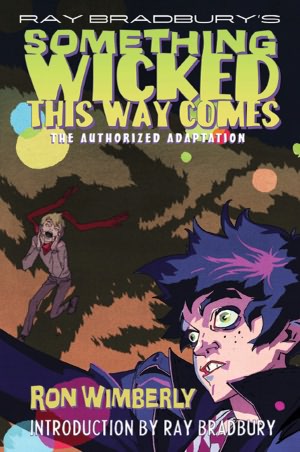
Ray Bradbury's Something Wicked This Way Comes, The Authorized Adaptation. Ron Wimberly. Introduction by Ray Bradbury. 2011. FSG. 144 pages.

First of all, it was October. A rare month for boys. Not that all months aren't rare. But there be bad and good, as the pirates say. Take September, a bad month: school begins. Consider August, a good month: school hasn't begun yet. July, well, July's really fine: there's no chance in the world for school. June, no doubting it, June's best of all, for the school doors spring wide and September's a billion years away. But you take October, now. School's been on a month and you're riding easier in the reins, jogging along. 

What makes a graphic novel adaptation work? I'm not sure I could say. For graphic novels are not in my comfort zone at all. I rarely pick up graphic novels to "review," for I don't feel qualified to comment. The graphic novels I tend to read are adaptations of novels that I've already read--for better or worse.

I recently read the official adaptation of Ray Bradbury's Something Wicked This Way Comes. What did I think of it? Well, it made me WANT to read the book, the "real" book. This story, in its adaptation, in its abridgment, just wasn't enough to satisfy me. I wanted more, needed more. That's not a bad thing at all. If every single reader of this graphic novel responds the same way I did--with the NEED or DESIRE to pick up the original Ray Bradbury novel, that wouldn't be a bad thing. Indeed, you might say it was a GOOD thing. For there is no replacing, no improving the original novel.

The magical wonder--the horror, the terror, the suspense--of this story is in the words, the phrases, the sentences. And this graphic novel adaptation is able to only capture a part of that wonder. Every reader will have to decide for himself (or herself) if the addition of the illustrations is worth losing a little something of the original. (For the record, only the cover has colored illustrations, the rest of the graphic novel is in black and white.) For me, the graphic novel just doesn't have that magical something of the original.

Read Ray Bradbury's Something Wicked This Way Comes, The Authorized Adaptation
  • If you're a fan of graphic novels
  • If you're a fan of dark fantasy, horror, and suspense
  • If you're looking for a dark(er) coming of age story
  • If you're a participant of the R.I.P. challenge and are looking for an easy read you could finish in just an afternoon
  • If you're a fan of Ray Bradbury
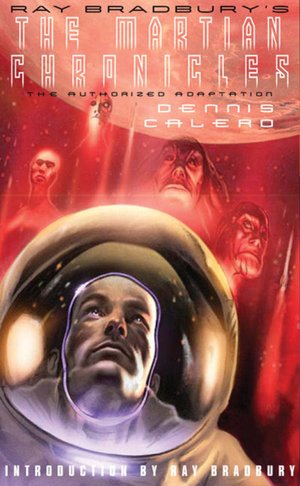
Ray Bradbury's The Martian Chronicles, The Authorized Adaptation. Dennis Calero. Introduced by Ray Bradbury. 2011. FSG. 160 pages.

One minute it was Ohio winter, with doors closed, windows locked, the panes blind with frost, icicles fringing every roof, children skiing on slopes, housewives lumbering like great black bears in their furs along the icy streets.

Compared to the adaptation of Ray Bradbury's Something Wicked This Way Comes, the official adaptation which I reviewed above, this adaptation of The Martian Chronicles is very satisfying indeed! Now, here's where it becomes tricky, compared to the original novel by Ray Bradbury, it still is second best at most. (I haven't listened to it on audio, or any radio dramas of it, and I definitely didn't make it past the twenty minute mark on the made-for-TV adaptation of it.) I definitely liked the cover and thought it well done! And the illustrations in this graphic novel are full color!!!

If this adaptation was a FULL adaptation, I wouldn't hesitate to give it my highest recommendation. But. Readers do not get the full collection of stories. Readers get just fourteen out of 27 stories. Here are the stories readers do get:
  • Rocket Summer
  • Ylla
  • The Summer Night
  • The Earth Men
  • The Third Expedition
  • --And the Men Be Still As Bright
  • The Green Morning
  • Night Meeting
  • Interim
  • The Musicians
  • The Martian
  • The Off Season
  • The Watchers
  • The Million-Year Picnic
Here are the stories, readers will be missing out on:
  • The Taxpayer
  • The Settlers
  • The Locusts
  • The Shore
  • The Fire Balloons
  • The Wilderness (*I believe The Wilderness replaced "Way In the Middle of the Air" in some editions. I don't know how other readers feel about the change, but I'm all for it. The Wilderness is a much better story in my opinion.) 
  • The Naming of Names
  • Usher II
  • The Old Ones
  • The Luggage Store
  • The Silent Towns
  • The Long Years
  • There Will Come Soft Rains
It is just wrong, wrong, WRONG that this adaptation does not include "Usher II" and "There Will Come Soft Rains."

Some of what is 'missing' are just vignettes or preludes, but, I think some of the preludes help transition between stories. For example, reading "The Luggage Store" before "The Off Season" helps. As does reading "The Old Ones" before "The Martian." And I think something is lost by not including "The Silent Towns" and "The Long Years" which reflect the absence of life on Mars, and "There Will Come Soft Rains" is the perfect, perfect story for setting up "The Million Year Picnic". Something important, something vital is missing--in terms of tone, of message--if you don't have the full sequence.

So the full-length stories that are missing are: The Fire Balloons, The Wilderness, Way In the Middle of the Air, Usher II, The Silent Towns, The Long Years, There Will Come Soft Rains.

How do I feel about the adaptations? Well, I thought some of them were well done. Probably my favorite adaptation was "Night Meeting."

Is the original novel still best? Yes!!! I won't lie. This collection of short stories is so wonderful, so amazing, so incredible, so thoughtful, so soulful, so beautiful, so practically perfect in every way that I have to say that the original is better than any adaptation.

Read Ray Bradbury's The Martian Chronicles, The Authorized Adaptation
  • If you're a fan of science fiction
  • If you're a fan of Ray Bradbury
  • If you're a fan of graphic novels
  • If you love short stories, Ray Bradbury's are among the BEST.
© 2012 Becky Laney of Becky's Book Reviews

Insurgent (YA)

Insurgent. Veronica Roth. 2012. HarperCollins. 525 pages.

 I absolutely LOVED Veronica Roth's Divergent. I just LOVED, LOVED, LOVED it. I recently reread it too just to prepare myself for reading the sequel, Insurgent. So how do the two compare? Well, I'm not sure that's ever a fair question. The better question may be did I love it? And the answer to that one is much, much easier! Yes, I loved Insurgent. Now does loving it translate into just love or love, love, love? Only time will tell.

Insurgent starts right where Divergent left off, which was great for me since I'd just read Divergent. Beatrice (Tris) is on the run with a handful of people including her boyfriend, Four, and her brother, Caleb. But among this group of survivors are a few people Tris doesn't trust or exactly like. They are seeking refuge with Amity unsure of their welcome. Well, unsure of how long-term this welcome will be. Amity is the kind of faction that gets along with everyone no matter how good or bad. But Tris and Four are almost sure that they cannot stay with Amity, they still have unfinished business.

While Insurgent definitely introduces new business--new dangers, new threats, new risks, etc--it does a great job in terms of consequences. Tris and Four (and the others) have a big, big mess to deal with. Many people have lost loved ones, many have lost homes, all have lost security. Tris' losses are monumental. She has lost both parents, parents with secrets that are only now coming to light, and she's dealing with her choices. Specifically her choice that led to a former friend, a close friend, losing his life. She is HAUNTED, beyond haunted almost, by what she has done.

But there is no time for Tris to relax, not really, for every day brings more decisions. Tris is having to make some tough, tough decisions; decisions that will impact not only her life, not only her relationship with her boyfriend, but will impact potentially everyone. And she struggles with the weight of it all. Does she have the right to think for herself? Does she have the right to disagree with the leaders? With the leaders of her own faction? Does she have the right to question people she's been told are trustworthy? How does she know who to trust?

I definitely loved this one! And I loved getting to know the characters. I loved the world-building, getting a chance to learn more about the other factions and the factionless too.

Read Insurgent
  • If you loved Divergent, or, even if you just liked Divergent
  • If you enjoy science fiction and dystopias
  • If you like dystopias with good world-building and a little romance too
© 2012 Becky Laney of Becky's Book Reviews

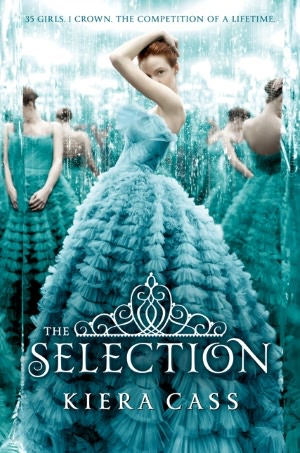
The Selection (YA)

The Selection. Kiera Cass. 2012. HarperCollins. 327 pages.

When we got the letter in the post, my mother was ecstatic. She had already decided that all our problems were solved, gone forever. The big hitch in her brilliant plan was me. I didn't think I was a particularly disobedient daughter, but this was where I drew the line.

The key to enjoying this one may be to approach it with no expectations at all. If you've been told--and I'm not sure who is doing the telling--that this one is in any way like The Hunger Games, then you'll be disappointed most likely. I admit that both books do have a love triangle. And I suppose that both books have a reality-TV aspect to them to a certain degree. But really these are two completely different books.

If The Selection reminded me of any book at all, it was the book of Esther from the Old Testament. Our heroine, America Singer, is one of thirty-five young women chosen to be a potential princess. The Prince, the heir to the throne, is about to begin courting these women--one woman from each district in the realm. They will live at the palace--along with the royal family, though on a different floor. The women will receive makeovers, beauty treatments, wardrobes, etc. The women will also undergo some training. Training that will only increase as the Prince narrows down the women from thirty-five to six. (Ultimately, of course, he'll be choosing one woman. But this book is the first book in a series, and the end of this book only gets us down to six.) America soon realizes that for some, it's a matter of seeing the crown and only the crown. In other words, they want to be princess--ultimately queen--and they don't care who they have to marry to get it. But other women do seem to care for the prince as a person--America is one of them.

The Love Triangle. My feelings weren't torn between the two men at all. I don't know how much I can say about the romance of this one without spoiling things. But. This one is mostly dialogue between America and Prince Maxon. And I liked that. When I'm reading romance, I want dialogue. I want to get to know both the heroine and the hero. I want to see the relationship develop.

What would have made this book more satisfying is if it had been resolved in one book...


Is The Selection the absolute best book I've ever read? Of course not. Was the characterization amazing? Not really. But did I really enjoy it? Did I read it in one day? Were there scenes that made me smile? Yes. Yes. Yes.

Read The Selection
  • If you're looking for a very light, somewhat shallow romance with shades of dystopia, political unrest, and terrorism. 
  • If you like romance with LOTS of dialogue
  • If you love books with love triangles (If you HATE books with love triangles, or if you especially hate dystopias with love triangles, this one won't be for you).


© 2012 Becky Laney of Becky's Book Reviews
Rereading Unwind

Unwind. Neal Shusterman. 2007. Simon & Schuster. 336 pages.

The prologue:  The Second Civil War, also known as "The Heartland War," was a long and bloody conflict fought over a single issue. To end the war, a set of constitutional amendments known as "The Bill of Life" was passed. It satisfied both the Pro-life and the Pro-choice armies. The Bill of Life states that human life may not be touched from the moment of conception until a child reaches the age of thirteen. However, between the ages of thirteen and eighteen, a parent may choose to retroactively "abort" a child...on the condition that the child's life doesn't technically end. The process by which a child is both terminated and yet kept alive is called "unwinding." Unwinding is now a common and accepted practice in society. 

First sentence: "There are places you can go," Ariana tells him, "and a guy as smart as you has a decent chance of surviving to eighteen." Connor isn't so sure, but looking into Ariana's eyes makes his doubts go away, if only for a moment. 

Did you know there is going to be a sequel to Unwind?! I know!!!! It's very exciting news. As soon as I learned about Unwholly--which releases in late August 2012--I knew I just HAD to reread Unwind. It's been years since I read Unwind, and essentially I just remembered how great it was and how it was near impossible to put it down. It was just so intense, so compelling, so DIFFERENT from what I was used to reading--at least at the time.

And I am very glad I took the time to reread this one. It is just as great as I remembered.

Imagine living in a world where—if you're a teenager—your life is constantly in danger. If you anger your parents just one time too many, you could be on the next bus out of town heading to a Harvest camp or the "chop shop" as it's called in slang. Your organs—every single part of you (except maybe your appendix), stripped away and 'donated' to make someone else's life better. This scenario is about to become terrifyingly real to three teenagers.

Connor is a guy who hasn't always had the best temper or attitude. But he never thought his parents could be so cruel as to unwind him just because he's going through a "difficult" stage. After accidentally finding the papers that will end his life—at least as he knows it—he decides to run away. After all, if he can manage to survive for two or three years—until his eighteenth birthday—he'll be safe and legal.

Risa is a girl from the State Home. She is a musical prodigy, but after making a few mistakes at a concert, she's told she's reached her potential in life and that she can best serve society now as an Unwind. After all, they can only feed and house so many, and new babies arrive all the time. It's normal to eliminate at least 5% of the teen population every year.

 Lev is different from Connor and Risa. He's only thirteen. But the big difference? Lev has known all along that he was 'destined' to be unwound. He's a tithe. A baby set apart from birth—chosen from birth—to be sacrificed on his thirteenth birthday for the good of society. He is told that his is a holy service, a holy life. It's a "religious" and "spiritual" experience or gift. After all, there is no greater gift of love than when a man lays down his life, right? When these three meet for the first time, it is pure chaos. But their lives, their destinies, are woven together for better or worse. Can these teens escape their fate?

Told through many narrators, Unwind is a suspenseful, fast-paced read. While the premise is fascinating in and of itself, Shusterman manages to make this story resonate with strong characters. The world he creates is haunting yet not completely without hope and redemption as people—teens and adults—team up to change the world one step at a time.

Unwind by Neal Shusterman is dystopia at its best.

Quotes:
"Funny but when he was little Connor was terrified of the boogeyman. He would have to sleep with the lights on, he would have his parents check his closet every night. They told him that the boogeyman wasn't real, but they lied. The Bill of Life made the boogeyman real, and he didn't need the closet; he came walking right in through the front door." (4) 
"What does it take to unwind the unwanted? It takes twelve surgeons, in teams of two, rotating in and out as their medical specialty is needed. It takes nine surgical assistants and four nurses. It takes three hours." (288)
Read Unwind
  • If you're a fan of dystopias, yes, it is YA dystopia, but I think adults will enjoy this one too.
  • If you're a fan of science fiction; if you like thought-provoking science fiction.
  • If you're looking for a book that's hard to put down.
  • If you're a fan of Neal Shusterman.
  • If you're looking forward to the sequel, Unwholly, and want to refresh your memory of the first book. 
© 2012 Becky Laney of Becky's Book Reviews

Rereading Divergent (YA)

Divergent. Veronica Roth. 2011. May 2011. HarperCollins. 496 pages.

There is one mirror in my house. Our faction allows me to stand in front of it on the second day of every third month, the day my mother cuts my hair. It is behind a sliding panel in the hallway upstairs.

What my original review couldn't tell you is how much I've continued to LOVE, LOVE, LOVE Veronica Roth's Divergent.  I read this one last February, and it remained a favorite throughout the year. It definitely came close to topping my favorite-and-best list of 2011. And was by far the best YA book I read last year. There was something about Beatrice (Tris) and Tobias (Four) that stuck with me. I wanted to pick it up a half a dozen times at least to reread it, but I restrained myself. I wanted to save it up to read it close to the release date of the second book in the series, Insurgent. The truth is the moment I finished Divergent (the first and second time) I wanted, no, NEEDED, Insurgent to be right there for me to pick up. Of course, that was impossible.

From my original review:
Beatrice Prior, our sixteen-year-old narrator, is about to make the most important decision of her life. For two big days are coming: the day of the aptitude test and the Choosing Ceremony. Soon Beatrice will have to decide which faction she'll belong to for the rest of her life. If she chooses outside her parents' faction, she may never see them again. For ties to one's faction must come first. The five factions are as follows: Abnegation (the selfless), Amity (the peaceful), Candor (the honest), Dauntless (the brave), and Erudite (the intelligent). Beatrice has been raised Abnegation, but it's always felt like a wrong fit. Selflessness does not come easy for her. She has spent the first sixteen years of her life practically invisible--blending into the background. But Beatrice has secretly been watching her Dauntless classmates. Dare she admit it aloud? She's thinking of choosing the most rebel faction of all!

But not all initiates make it into the Dauntless faction. Only the bravest. Only the strongest. Only the best. Readers follow Tris (Beatrice) on her new journey. We meet fellow initiates--those born Dauntless, and those transferring from other factions. We follow their training through three stages. They will be challenged physically, mentally, and emotionally. We become familiar with their two trainers--Eric and Four. We see the faction's strengths and weaknesses. As does Tris. On the one hand, Tris realizes she is fierce. She can be strong, determined, brave. She is learning to face her fears, learning to face life. But she's also realizing that compassion and love are part of courage. That selflessness has prepared her for her new life. On the other hand, she sees how heartless, how cruel some are. Yes, the Dauntless have their flaws.

Divergent is an action-packed dystopia. It's exciting. It's compelling. It's impossible to put down. The futuristic Chicago setting has been well-crafted. While only two factions are explored in this first novel in the trilogy, the glimpses we get of this world are fascinating. I loved the setting, the world-building. I loved the characters. Tris is such a great heroine. And Four. Well, I don't want to spoil it. But he's definitely a large part of why I loved this one! I would definitely recommend this one. I think I loved it even more than The Hunger Games trilogy.
What I can add:

There's nothing more to think about. I definitely, definitely LOVE, LOVE, LOVE this one above and beyond the Hunger Games. It's no contest really for me. I love this one above and beyond almost all the YA Science Fiction I've ever read. And maybe even more than I love most of the adult science fiction I've read.

And I just LOVE, LOVE, LOVE Four. I do. I just love every single scene he's in. He's giddy-making and oh-so-swoonworthy. (He even surpasses Marcus Flutie, something I thought near impossible. For those not familiar with Marcus Flutie--and why aren't you?--he's from Megan McCafferty's Jessica Darling series. The first book is Sloppy Firsts.)

Read Divergent
  • If you want to read a GREAT dystopian novel; I love it for the world-building; I love it for the characterization; I love it for its action and drama; I love it for its swoonworthy romance. This is NOT a romance book thinly disguised as dystopia. It's not. I promise.
  • If you want to read a great YA book. I know not every adult will pick up a YA book. I know some are prejudiced against reading YA. But. This book deserves to be read no matter your age!
  • If you want a book that you just CAN'T PUT DOWN. 

© 2012 Becky Laney of Becky's Book Reviews
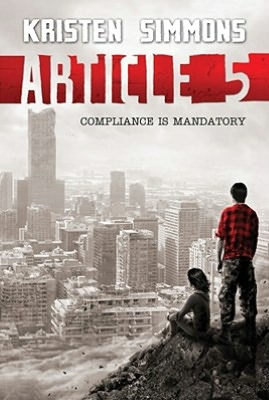
Article 5 (YA)

Article 5. Kristen Simmons. Tor. 368 pages.

Beth and Ryan were holding hands. It was enough to risk a formal citation for indecency, and they knew better, but I didn't say anything. Curfew rounds wouldn't begin for another two hours, and freedom was stolen in moments like these.

If you enjoy YA dystopias, then you should give Kristen Simmons' Article 5 a try. There's no guarantee that you'll love it or even like it. You may not even want to finish it. But. I think it's worth trying for yourself--especially if your library has a copy. There are so very, very many dystopias available now that it is easy to tire of them. You do have to be in the proper mood to enjoy a dystopia, and if you're already tired of the genre, well, give it time--plenty of time. It's better to wait and get back in the mood than to push it.

And if romance annoys you, well, Article 5 may be one that you're never in the mood to read. BUT. That isn't a bad thing. I am not against *some* dystopias having *some* romance. I'm just of the opinion that the romance should be natural, should feel authentic and not forced. Romance should never, ever, ever be a requirement for dystopian novels. And when 90% of the focus is on romance and only 10% given over to world-building, well, it can get annoying very quickly. If you LOVE romance, then there shouldn't be a problem with Article 5. (Though I'm not saying that every reader will love this hero and heroine.)

I honestly don't know how I feel about Article 5. So I'll stick with what I do know. Article 5 was not a painful read. I read it in two days. And it was, for the most part, an easy read. It was a book that I definitely wanted to finish. And at the end of it, I didn't regret my time. But did I like it enough to say that I liked it? I'm not sure. Ember, our heroine, was an odd heroine. She didn't seem all that smart. And some of her rigid ideas of right and wrong seemed a little out of place considering the world she lived in. I can't really give an example without spoiling the book. But when you're trying to survive, fighting to live, and there are people hunting you down, people who are very brutal, who wouldn't hesitate to shoot you dead no questions asked, then you shouldn't be lecturing your boyfriend on how he was wrong to use violence to protect you from being raped and possibly killed. You just shouldn't. There were a couple of scenes where Ember was just impossible to like, impossible to understand. Chase is the boyfriend that she has a love/hate relationship with. (She feels she always knows what is best, what is right, what they should do, how they should do it, even though Chase has way, way, way more experience in dealing with the real world.)

Read Article 5
  • If you enjoy YA dystopias, YA science fiction
  • If you like YA romances
  • If you like action/survival novels
© 2012 Becky Laney of Becky's Book Reviews

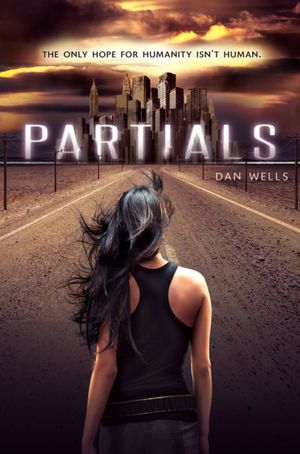
Partials (YA)

Partials. Dan Wells. 2012. HarperCollins. 480 pages.

Newborn #485GA18M died on June 30, 2076, at 6:07 in the morning. She was three days old. The average lifespan of a human child, in the time since the Break, was fifty-six hours. They didn't even name them anymore. Kira Walker looked on helplessly while Dr. Skousen examined the tiny body. The nurses--half of them pregnant as well--recorded the details of its life and death, faceless in bodysuits and gas masks. The mother wailed despondently from the hallway, muffled by the glass. Ariel McAdams, barely eighteen years old. The mother of a corpse.

It has been eleven years since a deadly virus (RM) killed most of the human race. The survivors who had--for one reason or another--a natural immunity to the virus have joined together and resettled on Long Island. The youngest human alive is a little over fourteen. Not long after the novel opens, the school shuts down because there are no more students to teach, and the teens are deemed old enough to go into a trade or be apprenticed into a trade. (Kira is in the medical field. She's not quite eighteen yet, so she's not "required" to be pregnant yet. But the Hope Mandate legislates women's lives. Humanity must be saved. And that means every woman old enough must do her part. True, no baby has survived past a few days old in eleven years. But they have to keep trying, right? They just can't give up on finding a cure and successfully reproducing, right? Well, hope isn't easy to come by. But when Kira's best friend becomes pregnant, she becomes DETERMINED to find the cure that will save her baby. Nothing is more important to Kira than the cure.

Once Kira's plan is formed, Partials is quite the compelling read!!! Kira and a handful of her friends set out to do something risky--something that appears to be quite insane. But Kira knows it is the only hope for finding a cure.

I enjoyed this one. I did. I'd definitely recommend it.

Favorite quote:
Happiness is the most natural thing in the world when you have it, and the slowest, strangest, most impossible thing when you don't. (78)
Read Partials
  • If you enjoy science fiction, dystopias, or post-apocalyptic novels
  • If you enjoy fiction with a survival theme
  • If you enjoy unique coming-of-age stories 

© 2012 Becky Laney of Becky's Book Reviews

Pandemonium (YA)

Pandemonium. Lauren Oliver. 2012. HarperCollins. 384 pages.

Alex and I are lying together on a blanket in the backyard of 37 Brooks. The trees look larger and darker than usual. The leaves are almost black, knitted so tightly together they blot out the sky. 

Pandemonium is the sequel to Lauren Oliver's Delirium. To get the most out of Pandemonium, you probably should make a point of reading the first book, though I don't think it's essential. It had been a full year since I'd read Delirium, so much so that I was, "Alex, who?!" But then again I remember being unimpressed with the romantic storyline in Delirium to begin with. Which made Pandemonium a VERY interesting read for me!!!


The novel definitely has a different format. The chapters are arranged "now" and "then." Readers are thrown in the middle of two stories with no idea really how the main character, Lena, got from one to the other.  In both realities, Lena is still missing Alex, the man she loved and lost in the first novel. But one reality is set in the wild and has Lena interacting with "Invalids" those who have not had the cure, those who don't want to be cured of love or passion. These chapters are all about survival, learning the skills it takes to survive. The other reality has Lena back in society...and mingling with the enemy.

The "now" story definitely proved more thrilling...in my opinion! Once she meets Julian Fineman. I don't want to spoil the book for anyone. I really don't. Maybe I just don't remember enough about Alex to care, but I definitely enjoyed Julian! These two had some great scenes--very exciting, very intense--together!

Read Pandemonium
  • If you enjoy dystopias, particularly YA dystopias. (The premise is that love is a disease that needs to be cured--with surgery. Strong emotions are bad--not just for society, but for individuals as well. Love is too dangerous to be allowed to exist.)
  • If you enjoyed Lauren Oliver's Delirium
  • If you enjoy your science fiction with a bit of mystery, action, and romance
  • If you enjoy YA books

© 2012 Becky Laney of Becky's Book Reviews

Parallelogram: Book 2: Caught in the Parallel

Parallelogram: Book 2: Caught in the Parallel. Robin Brande. 2011. (Dec. 2011). Ryer Publishing. 334 pages.

I am sitting on a plane. A private jet. Someone has put a glass of fresh pomegranate juice in front of me, but I haven't taken a sip. 

I think I enjoyed this one even more than the first book in the series. Perhaps because I've already made friends with the heroine, Audie. Though in this second novel, Audie is in a terrible-terrible mess. You see, in the first novel, Audie risked everything to try to save her other-self, her parallel-universe self, Halli. And now she's trapped in Halli's body, in Halli's universe, unsure if she'll ever, ever be able to get back to her own life, a life that she is only now beginning to appreciate. Halli's life is so completely, fundamentally different than her own. So how can Audie pretend to be Halli? She has to, she knows she has to, but she has to tell someone what has happened. But who can she trust?

Most of Caught in the Parallel takes place in Halli's universe with readers just as completely clueless as Audie is. I'm reminded in a way of The Parent Trap only in this instance there was no warning, no tips, no advice, and no way to switch back.

I enjoyed this one very much. Audie has so much to think about, there is so much on her mind. Some of it big stuff, some not so big stuff. It's hard to know what to do when you don't know whose life you're trying to save. Should she make the decisions based on what she thinks Halli would want to do, how Halli would like her life to be if/when she returns? Or should she make the decisions that feel right to her? After all, she's very different from Halli! They have very different personalities and they've lived such very different lives.

Read Parallelogram: Caught in the Parallel
  • If you're a fan of science fiction
  • If you're a fan of science fiction with a touch of a love triangle
  • If you're a fan of science fiction with alternate/parallel universes
  • If you're a fan of Robin Brande

© 2012 Becky Laney of Becky's Book Reviews

Fever (YA)

Fever. (Chemical Garden Series #2). Lauren DeStefano. 2012. Simon & Schuster. 352 pages.

We run, with water in our shoes and the smell of the ocean clinging to our frozen skin. 

Fever is the sequel to Wither. I definitely enjoyed it. I'm not sure if I liked it--or loved it--more than the first in the series. But I definitely found it compelling! I do think you'd need to read the series in order. I wouldn't recommend Fever to those who haven't read Wither. I think each book will, most likely, continue to get better and better. (Unless something weird happens like in Stephenie Meyer's Breaking Dawn. Oh, how I wish I would have known to stop with Eclipse.)

 I enjoyed seeing what happened next to Rhine and Gabriel....after their escape. Fever is very exciting, very compelling, very different from the first book, at least I thought so. This isn't a sequel that really copies the first book. We actually get to see more of this world, this society. We meet a handful of characters. Some we learn about in greater depth, some just brief sketches. But even brief sketches can help readers see the big picture. And it isn't exactly pretty and full of hope.

I definitely am enjoying DeStefano's writing, her characters, her pacing, her world-building.

Read Fever
  • If you're a fan of Wither, if you have to know what happens next
  • If you're a fan of dystopias, of science fiction, with a medical twist

© 2012 Becky Laney of Becky's Book Reviews

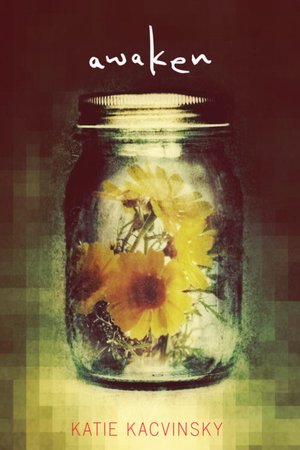
Awaken (YA)

Awaken. Katie Kacvinsky. 2011. Houghton Mifflin Harcourt. 320 pages.

My mom gave me an old leather-bound journal for my seventeenth birthday. At first the blank pages surprised me, as if the story inside was lost or had slipped out. She explained sometimes the story is supposed to be missing because it's still waiting to be written. Leave it to my mom to give me something from the past to use in the future.

Is Awaken a science fiction novel? Perhaps if you consider all books set in the future to be science fiction. Awaken is set in 2060. If I were to tell you the novel reads more like social commentary, would that frighten you away?

The premise of Awaken is simple. Maddie, our heroine, lives in a world where EVERYTHING is digital. Everyone--no matter your age--is always plugged into technology. If you're going for a walk with a friend--chances are, it's not a real walk, and you're not seeing your friend face to face. If you're meeting your friends at the coffee shop--same thing. And book club. And on those rare occasions when you do leave your house, when you do meet people, your technology isn't all that far away from you. You can be in the same room with someone and still be miles away from them--if your focus remains elsewhere.

The premise of Awaken is that people have forgotten how to LIVE their lives. They have forgotten what it was like to really feel, to really experience, to do. People have gotten comfortable--too comfortable choosing what is convenient, what is safe, what is known.

So the novel focuses on what happens when Maddie decides to start living life, what happens when she chooses to go out of the house, to start meeting people, to start hanging out with others. Of course, it's a bit more complex than that! Maddie's father isn't just anybody. He's SOMEBODY. And the strict rules are there for a reason--even though readers may not learn that for quite a while.

Read Awaken
  • If you like reading novels set in the future--like Rash, like Scored, like Surviving Antarctica: Reality TV 2083.
  • If you like reading books that challenge you to think
  • If you like your dystopia with a focus on education
  • If you like your dystopia with a hint of romance

© 2012 Becky Laney of Becky's Book Reviews

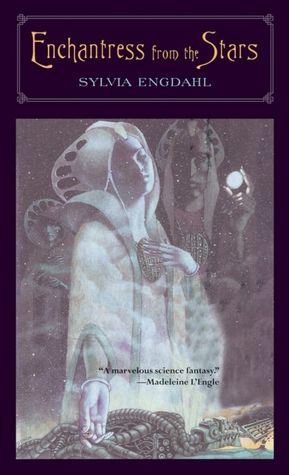
Enchantress from the Stars (MG)

Enchantress from the Stars. Sylvia Louise Engdahl. 1970/2003. Penguin. 304 pages. 

From the prologue: The planet shines below us, cloud-flecked, dazzling against the dark backdrop of space. Down there it is cool and green and peaceful. In a little while we will take the ship out of orbit and leave this world behind, a mere speck in the vast currents of the universe. This world, which we call Andrecia--the third planet of a quite ordinary yellow sun...but that's just coincidence, of course. What difference does it make that just such a planet was my own people's ancestral home?

From chapter one: At the edge of the Enchanted Forest there lived a poor woodcutter who had four sons, the youngest of whom was named Georyn. They were able to earn a meager living by selling wood to the folk of the village, and although there was seldom more than dry bread or thin gruel on their table, they were not miserable.

Oh, how I LOVED Enchantress from the Stars. It was one of those oh-so-magical-practically-perfect-in-every-way books for me. I know not every reader will feel the same connection, the same adoration for this as I do. But. It's one of those books that I could just gush on and on about!!!

What did I love about this one? Everything! I loved the premise. Just loved it! I loved the world-building, the setting, the atmosphere. I loved the storytelling. I loved the characterization!!! I loved Elana. I loved Georyn. I loved Jarel. I even cared a great deal about the Starwatcher and Evrek. I thought this book was just so well written.

Enchantress from the Stars is narrated, primarily, by a young woman named Elana. The novel is reflective, in a way, because the novel is an account of her first 'adventure' on another planet. She's writing her report, giving her side of the story. But this novel is more than just her side of the story. It ventures to include the perspectives of two others--a young man, the woodcutter's youngest son, Georyn, and a young medical officer named Jarel. Both Georyn and Jarel are from Youngling cultures. Georyn is a native to Andrecia; Jarel is from another planet, a planet in a different stage than Georyn's, but a great deal less advanced than Elana's. (He is with the Imperial Exploration Corps). Jarel is just one of many in the first ship sent to "colonize" this planet.

Elana is on a ship with several other agents--including her father--when they learn that Andrecia is being invaded, and a Youngling culture/civilization is being threatened. They can't directly intervene. And they definitely can't reveal themselves. But they can try to influence things subtly, indirectly. Elana is chosen--with some reluctance--to interact with the natives. Well, she's to interact with two brothers--Terwyn and Georyn. These two are on a quest--along with their older brothers--to KILL A DRAGON. Yes, they are on their way to get the king's blessing, the king's permission to enter the Enchanted Forest. They don't know what dangers they'll face, but they know the fiery dragon must be stopped. These brothers see Elana an an enchantress, a faery perhaps. They see her as having great power, great wisdom, great magic.

So Enchantress from the Stars reads as a fantasy novel--a fantasy novel in the style of a fairy tale. But. Of course it also reads as a great science fiction novel with space ships, etc.

Enchantress from the Stars won a Newbery Honor in 1971.

Read Enchantress from the Stars
  • If you love science fiction
  • If you love fantasy
  • If you love fairy tales
  • If you love adventures and quests
  • If you love great writing
  • If you love bittersweet love stories
  • If you're looking for a Newbery Honor

© 2012 Becky Laney of Becky's Book Reviews

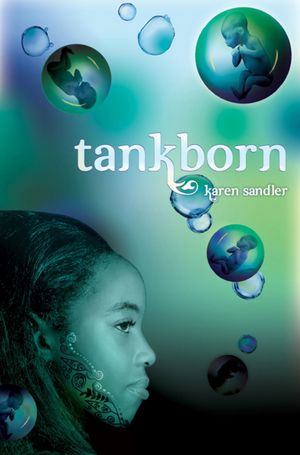
Tankborn (YA)

Tankborn. Karen Sandler. 2011. Lee & Low Books. 384 pages.

Kayla hunched on the bank of the Chadi River while below her, Jal, her slender, black-skinned nurture brother, skipped from one deep pool of the river to another, searching for sewer toads. 

What I liked best about Tankborn was the world-building. Sandler challenges readers with it in places, which I thought was a good thing. The society and culture, the vocabulary, it took work. Both to read and to create. But that is one of the more enjoyable elements of speculative fiction (both in science fiction and fantasy) visiting a place--a world--so unlike our own.

Tankborn is set on another planet. And our heroine(s) are two young women that have been genetically engineered. (Their genes have been spliced--animal DNA has been added to human DNA. One of our heroines "sket" is nurturing (I believe the book mentioned this coming from dolphins?) and the other heroine's strength is strength (I can't remember which animal this comes from.) In this society, those that are 'tankborn' are called GEN. The "N" stands for non-human, or does it?! So these GENs aren't even worth being the lowest of the low in the caste system. They're bred--artificially, of course--for servitude, for slavery. They are raised by nurturers. When they're fifteen, each receives an assignment.

Kayla and Mishalla are our two heroines. The story begins with Kayla's story, but soon Mishalla's story becomes an essential element.

I do NOT want to say too much about this one!!! I thought it was a compelling read, and as is often the case with science fiction, it is best to read this one without knowing too much.

Read Tankborn
  • If you're a fan of science fiction, particularly if you're interested in genetic engineering
  • If you're a fan of books set on another planet
  • If you're interested in social development, the development of different cultures, societies, caste systems, etc.
  • If you're a fan of dystopias
  • If you like a little romance with your science fiction (while romance doesn't dominate the story, it is definitely present)
  • If you're looking for multicultural science fiction (POC characters) 
  • If you don't mind new (created) vocabulary in your science fiction

© 2012 Becky Laney of Becky's Book Reviews