Tampilkan postingan dengan label YA realistic fiction. Tampilkan semua postingan

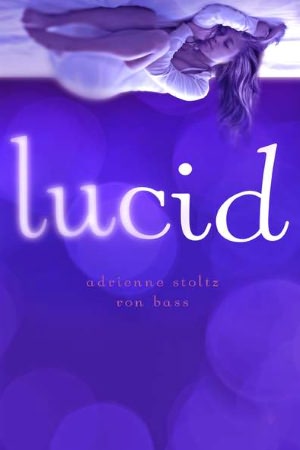
Lucid (YA)

Lucid. Adrienne Stoltz and Ron Bass. 2012. Penguin. 288 pages.

Right now, I'm Maggie. 

Maggie enters the same dream world every single night. Every single night she lives a day in Sloane's life. Sloane is a teenager living in Connecticut with her Mom, Dad, and younger brother. (She also has an older brother who has gone away to college.) Is Sloane's life perfect? Not exactly. True, she has some great friends, true, there's a new boy whom she has a love/hate interest in. His name is James. But she's still mourning the loss of her best friend, Bill. In fact, when the reader first meets Sloane she has just been asked to speak at a memorial celebration. Sloane also has a secret--a big secret. Every single night, she dreams a day in Maggie's life. No one would mistake Maggie's life for the perfect life. Her dad is dead, her younger sister, Jade, is having some health problems, and her mom, Nicole, is more of a hindrance than a help. But her Manhattan life is certainly far removed from Connecticut. Maggie is an actress. She is always auditioning for new roles and following her dreams. She's met two men Andrew and Thomas. One tempts her with auditions, the other offers only honest companionship: a willingness to listen, to respond with sincerity and honesty. As Maggie falls for Andrew, Sloane falls for James...will either girl get her happily ever after?

This book is certainly memorable! And it's definitely better than I expected!!! I would definitely recommend it. It was a compelling read--impossible to put down. And I cared about both Sloane and Maggie. While Andrew was my favorite love interest, James was also a good choice...at least for Sloane. I loved how their relationship began with debating literature.

I would have to say that this is one of my favorite YA reads of the year.

Read Lucid
  • If you like compelling YA Fiction
  • If you like the premise of lucid dreaming and dream worlds
  • If you were intrigued by the movie Inception
  • If you like fiction that questions the nature of reality

© 2012 Becky Laney of Becky's Book Reviews

Kepler's Dream (MG)

Kepler's Dream. Juliet Bell. 2012. Penguin.  256 pages.

It was the middle of the night, and that's not a time when you want to be hearing strange noises. I don't care how brave you are. No one wants to be restless and almost-sleep, then rustled awake by a thudding overhead and the feeling that someone is trying to get into the room.

Ella, our heroine, is visiting a grandmother she's never met, her paternal grandmother. Her father, whom she barely knows, does not get along with his mother. But Ella has to spend the summer with someone since her mother will be undergoing treatment for her leukemia. (She'll be receiving a bone marrow transplant, I believe.) And her grandmother is her last option, her only option.
Ella's first impressions of her grandmother, of her grandmother's house, are priceless. But through the course of a summer, the eccentricity and quirks of her grandmother have become familiar and comfortable. And she's made other friends as well.

Kepler's Dream is about a dysfunctional family who has a rather unique opportunity to heal, to mend, to come together. Could Ella  help bring her father and grandmother together again? Perhaps. For Ella who has never really known her grandmother and does not really know her father, it's an unique opportunity, for she'll get a chance to get to know them, to get to love them, to make them a part of her family.

But Kepler's Dream is also a mystery. And Ella's curiosity and determination to solve the mystery, to learn WHO stole her grandmother's precious book, Kepler's Dream, is the beginning of that opportunity. This mystery is the catalyst for a family to come together again.

I liked this one. I definitely liked it. There were places I just loved it. I liked the narrative voice, how Ella's reading influences her as a narrator. I love her grandmother's bookish lifestyle, and how she's always getting book deliveries. I liked how these relationships, friendships, happened naturally--nothing forced, nothing instant, nothing magical. I loved getting to know Ella at a very vulnerable time in her life. The thing I absolutely LOVED about this one were Ella's letters to her mom.

Read Kepler's Dream
  • If you like bookish heroines
  • If you like children's mysteries
  • If you like family books, plenty of drama but heart as well
© 2012 Becky Laney of Becky's Book Reviews
No Safety in Numbers (YA)

No Safety in Numbers. Dayna Lorentz. 2012. Random House. Penguin. 288 pages. 

The back cover reads: "It's just another Saturday in a busy suburban mall. But not for long." The front cover reads: "Four teens, 150 stores, 1 bomb." I'm not sure which one is more effective as a hook for drawing readers in, what do you think?! Essentially this is a book about a mall that gets quarantined with all its shoppers "trapped" inside after one employee discovers a hidden bomb. The book covers, I believe, the first week. And by the end of the week, the novelty has definitely worn off.

You should definitely know that there is no ending, this is book one, and those who absolutely need an ending to be satisfied should wait until the release of the second book. Personally, as long as I know that before I begin a book, it doesn't bother me that much. It's only when I spend two or three hours of time anxiously expecting an ending only to be surprised by a big "to be continued" that I get annoyed.

Is No Safety in Numbers premise-driven or plot-driven? I think it is. I think the premise itself is big enough to drive the plot forward. That doesn't mean that the characters are flat, boring, and lifeless. It just means that they are not the strongest element of the book. We've got two male narrators: Marco, a busboy at a restaurant; Ryan, a football player whose integrity is flexible depending on who is around. And two female narrators: Lexi, the daughter of a Senator, a true computer nerd who spends her time making movies, working with graphics and computer programming instead of having "real" friends; and Shay, who spends half her time taking care of her younger sister, Preeti, and her grandmother, Nani, and the other half of her time talking with either Marco OR Ryan.

Each narrator manages to bring a handful of other characters into view. (Lexi spends time with Ginger and Maddie, two popular girls from her school whom she's never really spent any time whatsoever with until this crisis; Lexi also keeps in touch with her mother, the Senator, and her father; all three are "trapped" in the mall. Shay has her younger sister and grandmother. Ryan has at least two if not three football players to hang out with. Marco, poor Marco, well he occasionally gets to mention a cook, waiter, or manager.) But despite the fact that readers are told about all the thousands of people who are trapped in this quarantined mall, despite the fact that readers see these people mass together to riot on at least one or two occasions, I couldn't help but get a sense of emptiness and loneliness. At times it felt like there were only ten or twelve people in this gigantic mall.

There were times it felt believable enough, then again, there were other times it didn't. And sometimes these instances are where you would least expect them.


I have a hard time putting No Safety in Numbers into a 'perfect' genre. On the one hand, there is nothing in it to make it science fiction. The setting could be present day or a few years into the future. So it could be classified as realistic fiction. There is a sense of danger, of terror, that makes this a thriller, to a certain extent. But for readers looking for ACTION, they might not appreciate all the time spent making friends and forming relationships. They might not appreciate the surreal "first date" between Shay and Ryan, for example. And all the talk of feelings and loneliness and not belonging. And the poetry reading.

So did I like it? Yes. For the most part. I found it compelling, or compelling enough. In other words, I read it essentially in one afternoon. I did get caught up into the story.

Read No Safety in Numbers
  • If you like thrillers and suspense novels; this one does have some action, but it isn't exactly fast-paced action. There is danger to be avoided, a sense of terror, but it is more subtle, at least for the first half. 
  • If you like survival fiction

© 2012 Becky Laney of Becky's Book Reviews

Unbreak My Heart (YA)

Unbreak My Heart. Melissa Walker. 2012. Bloomsbury. 240 pages.

I definitely enjoyed Melissa Walker's Unbreak My Heart. I thought it was a wonderful way to spend a summer afternoon. Clementine, the heroine, is an emotional mess when the novel opens. All will come to light as the story unfolds chapter by chapter, but, essentially she's lost someone really super-close to her, her best friend, Amanda, someone she's known and loved since grade school. Why are these two friends no longer speaking? (Or at least with words that can be repeated?!) Well, it has a little something to do with the notion of being betrayed. It's up to readers to decide just how much betrayal was involved and if Clementine is deserving (or not) of a second chance.

Unbreak My Heart is an intriguing YA book in that there are two stories unfolding at once. 1) The present summer (the summer before her senior year) where she is on a three month sailing trip with her parents and her younger sister, Olive. 2) The previous school year (her sophomore year) where readers see Amanda and Clementine and their friends and boyfriends. Readers, of course, know this is building to something allegedly BIG and SHATTERING.

The summer might be lonely, incredibly lonely, for Clementine, if it wasn't for meeting James, a cute red-haired guy with issues of his own. James and his Dad are sailing for the whole summer too. With James and tag-along Olive, Clementine does stop moping occasionally. And James does awaken something in her...

Read Unbreak My Heart
  • If you're a fan of Melissa Walker, Sarah Dessen, Elizabeth Scott, Deb Caletti, Susane Colasanti, etc.
  • If you're a fan of YA Romance, particularly YA Romances with an emphasis on music and playlists.
  • If you're looking for YA novels with complexly drawn characters, particularly if you're looking for well-drawn families. Truth be told, it's rare for parents, sisters, etc. to get fleshed out. But I think she did a great job making this feel like a real family on a real vacation. 
  • If you're looking for YA novels that explore the tension of friendships and relationships.

© 2012 Becky Laney of Becky's Book Reviews

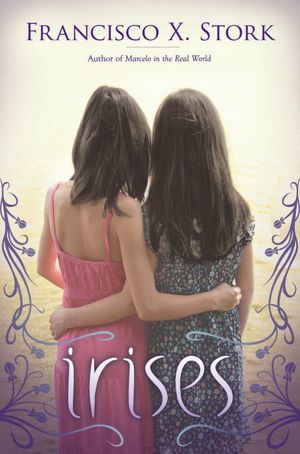
Irises (YA)

Irises. Francisco X. Stork. 2012. Scholastic. 304 pages.

From the prologue: Kate had finally agreed to pose under the willow tree.
From chapter one: Kate and her father sat in the shade of the willow tree, side by side in two wooden chairs. It was unusually hot for an April day in El Paso. 

Kate and Mary are sisters. Kate, 18, dreams of being a doctor, dreams of going away to Stanford for her college education. Mary, 16, is an artist, an artist struggling to recapture her initial joy perhaps, but a very talented, very dedicated artist nonetheless. In the first chapter of Irises, both girls receive a bit of a shock: their father, a pastor, dies. Arguably he knew the end was near for he has a great heart-to-heart with his daughter, Kate, urging her to look to her soul, mend her faith, take care of the family, etc. He tells her: "Love makes everything that is heavy light" (4). Kate, of course, not realizing the gravity of the situation, perhaps just thinking that her oh-so-strict father is just in an odd mood, quickly leaves the house and goes to study with her boyfriend, Simon. It is Mary, ever-sacrificing Mary, who is left behind to care for their Mom, who is in a vegetative state going on two years now, who discovers that her Dad has died in his sleep. While the two sisters have an aunt who lives in California, both girls know that more than likely they'll be on their own. Aunt Julia isn't exactly the most-nurturing type, after all. And Kate and Aunt Julia are like oil and water. The girls are facing at least half-a-dozen BIG, BIG decisions. And coming to agreement may not be easy...

The facts:
  • Mary and Kate have very limited funds, in part because their father's insurance is being denied; the insurance company will not make good with his insurance policy after his death.
  • Kate is having to make a decision about college; she's received a scholarship to Stanford, but taking it  will mean leaving her mother and sister behind. Is it fair to leave the care and to some extent the expense of caring for a mother in a vegetative state to a sixteen year old girl? A job that is emotionally, psychologically, financially, physically challenging for anyone.
  • Mary secretly wishes that there was a way for the family to stay together but she's afraid to disappoint Kate. 
Irises may not appeal to every reader, but, I liked it all the same. Was it too heavy or too heavy-handed? I'm not sure there is a right answer to that. Some might feel it was in-your-face with a somewhat potentially controversial (at least in some circles perhaps?) issue. The issue of when is it "right" or "ethical" to take someone off of life support. Some might feel there was too much God-talk. A few might feel there is not enough God-talk.

Irises is almost by necessity a serious-minded novel. It explores many questions while not necessarily giving ready-made answers to those questions. At least not ready-made-answers for every-single-person. What does it mean to be in a family? Who is in your family? Can you walk away from family without looking back? Is it right to ever turn your back on your family and put yourself first? What is love? How do you know you love someone? Does love always mean making sacrifices? Can you love someone and by your choices cause them hardship? Can you love someone and still love yourself more? By always putting yourself and your needs and wants first are you selfish? Is it always wrong to be selfish? What's the difference between being true to yourself and following your dreams and ambitions and being a horribly selfish self-centered person? Does being honest about how selfish you are help redeem your selfishness in any way? Does being selfish mean indulging your HUGE ego?

The rest of the review will be spoilerish, so I'll go ahead with...

Read Irises
  • If you are a fan of Francisco X. Stork
  • If you are looking for an art appreciation novel; Artistic Mary is a great narrator, and the way she uses art to help Marcus (her potential love-interest) is great. 
  • If you are looking for a YA novel that explores faith, hope, and belief
  • If you are looking for a book that addresses the complexity of what it means to be sisters
  • If you are looking for an issue book, a serious book; this one is about death, dying, grief, letting go, making sacrifices, reaching hard decisions, etc.
  • If you're looking for books with a Texas (West Texas) setting.

If you read the book jacket, you'll learn that there are three men in the picture. Two relate to Kate, one to Mary. I definitely don't want to spoil the book for anyone, but, I have to talk about one of the men: Andy.

S
P
O
I
L
E
R

Reverend "Andy" Soto was certainly charismatic in an oddly appealing and equally revolting way. When readers first meet him, he seems very dynamic, very charismatic, very friendly, very much a good guy. And yet. And yet. His true nature is revealed through the course of the novel. And he's so very, very, very slimy. There are some warning signs we can pick up on as readers--or adult readers may pick up on--but it isn't surprising that Kate doesn't quite see him clearly. 

Is he 100% evil? NO! That's NOT what I'm saying. Though his tact could use a LOT of work, (I hate to think what his bedside manner would be if visited the sick or dying or the family members of the sick or dying.) Some of his advice was actually good advice. Some of what he had to say needed to be said...by someone, by anyone.

M
O
R
E

S
P
O
I
L
E
R
S

I definitely found his EGO to be revolting. He was young, just twenty-two, and ambitious and selfish, and all ME, ME, ME, I LOVE MYSELF. And the way he behaved with Kate, well, it was a bit shocking or surprising. You would think that he'd learn somewhere along the way that inviting an eighteen year old girl, a member of your congregation, into his apartment to spend the night even if it was just "talking" or mainly talking...after his advances were halted...by her...with an apology for sending mixed signals. I do think he plays an extraordinary part in the novel. Mainly by mirroring to Kate the extremities of selfish ambition and pride and ego. His "you should totally do this without feeling guilt in any way whatsoever" attitude actually was a BIG, BIG wake-up call to Kate. I just LOVED her confrontation with him!!!! I was cheering her on!!!! Tell him, tell him, TELL HIM!

© 2012 Becky Laney of Becky's Book Reviews

Rereading The Schwa Was Here

The Schwa Was Here. Neal Shusterman. 2004. 240 pages.

I am definitely glad I chose to reread Neal Shusterman's The Schwa Was Here. I'm not exactly sure I loved it as much this second time, but, I am glad I reread it.

My reaction the first time I read this one--back in 2005--was that THIS WAS THE BEST, BEST, BEST book ever...at least of 2004. I was wowed by the characters of Schwa and Antsy. And smirked at the developing relationship between Old Man Crawley and Antsy. I thought it had heart and humor and a great narrative voice. And I still do, for the most part. I definitely think that Antsy is a GREAT narrator. The narrative voice in this one is so strong. Antsy can be very very funny in his observations--particularly in his observations about life, like how he compares life to a bad haircut, or change in life to a bad haircut. But he can also be authentic in some very tense, uncomfortable situations. In particular the tension-filled dynamics of his family. Never do readers get the idea that Antsy's life is one big joke after another. Readers see a blending of humor and pain. Which I think is authentic.

So the premise of this one is simple, Calvin Schwa is a middle schooler who, for the most part, remains invisible to teachers and students alike. They just don't see him. It's like he's not even there. Antsy does notice him, though even Antsy sometimes slips, and begins to make the Schwa a project of his. He decides to experiment to see the properties of the Schwa effect. The first few experiments are funny. Over-the-top ridiculous. But the experiments don't last forever, and the joke doesn't stay funny for long. Schwa may have enjoyed a couple of weeks of particular attention (not being taken seriously, mind you, not being seen for who he is, really is, but being the focus of a joke, a bet, a fad), but soon Antsy is his only friend. Almost. (A girl does enter into this.) How long can the Schwa go on being unseen and unheard? When will enough be enough? Can he turn his tragic non-life around?

I suppose the only thing that has changed in my rereading is that it doesn't strike me as truly being the best, best, best, best, best book ever. I still love it, I still really love it. I still seeing it as being a strong novel with a lot of heart and soul to it--a blending of emotions that make up life as we know it. I still love Antsy. I still love seeing a novel that addresses the invisibility of some kids. I still love seeing all the family drama. 

Read The Schwa Was Here
  • If you love Middle Grade Fiction
  • If you love coming-of-age stories
  • If you love stories with great narrators
  • If you have room in your heart for a grumpy old man
© 2012 Becky Laney of Becky's Book Reviews

Miracle (YA) Spoilers

Miracle. Elizabeth Scott. 2012. Simon & Schuster. 224 pages.

When I woke up the sky was burning. It was orange-red with flames, breathing hot all over me, and thick black smoke bloomed like clouds. I rose to my knees and the sky grew hotter and closer as water poured over me. I knew I should turn around, that there was something behind me. I didn't even know how I knew that. I just did. I didn't turn around, and in front of me, through the bright flame of the sky, I saw a hint of green. I started walking toward it. Smoke was winding itself inside me, slipping down my throat every time I breathed. 

I have a feeling that it isn't exactly fair to judge a book by an author's previous books. But. I can't help feeling that Miracle just isn't as wonderful as some of the author's previous books. Even if I exclude Elizabeth Scott's contemporary romances and only consider her darker YA novels like Grace, Living Dead Girl, Love You Hate You Miss You. Do I like her darker books? Yes and no. Grace wowed me, I won't lie. It was definitely a strong book for me. Same with Living Dead Girl. It was very, very, very, very dark. And not at all pleasant to read. But I did feel that it was a powerful story well told. I felt their was a certain strength in the writing, not anyone could write like that. And the fact that the same person who writes like that also writes giddy-making (seriously giddy-making) YA romances, it is a lot to keep in mind. Scott doesn't just write the same book over and over and over again. Although some fans might prefer her to keep writing giddy-making romances. I certainly wouldn't mind reading *more* YA romance from her. But neither do I expect her to just write one kind of a book and only one kind of book.

So. I didn't exactly love, love, love Miracle. I didn't dislike it. I really didn't. There were things I definitely liked, and things that I definitely didn't like. So what didn't I like? Well, I HATED (yes, hated) Megan's parents. I HATED the way they treated Megan's brother. I thought it was absolutely ridiculous. The way the parents treat David was all kinds of wrong. And the way we're led to believe that before the plane crash the case was reversed, well, it convinced me that Megan's parents need HELP. (Before David got 100% of the attention.) Is not liking the parents of a narrator reason enough to not particularly "like" a book, probably not. And I did like a handful of the characters. I particularly liked Margaret. She was one of two people who really got Megan, well, post-crash Megan. She was one of the only people who saw Megan for herself, who saw Megan's need and looked at it without turning away. The other person was Joe, a next door neighbor with swoon potential. If Miracle had more Bloom to it, well, it would be a different book. Still. Joe was an asset to this book. I did like the way he got to know Megan, and how he helped her through some of her darkest times.

I think Miracle is more of an issue book than a romance. It does go dark places. Being the sole survivor of a plane crash would be traumatic. Being a survivor--sole or not--would be traumatic. So there is a reason this isn't a giddy-making romance... 

Read Miracle
  • If you're looking for a novel about PTSD (Post-traumatic Stress Disorder)
  • If you're looking for a dark and gritty novel about a young woman tortured by what she doesn't quite remember--she's the sole survivor of a plane crash. 
  • If you prefer contemporary/realistic YA to YA romance.
  • If you're a fan of Elizabeth Scott. Particularly if you're a fan of Grace, Living Dead Girl, or Love You Hate You Miss You.
© 2012 Becky Laney of Becky's Book Reviews
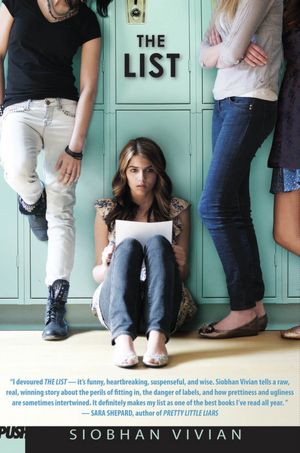
The List (YA)

The List. Siobhan Vivian. 2012. Scholastic. 336 pages.

From the prologue: For as long as anyone can remember, the students of Mount Washington High have arrived at school on the last Monday in September to find a list naming the prettiest and the ugliest girl in each grade. This year will be no different.

The List has an interesting enough premise. It is a novel with eight narrators. The prettiest freshman, ugliest freshman, prettiest sophomore, ugliest sophomore, prettiest junior, ugliest junior, prettiest senior, ugliest senior. Each girl, of course, has a name, but at least at first, names and personalities don't matter oh-so-much. The focus is on the label, the judgment. It is a question-driven novel, in a way.

How do others see me? Is that how I see myself? Do I care what everyone else thinks? Who is this 'everyone' else anyway? Do I feel prettier or uglier than I did the day before the list was posted? Am I going to let the list change me? Am I going to let myself be defined and objectified by others?

One of the strengths of the novel is showing that every single person on the list is a human being. No matter the appearance, no matter the popularity ranking. A pretty girl can have just as many problems and issues going on in her life as the next person. Being pretty doesn't mean living life problem-free without a concern or care in the world. The prettiest junior girl, for example, has an eating disorder. This problem popped up over the summer. And others may see her as beautiful, as pretty, as having everything she could possibly want or need. But all she knows is that food is the enemy, that fat is the enemy, that eating means that she will no longer be beautiful. She cannot accept herself or see herself as she truly is. She doesn't love herself. Her daily life is a torment to her in many ways. Yet she is supposed to be thrilled, happy, ecstatic that she is the most beautiful girl in her class.

I think at least five or six of these characterizations would have been strong enough to carry an entire novel. With eight narrators, little justice can be done to each story. So at times it was all a little too much.

The ending. I didn't really like this ending at all. I thought the last fifty or so pages of this one was a mess. Yes, books can have tricks; twists or turns that you aren't supposed to see coming. But. I felt that the ending would ruin any rereading of the novel. (Of course, I haven't tried it myself.) It's just that the semi-big-reveal doesn't feel right to me. It doesn't feel natural to how the character was presented up until that point. If it had just been a story or conflict between these two characters--the prettiest senior and the ugliest senior--if the whole novel had been about these two, then I think it might have worked better. It could have shown the necessary depth. These two were friends--close friends--in junior high. But before the start of high school, the prettiest dumped the ugliest. This relationship--past and present--could have been explored more. I think that just enough was revealed to create a spark of interest, but then it all ends right there.

Have you read this one? What did you think?

Read The List
  • If you like high school dramas set during Homecoming Week
  • If you like realistic YA
  • If you like books about mean girls and/or bullies
  • If you are looking for 'issue' books (bullying, eating disorders, etc.)
© 2012 Becky Laney of Becky's Book Reviews

Radiate (YA)

Radiate. Marley Gibson. 2012.  Houghton Mifflin Harcourt. 416 pages.

You know how you always think there's something...more?

Months before her Senior year in high school, our heroine, Hayley Matthews decides to give up marching band and try out for the varsity cheerleading squad. She isn't sure she'll make it, even though she knows how to tumble and is a fast-learner when it comes to dance. She makes the team--to her delight--and then her real struggles begin. But don't worry, these struggles all work together for her good.

ETA: The author thinks there should be a spoiler alert for my review, and I'm happy to comply. There is nothing in my review that the reader wouldn't learn for themselves after the first few chapters, or even after the prologue, but if you want to truly pick this one up knowing nothing about it. Don't read the rest of the review. Just don't. 

I'm not sure I like the prologue to Radiate. I'm not saying I hate it. I don't. It's just that sometimes you don't want to be told on page one that a book is a cancer-book. (Okay, it's not page one, but it is in the first few pages.) Not when there are chapters--quite a handful of chapters--to be read before she even goes to the doctor about a suspicious lump and a pain that just won't go away.

So our heroine Hayley is making new friends in the days and weeks following the announcement that she's now on the squad. And surprise, surprise the boy that she's liked since forever knows who she is now. And he can't stop flirting with her. Fortunately, Hayley is so smitten, so very, very smitten, that she fails to see he has any personality, any depth, any genuineness to him. Unfortunately--at least for this reader--I found little charm or charisma. In fact, I saw right away that he was so not the one for Hayley. That there was no way in the world he could possibly be there for Hayley when things got rough. But the lack of depth in the boyfriend is partially made well by the fact that there's a cute boy next door that has just come back to town. A boy that she grew up with. A boy that seems to genuinely see Hayley as a real person and not an object.

Did I like Radiate? Well. I'm not sure. On the one hand, it's hard not to cheer for a cheerleader who overcomes such harsh obstacles. She shows determination and courage, there is a real genuineness to her, a sincerity that makes her anything but shallow. But at the same time, the book lacks other developed characters. I had a hard time with most of the minor characters--including the boyfriend and the rest of the cheerleaders, for the most part. The family, on the other hand, had a little more depth. I felt there was definite potential there. I could see how this family functioned--or didn't function, as the case may be. For everything I liked about the novel--and there were quite a handful of things I liked about it--I found little things that didn't quite work for me. One thing that bothered me--and it's a thing that may not bother other readers at all--was the fact that this family was displayed as a Christian family, our heroine, so we're told is a Christian. Yet the novel itself uses language I wouldn't feel comfortable recommending to Christian readers. (Though it's miles away from being Nick & Norah's Infinite Playlist!)

Read Radiate
  • If you're looking for a happy-ending Cancer book
  • If you're looking for a YA book with a realistic school setting
  • If you love reading about cheerleaders and football games
  • If you love stories about how the boy-next-door is a much better catch than that oh-so-secret-crush you've had for years and years

© 2012 Becky Laney of Becky's Book Reviews

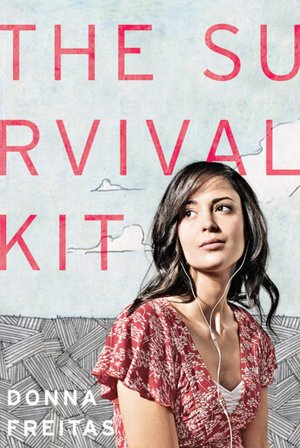
The Survival Kit (YA)

The Survival Kit. Donna Freitas. 2011. FSG. 368 pages.

I found it on the day of my mother's funeral, tucked in a place she knew I would look. There it was, hanging with her favorite dress, the one I'd always wanted to wear. "Someday when you are old enough," she used to say. Is sixteen old enough?

I LOVED this one. I just LOVED it. I don't always love realistic fiction, I tend to prefer other genres. But. The Survival Kit is a must-read. It's a beautifully bittersweet novel about the grieving process.

Rose Madison is grieving the death of her mom, the cancer came back, the miraculous recovery just didn't last. Her older brother is away at college, for the most part, and her dad is losing it. Though perhaps the distinction is obviously losing it. Her dad has become a drunk, he's losing the ability to function, to take care of himself and his daughter. He's become more than an embarrassment, he needs help, more help than she can provide. But. Rose is losing it in a different way. Her way might not be obvious, but the pain, in a way, is the same. Rose, for example, has shut music out of her life. She will not tolerate music playing in her life. She knows that music will invite emotions and feelings and memories. Music will unwrap the pain. With music comes reminders of life, of love, of loss. She's not ready to feel anything yet which makes her relationship with her boyfriend an impossibility. He's patient, to a point; understanding, to a point. But he's not perfect. He is tired of Rose being the new-and-unfeeling Rose. The Rose that will not respond to his kisses, to his touch. The Rose that doesn't care about his football games. The Rose that doesn't seem to care about anything anymore. The Rose that doesn't laugh or smile.

Truth be told, Rose is tired of the new Rose too. But she's just not sure when she'll be ready to start letting go, to start feeling again, to start living again. She knows that it would be good for her to surrender to her mother's "survival kit" a kit prepared just for this occasion, a loving gift from mother to child. But is she brave enough to start the process?

In her loss, Rose notices someone for the first time...someone that DOES understand her loss, her pain, because he's lost a parent himself...

The Survival Kit is a book about family, friendship, life, love, loss, grief, and pain. It's an emotional read, very compelling, and impossible to put down!

Read The Survival Kit
  • If you are looking for a bittersweet yet compelling read about grief
  • If you are looking for an authentic story about how cancer can effect a family
  • If you are looking for a sweet-yet-not-too-perfect romance

© 2012 Becky Laney of Becky's Book Reviews
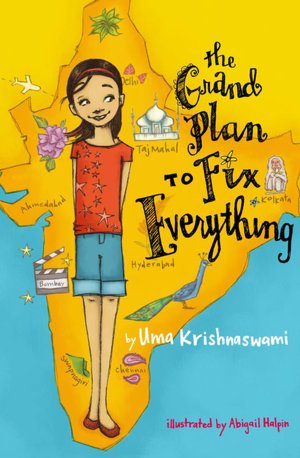
The Grand Plan to Fix Everything (MG)

The Grand Plan to Fix Everything. Uma Krishnaswami. Illustrated by Abigail Halpin. 2011. Simon & Schuster. 272 pages.


Dolly Singh's fabulous face floats across the screen of the TV in the family room. Two happy sighs float off the couch, one from Dini and the other from her best friend, Maddie. Dini is a Dolly fan. She has been forever, from the time she discovered that Dolly's first movie, in which she was just a kid, came out the day--the very day!--that Dini was born. You can't be more closely connected than that. Maddie is a fan because best friends share everything.

If you like quirky books, then I'd definitely recommend Uma Krishnaswami's The Grand Plan to Fix Everything. There is something odd and playful about the storytelling in this middle grade novel. There are many, many books about moving for this age group. Though not all moves are such big moves--from America to India. There are books about the struggles of best friends staying best friends after the move, and about how bittersweet it is to start to make new friends. But how many 'moving' books are as quirky as this one?!

Dini is more than a little obsessed with the actress Dolly Singh. And the only thing keeping her spirits up after she learns the news that her family will be moving to India for several years is the dream that maybe just maybe she'll meet her favorite actress when they move to India. True they'll be staying in a very small town or village. True, that village isn't exactly near Bombay (yes, she knows it's not called Bombay anymore, but that's how she'll always think of it) where the star lives. But anything is possible, right? And with two girls wishing so very hard...it has to improve the chances, right?!

There are so many characters in this novel! So many intersecting stories or coincidences. It's a very silly, very playful, yet at the same time heartfelt story about life.

Read The Grand Plan to Fix Everything
  • If you're a fan of Indian movies or musicals
  • If you're a fan of multicultural stories
  • If you love quirky stories that are odd and delightful all at the same time
  • If you don't mind coincidences 
  • If you're looking for a book with playful monkeys

© 2012 Becky Laney of Becky's Book Reviews

Under the Mesquite (YA)

 Under the Mesquite. Guadalupe Garcia McCall. 2011. Lee & Low. 225 pages.

I am standing just inside
the doorway, watching Mami talk
to the television screen.
As the latest episode
of her favorite telenovela unfolds,
the soap opera drawing her in,
the skins from the potatoes
she is peeling
drop into her apron
like old maple leaves...

Lupita is the heroine of Guadalupe Garcia McCall's verse novel Under the Mesquite. It's an emotional coming of age story. Lupita struggles with the ordinary things of growing up, it's true, but she does it all the while watching her mother die of cancer. She does it while trying to be both mother and father to her younger sisters and brothers. She becomes an adult all too soon as she tries to cope with the devastating news--the diagnosis, the treatment, and the cure that just didn't last long enough. Where does she find the strength to face the day? How does she hold it all together? How does she keep things together enough with her family? Well, it's a mystery to her too. But taking those drama classes sure does seem to be helping. And her coach wonders why she can cry on demand...

If you're looking for an emotional 'cancer' book that is more than just a cancer book, then Under the Mesquite may be just what you're looking for.

Read Under the Mesquite
  • If you're looking for a good multicultural read
  • If you're looking for an emotional book with very human characters
  • If you're looking for a good verse novel

© 2012 Becky Laney of Becky's Book Reviews
Wonder (MG)

Wonder. R. J. Palacio. 2012. Random House. 320 pages.

I know I'm not an ordinary ten-year-old kid. I mean, sure, I do ordinary things. I eat ice cream. I ride my bike. I play ball. I have an Xbox. Stuff like that makes me ordinary. I guess. And I feel ordinary. Inside. But I know ordinary kids don't make other ordinary kids run away screaming in playgrounds. I know ordinary kids don't get stared at wherever they go. If I found a magic lamp and I could have one wish, I would wish that I had a normal face that no one ever noticed at all. I would wish that I could walk down the street without people seeing me and then doing that look-away thing. Here's what I think: the only reason I'm not ordinary is that no one else sees me that way.

Oh how I loved, loved, loved R.J. Palacio's novel Wonder. I just LOVED, LOVED, LOVED it. While it would have been a great novel if it had just been told by Auggie (August), I think it's an even better novel because it is told through multiple points of view which gives readers insight into how others see Auggie--and treat Auggie. But. At the same time reminding us all that we ALL have issues. Auggie's sister, Via, for example, is dealing with changes of her own. She's having her own struggles. And because her brother is almost always the most needy or the most obviously needy one in the family, she can feel invisible and taken for granted. Every voice feels authentic in Wonder--which makes it a great read! One that is oh-so-easy to recommend.

So in Wonder, Auggie, a boy with a special face struggles to adapt to his new school, his first real school. His first day of fifth grade is his first day at school ever. He's nervous as can be, as you would expect. How will others treat him? How will teachers treat him for that matter? It won't be easy. Acceptance won't come all that easy. But can Auggie find friends--true friends who love and appreciate him?!

As I said, I just LOVED this one.


Read Wonder

If you're looking for a great coming-of-age read
If you're looking to read the best of the best in MG fiction
If you enjoy realistic fiction with school settings that deal with bullying and friendship
If you enjoy family dramas

S
P
O
I
L
E
R

Don't get attached to the dog. 

© 2012 Becky Laney of Becky's Book Reviews
The Running Dream (YA)

The Running Dream. Wendelin Van Draanen. 2011. Random House. 336 pages.

My life is over. Behind the morphine dreams is the nightmare of reality. A reality I can't face.

Jessica was a great runner, a star of her school's track team. But one day on the bus ride back from a meet, something horrible happens. Someone crashes into their bus. Lucy, her teammate, dies, and Jessica loses her leg. The novel is about how she copes with that loss. How the loss of a leg, at first, is the loss of a dream. But how through that loss she's able to see some things more clearly than before. Like how much her teammates really do care about her. So much that they sacrifice their time and energy and put all their heart and soul into fund raising for her. Like how she sees another classmate for the first time, a classmate in a wheel chair for quite another reason. Rosa was always so easy to ignore before, but now she's seeing her as a real person worth knowing.

So The Running Dream is a novel about hopes and dreams and perseverance. It is an emotional novel, of course. But it isn't purely inspirational. Jessica is, in many ways, just an ordinary girl with ordinary problems. Like how the guy she has a crush on doesn't really see her like that--not really. And how she struggles with keeping up in math, etc.

Read The Running Dream
  • If you're interested in sports stories with heart
  • If you're looking for an emotional, inspirational read
  • If you're looking for YA novels about friendship and family


© 2012 Becky Laney of Becky's Book Reviews

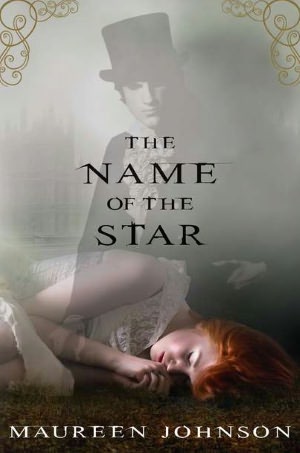
The Name of the Star (YA)

The Name of the Star. Maureen Johnson. 2011. Penguin. 384 pages.

The eyes of London were watching Claire Jenkins. She didn't notice them, of course. No one paid attention to the cameras. It was an accepted fact that London has one of the most extensive CCTV systems in the world. 

Considering the genre, I was pleasantly surprised by how much I liked this one. I wouldn't necessarily say I loved it. But. If you judge a book based on your need to finish it, then it was well worth it!

The heroine of The Name of the Star is Rory, a teen girl from Louisiana, who decides to give an English boarding school a try when her parents get an offer to go to Bristol for a year to teach American law. Rory chooses a London boarding school. She never could have predicted--who would have?!--the danger she'll face in that particular neighborhood. For around the time she arrives, there are a series of murders in the style of Jack the Ripper. The murderer is obviously duplicating almost every little thing about the murders, and so the murders follow a certain pattern, a certain schedule. But that doesn't make the neighborhood any "safer." As Rory learns when she catches a glimpse of the killer.

So The Name of the Star isn't quite my genre. It's a paranormal horror novel! And I still am not a fan of the genre. I'm not. It's just not the way I like to spend my time. But this novel kept me reading.

Read The Name of the Star
  • If you love ghost stories, OR I-can-speak-to-ghost stories
  • If you love horror novels or thrillers. This one isn't so much a mystery--although I suppose it has mystery in it--but it's more of a chasing novel where the heroine is at risk of becoming a victim than a detective novel with a mystery to solve. I prefer mysteries.
  • If you are interested in anything/everything Jack the Ripper
  • If you like stories with a boarding school setting


© 2012 Becky Laney of Becky's Book Reviews

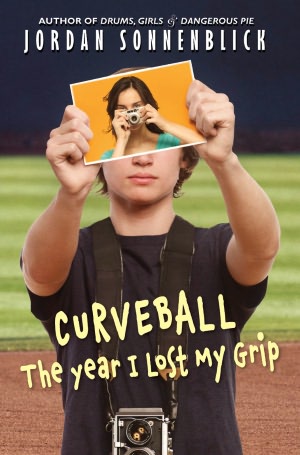
Curveball: The Year I Lost My Grip (MG/YA)

Curveball: The Year I Lost My Grip. Jordan Sonnenblick. 2012.  Scholastic. 304 pages.

The first picture is a wide-angle shot, taken through the chain-link fence of the backstop behind home plate. There's a boy standing on a pitcher's mound in full uniform: green and gold. His cap is pulled low over his eyes, and his unruly black hair sticks out below the brim in all directions. He leans in toward home plate, his throwing arm dangling loose at his side. He must be looking in to get his sign from the catcher.

I expected Curveball: The Year I Lost My Grip to be good--really good. Why? Well, Jordan Sonnenblick rarely--if ever--disappoints. He's an amazing writer; he's great at writing characters that I just love. His stories tend to be emotional and compelling. Though almost always they have a lightness to them as well. Curveball The Year I Lost My Grip did not disappoint. While I'm not sure that it is my favorite, favorite Sonnenblick novel--he's written so many that I just love!!! It is easy to recommend this one.

The hero of Curveball is Peter Friedman. The summer before his freshman year in high school, he plays his last baseball game. The injury in his arm is so severe that doctors tell him he'll never, ever be able to play the game he loves so much. So who is he if he's not a great pitcher and catcher? Who is he if he's not a great athlete? Well. He'll have plenty of time to figure that all out.

One of the main characters in Curveball is Peter's grandfather. I just LOVED him. I think there aren't enough--could never be enough--YA books that highlight the special relationship between grandparent and grandchild. Inter-generational stories make me happy, very happy. Even when they're sad. Even when they're bittersweet. Peter and his grandfather are incredibly close. And so it's not all that surprising that Peter's interest in photography becomes all that much stronger. (His grandfather was a professional.)

So Peter's interest in photography leads him to take a class where he meets a girl that wows him...

This YA book has it all. Great characters, good storytelling. It's just an enjoyable read!

Read Curveball The Year I Lost My Grip
  • If you're interested in baseball
  • If you're interested in photography
  • If you like realistic romances
  • If you're a fan of Jordan Sonnenblick
  • If you like coming-of-age stories with a strong emphasis on friendship

© 2012 Becky Laney of Becky's Book Reviews

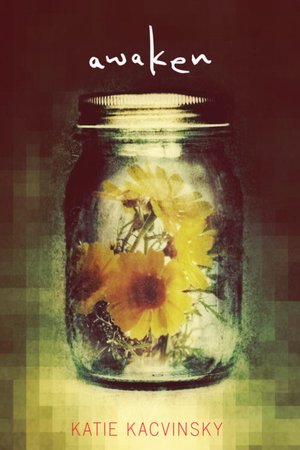
Awaken (YA)

Awaken. Katie Kacvinsky. 2011. Houghton Mifflin Harcourt. 320 pages.

My mom gave me an old leather-bound journal for my seventeenth birthday. At first the blank pages surprised me, as if the story inside was lost or had slipped out. She explained sometimes the story is supposed to be missing because it's still waiting to be written. Leave it to my mom to give me something from the past to use in the future.

Is Awaken a science fiction novel? Perhaps if you consider all books set in the future to be science fiction. Awaken is set in 2060. If I were to tell you the novel reads more like social commentary, would that frighten you away?

The premise of Awaken is simple. Maddie, our heroine, lives in a world where EVERYTHING is digital. Everyone--no matter your age--is always plugged into technology. If you're going for a walk with a friend--chances are, it's not a real walk, and you're not seeing your friend face to face. If you're meeting your friends at the coffee shop--same thing. And book club. And on those rare occasions when you do leave your house, when you do meet people, your technology isn't all that far away from you. You can be in the same room with someone and still be miles away from them--if your focus remains elsewhere.

The premise of Awaken is that people have forgotten how to LIVE their lives. They have forgotten what it was like to really feel, to really experience, to do. People have gotten comfortable--too comfortable choosing what is convenient, what is safe, what is known.

So the novel focuses on what happens when Maddie decides to start living life, what happens when she chooses to go out of the house, to start meeting people, to start hanging out with others. Of course, it's a bit more complex than that! Maddie's father isn't just anybody. He's SOMEBODY. And the strict rules are there for a reason--even though readers may not learn that for quite a while.

Read Awaken
  • If you like reading novels set in the future--like Rash, like Scored, like Surviving Antarctica: Reality TV 2083.
  • If you like reading books that challenge you to think
  • If you like your dystopia with a focus on education
  • If you like your dystopia with a hint of romance

© 2012 Becky Laney of Becky's Book Reviews
The Way We Fall (YA)

The Way We Fall. Megan Crewe. 2012. Hyperion. 320 pages.

Sept 2
Leo,
It's about six hours since you left the island. The way things have been, I know you wouldn't have expected me to come to see you off, but I keep thinking about how you waved and waved from the dock five years ago, when I was leaving for Toronto.

The Way We Fall reminded me of Susan Beth Pfeffer's Life As We Knew It. Not that the catastrophe's are that similar. They're not. (I still haven't decided which is more devastating...) Perhaps it is the personal touch of the narrators that make them similar. Miranda writing a personal journal that might--one day--be shared with others; Kaelyn writing specifically to an ex-best-friend, Leo. (She wanted to be more than friends, he didn't. There was awkwardness, silence, and avoidance.)

So The Way We Fall is set on a small Canadian island. Kaelyn's father is a doctor, a specialist, whose expertise is about to become essential. For there is a virus, a very deadly virus, spreading through the island. Within a week or two the island will be under quarantine to keep people from spreading the virus to the mainland. The survival rate is almost non-existent, out of hundreds of cases, only a handful have survived. (I can't remember if it is five or eight--but it is a SMALL number.) Once people start showing the symptoms, that's it, that's the end of hope and the beginning of misery. Because in the first few days, victims KNOW what's happening, true, they forget by the time the illness has progressed, and by the time it reaches the final stages they're beyond caring, but still, it's NOT a pretty way to go. The dust jacket says it all, "it starts with an itch you just can't shake. Then comes a fever and a tickle in your throat. A few days later, you'll be blabbing your secrets and chatting with strangers like they're old friends. Three more, and the paranoid hallucinations kick in. And then you're dead."

So The Way We Fall is a the personal account of our young heroine, Kaelyn. Through her eyes we witness the best and worst of humanity--as the island's society collapses a bit. As some people in the community go out of control...

Read The Way We Fall
  • If you're a fan of survival stories like Life As We Knew It or Ashfall
  • If you're a fan of dystopias, this one is plague/virus driven


© 2012 Becky Laney of Becky's Book Reviews
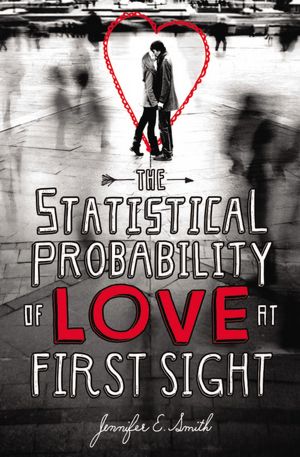
The Statistical Probability of Love at First Sight (YA)

The Statistical Probability of Love at First Sight. Jennifer E. Smith. 2012. Little, Brown. 236 pages.

From the prologue:
There are so many ways it could have all turned out differently. Imagine if she hadn't forgotten the book. She wouldn't have had to run back into the house while Mom waited outside with the car running, the engine setting loose a cloud of exhaust in the late-day heat. Or before that, even: Imagine if she hadn't waited to try on her dress, so that she might have noticed earlier that the straps were too long, and Mom wouldn't have had to haul out her old sewing kit, turning the kitchen counter into an operating table as she attempted to save the poor lifeless swath of purple silk at the very last minute...

From chapter one: Airports are torture chambers if you're claustrophobic.

The Statistical Probability of Love at First Sight has to be one of the best, best YA romances I've read in years. This one is seriously giddy-making. It was practically perfect in every way. One of those oh-so-satisfying novels that keep you happy and satisfied from start to finish. One of those that almost from the start you know you're going to absolutely love.

So. The heroine of The Statistical Probability of Love at First Sight is Hadley Sullivan. She is ever-so-reluctantly flying to London to be in her father's wedding. She's never met the woman destined to be her stepmother. Never wanted to have to meet such a woman. But she's to be in the wedding--a bridesmaid. So no matter how much she doesn't want to go, she has to go.

The big question...did she miss her flight on purpose?! No, not really. Not intentionally. But those four minutes--the four minutes that kept her from her scheduled flight turn out to be the best thing that ever happened to her. For she happens to meet Oliver at the airport. He's on his way to London. He's actually from there, he's just studying at Yale, as to why he's going back just now...well...that's best left a surprise.

If you love romances where it is all about the dialogue, then this one will make you oh-so-happy. So much is revealed about both Oliver and Hadley through their conversations. The whole novel just covers a little over twenty-four hours. And these two are sitting side-by-side on an airplane, so that is just one reason why there is so much conversation in this one...

One thing that I just LOVED, loved absolutely about this one, was the fact that a book came to symbolize so very, very much. And the book in question is Charles Dickens Our Mutual Friend, my favorite-and-best Dickens. And the novel even quotes some of my very, favorite lines. And these lines help clarify things for the heroine. So it was just a lovely thing for me!!!

I loved everything about this one. The writing. The setting. The dialogue. The characters. How their stories unfold...it's just a GREAT book, a great romance.

Read The Statistical Probability of Love At First Sight
  • If you want a new book, a new romance, to gush about!
  • If you're a fan of teen romances
  • If you're looking for a romance with substance, with actual character development
  • If you're a fan of Jennifer E. Smith


© 2012 Becky Laney of Becky's Book Reviews
The Fault In Our Stars (YA)

The Fault In Our Stars. John Green. 2012. Penguin. 336 pages.

Late in the winter of my seventeenth year, my mother decided I was depressed, presumably because I rarely left the house, spent quite a lot of time in bed, read the same book over and over, ate infrequently, and devoted quite a bit of my abundant free time to thinking about death. 
Whenever you read a cancer booklet or website or whatever, they always list depression among the side effects of cancer. But, in fact, depression is not a side effect of cancer. Depression is a side effect of dying. (Cancer is also a side effect of dying. Almost everything is, really.) 

Hazel, our heroine, is dying of cancer. When she ever-so-reluctantly attends a cancer support group, she meets Augustus Waters. After these two meet, well, both have reason to want to live. Augustus definitely loves her and wants to be with her. She's slightly more reluctant because she gets caught up thinking about the future, how there can be no future, since she could end up dying in a matter of weeks, months, whatever. She would rather hurt him now--by refusing to be with him--than hurt him later by her death. But a few things happen to change her mind, to cause her to open her heart and mind to living life in the present.

It's a bittersweet romance. But bittersweet in a good way. Much of the novel does deal with serious subjects--like death, dying, questioning the 'meaning' of life, the 'point' of it all. But it's not without its lighter moments--like the lonely swing set. It's a sad novel, to be sure, but it's not without hope.

I liked this one. I'm not sure that I LOVED it. (Peter Van Houten annoyed me greatly even when he wasn't being super-cranky. I didn't find his book, his writing, oh-so-wonderful like Hazel does. I thought he was obnoxious from the start.) But I definitely found this one worth reading. The book is very well-written. And the dialogue between these two was great.

Read The Fault In Our Stars:
  • If you love John Green, if you've enjoyed his previous books
  • If you are looking for a bittersweet all-too-realistic, all-too-heartbreaking romance
  • If you are looking for a good YA book with plenty of heart (don't mistake heart for cute and sweet though)
Two of my favorite quotes:
"I'm in love with you," he said quietly.
"Augustus," I said.
"I am," he said. He was staring at me, and I could see the corners of his eyes crinkling. "I'm in love with you, and I'm not in the business of denying myself the simple pleasure of saying true things. I'm in love with you, and I know that love is just a shout into the void, and that oblivion is inevitable, and that we're all doomed and that there will come a day when all our labor has been returned to dust, and I know the sun will swallow the only earth we'll ever have, and I am in love with you."
"Augustus," I said again, not knowing what else to say. (153)

"What am I at war with? My cancer. And what is my cancer? My cancer is me. The tumors are made of me. They're made of me as surely as my brain and my heart are made of me. It is a civil war, Hazel Grace, with a predetermined winner." (216)


© 2012 Becky Laney of Becky's Book Reviews