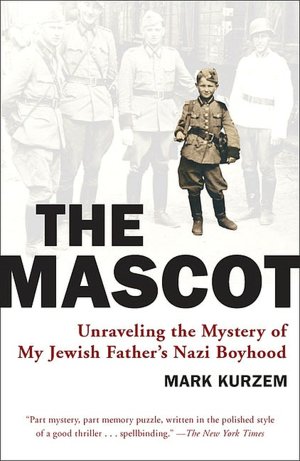
Mascot: Unraveling the Mystery of My Jewish Father's Nazi Boyhood. Mark Kurzem. 2007. Penguin. 432 pages.
If I'm ever asked, "What's your father like?" a simple answer always escapes me. Even though I can look back on a lifetime spent in his company, I have never been able to take his measure. One part of him is a shy, brooding Russian peasant who shows a certain air of naivete, if not gullibility, with strangers. Then there is another side: alert, highly gregarious, and astonishingly worldly. His unexpected appearance on my doorstep in Oxford one May afternoon in 1997 left me more mystified than ever. The Mascot is such a powerful and compelling biography. It is not your traditional biography--Holocaust or not. It is the story of how one man's past is revealed, how a father chooses to share his memories--some quite vivid, others very vague or fuzzy--with his adult son. The father's life is revealed to his son in a series of conversations and through the son's research to validate his father's story.
Mark, our narrator, always knew his father had his secrets. His father had a brown bag he carried with him everywhere. No one was allowed to see this bag's contents. But. Occasionally, the father would share with his family--his wife and sons--stories from the past. On these occasions, he'd pull out a photograph, an article, an item from the bag. Mark suspected that these stories were just that--stories, being part fact, part embellishment.
But one day his father tries to tell him the truth, the whole truth, the whole UGLY truth about his past. Pieces and fragments. A memory here and there. What is certainly understandable is just how much is missing, how much he doesn't know about who he is and where he comes from.
He was told by his rescuers (Latvian police men or Latvian soldiers?) that he was found in the woods or forest. Alone. Wandering. Obviously struggling to survive. He was taken in by the soldiers and "adopted" into their company. They gave him a name. They gave him a birthday. They gave him a small uniform--from 1941 to 1945 he was given three uniforms. Though he was taken into one man's home--"adopted" (though not legally) by a husband and wife--he stayed connected or associated with a unit of soldiers. He witnessed things NO CHILD of five, six, seven, eight, or nine should EVER witness. He saw men, women, children, babies being killed--in one instance herded together into a building which was then set on fire.
Though he doesn't remember his name--his family name, the names of his brother and sister, father and mother--or the name of his village, the name of his country--he does remember one thing: he witnessed the slaughter of his mother, his younger brother, his baby sister. He witnessed the slaughter of an entire neighborhood or village. At the time, he didn't realize this violence, this bloody slaughter, was because they were Jewish. In fact, his very "Jewishness" was buried deep inside him. At times he seemed aware that he too was Jewish, that his life was at risk if his Jewishness was revealed. But at the same time, the only way he could cope with his present--with his new reality, his new identity, the company he was keeping--was forced to keep in a way--was to bury his 'true' Jewish identity and become the boy others wanted/needed him to be. To survive, he had to deny so very very much.
So the story Mark hears from his father is fragmented, in a way, with very few clues. But it is emotional and intense. Almost too much for him to handle. In fact, it is almost too much for him--the father--to handle. And at one point, he asks himself and he asks his son why. Why bother remembering the past? What good--if any--can come from remembering, from seeking to remember, from uncovering the truth, from piecing everything together, from telling and sharing his story with his family, his friends, his community. For those expecting a clear answer to this, you might be disappointed. The truth is not that black and white. A son and father learn much about one another. The family is at times strengthened, but at other times put under great stress and pressure--by all this. There were things that seemed a little shocking to me, for one, that there were certain organizations (if organizations is the right word?) that denied and rejected his story. Who told him that he was NOT Jewish, that he did NOT suffer during the war, that his story was not part of the Holocaust. Still others (sometimes just individuals, other times groups of individuals) who denied his story, who essentially said that his story was all lies, that it could not happen, did not happen. I think this shocked the son as well, that people could hear the story, see the photographs, and come to the conclusion that this small child (he was found at the age of five) was a willing participant in the war, that he voluntarily joined the enemy, that he was a Nazi just like the others--the adult soldiers. Was he ethically responsible for the actions taken by others? True, you might argue, that the soldiers were trying to "train" him to be a little Nazi, a good, little soldier. But what choice--if any--would he have had?
Read The Mascot
- If you can't get enough nonfiction about World War II (like me)
- If you enjoy reading Jewish books; Holocaust books.
- If you are interested in family dynamics (relationships); this one is great at exploring a father-son relationship.
- If you are interested in history and research; this one provides a behind-the-scenes look at how research is done in a very practical, personal way. (Research isn't just about getting a grade.)
- If you enjoy biographies.
© 2012 Becky Laney of
Becky's Book Reviews