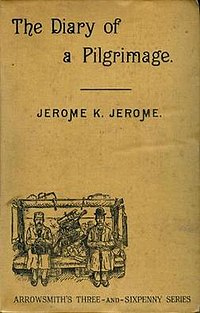
Diary of a Pilgrimage. Jerome K. Jerome. 1891. 192 pages.
From the preface:
Said a friend of mine to me some months ago: “Well now, why don’t you write a sensible book? I should like to see you make people think.”
“Do you believe it can be done, then?” I asked.
“Well, try,” he replied.
Accordingly, I have tried. This is a sensible book. I want you to understand that. This is a book to improve your mind. In this book I tell you all about Germany—at all events, all I know about Germany—and the Ober-Ammergau Passion Play. I also tell you about other things. I do not tell you all I know about all these other things, because I do not want to swamp you with knowledge. I wish to lead you gradually. When you have learnt this book, you can come again, and I will tell you some more. I should only be defeating my own object did I, by making you think too much at first, give you a perhaps, lasting dislike to the exercise. I have purposely put the matter in a light and attractive form, so that I may secure the attention of the young and the frivolous. I do not want them to notice, as they go on, that they are being instructed; and I have, therefore, endeavoured to disguise from them, so far as is practicable, that this is either an exceptionally clever or an exceptionally useful work. I want to do them good without their knowing it. I want to do you all good—to improve your minds and to make you think, if I can.
What you will think after you have read the book, I do not want to know; indeed, I would rather not know. It will be sufficient reward for me to feel that I have done my duty, and to receive a percentage on the gross sales.

I don't want to overwhelm you with quotes, but, I'm not sure I have enough will power to resist. Why? Well, Diary of a Pilgrimage is so very, very, very good!!! I just LOVED, LOVED, LOVED it. It was amusing, yes, and charming, and delightful. But it was also laugh out loud funny. And at the same time, he managed to sneak in serious asides. A phrase here and there that resonates.
I already knew I was a fan of Jerome K. Jerome, I've read
Three Men In A Boat and
Three Men on a Brummel. I don't know WHY I waited so long to read more Jerome. This travel book featuring the adventures of J and B is laugh out loud funny.
The book begins when his friend, B, asks him if he wants to go to the theatre, not mentioning, at first, that the theatre is in Germany and that it is no ordinary play they go to see, but a quite famous Passion Play that literally lasts all day long. J, our narrator, pauses to consider, realizes that the trip will prove quite convenient and agrees to go. The rest of the book is about all the stages of their trip beginning with what to pack and concluding with what train to take to escape from Munich. It is full of detail and description. Often humorous, but, at times serious as well. For example, though he might make a big to do about how he has nothing at all to say about the Passion Play itself, he does quite the job of it!!! And for that chapter this book does take a different tone. (I've included just one tiny quote from that section.) But. For the most part it is about two men having adventures in a handful of European countries. J pretending to know more of the language than he actually does. B worrying about which trains to take next, etc. That is when B isn't wanting to stop and see each and every cathedral along the way. It's about them enjoying the company of others (except when they don't). Descriptions of trains, ships, cathedrals, restaurants, hotels, rivers, lakes, towns, cities, etc.
I just LOVE Jerome K. Jerome's writing style. His narration is wonderful!!!
Read The Diary of a Pilgrimage:
- If you like to laugh
- If you're a fan of travel books, if you are curious to read about nineteenth century Germany
- If you are a fan of Jerome K. Jerome
- If you enjoy Victorian fiction
- If you DON'T think you like Victorian fiction but are willing to take a chance. This is SHORT and FUNNY.
Favorite quotes (of a short variety):I pondered for a moment, looked at my diary, and saw that Aunt Emma was coming to spend Saturday to Wednesday next with us, calculated that if I went I should miss her, and might not see her again for years, and decided that I would go.
I always like to be prepared for work; one never knows when one may feel inclined for it.
"Oh! Take as much advice as you like; that always comes in useful to give away."
Aunt Emma came in the afternoon. She said she was so glad she had caught me. Something told her to change her mind and come on Friday instead of Saturday. It was Providence, she said. I wish Providence would mind its own business, and not interfere in my affairs; it does not understand them. She says she shall stop till I come back, as she wants to see me again before she goes. I told her I might not be back for a month. She said it didn't matter; she had plenty of time, and would wait for me. The family entreated me to hurry home.
When men have nothing else to occupy their minds, they take to thinking.
One day she [Society] will arrive at perfect wisdom, and will pay each man according to his deserts. But do not be alarmed. This will not happen in our time.
Time is a shadow that will vanish with the twilight of humanity; but Silence is a part of the eternal. All things that are true and lasting have been taught to men’s hearts by Silence.
A conscientious man who really felt that his words would carry weight and influence with them would be almost afraid to speak at all. It is the man who knows that it will not make an ounce of difference to anyone what he says, that can grow eloquent and vehement and positive. It will not make any difference to anybody or anything what I say about the Ober-Ammergau Passion Play. So I shall just say what I want to.
Not by his doctrines, not even by his promises, has Christ laid hold upon the hearts of men, but by the story of his life.
Our first thoughts are the thoughts that are given to us; our second thoughts are the thoughts that we make for ourselves. I prefer to trust the former.
Favorite Long Quotes: A Story About a Talkative Man on a Train:
There was a very talkative man in our carriage. I never came across a man with such a fund of utterly uninteresting anecdotes. He had a friend with him—at all events, the man was his friend when they started—and he talked to this friend incessantly, from the moment the train left Victoria until it arrived at Dover. First of all he told him a long story about a dog. There was no point in the story whatever. It was simply a bald narrative of the dog’s daily doings. The dog got up in the morning and barked at the door, and when they came down and opened the door there he was, and he stopped all day in the garden; and when his wife (not the dog’s wife, the wife of the man who was telling the story) went out in the afternoon, he was asleep on the grass, and they brought him into the house, and he played with the children, and in the evening he slept in the coal-shed, and next morning there he was again. And so on, for about forty minutes.
A very dear chum or near relative of the dog’s might doubtless have found the account enthralling; but what possible interest a stranger—a man who evidently didn’t even know the dog—could be expected to take in the report, it was difficult to conceive.
The friend at first tried to feel excited, and murmured: “Wonderful!” “Very strange, indeed!” “How curious!” and helped the tale along by such ejaculations as, “No, did he though?” “And what did you do then?” or, “Was that on the Monday or the Tuesday, then?” But as the story progressed, he appeared to take a positive dislike to the dog, and only yawned each time that it was mentioned.
Indeed, towards the end, I think, though I trust I am mistaken, I heard him mutter, “Oh, damn the dog!”
After the dog story, we thought we were going to have a little quiet. But we were mistaken; for, with the same breath with which he finished the dog rigmarole, our talkative companion added:
“But I can tell you a funnier thing than that—”
We all felt we could believe that assertion. If he had boasted that he could tell a duller, more uninteresting story, we should have doubted him; but the possibility of his being able to relate something funnier, we could readily grasp.
But it was not a bit funnier, after all. It was only longer and more involved. It was the history of a man who grew his own celery; and then, later on, it turned out that his wife was the niece, by the mother’s side, of a man who had made an ottoman out of an old packing-case.
The friend glanced round the carriage apologetically about the middle of this story, with an expression that said:
“I’m awfully sorry, gentlemen; but it really is not my fault. You see the position I’m in. Don’t blame me. Don’t make it worse for me to bear than it is.”
And we each replied with pitying, sympathetic looks that implied:
“That’s all right, my dear sir; don’t you fret about that. We see how it is. We only wish we could do something to help you.”
The poor fellow seemed happier and more resigned after that.
A Story About Not Sleeping On A Boat
I got a little sleep at last. Not in the bunk I had been at such pains to secure: I would not have stopped down in that stuffy saloon, if anybody had offered me a hundred pounds for doing so. Not that anybody did; nor that anybody seemed to want me there at all. I gathered this from the fact that the first thing that met my eye, after I had succeeded in clawing my way down, was a boot. The air was full of boots. There were sixty men sleeping there—or, as regards the majority, I should say trying to sleep there—some in bunks, some on tables, and some under tables. One man was asleep, and was snoring like a hippopotamus—like a hippopotamus that had caught a cold, and was hoarse; and the other fifty-nine were sitting up, throwing their boots at him. It was a snore, very difficult to locate. From which particular berth, in that dimly-lighted, evil-smelling place, it proceeded nobody was quite sure. At one moment, it appeared to come, wailing and sobbing, from the larboard, and the next instant it thundered forth, seemingly from the starboard. So every man who could reach a boot picked it up, and threw it promiscuously, silently praying to Providence, as he did so, to guide it aright and bring it safe to its desired haven.
J's Language Troubles
B. suggested that while we were in Belgium, where everybody spoke French, while very few indeed knew German, I should stand a better chance of being understood if I talked less German and more French.
He said:
“It will be easier for you, and less of a strain upon the natives. You stick to French,” he continued, “as long as ever you can. You will get along much better with French. You will come across people now and then—smart, intelligent people—who will partially understand your French, but no human being, except a thought-reader, will ever obtain any glimmering of what you mean from your German.”
“Oh, are we in Belgium,” I replied sleepily; “I thought we were in Germany. I didn’t know.” And then, in a burst of confidence, I added, feeling that further deceit was useless, “I don’t know where I am, you know.”
“No, I thought you didn’t,” he replied. “That is exactly the idea you give anybody. I wish you’d wake up a bit.”
J's German Bed Woes
We went to bed after our wash. To the blasé English bed-goer, accustomed all his life to the same old hackneyed style of bed night after night, there is something very pleasantly piquant about the experience of trying to sleep in a German bed. He does not know it is a bed at first. He thinks that someone has been going round the room, collecting all the sacks and cushions and antimacassars and such articles that he has happened to find about, and has piled them up on a wooden tray ready for moving. He rings for the chambermaid, and explains to her that she has shown him into the wrong room. He wanted a bedroom.
She says: “This is a bedroom.”
He says: “Where’s the bed?”
“There!” she says, pointing to the box on which the sacks and antimacassars and cushions lie piled.
“That!” he cries. “How am I going to sleep in that?”
The chambermaid does not know how he is going to sleep there, never having seen a gentleman go to sleep anywhere, and not knowing how they set about it; but suggests that he might try lying down flat, and shutting his eyes.
“But it is not long enough,” he says.
The chambermaid thinks he will be able to manage, if he tucks his legs up.
He sees that he will not get anything better, and that he must put up with it.
“Oh, very well!” he says. “Look sharp and get it made, then.”
She says: “It is made.”
He turns and regards the girl sternly. Is she taking advantage of his being a lonely stranger, far from home and friends, to mock him? He goes over to what she calls the bed, and snatching off the top-most sack from the pile and holding it up, says:
“Perhaps you’ll tell me what this is, then?”
“That,” says the girl, “that’s the bed!”
He is somewhat nonplussed at the unexpected reply.
“Oh!” he says. “Oh! the bed, is it? I thought it was a pincushion! Well, if it is the bed, then what is it doing out here, on the top of everything else? You think that because I’m only a man, I don’t understand a bed!”
“That’s the proper place for it,” responds the chambermaid.
“What! on top?”
“Yes, sir.”
“Well, then where are the clothes?”
“Underneath, sir.”
“Look here, my good girl,” he says; “you don’t understand me, or I don’t understand you, one or the other. When I go to sleep, I lie on a bed and pull the clothes over me. I don’t want to lie on the clothes, and cover myself with the bed. This isn’t a comic ballet, you know!”
The girl assures him that there is no mistake about the matter at all. There is the bed, made according to German notions of how a bed should be made. He can make the best of it and try to go to sleep upon it, or he can be sulky and go to sleep on the floor.
He is very much surprised. It looks to him the sort of bed that a man would make for himself on coming home late from a party. But it is no use arguing the matter with the girl.
“All right,” he says; “bring me a pillow, and I’ll risk it!”
The chambermaid explains that there are two pillows on the bed already, indicating, as she does so, two flat cushions, each one a yard square, placed one on top of the other at one end of the mixture.
“These!” exclaims the weary traveller, beginning to feel that he does not want to go to bed at all. “These are not pillows! I want something to put my head on; not a thing that comes down to the middle of my back! Don’t tell me that I’ve got to sleep on these things!”
But the girl does tell him so, and also implies that she has something else to do than to stand there all day talking bed-gossip with him.
“Well, just show me how to start,” he says, “which way you get into it, and then I won’t keep you any longer; I’ll puzzle out the rest for myself.”
She explains the trick to him and leaves, and he undresses and crawls in.
The pillows give him a good deal of worry. He does not know whether he is meant to sit on them or merely to lean up against them. In experimenting upon this point, he bumps his head against the top board of the bedstead. At this, he says, “Oh!” and shoots himself down to the bottom of the bed. Here all his ten toes simultaneously come into sharp contact with the board at the bottom.
Nothing irritates a man more than being rapped over the toes, especially if he feels that he has done nothing to deserve it. He says, “Oh, damn!” this time, and spasmodically doubles up his legs, thus giving his knees a violent blow against the board at the side of the bed. (The German bedstead, be it remembered, is built in the form of a shallow, open box, and the victim is thus completely surrounded by solid pieces of wood with sharp edges. I do not know what species of wood it is that is employed. It is extremely hard, and gives forth a curious musical sound when struck sharply with a bone.)
After this he lies perfectly still for a while, wondering where he is going to be hit next. Finding that nothing happens, he begins to regain confidence, and ventures to gently feel around with his left leg and take stock of his position.
For clothes, he has only a very thin blanket and sheet, and beneath these he feels decidedly chilly. The bed is warm enough, so far as it goes, but there is not enough of it. He draws it up round his chin, and then his feet begin to freeze. He pushes it down over his feet, and then all the top part of him shivers.
He tries to roll up into a ball, so as to get the whole of himself underneath it, but does not succeed; there is always some of him left outside in the cold.
He reflects that a “boneless wonder” or a “man serpent” would be comfortable enough in this bed, and wishes that he had been brought up as a contortionist. If he could only tie his legs round his neck, and tuck his head in under his arm, all would yet be well.
Never having been taught to do any really useful tricks such as these, however, he has to be content to remain spread out, warming a bit of himself at a time.
It is, perhaps, foolish of him, amid so many real troubles, to allow a mere æsthetical consideration to worry him, but as he lies there on his back, looking down at himself, the sight that he presents to himself considerably annoys him. The puffed-up bed, resting on the middle of him, gives him the appearance of a man suffering from some monstrous swelling, or else of some exceptionally well-developed frog that has been turned up the wrong way and does not know how to get on to its legs again.
Another vexation that he has to contend with is, that every time he moves a limb or breathes extra hard, the bed (which is only of down) tumbles off on to the floor.
You cannot lean out of a German bed to pick up anything off the floor, owing to its box-like formation; so he has to scramble out after it, and of course every time he does this he barks both his shins twice against the sides of the bed.
When he has performed this feat for about the tenth time, he concludes that it was madness for him, a mere raw amateur at the business, to think that he could manage a complicated, tricky bed of this sort, that must take even an experienced man all he knows to sleep in it; and gets out and camps on the floor.
J Gets Very Philosophical on Silence
There is much help in Silence. From its touch we gain renewed life. Silence is to the Soul what his Mother Earth was to Briareus. From contact with it we rise healed of our hurts and strengthened for the fight.
Amid the babel of the schools we stand bewildered and affrighted. Silence gives us peace and hope. Silence teaches us no creed, only that God’s arms are around the universe.
How small and unimportant seem all our fretful troubles and ambitions when we stand with them in our hand before the great calm face of Silence! We smile at them ourselves, and are ashamed.
Silence teaches us how little we are—how great we are. In the world’s market-places we are tinkers, tailors, apothecaries, thieves—respectable or otherwise, as the case may be—mere atoms of a mighty machine—mere insects in a vast hive.
It is only in Silence that it comes home to us that we are something much greater than this—that we are men, with all the universe and all eternity before us.
It is in Silence we hear the voice of Truth. The temples and the marts of men echo all night and day to the clamour of lies and shams and quackeries. But in Silence falsehood cannot live. You cannot float a lie on Silence. A lie has to be puffed aloft, and kept from falling by men’s breath. Leave a lie on the bosom of Silence, and it sinks. A truth floats there fair and stately, like some stout ship upon a deep ocean. Silence buoys her up lovingly for all men to see. Not until she has grown worn-out and rotten, and is no longer a truth, will the waters of Silence close over her.
Silence is the only real thing we can lay hold of in this world of passing dreams. Time is a shadow that will vanish with the twilight of humanity; but Silence is a part of the eternal. All things that are true and lasting have been taught to men’s hearts by Silence.
One Comedy They Witnessed On Their Way Involving a Goat:
We witnessed the opening scenes of a very amusing little comedy at one of the towns where the train drew up. The chief characters were played by an active young goat, a small boy, an elderly man and a woman, parents of the small boy and owners of the goat, and a dog.
First we heard a yell, and then, from out a cottage opposite the station, bounded an innocent and happy goat, and gambolled around. A long rope, one end of which was fastened to his neck, trailed behind him. After the goat (in the double sense of the phrase) came a child. The child tried to catch the goat by means of the rope, caught itself in the rope instead, and went down with a bump and a screech. Whereupon a stout woman, the boy’s mother apparently, ran out from the cottage, and also made for the goat. The goat flew down the road, and the woman flew after it. At the first corner, the woman trod on the rope, and then she went down with a bump and a screech. Then the goat turned and ran up the street, and, as it passed the cottage, the father ran out and tried to stop it. He was an old man, but still seemed to have plenty of vigour in him. He evidently guessed how his wife and child had gone down, and he endeavoured to avoid the rope and to skip over it when it came near him. But the goat’s movements were too erratic for him. His turn came, and he trod on the rope, and went down in the middle of the road, opposite his own door, with a thud that shook us all up against each other as we stood looking out of the carriage-window, and sat there and cursed the goat. Then out ran a dog, barking furiously, and he went for the goat, and got the end of the rope in his teeth and held on to it like grim death. Away went the goat, at his end of the rope, and, with him, the dog at the other end. Between them, they kept the rope about six inches above the ground, and with it they remorselessly mowed down every living thing they came across in that once peaceful village. In the course of less than half a minute we counted fourteen persons sitting down in the middle of the road. Eight of them were cursing the goat, four were cursing the dog, and two of them were cursing the old man for keeping the goat, one of these two, and the more violent one, being the man’s own wife.
J's Attempt to Order a Savoury Omelette:
I ordered the breakfast. I thought it would be a good opportunity for me to try my German. I ordered coffee and rolls as a groundwork. I got over that part of my task very easily. With the practice I had had during the last two days, I could have ordered coffee and rolls for forty. Then I foraged round for luxuries, and ordered a green salad. I had some difficulty at first in convincing the man that it was not a boiled cabbage that I wanted, but succeeded eventually in getting that silly notion out of his head.
I still had a little German left, even after that. So I ordered an omelette also.
“Tell him a savoury one,” said B., “or he will be bringing us something full of hot jam and chocolate-creams. You know their style.”
“Oh, yes,” I answered. “Of course. Yes. Let me see. What is the German for savoury?”
“Savoury?” mused B. “Oh! ah! hum! Bothered if I know! Confound the thing—I can’t think of it!”
I could not think of it either. As a matter of fact, I never knew it. We tried the man with French. We said:
“Une omelette aux fines herbes.”
As he did not appear to understand that, we gave it him in bad English. We twisted and turned the unfortunate word “savoury” into sounds so quaint, so sad, so unearthly, that you would have thought they might have touched the heart of a savage. This stoical Teuton, however, remained unmoved. Then we tried pantomime.
Pantomime is to language what marmalade, according to the label on the pot, is to butter, “an excellent (occasional) substitute.” But its powers as an interpreter of thought are limited. At least, in real life they are so. As regards a ballet, it is difficult to say what is not explainable by pantomime. I have seen the bad man in a ballet convey to the première danseuse by a subtle movement of the left leg, together with some slight assistance from the drum, the heartrending intelligence that the lady she had been brought up to believe was her mother was in reality only her aunt by marriage. But then it must be borne in mind that the première danseuse is a lady whose quickness of perception is altogether unique. The première danseuse knows precisely what a gentleman means when he twirls round forty-seven times on one leg, and then stands on his head. The average foreigner would, in all probability, completely misunderstand the man.
J on his "Handy" German Dialogue/Conversation Guide:
How stupid of me not to have thought of it before. Here had we been racking our brains and our bodies, trying to explain our wants to an uneducated German, while, all the time, there lay to our hands a book specially written and prepared to assist people out of the very difficulty into which we had fallen—a book carefully compiled with the express object of enabling English travellers who, like ourselves, only spoke German in a dilettante fashion, to make their modest requirements known throughout the Fatherland, and to get out of the country alive and uninjured.
I hastily snatched the book from my pocket, and commenced to search for dialogues dealing with the great food question. There were none!
There were lengthy and passionate “Conversations with a laundress” about articles that I blush to remember. Some twenty pages of the volume were devoted to silly dialogues between an extraordinarily patient shoemaker and one of the most irritating and constitutionally dissatisfied customers that an unfortunate shop-keeper could possibly be cursed with; a customer who, after twaddling for about forty minutes, and trying on, apparently, every pair of boots in the place, calmly walks out with:
“Ah! well, I shall not purchase anything to-day. Good-morning!”
The shopkeeper’s reply, by-the-by, is not given. It probably took the form of a boot-jack, accompanied by phrases deemed useless for the purposes of the Christian tourist.
There was really something remarkable about the exhaustiveness of this “conversation at the shoemaker’s.” I should think the book must have been written by someone who suffered from corns. I could have gone to a German shoemaker with this book and have talked the man’s head off.
Then there were two pages of watery chatter “on meeting a friend in the street”—“Good-morning, sir (or madam).” “I wish you a merry Christmas.” “How is your mother?” As if a man who hardly knew enough German to keep body and soul together, would want to go about asking after the health of a foreign person’s mother.
There were also “conversations in the railway carriage,” conversations between travelling lunatics, apparently, and dialogues “during the passage.” “How do you feel now?” “Pretty well as yet; but I cannot say how long it will last.” “Oh, what waves! I now feel very unwell and shall go below. Ask for a basin for me.” Imagine a person who felt like that wanting to know the German for it.
At the end of the book were German proverbs and “Idiomatic Phrases,” by which latter would appear to be meant in all languages, “phrases for the use of idiots”:—“A sparrow in the hand is better than a pigeon on the roof.”—“Time brings roses.”—“The eagle does not catch flies.”—“One should not buy a cat in a sack,”—as if there were a large class of consumers who habitually did purchase their cats in that way, thus enabling unscrupulous dealers to palm off upon them an inferior cat, and whom it was accordingly necessary to advise against the custom.
I skimmed through all this nonsense, but not a word could I discover anywhere about a savoury omelette. Under the head of “Eating and Drinking,” I found a short vocabulary; but it was mainly concerned with “raspberries” and “figs” and “medlars” (whatever they may be; I never heard of them myself), and “chestnuts,” and such like things that a man hardly ever wants, even when he is in his own country. There was plenty of oil and vinegar, and pepper and salt and mustard in the list, but nothing to put them on. I could have had a hard-boiled egg, or a slice of ham; but I did not want a hard-boiled egg, or a slice of ham. I wanted a savoury omelette; and that was an article of diet that the authors of this “Handy Little Guide,” as they termed it in their preface, had evidently never heard of.
Since my return home, I have, out of curiosity, obtained three or four “English-German Dialogues” and “Conversation Books,” intended to assist the English traveller in his efforts to make himself understood by the German people, and I have come to the conclusion that the work I took out with me was the most sensible and practical of the lot.
J's Melancholy Experience with Cheese:
I mention that we had dinner, not because I think that the information will prove exciting to the reader, but because I wish to warn my countrymen, travelling in Germany, against undue indulgence in Liptauer cheese.
I am fond of cheese, and of trying new varieties of cheese; so that when I looked down the cheese department of the bill of fare, and came across “liptauer garnit,” an article of diet I had never before heard of, I determined to sample it.
It was not a tempting-looking cheese. It was an unhealthy, sad-looking cheese. It looked like a cheese that had seen trouble. In appearance it resembled putty more than anything else. It even tasted like putty—at least, like I should imagine putty would taste. To this hour I am not positive that it was not putty. The garnishing was even more remarkable than the cheese. All the way round the plate were piled articles that I had never before seen at a dinner, and that I do not ever want to see there again. There was a little heap of split-peas, three or four remarkably small potatoes—at least, I suppose they were potatoes; if not, they were pea-nuts boiled soft,—some caraway-seeds, a very young-looking fish, apparently of the stickleback breed, and some red paint. It was quite a little dinner all to itself.
What the red paint was for, I could not understand. B. thought that it was put there for suicidal purposes. His idea was that the customer, after eating all the other things in the plate, would wish he were dead, and that the restaurant people, knowing this, had thoughtfully provided him with red paint for one, so that he could poison himself off and get out of his misery.
I thought, after swallowing the first mouthful, that I would not eat any more of this cheese. Then it occurred to me that it was a pity to waste it after having ordered it, and, besides, I might get to like it before I had finished. The taste for most of the good things of this world has to be acquired. I can remember the time when I did not like beer.
So I mixed up everything on the plate all together—made a sort of salad of it, in fact—and ate it with a spoon. A more disagreeable dish I have never tasted since the days when I used to do Willie Evans’s “dags,” by walking twice through a sewer, and was subsequently, on returning home, promptly put to bed, and made to eat brimstone and treacle.
I felt very sad after dinner. All the things I have done in my life that I should not have done recurred to me with painful vividness. (There seemed to be a goodish number of them, too.) I thought of all the disappointments and reverses I had experienced during my career; of all the injustice that I had suffered, and of all the unkind things that had been said and done to me. I thought of all the people I had known who were now dead, and whom I should never see again, of all the girls that I had loved, who were now married to other fellows, while I did not even know their present addresses. I pondered upon our earthly existence, upon how hollow, false, and transient it is, and how full of sorrow. I mused upon the wickedness of the world and of everybody in it, and the general cussedness of all things.
I thought how foolish it was for B. and myself to be wasting our time, gadding about Europe in this silly way. What earthly enjoyment was there in travelling—being jolted about in stuffy trains, and overcharged at uncomfortable hotels?
B. was cheerful and frivolously inclined at the beginning of our walk (we were strolling down the Maximilian Strasse, after dinner); but as I talked to him, I was glad to notice that he gradually grew more serious and subdued. He is not really bad, you know, only thoughtless.
B. bought some cigars and offered me one. I did not want to smoke. Smoking seemed to me, just then, a foolish waste of time and money. As I said to B.:
“In a few more years, perhaps before this very month is gone, we shall be lying in the silent tomb, with the worms feeding on us. Of what advantage will it be to us then that we smoked these cigars to-day?”
B. said:
“Well, the advantage it will be to me now is, that if you have a cigar in your mouth I shan’t get quite so much of your chatty conversation. Take one, for my sake.”
To humour him, I lit up.
J's Impossible Bradshaw Timetable
I do believe I am the most unfortunate man at a time-table that ever was born. I do not think it can be stupidity; for if it were mere stupidity, I should occasionally, now and then when I was feeling well, not make a mistake. It must be fate.
If there is one train out of forty that goes on “Saturdays only” to some place I want to get to, that is the train I select to travel by on a Friday. On Saturday morning I get up at six, swallow a hasty breakfast, and rush off to catch a return train that goes on every day in the week “except Saturdays.”
I go to London, Brighton and South Coast Railway-stations and clamour for South-Eastern trains. On Bank Holidays I forget it is Bank Holiday, and go and sit on draughty platforms for hours, waiting for trains that do not run on Bank Holidays.
To add to my misfortunes, I am the miserable possessor of a demon time-table that I cannot get rid of, a Bradshaw for August, 1887. Regularly, on the first of each month, I buy and bring home with me a new Bradshaw and a new A.B.C. What becomes of them after the second of the month, I do not know. After the second of the month, I never see either of them again. What their fate is, I can only guess. In their place is left, to mislead me, this wretched old 1887 corpse.
For three years I have been trying to escape from it, but it will not leave me.
I have thrown it out of the window, and it has fallen on people’s heads, and those people have picked it up and smoothed it out, and brought it back to the house, and members of my family—“friends” they call themselves—people of my own flesh and blood—have thanked them and taken it in again!
I have kicked it into a dozen pieces, and kicked the pieces all the way downstairs and out into the garden, and persons—persons, mind you, who will not sew a button on the back of my shirt to save me from madness—have collected the pieces and stitched them carefully together, and made the book look as good as new, and put it back in my study!
It has acquired the secret of perpetual youth, has this time-table. Other time-tables that I buy become dissipated-looking wrecks in about a week. This book looks as fresh and new and clean as it did on the day when it first lured me into purchasing it. There is nothing about its appearance to suggest to the casual observer that it is not this month’s Bradshaw. Its evident aim and object in life is to deceive people into the idea that it is this month’s Bradshaw.
It is undermining my moral character, this book is. It is responsible for at least ten per cent. of the bad language that I use every year. It leads me into drink and gambling. I am continually finding myself with some three or four hours to wait at dismal provincial railway stations. I read all the advertisements on both platforms, and then I get wild and reckless, and plunge into the railway hotel and play billiards with the landlord for threes of Scotch.
I intend to have that Bradshaw put into my coffin with me when I am buried, so that I can show it to the recording angel and explain matters. I expect to obtain a discount of at least five-and-twenty per cent. off my bill of crimes for that Bradshaw.
Eating in Munich "in time" with a Military Band:
If you are within a mile of a Munich military band, and are not stone deaf, you listen to it, and do not think of much else. It compels your attention by its mere noise; it dominates your whole being by its sheer strength. Your mind has to follow it as the feet of the little children followed the playing of the Pied Piper. Whatever you do, you have to do in unison with the band. All through our meal we had to keep time with the music.
We ate our soup to slow waltz time, with the result that every spoonful was cold before we got it up to our mouth. Just as the fish came, the band started a quick polka, and the consequence of that was that we had not time to pick out the bones. We gulped down white wine to the “Blacksmith’s Galop,” and if the tune had lasted much longer we should both have been blind drunk. With the advent of our steaks, the band struck up a selection from Wagner.
I know of no modern European composer so difficult to eat beefsteak to as Wagner. That we did not choke ourselves is a miracle. Wagner’s orchestration is most trying to follow. We had to give up all idea of mustard. B. tried to eat a bit of bread with his steak, and got most hopelessly out of tune. I am afraid I was a little flat myself during the “Valkyries’ Ride.” My steak was rather underdone, and I could not work it quickly enough.
After getting outside hard beefsteak to Wagner, putting away potato salad to the garden music out of Faust was comparatively simple. Once or twice a slice of potato stuck in our throat during a very high note, but, on the whole, our rendering was fairly artistic.
We rattled off a sweet omelette to a symphony in G—or F, or else K; I won’t be positive as to the precise letter; but it was something in the alphabet, I know—and bolted our cheese to the ballet music from Carmen. After which we rolled about in agonies to all the national airs of Europe.
© 2012 Becky Laney of
Becky's Book Reviews