Tampilkan postingan dengan label YA Fantasy. Tampilkan semua postingan

For Darkness Shows the Stars (MG/YA)

For Darkness Shows the Stars. Diana Peterfreund. 2012. HarperCollins. 416 pages.

Elliot North raced across the pasture, leaving a scar of green in the silver, dew-encrusted grass. Jef followed, tripping a bit as his feet slid inside his too-big shoes. 

I really enjoyed Diana Peterfreund's For Darkness Shows the Stars. Did I enjoy it because it was a futuristic dystopia, OR, because it was a retelling of Jane Austen's Persuasion? A bit of both. For those expecting Captain Malakai Wentforth to be as swoon-worthy as Captain Wentworth, well, you might be disappointed. Might. For Kai's romance with Elliot North doesn't exactly mirror that of Wentworth and Anne Elliot. Peterfreund has definitely made this story her own.

For Darkness Shows the Stars is definitely a novel about social class or status. There are three "types" of people in this futuristic world: the Luddites, those with the highest status and wealth, the elite, those that have estates and titles, those that MATTER; the Reduced, those with slave status, essentially, they are thought to be mindless sub-humans, incapable of thought and feelings, definitely thought to be genetically inferior; the POST-Reductionists, the children of the Reduced who happen to be smart enough to function with more independence in the world, they have skills and abilities that make them worth something, they are not thought to be mindless and incapable, but, they're "socially" inferior to the Luddites. No matter how smart or brilliant a POST is, no matter how much money they acquire, they will never be on equal status with the Luddites.

Kai and Elliot grew up together; they share a birthday in fact. (Actually, there are three that share an exact birthday: Kai (Post), Elliot (Luddite), and Ro (Reduced).) But their friendship always had to be a secret, for if Elliot's father or older sister, Tatiana, found out, then everyone would get in trouble. Elliot enjoyed Kai's company, enjoyed spending time with him in the barn, enjoyed watching him fix things--he's a mechanic, the son of a mechanic. But when Elliot chose not to run away with Kai when they were fourteen (or possibly fifteen?), the friendship was broken. He chose to leave the estate, to risk everything in hopes of finding a better future. Elliot hasn't heard from him since the day he left, and he still matters to her. She chose to stay not because she didn't love him, but, because she needed to be responsible, because she was the ONLY one capable of being responsible on the estate, the only one who cared for the welfare of the Reduced, and also respected the Posts.

Meanwhile, Elliot's life has been as unpleasant as ever. Her father and sister are heartless and selfish and at times cruel. The novel opens with her father destroying his daughter's wheat field--weeks before harvest. That wheat could have helped feed the Reduced, it could have been sold for a profit, as well, to help the estate. But her father's "need" for a race track was more important. He's unwilling to see that the estate is struggling financially that they have a responsibility to the Reduced and the Posts that work their land/manage the estate. Elliot doesn't even bother protesting; true, the damage is already done and nothing can bring her wheat back, but, she also has a secret of her own. That wheat was her wheat--her special experimental seed. And Luddites do NOT under any circumstances experiment.

So in an effort to help finances, Elliot decides to rent out the estate to Cloud Fleet....and one of the guests is Captain Malakai Wentforth. Of course, there are plenty of other guests as well.

I enjoyed meeting the different characters in For Darkness Shows the Stars. Since this is a retelling, there is always a chance that the characters could have been weak, shallow copies of the original. For the most part, that was not the case.

I also enjoyed the story; there were just enough twists in the story that it really worked as an original story. The dystopian setting was interesting to me. I didn't have all my questions answered--at least not right away--and this futuristic society definitely added something to the story. 

Read for Presenting Lenore's Dystopian August

Read For Darkness Shows the Stars
  • If you enjoy science fiction, dystopias, post-apocalyptic fiction
  • If you enjoy futuristic stories 
  • If you are interested in a new retelling of Jane Austen's Persuasion
  • If you enjoy a little romance in your science fiction

© 2012 Becky Laney of Becky's Book Reviews

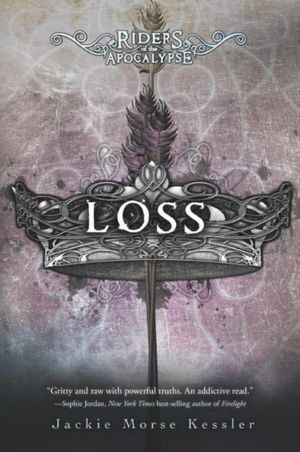
Loss (YA)

Loss. (Riders of the Apocalypse #3) Jackie Morse Kessler. 2012. Houghton Mifflin Harcourt. 272 pages.

The day before Death came for Billy Ballard...
...Billy was on the ground, getting the snot pounded out of him. Again. No special reason this time; maybe it was because it was Tuesday, or because Eddie Glass didn't like Billy's hair.

This is the third novel in Jackie Morse Kessler's Riders of the Apocalypse series. The first two books are Hunger and Rage. Hunger was a novel about a young teen girl with an eating disorder becoming Famine; Rage was a novel about a trouble teen girl, a girl who cuts herself, becoming War. The third novel is about a GUY who has spent years of his life being bullied becoming Pestilence. (For the record, the books do stand alone; you don't need to read them in a certain order; each book is about a different Rider of the Apocalypse.)

The hero of Loss is Billy Ballard. And he's going to have to become confident in the role of hero fast if he's going to stand a chance at saving the world from self-destruction, at stopping the end of the world. He's going to have to face what is troubling him--everything that is troubling him. At home, he's having to deal with a grandfather with Alzheimer's disease. Every room, every window, must be locked. And the front door itself must be "hidden" so that the grandfather can't escape and get lost and cause problems. Soon after the novel opens, readers see what happens when the Mom is careless when she comes in from work. The two are soon rushing through the streets, yelling as they search, needing to find him before something horrible happens. And that something horrible does almost happen--but Billy is there just in time. It was the closest of close calls. And it makes Billy "a hero" in the eyes of his best friend, a girl Billy wishes was his actual girlfriend. But. Billy feels silly thinking himself a hero when he's too scared to go to school, too afraid to go to his classes, his gym class, his locker room. He spends his life dreading every moment he's out of the house; considering what his home life is like--taking care of a grumpy, sometimes-violent grandfather who does not remember him, does not love him, does not want him around--that is saying a lot. But everything changes, everything goes topsy-turvy, everything becomes surreal when Billy is greeted by Death and given the Bow of the Conqueror, of Pestilence. Billy has a chance to wield power, destructive power. But he doesn't necessarily have to do it recklessly or irresponsibly.

Loss will best work for readers who don't require their fiction to make sense 100% of the time. In other words, for those that can accept a certain flowing ever-changing magic-realism, poetical, fantastical dream-state. While Billy does interact in the real world after assuming his bow and the 'office' of Pestilence, most of it does occur in Billy's mind. The imagery and allusions are powerful, in a way, and are incredibly creative. But. At the same time, it didn't quite work...for this reader. It was not quite my personal style.

Though the author uses some biblical imagery in these novels, the whole concept of the (four) riders of the Apocalypse, I can't say that the books are ever faith-friendly. In particular, this book has bothered me more than the others. True, it has been a few years since I've read them, and true, it's possible that I didn't just mention it in my reviews. In general, my philosophy is that I don't expect books to "be biblical" or to meet certain moral standards if they're obviously secular or mainstream. (If, like in Irises, they have characters that profess faith, then, that's somewhat different.) Loss is definitely, definitely a secular book. Yes, it may be using imagery from Revelation, but not in a biblical way. The viewpoint is not biblical. I found it disturbing--actually extremely offensive--when the author has "the Conqueror" say twice:
"Death is in all things," the Conqueror continued, babbling now, his words like wasps in Billy's ears. "He is the alpha and the omega, and we exist only on his whim. And he is done with whimsy!" (229, 243)
At one point Death says, "I'm not a god. Those come and go. I'm more like a permanent fixture." (48)

The novel also holds an unbiblical view of good and evil. In Kessler's novel, for example, and it won't be the first or last time this is done, I know, but good and evil are presented as equal, equal in terms of strength and power and forces and influences. Both good and evil being in eternal opposition forever and ever and ever without end. Neither good nor evil being able to overcome the other. The war between the two resulting not in their losses exactly, but in human losses.

Personally, I liked the first two books better than this one. I think this one is the weirdest one; I think it requires the biggest stretch to suspend your disbelief. I think it takes the most work to understand the surreal storyline which occurs mainly in a weird dream-memory-mind state.

Read Loss
  • If you're a fan of the series
  • If you enjoy magic realism and fantasy
© 2012 Becky Laney of Becky's Book Reviews
The Gathering Storm (YA)

The Gathering Storm. Robin Bridges. 2012. Random House. 386 pages.

An afternoon spent solving quadratic equations would have been infinitely more pleasant. 

 The Gathering Storm is a paranormal fantasy that almost-almost worked for me. It is a paranormal novel starring necromancers, werewolves, vampires, and zombies set in 1880s Russia; the characters are aristocratic and often royal. Our heroine is a young woman named Katerina Alexandrovna, Duchess of Oldenburg. She's making her debut in society, and she's caught the attention of two men. One is the middle son of the tsar, his name is George Alexandrovich, at first Katerina is not impressed with him. The second is the crown prince of Montenegro, Prince Danilo, her first impression of him is much stronger. Then again, it could be because he's a vampire who has mesmerized her.

Is there a single character in this one that doesn't have at least one secret? And most of the main characters--the five or six 'main' characters--have DOZENS of secrets between them. This was truly a case of the main character not knowing WHO to trust. Could she have made better guesses at who to trust? Perhaps. Did the reader have a little more information? Not really. Sure, readers can make their own guesses as to who's telling the truth, who's lying, and who's being the MOST manipulative. What kept me from making predictions--or sticking with the predictions that I made early on--was the fact that you never do know for sure if/when authors are going to put in twists and turns and surprise you.

Did I care about the characters? Well, I almost cared about Katerina. And I did care about George Alexandrovich. I did like Katerina's father. The rest of the characters? Well, I almost-almost cared about some of them, but, some of them not even that much. There were SO VERY MANY characters, usually these characters were related to one another. And I could never remember who was who, who liked each other, who hated each other, who got along, etc. The politics did get confusing at times.

I think I would have liked this one more if it hadn't felt so modern. At times the historical setting worked for me, but other times I just didn't believe it. Katerina has ONE BIG DREAM, to go to medical school and become a doctor. But the universities in Russia do not accept women in their medical programs, and, her parents aren't quite willing to send their daughter away to another European university. But Katerina's dream to have a career remains strong. She hasn't decided against marriage, she hasn't embraced the single life. No, she wants a very open-minded husband who will celebrate her decision to work outside the home and have a career as a doctor. And Katerina seems genuinely surprised when the CROWN PRINCE frowns on her demands to be a working woman. Every time I see Katerina interact with the doctors in the hospital (or in private homes, for that matter), I was thrown out of the story a bit. I don't know how modern, how advanced, how scientific and research-oriented the medical field was in 1880s Russia, but, I do know that at this time in other parts of the world, it was not very. That the field of medicine was very different than modern medicine.

Does it work as a paranormal fantasy? Probably. This isn't my favorite genre, but, it has potential. Does it work as a romance? Well, it has potential. A little more time focused on romance would probably have been a good thing. But, what we do get of George was nice.

Read The Gathering Storm
  • If you enjoy paranormal fantasies with light romance (love triangle of sorts)
  • If you enjoy historical fantasy with some paranormal elements (vampires, zombies, werewolves)
  • If you enjoy books set in Russia in the nineteenth century
© 2012 Becky Laney of Becky's Book Reviews

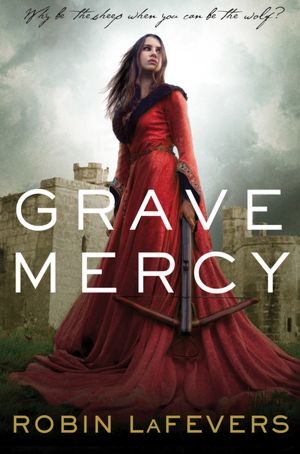
Grave Mercy (YA/Adult)

Grave Mercy. Robin LaFevers. 2012. Houghton Mifflin Harcourt. 560 pages.
Brittany 1485
I bear a deep red stain that runs from my left shoulder down to my right hip, a trail left by the herbwitch’s poison that my mother used to try to expel me from her womb. That I survived, according to the herbwitch, is no miracle but a sign I have been sired by the god of death himself.
I am told my father flew into a rage and raised his hand to my mother even as she lay weak and bleeding on the birthing bed. Until the herbwitch pointed out to him that if my mother had lain with the god of death, surely He would not stand idly by while my father beat her.
I risk a glance up at my husband-to-be, Guillo, and wonder if my father has told him of my lineage. I am guessing not, for who would pay three silver coins for what I am? Besides, Guillo looks far too placid to know of my true nature. If my father has tricked him, it will not bode well for our union. That we are being married in Guillo’s cottage rather than a church further adds to my unease.
I feel my father’s heavy gaze upon me and look up. The triumph in his eyes frightens me, for if he has triumphed, then I have surely lost in some way I do not yet understand. Even so, I smile, wanting to convince him I am happy—for there is nothing that upsets him more than my happiness.
Wow. If you're looking for two words: assassin nuns. Of course, our heroine, Ismae isn't a nun in the Catholic church. No, she's in a special nunnery, the nuns live to serve Death whom they call St. Mortain, and she's received very special training. They've taught her to kill, to be an assassin. The nuns are loyal to the Duchess of Brittany, and the victims are often her political enemies--foreign or domestic--those that pose the greatest threat to Brittany's independence.

While we do see her first few jobs carried out, most of the novel focuses on one job in particular. The abbess wants her to team up with Duval, the Duchess' older brother and her most trusted friend and advisor. She's to pose as his mistress, and travel with him to the Duchess' household. There she will "help him" find any possible traitors. He doesn't exactly trust her, he knows exactly what she's capable of, and who she serves. He knows that if given orders, she'd kill him to please her Lord. She doesn't exactly trust him either. Though the marque hasn't appeared on him yet--the special sign or symbol that she sees on her victims before they're killed--she knows that he could be lying to her, that his loyalty to the Duchess could be an act. But both know that it is of the utmost importance to protect the Duchess, and to find any traitors and uncover any conspiracies, if that means working together, so be it. Of course, this means spending a LOT of time with one another...

...the time will come when Ismae must choose who to trust and who to believe...

Politics. Romance. Drama. Dysfunctional Families. Poison. Murder. Betrayal. Mystery. Suspense.

This one probably won't please every reader. Some may not be able to get past the premise of old or ancient religions continuing to exist under the guise of Christianity. And this one isn't squeaky clean. For those that have no tolerance whatsoever when it comes to sensuality. (I would consider it mild up until the very end when their relationship changes.) But. For those that can, well, this is one COMPELLING read. My favorite character happens to be Duval. I just LOVED him. I did. He was such a swoon-worthy hero!!! And our heroine, Ismae, is quite strong and resourceful. I loved the drama. I loved the history. I loved seeing the court life and family drama play out. I enjoyed the setting, the characters, the writing. It worked really well for me.

Favorite quotes:
"Are you drunk?" I try to put as much scorn into my words as he did.
"No. Yes. Perhaps a little. Definitely not enough." The bleakness is back and he turns to stare into the flames.
I am torn between wanting to leave him to wallow in his despair and wanting to rush to his side and chase that look from his eyes. That I long to do this appalls me, sets panic fluttering against my ribs.
"I suggest you return to your room," Duval says, his gaze still fixed woodenly on the fire. "Unless you have come to practice your lessons of seduction on me?" His mouth twists in bitter amusement. "That could well entertain me till sunrise."
I jerk my head back as if I have been slapped. "No, milord. I had thought only to pray for your soul if Madame Hivern had seen fit to poison you. Nothing more." And with that, I turn and flee the room, then bolt the door against the disturbing glimpse of both his soul and mine. Whatever games are being played here, he is master at them, and I will do well to remember that. (155)
"What is my fair assassin so afraid of? I wonder."
"I'm not afraid."
Duval tilts his head to the side. "No?" He studies me a long moment, then rises out of his chair. I hold my breath as he crosses to my bed. "Are you afraid I will draw closer, perhaps?" His voice is pitched low, little more than a purr. My breath catches in my throat, trapped by something I long to call fear but that doesn't feel like fear at all. (174)
His smile flashes, quick and surprising in the darkness. "When one consorts with assassins, one must expect to dance along the edge of a knife once or twice. I bid you good night." (218)
Read Grave Mercy
  • If you're a fan of Robin LaFevers
  • If you're a fan of historical romance, with a fantasy feel to it (mythology/supernatural)
  • Also if you're a fan of mystery/suspense/political thrillers

© 2012 Becky Laney of Becky's Book Reviews
Two Graphic Novels (Ray Bradbury)

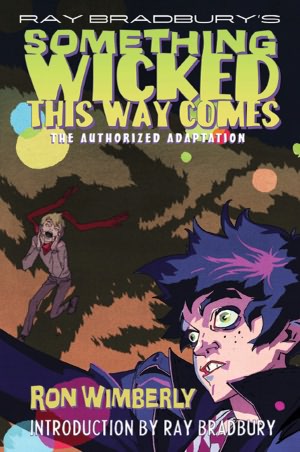
Ray Bradbury's Something Wicked This Way Comes, The Authorized Adaptation. Ron Wimberly. Introduction by Ray Bradbury. 2011. FSG. 144 pages.

First of all, it was October. A rare month for boys. Not that all months aren't rare. But there be bad and good, as the pirates say. Take September, a bad month: school begins. Consider August, a good month: school hasn't begun yet. July, well, July's really fine: there's no chance in the world for school. June, no doubting it, June's best of all, for the school doors spring wide and September's a billion years away. But you take October, now. School's been on a month and you're riding easier in the reins, jogging along. 

What makes a graphic novel adaptation work? I'm not sure I could say. For graphic novels are not in my comfort zone at all. I rarely pick up graphic novels to "review," for I don't feel qualified to comment. The graphic novels I tend to read are adaptations of novels that I've already read--for better or worse.

I recently read the official adaptation of Ray Bradbury's Something Wicked This Way Comes. What did I think of it? Well, it made me WANT to read the book, the "real" book. This story, in its adaptation, in its abridgment, just wasn't enough to satisfy me. I wanted more, needed more. That's not a bad thing at all. If every single reader of this graphic novel responds the same way I did--with the NEED or DESIRE to pick up the original Ray Bradbury novel, that wouldn't be a bad thing. Indeed, you might say it was a GOOD thing. For there is no replacing, no improving the original novel.

The magical wonder--the horror, the terror, the suspense--of this story is in the words, the phrases, the sentences. And this graphic novel adaptation is able to only capture a part of that wonder. Every reader will have to decide for himself (or herself) if the addition of the illustrations is worth losing a little something of the original. (For the record, only the cover has colored illustrations, the rest of the graphic novel is in black and white.) For me, the graphic novel just doesn't have that magical something of the original.

Read Ray Bradbury's Something Wicked This Way Comes, The Authorized Adaptation
  • If you're a fan of graphic novels
  • If you're a fan of dark fantasy, horror, and suspense
  • If you're looking for a dark(er) coming of age story
  • If you're a participant of the R.I.P. challenge and are looking for an easy read you could finish in just an afternoon
  • If you're a fan of Ray Bradbury
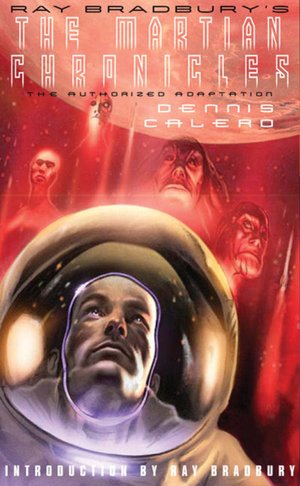
Ray Bradbury's The Martian Chronicles, The Authorized Adaptation. Dennis Calero. Introduced by Ray Bradbury. 2011. FSG. 160 pages.

One minute it was Ohio winter, with doors closed, windows locked, the panes blind with frost, icicles fringing every roof, children skiing on slopes, housewives lumbering like great black bears in their furs along the icy streets.

Compared to the adaptation of Ray Bradbury's Something Wicked This Way Comes, the official adaptation which I reviewed above, this adaptation of The Martian Chronicles is very satisfying indeed! Now, here's where it becomes tricky, compared to the original novel by Ray Bradbury, it still is second best at most. (I haven't listened to it on audio, or any radio dramas of it, and I definitely didn't make it past the twenty minute mark on the made-for-TV adaptation of it.) I definitely liked the cover and thought it well done! And the illustrations in this graphic novel are full color!!!

If this adaptation was a FULL adaptation, I wouldn't hesitate to give it my highest recommendation. But. Readers do not get the full collection of stories. Readers get just fourteen out of 27 stories. Here are the stories readers do get:
  • Rocket Summer
  • Ylla
  • The Summer Night
  • The Earth Men
  • The Third Expedition
  • --And the Men Be Still As Bright
  • The Green Morning
  • Night Meeting
  • Interim
  • The Musicians
  • The Martian
  • The Off Season
  • The Watchers
  • The Million-Year Picnic
Here are the stories, readers will be missing out on:
  • The Taxpayer
  • The Settlers
  • The Locusts
  • The Shore
  • The Fire Balloons
  • The Wilderness (*I believe The Wilderness replaced "Way In the Middle of the Air" in some editions. I don't know how other readers feel about the change, but I'm all for it. The Wilderness is a much better story in my opinion.) 
  • The Naming of Names
  • Usher II
  • The Old Ones
  • The Luggage Store
  • The Silent Towns
  • The Long Years
  • There Will Come Soft Rains
It is just wrong, wrong, WRONG that this adaptation does not include "Usher II" and "There Will Come Soft Rains."

Some of what is 'missing' are just vignettes or preludes, but, I think some of the preludes help transition between stories. For example, reading "The Luggage Store" before "The Off Season" helps. As does reading "The Old Ones" before "The Martian." And I think something is lost by not including "The Silent Towns" and "The Long Years" which reflect the absence of life on Mars, and "There Will Come Soft Rains" is the perfect, perfect story for setting up "The Million Year Picnic". Something important, something vital is missing--in terms of tone, of message--if you don't have the full sequence.

So the full-length stories that are missing are: The Fire Balloons, The Wilderness, Way In the Middle of the Air, Usher II, The Silent Towns, The Long Years, There Will Come Soft Rains.

How do I feel about the adaptations? Well, I thought some of them were well done. Probably my favorite adaptation was "Night Meeting."

Is the original novel still best? Yes!!! I won't lie. This collection of short stories is so wonderful, so amazing, so incredible, so thoughtful, so soulful, so beautiful, so practically perfect in every way that I have to say that the original is better than any adaptation.

Read Ray Bradbury's The Martian Chronicles, The Authorized Adaptation
  • If you're a fan of science fiction
  • If you're a fan of Ray Bradbury
  • If you're a fan of graphic novels
  • If you love short stories, Ray Bradbury's are among the BEST.
© 2012 Becky Laney of Becky's Book Reviews
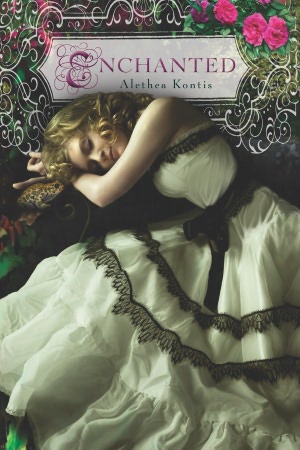
Enchanted (YA) (Spoilers)

Enchanted. Alethea Kontis. 2012. Houghton Mifflin Harcourt. 320 pages.

My name is Sunday Woodcutter, and I am doomed to a happy life. I am the seventh daughter of Jack and Seven Woodcutter, Jack a seventh son and Seven a seventh daughter herself. 

I have mostly positive things to say about Enchanted. I do have something negative to say, something that kept me from truly enjoying this one completely. But I think I'll save that for the end of the review.

The good news. If you enjoy fairy tales, then you should give Enchanted a try. This one isn't a retelling of one story specifically, more like a retelling of a dozen. With snippets from each fairy tale.
The more fairy tales you know, the more you'll recognize. Would the book have been better if the author had stuck just to one or two fairy tales? I'm not sure. That is NOT my place to say, really. Because while it could feel a bit scattered, it was scattered in a fun way. If that makes sense. If something is going to be crazy, you should try to see it as a good kind of crazy, right? And many of the details--especially details about some of her sisters--made me want more. (Monday and Thursday, I think were the sisters I was most interested in.) This story focuses mainly on Sunday and Wednesday. Though Saturday does come into a few chapters at least. Friday, I believe, is the one that interested me least. Though I'm not sure that's her fault.

Anyway, the good news is that this is, for the most part, a playful novel with an interesting premise. The premise is that Sunday Woodcutter, the seventh daughter, has a magical gift. I would feel horrible revealing this, but, it is on the book jacket. And this is a fantasy fairy-tale retelling, so "gifts" from fairies shouldn't be completely unexpected, right? Well, Sunday's gift is that her words come true. At first she believes that she only has this power through the written word--through her written stories. Which is SOMETHING to deal with--for better or worse.

So the novel begins with Sunday befriending a frog. And since the frog is a talking frog, and since Sunday isn't completely clueless, she has a very, very strong suspicion that this frog is an enchanted frog, perhaps even a prince. But what she doesn't guess--and won't really get around to guessing--is that this Prince is the enemy of her family.

There are a couple of charming things about this one. It did hold my interest. BUT. It was also confusing. I kept hoping that the big reveal would actually clarify things for me. But. No. That wasn't really the case. This could be a matter of me being a sloppy reader and just not getting it. But. I've read in other reviews that other readers had trouble making sense of things too. And that it was very confusing.

S
P
O
I
L
E
R

So. The big thing that confused me had to do with the Prince's father, the Prince's nameless father. It seems that NO ONE can remember his first name, and that there are also many other fuzzy details about this king and his reign. I wasn't sure if the King himself was evil through-and-through, or, if perhaps he was trapped or ensnared by this evil-evil fairy godmother, Sorrow. Or a bit of both. But the even bigger thing that confused me was the Prince's mental state. The "voices" he heard each and every night. Someone begging, begging, begging to be killed so they could be set free. Where was the voice coming from? Was it some message his father was trying to send him? Or was it some message from his mother? Or was it a message from someone else? At first, I thought it might be that there was something good in his father still remaining and that he wanted his son to find out the truth and set him free. But then after the big reveal, I became less sure. And when we learn the fate of his mother, well, I didn't know what to think of anything. (Same with Wednesday. Her role in all this.)

Anyway, the truth is that what I did understand, I did enjoy. But there was so very much I didn't understand, or understand fully.

Read Enchanted
  • If you like fairy tales
  • If you like fantasy
  • If you like mysteries 
© 2012 Becky Laney of Becky's Book Reviews
The Lunatic's Curse (YA?)

The Lunatic's Curse. F.E. Higgins. 2011. Feiwel & Friends. 352 pages.

In nightshirt and robe, slippers and nightcap, Rex Grammaticus quietly entered the large dark-paneled dining room. On the far side of the room, lit in candle glow, he could see his stepmother, Acantha, and his father, Ambrose, at the table eating their evening meal. Rex had eaten earlier, at his stepmother's request, in the kitchen. One more change that she had made since marrying his father; one more way to push him out of the picture. It had only been eight weeks since the marriage, but Acantha moved about the house as if she had lived there all her life. It was Rex who felt like the newcomer. 

This review will contain spoilers. I will let you know exactly when to start expecting them.

While I've enjoyed the other books in F.E. Higgins' series, I cannot say the same for The Lunatic's Curse. For better or worse, I just can't bring myself to say anything good about a book this disturbing. While the other books have flirted with the dark side, they've been well-balanced. Equal parts charm, humor, and dark side. The descriptive writing and atmospheric writing have added to all of the above.

The Lunatic's Curse is set in the same strange world, for the most part. But not really. It is much, much, much, much darker. And there isn't one drop of humor in it. There isn't even a glimpse of lightness, of humor, of hope. And while the other books dependably showed justice being served, The Lunatic's Curse did NOT redeem itself by any stretch of the imagination. It is not only dark and depressing, it is EXCEEDINGLY dark and COMPLETELY depressing.

I don't know that I'd say The Lunatics Curse is as depressingly evil and pointless as say Animal Farm or Jude the Obscure. But. The very fact that they've come to mind, speaks volumes.

S
p
o
i
l
e
r

While the rest of the series rests comfortably in the MG camp, I don't know that I'd say the same with The Lunatic's Curse. For it is ALL about cannibalism. Truly. And our narrator? Well, he's a cannibal-in-the-making. And the oh-so-depressing big six-year-later-reveal shows that he is indeed a cannibal. That he could not escape the "curse" brought upon him by his oh-so-incredibly wicked stepmother and his father who had succumbed to his wife's "stew" and unknowingly developed a taste for human flesh. And I HATED learning what happened to his companion. I mean SERIOUSLY. Was that even necessary? Although I guess I should be grateful that he didn't EAT her on his way out of the maze.

Anyway, if you love reading about insanity, lunatics, insane asylums run by cannibals, big scary underwater monsters who live on human flesh, and did I mention cannibals?, then maybe this one is for you.


Read The Lunatic's Curse
  • If you LIKE to be disturbed; some people do like horror novels. I'm not one of them. But you may be.
  • If you like dark-disturbing-creepy horror novels supposedly written for the MG/YA crowd
  • If you're a fan of F.E. Higgins and are prepared to go to really dark places


© 2012 Becky Laney of Becky's Book Reviews
Chitty Chitty Bang Bang Flies Again (MG)

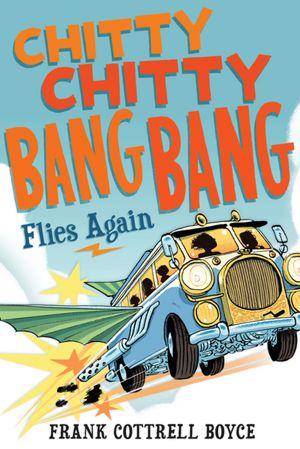
Chitty Chitty Bang Bang Flies Again. Frank Cottrell Boyce. 2012. Candlewick Press. 192 pages.

Most cars are just cars. Four wheels. An engine. Some seats. They take you to work. Or to school. They bring you home again. But some cars--just a few--are more than cars.
Some cars are different.
Some cars are amazing.
And the Tooting family's car was absolutely definitely not one of those.
Not amazing.
Not different.
It was so undifferent and so unamazing, in fact, that on the last day of the summer term when Lucy and Jem strolled out of the school gates and into the holidays, they walked straight past it. They didn't even notice it was there until their father popped his head out of the window and shouted, Lucy! Jem! Jump in! I'm giving you a lift!"

 Did I love Chitty Chitty Bang Bang Flies Again? Not really. Not love. It's not that kind of book, at least not for me. Did I like it? Yes! Not that I'd go so far as to say I really, really, really liked it. But. It was definitely a fun, silly, predictably over-the-top adventure story--the sort that's perfect for family read alouds. The family is just wonderfully silly. There's a clever Dad who loves to invent or tamper with things. A cleverer Mom who thinks its a great idea if Dad tampers with a camper van instead of the house. And three children: Jem, Lucy, and Little Harry. Each has their role to play in the novel, as you might expect, but don't expect brilliant, amazing characterization. These characters feel like humorous character sketches created for our amusement. Jem was fun because as he worked with his Dad, his confidence grew and grew. And soon we have our own hero in the making. Lucy was also fun. You might think you know what Lucy does in her black bedroom, but, trust me, you don't know the half of it. Little Harry, well, no one takes him as seriously as they should. And he does provide the twist at the end!

If you enjoy adventure-fantasies that are completely over-the-top, then Chitty Chitty Bang Bang Flies Again is just the novel for you. I do think it would make a good read aloud. I do think it's a fun, playful, enjoyable read.

Read Chitty Chitty Bang Bang Flies Again
  • If you enjoy fantasy-adventure novels 
  • If you love humorous adventure stories that aren't quite believable but are oh-so-fun in the moment
  • If you love family books
  • If you are looking for books with biracial characters
© 2012 Becky Laney of Becky's Book Reviews

Over Sea, Under Stone (MG)

Over Sea, Under Stone (Dark Is Rising, #1) Susan Cooper. 1965. 208 pages.

"Where is he?" Barney hopped from one foot to the other as he clambered down from the train, peering in vain through the white-faced crowds flooding eagerly to the St. Austell ticket barrier. "Oh, I can't see him. Is he there?"

 I liked this one, I definitely liked it. But it wasn't quite love for me. Not love, love, love at any rate. Over Sea, Under Stone reminded me in so many ways of fantasy novels that I've read and enjoyed in the past. And it definitely had its charming moments, its cute moments. But sometimes a book needs just a little bit more than that. Still. I liked it. I liked the setting. I liked the characters. Perhaps the three Drew children (Simon, Jane, and Barney) weren't the most amazingly well-developed characters I've ever met. But Great-Uncle Merry (Gumerry) made me more than a little curious. And I definitely want to read more in this series.

Read Over Sea, Under Stone
  • If you're looking for a classic fantasy novel
  • If you're looking for children's fantasy
  • If you're looking for a children's fantasy set in Britain
  • If you like books with more than a little charm

© 2012 Becky Laney of Becky's Book Reviews
Eyeball Collector (MG/YA)

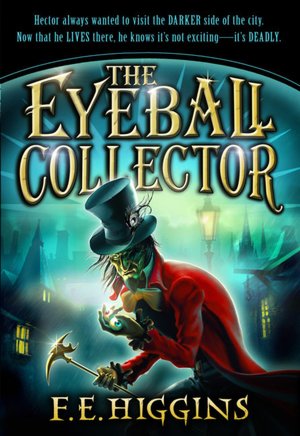
The Eyeball Collector. F.E. Higgins. 2009. Feiwel and Friends. 250 pages.

"Tartri flammis!" cursed Hector as his stomach tightened in a knot and his chest jerked violently with every beat of his heart. He rotated slowly on the spot, panting from the chase. His nose tingled with the stench that filled the air. Already his ears were pricking to the menacing sounds around him: screeches and wails, scraping and dragging, and the ominous unrelenting moaning. So this is fear, he thought. In a strange way it excited him.

See what reading one great book can do?! It can lead you to reading other great books! Yesterday, I was oh-so-happy to have read F.E. Higgin's The Bone Magician. And I was oh-so-happy that I'd thought ahead to check out all of her books at the same time. Because I just couldn't wait to get to The Eyeball Collector! And it did NOT disappoint. It was absolutely wonderful!

Six or seven years have passed since the events of The Black Book of Secrets and The Bone Magician. The Eyeball Collector is set in the same town as The Bone Magician, the dreadfully unpleasant city of Urbs Umida. (One thing you might notice if you read both books is that it seems Beag Hickory has made it as a poet at last. This novel is not only dedicated to Beag, it opens with one of Beag's poems, and in passing a reference is made in a bookshop to a book of Beag's poetry!) The Eyeball Collector can definitely be read on its own as a standalone--it's nice to know just in case you've got access to one but not all. But I do think that after getting a taste of Higgins' writing, you'll want to read them all.

The hero of The Eyeball Collector is a young boy, Hector Fitzbaudly. He's from the good side of town. (All the somebodies live on the North side of town.) Which makes him being on the wrong side of town--the South side, the too-close-to-the-stinky-river-side--a big mistake on his part. But he wanted adventure, excitement, he wanted to see how the other side lived. He didn't quite expect to be so completely robbed. But if that was the worst that happened to young Hector, he'd consider himself fortunate. For it isn't too long after that he witnesses someone--a one-eyed someone--trying to blackmail his father. His father gives in to the blackmailer's demands, but the blackmailer sells his story to the papers anyway. So all was for nothing. Long story short, Hector's father isn't long for this world. And soon he's an orphan, an orphan determined to find the man responsible for his father's downfall and death. He's determined to find this one-eyed man and kill him.

Of course, that's just one aspect of the story...

I loved so much about The Eyeball Collector. I loved the atmosphere and setting, the tone of this one. There is something delightfully-and-charmingly creepy about this one. The villains and even the heroes are a bit eccentric, you might say. And the storytelling, well, it kept me reading.

Read The Eyeball Collector
  • If you are a fan of F.E. Higgins
  • If you are a fan of middle grade or young adult fantasy
  • If you aren't quite a Dickens fan but you've always thought you should be
  • If you like atmospheric shady-gothic reads full of eccentric characters
  • If you're a cat lover who can forgive a book for killing off two cats

© 2012 Becky Laney of Becky's Book Reviews

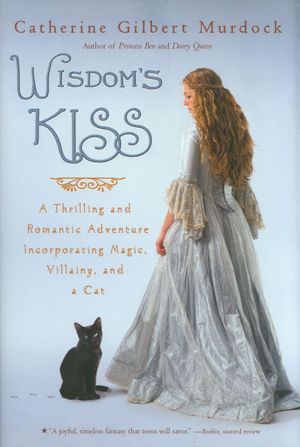
Wisdom's Kiss (YA)

Wisdom's Kiss. Catherine Gilbert Murdock. 2011. Houghton Mifflin Harcourt. 304 pages.


Trudy's sight revealed itself one warm summer night when the child was no older than three.

Wisdom's Kiss is good example of an almost novel. Perhaps I would have enjoyed this one more if I'd read Princess Ben. Perhaps I would have known more what to expect from this fantasy novel by Catherine Gilbert Murdock. Perhaps I would have cared more going into it, connected with the characters more. I don't know. I haven't read Princess Ben, though I've been meaning to read it for more than a few years now.

It is an almost for me because while I almost cared about the characters, I didn't quite. And I almost cared about the story, but I didn't quite. And I almost found the writing wonderful, but I also found it a little much.

There are many, many, many narrators in Wisdom's Kiss. (Would I have loved it more if they'd been fewer?) The narrator we meet first is a maid named Fortitude, "Trudy." She's head over heels in love with Tips, a "soldier" with a secret who doesn't really want to come back home just yet even though that's not what he's telling her in his (messy) letters to his childhood friend. This maid, for better or worse, is made a "Lady" when the Queen Mother, Benevolence, and her second granddaughter, Wisdom (Dizzy) travel through their mountain village. Wisdom is getting married soon, and the oyster-disaster at a previous inn leaves her much in need of another lady in waiting. Ben also appreciates Trudy for who she is. So reluctantly Trudy joins the royal procession on their way...

Wisdom's Kiss is a fantasy novel. And it feels like it. Which is a good thing, I think. I think I would have preferred this one if it had been presented more traditionally. While this one wasn't a difficult read, I discovered as I kept reading that I just didn't care about any of the characters. And I'm not sure I was 'liking' the right characters, the characters I was meant to like. (Was Dizzy supposed to be so....unpleasant?! Was I supposed to feel sympathetic towards her? Was I supposed to be happy that she got Tips instead of Trudy?! Because I just found her to be selfish and spoiled.)

Read Wisdom's Kiss
  • If you're a fan of fantasy novels for young adults
  • If you're a fan of romance-fantasy novels
  • If you like your fantasy to be a little quirky

© 2012 Becky Laney of Becky's Book Reviews
The Bone Magician (YA)

The Bone Magician. F.E. Higgins. 2008. Feiwel and Friends. 274 pages.

How I have come to hate this place of evil, this city of nightmares. Urbs Umida they call it, Dank City, and well it deserves its name. It has taken everything that was precious to me. But I shall leave one day, soon, when I know the truth. I shall pass through those gates and it would please me greatly to not look back. Imagine, never again to inhale the stink of rot and decay, never again to see despairing eyes in the shadows, and never again to hear the name Deodonatus Snoad or to read the lies from his poisonous quill. 

Don't judge a book by its cover. Just don't.  Especially don't judge this book by its cover. (I prefer the original cover, though even that doesn't seem like a good enough cover for the contents.)

In 2009, I reviewed F.E. Higgins novel, The Black Book of Secrets. And it was love. It really was. I fell in love with the atmosphere and tone created by Higgins. I just loved his writing. Sure it was a little over-the-top, but it worked really, really well. The way he created such quirky characters, how each quirky character had a name that suited them just so.

I was not disappointed with The Bone Magician. In fact reading the Bone Magician made me want to go out and reread The Black Book of Secrets. Not to mention picking up The Eyeball Collector and The Lunatics Curse.

So in this non-sequel, readers meet quite a cast of characters. The hero is a young might-as-well-be-an-orphan named Pin Carpue. (Pin's mother is dead; his father is just on the run, supposedly because he's murdered Pin's uncle, but Pin isn't really sure that is true and Pin's father could have just disappeared the day his uncle died by pure coincidence). And the heroine is a young girl with plenty of secrets named Juno Catchpole. I could tell you that readers first meet Pin after he's been drugged seemingly unconscious by Juno and her associates. I could tell you that Pin witnesses something incredible and unbelievable: he witnesses Juno 'raising' the dead corpse in the coffin on display at the undertakers. Or I could tell you about Benedict Pantagus, Madame de Bona, Deodonatus Snoad, Aluph Buncombe, or Beag Hickory. But I won't. I think the magic of this fantasy is in letting it surprise you.

I loved this one. I just loved it. I like the writing, the storytelling, the characterization. It is just charming and funny. True, the humor could be seen as being on the dark side. And perhaps dark dramas aren't usually considered to be all that charming. But in this case, it all works. It is not as dark and as creepy as the cover would have you believe. It is not a creepy-scary book. Even if it does feature the Silver Apple killer.

An example of the writing:
Whether or not Hickory Reds were the preferred choice of a potato thrower, it was certainly true that when it came to projecting medium-sized weighty objects through the air, there was no one to match Beag. It wasn't just the distance, you understand, it was also the accuracy with which he threw them.
Beag was a man with many talents and he had left his home village at a young age to see the world, to learn, and to seek his fortune. He was not going to let his lack of stature be an obstacle and by the ripe old age of twenty-four he had achieved two out of three of his fine objectives. He had certainly traveled extensively and had written songs and poems to prove it. Aluph was not wrong in saying he was an intellectual giant. Beag had acquired knowledge that few Urbs Umidians would believe, let alone remember, and he had forgotten more than most could even know. But on the third, the matter of his fortune, Beag had been well and truly thwarted. Of all the facts he had learned, the hardest had to be that there was no money to be made from poetry and singing. But perhaps there was a living to be earned from potato throwing. Certainly it was a talent that appealed to the stunted imaginations of the Urbs Umidians. (91-92)

Read The Bone Magician
  • If setting, tone, and atmosphere are important to you; this one has it in abundance!
  • If you enjoy quirky, charming, slightly-dark, but mostly-all-in-good-fun fantasy novels
  • If you want to like Dickens but don't quite; OR if you love Dickens for his eccentric, shady characters
  • If you're looking for a good YA fantasy
© 2012 Becky Laney of Becky's Book Reviews
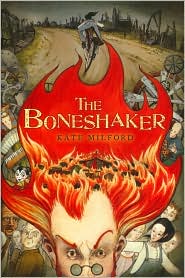
Rereading Boneshaker

The Boneshaker. Kate Milford. 2010. May 2010. Houghton Mifflin Harcourt. 372 pages.

Strange things can happen at a crossroads. It might look like nothing but a place where two dusty roads meet, but a crossroads can be something more. A crossroads can be something special, a compass with arms reaching to places you might never find the way to again; places that might exist, or might have existed once, or might exist someday, depending on whether or not you decide to look for them.
But whatever else it might be, a crossroads is a place where you choose.


I have now read Kate Milford's The Boneshaker three times. (The first time was in July 2010, the second in December 2010). I can now truly say that this is indeed one of my favorite, favorite historical fantasy novels. Not that it's fully, completely fantasy. It is set in the real world, in a small American town in 1913. And many details do feel authentic for the time period. But. There are characters that have had showdowns with the devil himself. (Think The Devil Went Down To Georgia.) And there is something more--much more--to the traveling carnival that has come to town.

Almost everything from my original review still rings true:

Read this book. Now. Why? Because this book is so very, very good. It's one of those books where the moment you finish it, you want to start it all over again. You don't want it to be over. You want to keep experiencing it.

What did I love about this book? The characters, the story, the storytelling, the setting, the atmosphere, the descriptions. It was such an amazing blend of history, mystery, and fantasy. The Boneshaker is set in 1913, in Arcane, Missouri. This is a town that for whatever reason makes travelers uneasy. It's not a place most would stop and see for fun, for pleasure. Perhaps it's a little too close for comfort to the Old Village, the first settlement of the crossroads that was abandoned several generations before the novel opens. So while Arcane may not seem like much--at least to the outsider--it is home to our heroine, Natalie Minks. She's very smart, very curious. She likes to know how things work. She's fascinated by machines. And she loves spending time with her father who is a mechanic--a bicycle mechanic mostly, though he fixes anything with wheels for the most part.

Arcane doesn't see many strangers. But one day a stranger shows up in town--his wheel broke, you see--and this stranger is none other than Dr. Jake Limberleg. He has a medicine show. The full name is Dr. Jake Limberleg's Nostrum Fair and Technological Medicine Show. And while he's waiting for his wheel to be fixed--so he can go on his way, Arcane was not a planned stop by any means--he decides to go ahead and open up his show, his fair. There are a handful of people in the community who are skeptical about this man and his team of 'doctors' of 'experts.' Among these is Natalie. She may be the cleverest one of them all. She may be the only one able to solve this mystery. But can she do it in time?

The Boneshaker is so compelling. It had me from hello. The characters, the storytelling, the writing, I thought all of it was so well done. Kate Milford made me care about these characters, and she kept me hooked from start to finish.


Read The Boneshaker
  • If you like historical fiction, historical fantasy, historical mysteries
  • If you like stories with a bit of supernatural to them--not TOO much, just enough and no more
  • If you like strong heroines that are on their way to developing their full potential (Loved her resourcefulness, her curiosity, her courage, her determination)
  • If you love stories with well-developed, fascinating characters
  • If you love stories with atmosphere, with a strong setting,
  • If you love stories with mysteriously creepy traveling carnivals or medicine shows

© 2012 Becky Laney of Becky's Book Reviews

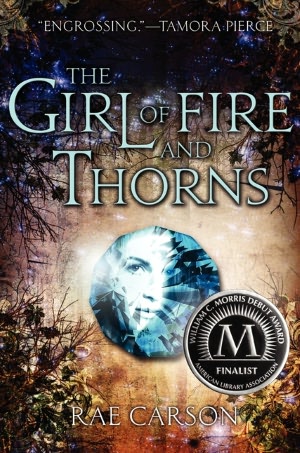
The Girl of Fire and Thorns (YA)

The Girl of Fire and Thorns. Rae Carson. 2011. HarperCollins. 425 pages.

Prayer candles flicker in my bedroom. The Scriptura Sancta lies discarded, pages crumpled, on my bed. Bruises mark by knees from kneeling on the tiles, and the Godstone in my navel throbs. I have been praying--no, begging--that King Alejandro de Vega, my future husband, will be ugly and old and fat. Today is the day of my wedding. It is also my sixteenth birthday.

The Girl of Fire and Thorns was nothing like I expected. I read the first few chapters and imagined it heading in one direction. I didn't expect it to go oh-so-differently than how I imagined it. And yet, I can't say that those differences kept me from enjoying this novel. Not really.

Elisa is a princess, the second princess. But she's been Chosen, chosen almost since birth. For she bears the godstone in her navel. And chosen ones only appear every four hundred years or so. So she's special. But her being special makes her all that much more vulnerable. For it seems that there are oh-so-many ways to view the godstone. Yes, some react with reverence and respect, devotion and loyalty. But not all. There are some who would kill her for the stone in her navel. Some who would see her as expendable, her only worth being the stone itself. So while her 'chosen' status is known in some circles, in others it's a very closely kept secret.

So. The novel opens with Elisa preparing for her marriage. She's nervous for many reasons. She'll be marrying a stranger, a King, a king with a young son, a king that may or may not be over the loss of his first wife, a king that may or may not ever care for her, a king whose character is completely unknown to her. She's nervous about the impression she'll make on him her future husband. She's definitely on the plump side, and she feels her wedding dress makes her look like an over-stuffed sausage. She sees rolls and rolls of fat and worries that that is all he'll see too. She worries that he'll never look at her with respect, with friendship, or love. So part of her hopes that she won't be attracted to him. She hopes that she won't want a real marriage.

But the King is anything but ugly or fat or old. He makes quite a first impression on her. Not that it's love at first sight. It isn't. It really isn't. But he's kind and gentle. And he seems to see her. Enough that readers feel there is potential. That there is a spark of something that will work in the heroine's favor...

So their journey together begins soon after the marriage. The trip to his kingdom is NOT easy. In fact, it clarifies things for readers. Rae Carson is NOT afraid to kill off characters.

They arrive...and she learns that her marriage is to be kept secret...indefinitely. Once they arrive, she barely sees her new husband...at all. And that small spark of potential seems to vanish completely. But her new life isn't horribly lonely. Not really. But before she can adapt to her new role, a role that has her merely as visiting princess, she's kidnapped...and EVERYTHING changes...Elisa most of all. She goes from a shy and uncertain oh-so-vulnerable heroine who doubts that she'll ever live up to being 'the chosen one' to being someone who's incredibly fierce and resourceful and stronger than she ever imagined herself being...

I liked The Girl of Fire and Thorns. There were things I loved about it. There were things I didn't quite love about it. But for the most part I enjoyed it and would recommend it.

Read The Girl of Fire and Thorns
  • If you're a fan of Shannon Hale
  • If you're a fan of Megan Whalen Turner
  • If you're a fan of strong heroines
  • If you're looking for a heroine that doesn't quite look--at least at first--like your typical heroine
  • If you're a fan of fantasy novels
  • If you don't mind losing more than a few characters along the way

© 2012 Becky Laney of Becky's Book Reviews

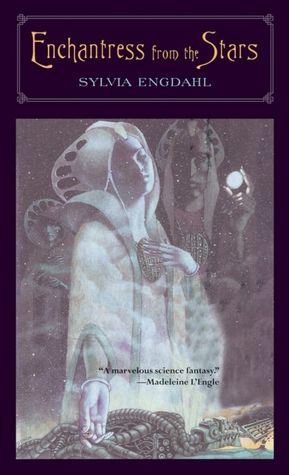
Enchantress from the Stars (MG)

Enchantress from the Stars. Sylvia Louise Engdahl. 1970/2003. Penguin. 304 pages. 

From the prologue: The planet shines below us, cloud-flecked, dazzling against the dark backdrop of space. Down there it is cool and green and peaceful. In a little while we will take the ship out of orbit and leave this world behind, a mere speck in the vast currents of the universe. This world, which we call Andrecia--the third planet of a quite ordinary yellow sun...but that's just coincidence, of course. What difference does it make that just such a planet was my own people's ancestral home?

From chapter one: At the edge of the Enchanted Forest there lived a poor woodcutter who had four sons, the youngest of whom was named Georyn. They were able to earn a meager living by selling wood to the folk of the village, and although there was seldom more than dry bread or thin gruel on their table, they were not miserable.

Oh, how I LOVED Enchantress from the Stars. It was one of those oh-so-magical-practically-perfect-in-every-way books for me. I know not every reader will feel the same connection, the same adoration for this as I do. But. It's one of those books that I could just gush on and on about!!!

What did I love about this one? Everything! I loved the premise. Just loved it! I loved the world-building, the setting, the atmosphere. I loved the storytelling. I loved the characterization!!! I loved Elana. I loved Georyn. I loved Jarel. I even cared a great deal about the Starwatcher and Evrek. I thought this book was just so well written.

Enchantress from the Stars is narrated, primarily, by a young woman named Elana. The novel is reflective, in a way, because the novel is an account of her first 'adventure' on another planet. She's writing her report, giving her side of the story. But this novel is more than just her side of the story. It ventures to include the perspectives of two others--a young man, the woodcutter's youngest son, Georyn, and a young medical officer named Jarel. Both Georyn and Jarel are from Youngling cultures. Georyn is a native to Andrecia; Jarel is from another planet, a planet in a different stage than Georyn's, but a great deal less advanced than Elana's. (He is with the Imperial Exploration Corps). Jarel is just one of many in the first ship sent to "colonize" this planet.

Elana is on a ship with several other agents--including her father--when they learn that Andrecia is being invaded, and a Youngling culture/civilization is being threatened. They can't directly intervene. And they definitely can't reveal themselves. But they can try to influence things subtly, indirectly. Elana is chosen--with some reluctance--to interact with the natives. Well, she's to interact with two brothers--Terwyn and Georyn. These two are on a quest--along with their older brothers--to KILL A DRAGON. Yes, they are on their way to get the king's blessing, the king's permission to enter the Enchanted Forest. They don't know what dangers they'll face, but they know the fiery dragon must be stopped. These brothers see Elana an an enchantress, a faery perhaps. They see her as having great power, great wisdom, great magic.

So Enchantress from the Stars reads as a fantasy novel--a fantasy novel in the style of a fairy tale. But. Of course it also reads as a great science fiction novel with space ships, etc.

Enchantress from the Stars won a Newbery Honor in 1971.

Read Enchantress from the Stars
  • If you love science fiction
  • If you love fantasy
  • If you love fairy tales
  • If you love adventures and quests
  • If you love great writing
  • If you love bittersweet love stories
  • If you're looking for a Newbery Honor

© 2012 Becky Laney of Becky's Book Reviews
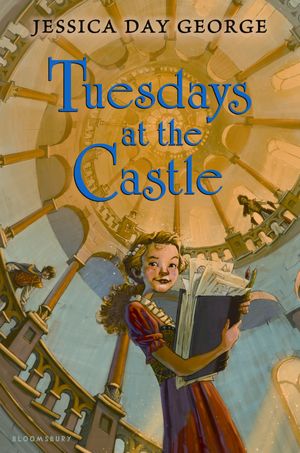
Tuesdays at The Castle (MG)

Tuesdays at the Castle. Jessica Day George. 2011. Bloomsbury. 254 pages.

Whenever Castle Glower became bored, it would grow a new room or two. It usually happened on Tuesdays, when King Glower was hearing petitions, so it was the duty of the guards at the front gates to tell petitioners the only two rules the Castle seemed to follow. Rule One: the Throne Room was always to the east. No matter where you were in the castle, if you kept heading east you would find the Throne Room eventually. The only trick to this was figuring out which way east was, especially if you found yourself in a windowless corridor. Or the dungeon. This was the reason that most guests stuck with Rule Two: if you turned left three times and climbed through the next window, you'd end up in the kitchens, and one of the staff could lead you to the Throne Room, or wherever you needed to go. Celie only used Rule Two when she wanted to steal a treat from the kitchens, and Rule One when she wanted to watch her father at work. Her father was King Glower the Seventy-Ninth, and like him, Celie always knew which way was east.

I liked Tuesdays at the Castle. I really liked it. It definitely reads like a fairy-tale inspired fantasy novel. Celie, our heroine, is the fourth child of the King and Queen. And she is the one the Castle loves best of all, perhaps. Though the Castle has also chosen preference to the second son, Rolf. The Castle has indicated that Rolf will be the next King.

The novel opens with the children awaiting the return of their parents and oldest brother. Instead of a happy reunion, however, they receive some shocking news. There was an ambush. Their parents are dead. Their brother is dead. Many of the escorts are dead. True their bodies were not found. But it's just a matter of finding them now.

Celie is one of the people who refuses to believe the news and continues to hope. She feels that if her parents were truly dead the Castle itself would know it--and show it. Her parents rooms would have changed, and her brother's room would have changed too.

The Castle DOES want to show her something, but acting on what she's learned will be risky...

Read Tuesdays In The Castle
  • If you're a fan of Jessica Day George's previous novels (Dragon Slippers, Dragon Flight, Dragon Spear, Princess of the Midnight Ball, Princess of Glass, Sun and Moon, Ice and Snow).
  • If you're a fan of Shannon Hale, Gail Carson Levine, or Diana Wynne Jones
  • If you're a fan of fantasy novels for children

© 2012 Becky Laney of Becky's Book Reviews
Gideon The Catpurse (The Time Travelers) (MG)

Gideon The Catpurse. Linda Buckley-Archer. 2006. Simon & Schuster. 405 pages.

It was early morning on Saturday, the sixteenth of December, the first day of the Christmas holidays. 

I wanted to really love this one. I think I wanted to love it so much because the premise sounded so great. But, for me, it wasn't quite love. I definitely liked it. I am definitely glad I discovered this series. And I definitely want to continue on to see what happens next. But it's not love, not yet.

Our hero (Peter) and heroine (Kate)--two people who are practically strangers until IT happens--are forced to adapt--and adapt quickly--when the two are mysteriously thrown back in time, back to the eighteenth century.

They know their only hope of getting back to the twenty-first century, back to their own time, is if they work together to recover an antigravity machine or device. But this device has fallen into the hands of a villain, a man nicknamed Tar Man. But all hope is not lost, for they become very good friends with a man named Gideon. A man with a past, it's true, but his past may be the key they need to return to the future. For Gideon knows much about the Tar Man and the Tar Man's employer.

I liked the world Linda Buckley-Archer created. I liked many of the characters--especially Gideon. But it didn't quite work for me. At least not as much as I wanted--or needed--it to.

Have you read this one? What did you think?


© 2011 Becky Laney of Becky's Book Reviews
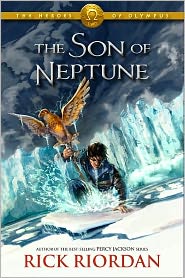
The Son of Neptune (Heroes of Olympus #2)

The Son of Neptune (Heroes of Olympus #2). Rick Riordan. 2011. Hyperion. 525 pages.

The snake-haired ladies were starting to annoy Percy. They should have died three days ago when he dropped a crate of bowling balls on them at the Napa Bargain Mart. They should have died two days ago when he ran over them with a police car in Martinez. They definitely should have died this morning when he cut off their heads in Tilden Park.  

I loved this book. I just LOVED, LOVED, LOVED this book. The Son of Neptune is the sequel to The Lost Hero. In the first book, a new hero, Jason Grace, is introduced to readers. He with two other newbies (Piper and Leo) are trying to reach the relative safety of the Camp Half Blood, the Greek camp. They arrive, of course, meet everyone--including some characters that we know and love--and are sent on a big, big, big mission of their own.

The second book stars Percy Jackson. He is trying to make his way to camp--but not the Greek camp that is his home away from home. No, when readers meet Percy he can't remember who he is--not really. Though he has a very strong but very vague memory of Annabeth. No, he's on his way to the Roman camp for demi-gods.

This book is all about Roman mythology. We see how the sons and daughters of Roman gods and goddesses do things. Is this Roman camp anything like Camp Half-Blood?! Percy becomes close with two campers in particular Frank and Hazel. In fact, the story is told in alternating perspectives of the three.

I really, really, really loved reading all three perspectives. I loved the new characters, the new mythologies, the new stories. I loved the action and adventure of it. I thought it was an exciting read. It was just a great, great book!

I would definitely recommend this one. But I'd start with the first book of the first series, The Lightning Thief, and go from there.

© 2011 Becky Laney of Becky's Book Reviews
The Wikkeling (MG)

The Wikkeling. Steven Arntson. Illustrated by Daniela J. Terrazzini. 2011. Running Kids Press. 235 pages.

Prologue: The Old City lies on a long, low hill. It is dangerous and dilapidated.

Chapter one: "Sensible students succeed splendidly!" said Ms. Span, a primly dressed teacher sitting behind a computer at the front of the class, her thick, black eyebrows arching over the top of her reading glasses. "Yes, Ms. Span!" said the students. They sat in neat rows that filled the room, faces lit yellow from the light of their own computers.

I'm not sure that The Wikkeling is right for every reader, but I think some readers will find it deliciously creepy and haunting. This dystopian fantasy focuses on education, on the education system. (Though the focus isn't exclusively on schools and classrooms and tests. We do get a wider glimpse of this society, and all the "corrections" they've made.)

In this society, almost every one lives in the Addition, lives in plastic houses, I believe. But that isn't the case for our heroine, Henrietta, or her much younger friend, Rose. She still lives with her family in an older house, though there is still pressure for them all to move to a safer house, a house that wouldn't be a 'danger'. And, Rose, well, she lives in a GREAT place. But that is a big, big secret. These two are friends with Gary, Ms. Span's son. And these three discover something mysteriously wonderful in Henrietta's attic. And it all begins with a discovery of a cat.

I enjoyed this one. I'm not sure I loved it exactly. It was a little too weird. (Like Coraline was a little too weird for me to love.) But I certainly enjoyed it; I'm glad I read it. I think this novel had a great blend to it. I definitely found it interesting. And the chapter on the test is a great example of that. (I also loved the relationship between Henrietta and her grandfather, and how he becomes involved in this mystery.)


© 2011 Becky Laney of Becky's Book Reviews
Jake Ransom and the Howling Sphinx (MG)

Jake Ransom and the Howling Sphinx. James Rollins. 2011. HarperCollins. 370 pages.

Most days people don't kick you in the head. For Jacob Bartholomew Ransom, it was just another Monday.

If the second book hadn't caught my attention, I don't know that I would have picked up the first novel in the series, Jake Ransom and the Skull King's Shadow. This is Jake's second adventure, and it is just as action-packed as the first. I definitely recommend you read the series from the beginning. Because many--if not most--of the characters are introduced in the first book. Even though this book has a different setting, in a way. The books do share a villain.

I don't know how to talk about this one without spoiling the first novel. With fantasy series that is often the case. I can only say that it was a quick read, a very quick read, and quite a satisfying one! I am still liking Jake and his sister, Kady. I'm liking their resourcefulness, their strength. The pacing, the plot, the characters, everything works.

© 2011 Becky Laney of Becky's Book Reviews