Tampilkan postingan dengan label short stories. Tampilkan semua postingan

The Stories of Ray Bradbury

The Stories of Ray Bradbury. Ray Bradbury. 1980/2010. Everyman's Library. 1063 pages.

It would be difficult to try to review a collection of one-hundred short stories by Ray Bradbury. My thoughts on these stories are scattered over two years. (To visit the other posts in the series: first twelve, next twenty-six, next three, next ten, next twelve, next-to-last twenty-two, final fifteen.) The collection is very diverse: science fiction, fantasy, horror, mystery, and realistic fiction. There are stories celebrating friendship, love, marriage, and family. And stories depicting the break down of human relationships. Some of the stories are extremely dark and disturbing, others very light and humorous.

Here are my thoughts on the MOST memorable:

The Coffin

There was any amount of banging and hammering for a number of days; deliveries of metal parts and oddments which Mr. Charles Braling took into his little workshop with a feverish anxiety.
"The Coffin" is just creepy. Readers meet two brothers--Charles and Richard. One brother dies soon after completing his "custom" coffin. He boasts to his brother about how revolutionary this coffin is--how it is a complete all-in-one funeral experience. "Simply place body in coffin--and music will start." His brother is curious. Perhaps a little too curious?!

There Was an Old Woman

"No, there's no lief arguin'. I got my mind fixed. Run along with your silly wicker basket. Land, where you ever get notions like that? You just skit out of here; don't bother me, I got my tattin' and knittin' to do, and no never minds about tall, dark gentlemen with fangled ideas."
"There Was An Old Woman" shows just how stubborn one woman is to conquer death. She refuses--I mean REFUSES to believe in death. So what happens when she dies and her body is taken away? You might just be surprised.

The Scythe

Quite suddenly there was no more road.
"The Scythe" is also quite interesting! It is about a desperate man with a family who suddenly finds himself in a new situation. Finds himself in plenty for once. But there is a price to pay for having everything so perfect. Is he willing to pay that price? He may have no choice!

There Will Come Soft Rains

In the living room the voice-clock sang, Tick-tock, seven o'clock, time to get up, time to get up, seven o'clock! as if it were afraid that nobody would. The morning house lay empty.  
 "There Will Come Soft Rains" is a very, very, very lonely story where we get a glimpse--just a small glimpse perhaps--of the desolation and destruction of life as we know it in at least one human city. We see the ending of an era, perhaps. There are no human characters in this one.

The Murderer

Music moved with him in the white halls. He passed an office door: "The Merry Widow Waltz." Another door: Afternoon of a Faun. A third: "Kiss Me Again." He turned into a cross corridor: "The Sword Dance" buried him in cymbals, drums, pots, pans, knives, forks, thunder, and tin lightning. All washed away as he hurried through an anteroom where a secretary sat nicely stunned by Beethoven's Fifth. He moved himself before her eyes like a hand; she didn't see him.
Have you read it? You should! It was written in 1953. Albert Brock's first victim? The telephone? His second victim? The television. Our hero in this short story has had it with technology. Has had enough of being connected--always connected--with everybody, with everything.  He's on a mission to deliver man from modern 'conveniences'. 

The Fire Balloons

Fire exploded over summer night lawns.
In it two priests go to Mars as missionaries. One at least was expecting, was hoping, to meet Martians, to actually BE a missionary TO Martians, to an alien species. So when given the opportunity of going out into the hills and trying to communicate with blue balloon-like hovering creatures OR ministering to humans who have migrated to Mars, the answer is clear to Father Peregrine. But do the Martians need his church? This story has one of my favorite quotes:

"Father Peregrine, won't you ever be serious?"
"Not until the good Lord is. Oh, don't look so terribly shocked, please. The Lord is not serious. In fact, it is a little hard to know just what else He is except loving. And love has to do with humor, doesn't it? For you cannot love someone unless you put up with him, can you? And you cannot put up with someone constantly unless you can laugh at him. Isn't that true? And certainly we are ridiculous little animals wallowing in the fudge bowl, and God must love us all the more because we appeal to His humor."

"Exorcism"

She came out of the bathroom putting iodine on her finger where she had almost lopped it off cutting herself a chunk of coconut cake.
My thoughts: I believe this one is supposed to be a comedy! I certainly read it that way. A rivalry gone wrong between two women who want to be president of the same club. One woman, the narrator, is the clumsiest woman in town. She's accusing her neighbor and fellow club-member of being a witch and using witchcraft to keep her from winning the election. (She always has only one vote--her own.) She also writes out a list of every "accident" and illness she's had in the past year. (She totals it all up and says that this other woman is responsible for $98 worth of medicine.) No one is taking her seriously, which, is a good thing I suppose. It ends in laughter and tears.


The Wonderful Ice Cream Suit

It was summer twilight in the city, and out front of the quiet-clicking pool hall three young Mexican-American men breathed the warm air and looked around at the world. 
This story, on the other hand, I remember quite well! I just loved it, found it very fun, rather light-hearted, charming in tone and not too dark. It is a story about a group of friends who came together, in a way, because they are all the same size. Because they are the same size, they can share this one wonderful, marvelous suit. A suit that none of the men could have dreamed of buying on their own. But they take turns wearing it, and have the time of their lives.

Dark They Were, and Golden-Eyed

The rocket metal cooled in the meadow winds. 
Another short story that I just LOVED AND ADORED. This one is science fiction, it is set on Mars. It's the story of human settlers on Mars...and that's all I'm going to say about that. But it was FABULOUS. This one was not from Martian Chronicles, but, it was included in S is for Space.

Frost and Fire

During the night, Sim was born. He lay wailing upon the cold cave stones. His blood beat through him a thousand pulses each minute. He grew, steadily.
This (long) short story certainly grew on me as I read it. The first few pages I was skeptical, but, once I began to realize what was going on, I was hooked! This science fiction story is narrated by a boy named Sim. In the opening pages, he's a newborn. And we're seeing the world through his eyes--as he tries to make sense of the world around him. The environment is just as strange and foreign to readers almost. But. It is set on another planet, and the expedition was a total disaster. The humans live twenty-two hours a day in a cave--only braving the environment one hour at dawn, one hour at twilight. But even living in the caves is not protection enough--the environment is too damaging; it is changing human growth rate and effecting the life span. When Sim is born--the human life span in his particular cave is just eight days. In those days, he'll grow into a man, perhaps have a child of his own, before dying of old age. Sim is not accepting that fate--and he's determined to do something about it.
I also enjoyed: "I Sing the Body Electric," "A Medicine for Melancholy," "A Scent of Sarsaparilla," "The Great World Over There," and "The Black Ferris." Several of these were in Martian Chronicles, and were very enjoyable, but, since I've already talked about them in that post/review, I didn't necessarily feel I had to cover them in this one. 

© 2012 Becky Laney of Becky's Book Reviews

Short Stories Read in July

I made it a personal goal to try to read ONE HUNDRED short stories in the month of July. I'll italicize my favorites.

From Agatha Christie's Poirot Investigates
  1. The Adventure of the Western Star
  2. The Tragedy at Marsdon Manor
  3. The Adventure of the Cheap Flat
  4. The Mystery of Hunter's Lodge
  5. The Million Dollar Bond Robbery
  6. The Adventure of the Egyptian Tomb
  7. The Jewel Robbery at the Grand Metropolitan
  8. The Kidnapped Prime Minister
  9. The Disappearance of Mr. Davenheim
  10. The Adventure of the Italian Nobleman
  11. The Case of the Missing Will
  12. The Veiled Lady
  13. The Lost Mine
  14. The Chocolate Box
 From The Dead Witness
  1. The Secret Cell by William E. Burton
  2. The Murders in the Rue Morgue by Edgar Allen Poe
  3. On Duty With Inspector Field by Charles Dickens
  4. The Diary of Anne Rodway by Wilkie Collins
  5. You Are Not Human, Monsieur d'Artagnan by Alexandre Dumas, pere
  6. Arrested on Suspicion by Andrew Forrester Jr.
  7. The Dead Witness, or, The Bush Waterhole by W.W. (Mary Fortune)
  8. The Mysterious Human Leg by James McGovan (William Crawford Honeyman)
  9. The Little Old Man of Batignolles by Emile Gaboriau
  10. The Science of Deduction by Arthur Conan Doyle
  11. The Whitechapel Mystery by Anonymous
  12. The Assassin's Natal Autograph by Mark Twain
  13. The Murder at Troyte's Hill by C.L. Pirkis
  14. The Haverstock Hill Murder by George R. Sims
  15. The Stolen Cigar-Case by Bret Harte
  16. The Absent-Minded Coterie by Robert Barr
  17. The Hammer of God by G.K. Chesterton
  18. The Angel of the Lord by Melville Davisson Post
  19. The Crime at Big Tree Portage by Ernest Bramah
  20. The Case of Padages Palmer by Harvey O'Higgins
  21. An Intangible Clue by Anna Katherine Greene
From After Dark by Wilkie Collins
  1. The Traveller's Story of a Terribly Strange Bed (1852)
  2. The Lawyer's Story of a Stolen Letter (1854)
  3. The French Governess's Story of Sister Rose (1855)
  4. The Angler's Story of The Lady of Glenwith Grange (new for After Dark)
  5. The Nun's Story of Gabriel's Marriage (1853)
  6. The Professor's Story of the Yellow Mask (1855)
From The End of the World: Stories of the Apocalypse
  1. The Hum by Rick Hautala
  2. We Can Get Them For You Wholesale by Neil Gaiman
  3. The Big Flash by Norman Spinrad
  4. Kindness by Lester Del Rey
From The Stories of Ray Bradbury
  1. The Man Upstairs
  2. Touched With Fire
  3. The Emissary
  4. The Jar
  5. The Small Assassin
  6. The Next in Line
  7. Jack-in-the-Box
  8. The Leave-Taking
  9. Exorcism
  10. The Happiness Machine
  11. Calling Mexico
  12. The Wonderful Ice Cream Suit
  13. Dark They Were, and Golden-Eyed
  14. The Strawberry Window
  15. A Scent of Sarsaparilla
  16. The Picasso Summer
  17. The Day It Rained Forever
  18. A Medicine for Melancholy
  19. The Shoreline at Sunset
  20. Fever Dream
  21. The Town Where No One Got Off
  22. All Summer in a Day 
  23. Frost and Fire
  24. The Anthem Sprinters
  25. And So Died Riabouchinska
  26. Boys! Raise Giant Mushrooms In Your Cellar!
  27. The Vacation
  28. The Illustrated Woman
  29. Some Live Like Lazarus
  30. The Best of All Possible Worlds
  31. The One Who Waits
  32. Tyrannosaurus Rex
  33. The Screaming Woman
  34. The Terrible Conflagration Up At the Place
  35. Night Call, Collect
  36. The Tombling Day
  37. The Haunting of the New
  38. Tomorrow's Child
  39. I Sing the Body Electric
  40. The Women
  41. The Inspired Chicken Motel
  42. Yes, We'll Gather At the River
  43. Have I Got a Chocolate Bar For You!
  44. A Story of Love  
  45. The Parrot Who Met Papa
  46. The October Game
  47. Punishment without Crime
  48. A Piece of Wood
  49. The Blue Bottle
  50. Long After Midnight
  51. The Utterly Perfect Murder
  52. The Better Part of Wisdom
  53. Interval in Sunlight
  54. The Black Ferris
  55. Farewell Summer
  56. McGillahee's Brat
  57. The Aqueduct
  58. Gotcha!
  59. The End of the Beginning 
From The Tuesday Club Murders by Agatha Christie
  1. The Tuesday Night Club
  2. The Idol House of Astarte
  3. Ingots of Gold
  4. The Blood-Stained Pavement
  5. Motive v. Opportunity
  6. The Thumb Mark of St. Peter
  7. The Blue Geranium
  8. The Companion
  9. The Four Suspects
  10. A Christmas Tragedy
  11. The Herb of Death
  12. The Affair at the Bungalow
  13. Death by Drowning

© 2012 Becky Laney of Becky's Book Reviews
Final Fifteen: Ray Bradbury Stories

To visit the other posts in the series: first twelve, next twenty-six, next three, next ten, next twelve, next-to-last twenty-two.

The Parrot Who Met Papa
The kidnapping was reported all around the world, of course. 
A story about an oh-so-talkative parrot who knew Ernest Hemingway and possibly knew Hemingway's secrets.

The October Game
He put the gun back into the bureau drawer and shut the drawer.
A despicable horror story. Okay, the main character is the one who is despicable. But still.

Punishment without Crime
"You wish to kill your wife?" said the dark man at the desk.
A futuristic story where a man kills a robot-version of his wife and pays the consequences for it--even though no human life is lost.

A Piece of Wood
"Sit down, young man," said the Official.
A disturbed young man...with an unique gift of sorts...is on a mission for world peace.

The Blue Bottle
The Sundials were tumbled into white pebbles.
Short story set on Mars.

Long After Midnight
The police ambulance went up into the palisades at the wrong hour.
A short story about a tragic suicide.

The Utterly Perfect Murder
It was such an utterly perfect, such an incredibly delightful idea for murder, that I was half out of my mind all across America.
A man decides almost thirty years after the teasing and bullying to get back at his "friend" from childhood days.

The Better Part of Wisdom
The room was like a great warm hearth, lit by an unseen fire, gone comfortable. 
A grandfather visits his son, Tom, and meets Tom's friend, Frank. The grandfather has decided to go and visit all his family in his last days--instead of waiting and hoping that they will come to him. He has quite a long chat with his grandson.

Interval in Sunlight
They moved into the Hotel de Las Flores on a hot green afternoon in late October.
A short story about a toxic marriage.

The Black Ferris
The carnival had come to town like an October wind, like a dark bat flying over the cold lake, bones rattling in the night, mourning, sighing, whispering up the tents in the dark rain.
A short story with a very similar feel to Something Wicked This Way Comes.

Farewell Summer
Farewell Summer.
Grandma looked it.
Grandpa said it.
Douglas felt it.
Farewell summer.
A short story about a bad dream...

McGillahee's Brat
In 1953 I had spent six months in Dublin, writing a screenplay. I had not been back since.
Yet another short story set in Dublin.

The Aqueduct
It leapt over the country in great stone arches.
A horror story, of sorts.

Gotcha!
They were incredibly in love. They said it. They knew it. They lived it. When they weren't staring at each other they were hugging. When they weren't hugging they were kissing.
A relationship begins to decline after the woman SCARES the guy horribly and traumatically. 

The End of the Beginning
He stopped the lawn mower in the middle of the yard, because he felt that the sun at just that moment had gone down and the stars come out.
A story about the start of a space program.

© 2012 Becky Laney of Becky's Book Reviews
Twenty-Two Stories of Ray Bradbury

It is my goal to finish The Stories of Ray Bradbury by the end of July. I started this project, initially, in 2010, and after a two year pause picked it up again this summer. To visit the other posts in the series: first twelve, next twenty-six, next three, next ten, next twelve.

Frost and Fire
During the night, Sim was born. He lay wailing upon the cold cave stones. His blood beat through him a thousand pulses each minute. He grew, steadily.
This (long) short story certainly grew on me as I read it. The first few pages I was skeptical, but, once I began to realize what was going on, I was hooked! This science fiction story is narrated by a boy named Sim. In the opening pages, he's a newborn. And we're seeing the world through his eyes--as he tries to make sense of the world around him. The environment is just as strange and foreign to readers almost. But. It is set on another planet, and the expedition was a total disaster. The humans live twenty-two hours a day in a cave--only braving the environment one hour at dawn, one hour at twilight. But even living in the caves is not protection enough--the environment is too damaging; it is changing human growth rate and effecting the life span. When Sim is born--the human life span in his particular cave is just eight days. In those days, he'll grow into a man, perhaps have a child of his own, before dying of old age. Sim is not accepting that fate--and he's determined to do something about it.

The Anthem Sprinters
"There's no doubt of it, Doone's the best." 
Not science fiction. Not horror. Not twilight-zone-ish. It is about a group of Irishmen, I believe, who take bets on who can run out of the theatre the fastest after the credits of the movie and before the start of the anthem.

And So Died Riabouchinska
The cellar was cold cement and the dead man was cold stone and the air was filled with an invisible fall of rain, while the people gathered to look at the body as if it had been washed in on an empty shore at morning.
This one feels more like proper Ray Bradbury. It is very creepy--and involves a ventriloquist and his dummy.

 Boys! Raise Giant Mushrooms in Your Cellar!
Hugh Fortnum woke to Saturday's commotions and lay, eyes shut, savoring each in its turn. 
A good conspiracy story--are aliens masterminding plans to take over the Earth through encouraging young people to grow mushrooms in their cellars and basements?

The Vacation
It was a day as fresh as grass growing up and the clouds going over and butterflies coming down can make it.
A man and wife make a wish one day that everyone else in the world--except for their family--would vanish overnight. The wish comes true. For better or worse.

The Illustrated Woman
When a new patient wanders into the office and stretches out to stutter forth a compendious ticker tape of free association, it is up to the psychiatrist immediately beyond, behind and above to decide at just which points of the anatomy the client is in touch with the couch. In other words, where does the patient make contact with reality?
A very strange story about one particular woman (and her husband) who visit a psychiatrist.

Some Live Like Lazarus
You won't believe it when I tell you I waited more than sixty years for a murder, hoped as only a woman can hope that it might happen, and didn't move a finger to stop it when it finally drew near. Anna Marie, I thought, you can't stand guard forever. Murder, when ten thousand days have passed, is more than a surprise, it is a miracle.
A story about waiting. A boy and girl meet during the summer and fall for each other. He has a controlling mother. She wants to get married, settle down, etc. He wants to wait for his mother to die first. How long will a woman wait before moving on?

The Best of All Worlds
The two men sat swaying side by side, unspeaking for the long while it took for the train to move through cold December twilight, pausing at one country station after another.
A short story about two marriages.

The One Who Waits
I live in a well. I live like smoke in a well.
A short story set on Mars.
 
Tyrannosaurus Rex
He opened a door on darkness.
A short story about the movie business.

The Screaming Woman
My name is Margaret Leary and I'm ten years old and in the fifth grade at Central School.
Definitely a horror story!

The Terrible Conflagration Up at The Place
The men had been hiding down by the gatekeeper's lodge for half an hour or so, passing a bottle of the best between, and then, the gatekeeper having been carried off to bed, they dodged up the path at six in the evening and looked at the great house with the warm lights lit in each window.
Didn't like this one very much.

Night Call, Collect
What made the old poem run in his he could not guess, but run it did.
A short story set on Mars.

The Tombling Day
It was the Tombling day, and all the people had walked up the summer road, including Grandma Loblilly, and they stood now in the green day and the high sky country of Missouri, and there was a smell of the seasons changing and the grass breaking out in flowers.
A story set in a cemetery.

The Haunting of the New
I hadn't been in Dublin for years. 
A short story about Charles and Nora...a strange friendship...and a very strange house.

Tomorrow's Child
He did not want to be the father of a small Blue Pyramid.
What would you do if your child was born in another dimension?

I Sing the Body Electric
Grandma!
I remember her birth.
A story about a family who buys a Grandma.

The Women
It was as if a light came on in a green room.
A couple at the beach, I believe. The woman has a premonition that he should not go into the water, that if he does, he'll die. So she tries everything to distract him, to get him away from danger, but will she succeed?

The Inspired Chicken Motel
It was in the Depression, deep down in the empty soul of the Depression in 1932, when we were heading west by 1928 Buick, that my mother, father, my brother Skip, and I came upon what we ever after called the Inspired Chicken Motel.
A strange story set during the Depression.

Yes, We'll Gather at the River
At one minute to nine he should have rolled the wooden Indian back into warm tobacco darkness and turned the key in the lock.

A short story about the "dying" of a town.

Have I Got A Chocolate Bar For You!
It all began with the smell of chocolate.
A non-catholic, overweight man begins confessing to a local priest about his need to consume several pounds of chocolate daily. The priest isn't sure how he can help, and, in fact, there are months that go by when he doesn't hear from this man in the confessional. When he does--he learns that the man has given up chocolate and his life has turned around...and he's very thankful to the priest...

A Story of Love
That was the week Ann Taylor came to teach summer school at Green Town Central. It was the summer of her twenty-fourth birthday, and it was the summer when Bob Spaulding was just fourteen.
A student falls for his teacher...

© 2012 Becky Laney of Becky's Book Reviews
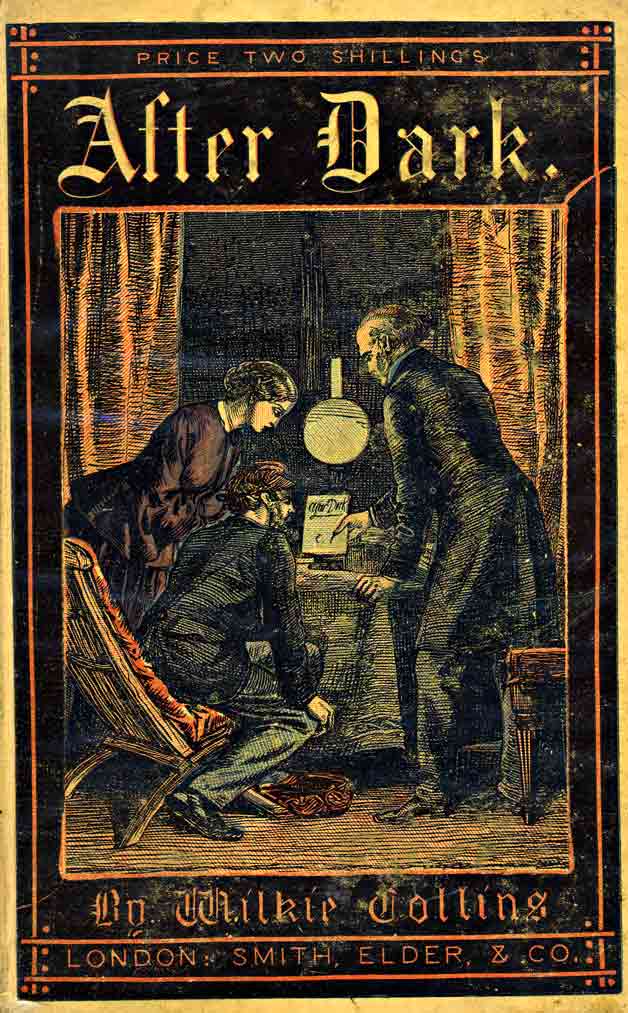
After Dark

After Dark. Wilkie Collins. 1856. 404 pages.

From "Leaves From Leah's Diary"
26th February, 1827.—The doctor has just called for the third time to examine my husband's eyes. Thank God, there is no fear at present of my poor William losing his sight, provided he can be prevailed on to attend rigidly to the medical instructions for preserving it. These instructions, which forbid him to exercise his profession for the next six months at least, are, in our case, very hard to follow. They will but too probably sentence us to poverty, perhaps to actual want; but they must be borne resignedly, and even thankfully, seeing that my husband's forced cessation from work will save him from the dreadful affliction of loss of sight. I think I can answer for my own cheerfulness and endurance, now that we know the worst. Can I answer for our children also? Surely I can, when there are only two of them. It is a sad confession to make, but now, for the first time since my marriage, I feel thankful that we have no more.
I tend to love Wilkie Collins. And I did enjoy his short story collection, After Dark. But I didn't find all six of the short stories equally compelling. And while I *loved* some of the stories in this book, I didn't love them all. I found them all worthwhile, all entertaining.

There's a framework to After Dark. A portrait-painter, William, suffers damage to his eyesight, the doctor tells him he needs LOTS of time to recuperate if he hopes to be able to see again. He can no longer count on his painting to bring in the income and take care of his family, so, the family is forced to come up with plan B. Plan B just happens to be writing and publishing a book of stories. These are stories that have been told to the painter--usually while his subject is being painted--through the years. He will now recollect the best stories he's ever heard and relate them to his wife, Leah, who will write them down each night...after dark. (That is after her long day's work is through.)

The six stories are:

  • The Traveller's Story of a Terribly Strange Bed (1852)
  • The Lawyer's Story of a Stolen Letter (1854)
  • The French Governess's Story of Sister Rose (1855)
  • The Angler's Story of The Lady of Glenwith Grange (new for After Dark)
  • The Nun's Story of Gabriel's Marriage (1853)
  • The Professor's Story of the Yellow Mask (1855)
Five of the six short stories were reprints, only one story was brand new and written especially for this book.

In my opinion, the best, best, best short story in this collection is The French Governess's Story of Sister Rose. This story has DRAMA and action. It is set during the French Revolution. And in my opinion, this story is a MUST read. Not only if you're a fan of Victorian literature OR a fan of Wilkie Collins, but if you're a fan of historical fiction set during the French Revolution, you should really consider reading this novella. (In my opinion, it is closer to a novella than a proper short story. It has parts and chapters.) So Louis Trudaine made a deathbed promise to his mother to always be there for his sister, Rose, and protect her. Rose has fallen in love with a man Louis feels is unworthy of her, a Charles Danville. The marriage does happen, though not without some unpleasant exchanges on the eve of the wedding. But he never feels quite sure of his sister's husband, and so he chooses to remain nearby even if it means passing up a job opportunity. Years pass--we learn from the narrator--and the Revolution comes. And with it danger, drama, action, betrayal, and so much more. This story is so very, very, very good. It's quite intense and I loved every minute of it.

The Traveller's Story of a Terribly Strange Bed is actually Wilkie Collins first published short story. It is quite creepy! It also happens to be set in Paris, by the way, anyway, the narrator is a young man named Faulkner. His good luck at a gambling house almost proves fatal. For a very, very friendly man convinces him that it is much too risky to leave the house at that time of night and wander the streets carrying his winnings. No, no, it would be much much safer to stay there for the night. But is that the truth? Well, his insomnia may just be a lifesaver!

The Nun's Story of Gabriel's Marriage is another story set in France during the French Revolution. While it isn't as good as The French Governess's Story of Sister Rose, in my opinion, it was interesting to get another story set in France--in Brittany--from Collins. The theme of this one is forgiveness and reconciliation. If you want a story with a couple of BIG twists, this one may prove satisfying.

The Angler's Story of The Lady of Glenwith Grange is another story with a BIG, BIG twist. Ida has promised to always, always, always take care of her younger sister, Rosamond. (Their mother died when Rosamond was a baby.) So when Rosamond marries, it's agreed that Ida will always live with them. The marriage, as you might expect, does not exactly exactly go as planned. And readers...along with Ida...learn why.

The Professor's Story of the Yellow Mask is set in Italy, I believe. It has a larger cast of characters than some of the other stories in the collection. And it has its own share of drama. It is a darker story balanced perhaps in a way by a love story with many, many obstacles. It also has lots of twists and turns and such. That being said, I wasn't thrilled with it.

The Lawyer's Story of a Stolen Letter is a detective story. It was a nice enough story, I suppose, but I wasn't wowed by it. Still, it's enjoyable enough. 


Read After Dark
  • If you're a fan of Wilkie Collins
  • If you're a fan of Victorian literature
  • If you're a fan of mystery, suspense, detective, or sensation stories
  • If you like short stories
  • If you like "shocking" stories with plenty of drama and twists and turns
© 2012 Becky Laney of Becky's Book Reviews
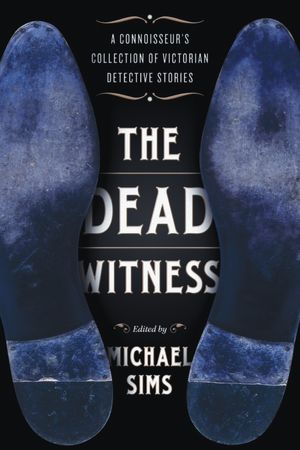
The Dead Witness

The Dead Witness: A Connoisseur's Collection of Victorian Detective Stories. Edited by Michael Sims. 2011. Walker & Company. (Late December 2011). 608 pages.

The Dead Witness is a short story collection that I absolutely LOVE, LOVE, LOVE. Now I am not usually a short story person, I feel it's important for everyone to know that. There are a couple of authors whose short fiction I enjoy, but, for the most part I like my novels.  But. I just LOVED this collection. I think it is a real MUST-READ.

Readers are introduced to twenty-two authors and twenty-two short stories. Each introduction was written by Michael Sims who did a fabulous job. There's just enough in each introduction to make you curious and eager to read their work, some of the introductions tease more than others. For example, they mention other stories, other novels, etc. The introductions are anything but boring! The authors presented are English, American, Canadian, Australian, and French. The collection includes men and women authors and men and women detectives! Some were narrated by a man or woman who just 'accidentally' got involved in the case, who just happened to put the clues together to solve the mystery. Others were narrated by amateur and professional detectives. (For example, The Diary of Anne Rodway is narrated by someone who just happens to become involved in this mystery. Her good friend, her roommate, is killed. She feels it was murder and has a clue or two to go by.)
  • The Secret Cell by William E. Burton
  • The Murders in the Rue Morgue by Edgar Allen Poe
  • On Duty With Inspector Field by Charles Dickens
  • The Diary of Anne Rodway by Wilkie Collins
  • You Are Not Human, Monsieur d'Artagnan by Alexandre Dumas, pere
  • Arrested on Suspicion by Andrew Forrester Jr.
  • The Dead Witness, or, The Bush Waterhole by W.W. (Mary Fortune)
  • The Mysterious Human Leg by James McGovan (William Crawford Honeyman)
  • The Little Old Man of Batignolles by Emile Gaboriau
  • The Science of Deduction by Arthur Conan Doyle
  • The Whitechapel Mystery by Anonymous
  • The Assassin's Natal Autograph by Mark Twain
  • The Murder at Troyte's Hill by C.L. Pirkis
  • The Haverstock Hill Murder by George R. Sims
  • The Stolen Cigar-Case by Bret Harte
  • The Absent-Minded Coterie by Robert Barr
  • The Hammer of God by G.K. Chesterton
  • The Angel of the Lord by Melville Davisson Post
  • The Crime at Big Tree Portage by Ernest Bramah
  • The Case of Padages Palmer by Harvey O'Higgins
  • An Intangible Clue by Anna Katherine Greene
 Chances are you're familiar with some of these authors. But some of these will probably be as new to you as they were to me.


My favorite favorite story was "The Diary of Anne Rodway," which I just LOVED and ADORED. True, I was already familiar with his work, but, even if I hadn't been, I think I would have loved this piece. The short story is a series of diary entries by a young woman, a poor woman. She's good friends with another young woman, Mary Mallinson. The two are in similar situations--in a way--both poor, both working hard to survive, both in love but facing obstacles to their happiness. But when Mary is murdered, Anne Rodway takes it upon herself to try to solve the mystery and discover the identity of the man who killed her friend.

I also enjoyed "The Secret Cell" by William E. Burton first published in 1837--several years before Edgar Allen Poe's oh-so-famous detective story, "The Murders in the Rue Morgue." I personally preferred The Secret Cell. I read that this is the first time it is being republished since its initial publication which I thought was nice! The Secret Cell is the story of a missing woman. The narrator had a laundress who had a daughter. The daughter of the laundress became a companion to a wealthy woman, the wealthy woman favors her companion in her will, and when the daughter inherits a fortune, well, it's not long before she turns up missing. It is a very interesting story!

Other favorites include, "The Murder at Troyte's Hill" by C.L. Pirkis, "The Angel of the Lord," by Melville Davisson Post, "The Stolen Cigar Case" by Bret Harte, and "An Intangible Clue" by Anna Katherine Greene.

Read The Dead Witness
  • If you enjoy detective fiction, mysteries, casebooks, etc.
  • If you enjoy Victorian literature
  • If you enjoy short stories
© 2012 Becky Laney of Becky's Book Reviews

Twelve Stories of Ray Bradbury

I am slowly-but-surely making my way through The Stories of Ray Bradbury. To visit the other posts in the series: first twelve, next twenty-six, next three, next ten. Since Sunday, I've been able to read twelve more stories in this massive collection--it's over 1,100 pages.

Calling Mexico
And then there is that day when all around, all around you hear the dropping of the apples, one by one, from the trees. 
A short story about death. I'm sure I should remember more than that--after all, it's only been three or four days since I read this one, but, an old man dying is all I can seem to remember.

The Wonderful Ice Cream Suit
It was summer twilight in the city, and out front of the quiet-clicking pool hall three young Mexican-American men breathed the warm air and looked around at the world. 
This story, on the other hand, I remember quite well! I just loved it, found it very fun, rather light-hearted, charming in tone and not too dark. It is a story about a group of friends who came together, in a way, because they are all the same size. Because they are the same size, they can share this one wonderful, marvelous suit. A suit that none of the men could have dreamed of buying on their own. But they take turns wearing it, and have the time of their lives.

Dark They Were, and Golden-Eyed
The rocket metal cooled in the meadow winds. 
Another short story that I just LOVED AND ADORED. This one is science fiction, it is set on Mars. It's the story of human settlers on Mars...and that's all I'm going to say about that. But it was FABULOUS. This one was not from Martian Chronicles, but, it was included in S is for Space.

The Strawberry Window
In his dream he was shutting the front door with its strawberry windows and lemon windows and windows like white clouds like clear water in a country stream.
Another short story set on Mars involving settlers. A husband knows his wife is homesick, but, he has a surprise for her. He has no idea if his surprise will be a total fail or a success. I enjoyed this one, I did. I'm not sure I loved it as much as "Dark They Were, and Golden-Eyed" though it is a lighter story, in a way.

A Scent of Sarsaparilla
Mr. William Finch stood quietly in the dark and blowing attic all morning and afternoon for three days. For three days in late November, he stood alone, feeling the soft, white flakes of Time falling out of the infinite cold steel sky, silently, softly, feathering the roof and powdering the eaves. 
Another story that I really really enjoyed! This one involves a man who discovers a way to travel in time! Well, if you believe him that is...it features a husband and wife...
"If you don't finish that attic today, I'll come up and toss everything out myself."
"Oh, no," he cried. "I have everything the way I want it!"
She looked at him coldly.
"Cora," he said, eating his lunch, relaxing, beginning to enthuse again, "you know what attics are? They're Time Machines, in which old, dim-witted men like me can travel back forty years to a time when it was summer all year round and children raided ice wagons. Remember how it tasted? You held the ice in your handkerchief. It was like sucking the flavor of linen and snow at the same time."
Cora fidgeted.
It's not impossible, he thought, half closing his eyes, trying to see it and build it. Consider an attic. Its very atmosphere is Time. It deals in other years, the cocoons and chrysalises of another age. All the bureau drawers are little coffins where a thousand yesterdays lie in state. Oh, the attic's a dark, friendly place, full of Time, and if you stand in the very center of it, straight and tall, squinting your eyes, and thinking and thinking, and smelling the Past, and putting out your hands to feel of Long Ago, why, it...
He stopped, realizing he had spoken some of this aloud. Cora was eating rapidly.
"Well, wouldn't it be interesting," he asked the part in her hair, "if Time Travel could occur? And what more logical, proper place for it to happen than in an attic like ours, eh?"
The Picasso Summer
George and Alice Smith detrained at Biarritz one summer noon and in an hour had run through their hotel onto the beach into the ocean and back out  to bake upon the sand.
Don't remember much about this one...except that it is about George's accidental meeting with a nameless (to readers) artist on the beach.

The Day It Rained Forever
The hotel stood like a hollowed dry bone under the very center of the desert sky where the sun burned the roof all day.
This story has atmosphere, but, I'm not quite sure I "get" every little thing about it. It is set in the desert at a hotel in a ghost town. The story features three men, three lonely, lonely men who are waiting for one thing and only one thing: the sound of rain. It is January 29th, the one day of the year--supposedly--when rain comes. But something--or someone--comes that day this year...

A Medicine for Melancholy
"Send for some leeches; bleed her," said Doctor Gimp
Melodrama perhaps at its best?! This is the DRAMATIC story of a young teen girl who is "dying." Her parents have tried everything to help their daughter get over her melancholy--including asking neighbors and strangers alike for "advice" on how to treat what ails her... the Dustman, for example, tells her that the moon will cure her...
The moon rose.
And the higher the moon, the larger grew Camillia's eyes as she watched the alleys, the courts, the streets until at last, at midnight, the moon moved over her to show her like a marble figure atop an ancient tomb.
A motion in darkness.
Camillia pricked her ears.
A faint melody sprang out on the air.
A man stood in the shadows of the court.
Camillia gasped.
The man stepped forth into moonlight, carrying a lute which he strummed softly. He was a man well-dressed, whose face was handsome and, now anyway, solemn.
"A troubadour," said Camillia aloud.
The man, his finger on his lips, moved slowly forward and soon stood by her cot.
"What are you doing out so late?" asked the girl, unafraid but not knowing why.
"A friend sent me to make you well." He touched the lute strings. They hummed sweetly. He was indeed handsome there in the silver light.
"That cannot be," she said, "for it was told me, the moon is my cure."
"And so it will be, maiden."
"What songs do you sing?"
"Songs of spring nights, aches, and ailments without name. Shall I name your fever, maiden?"
"If you know it, yes."
"First, the symptoms: raging temperatures, sudden cold, heart fast then slow, storms of temper, then sweet calms, drunkenness from having sipped only well water, dizziness from being touched only thus--"
He touched her wrist, saw her melt toward delicious oblivion, drew back.
"Depressions, elations," he went on. "Dreams--"
"Stop!" she cried, enthralled. "You know me to the letter. Now name my ailment!"
"I will." He pressed his lips to the palm of her hand so she quaked suddenly. "The name of the ailment is Camillia Wilkes."
The Shoreline at Sunset
Tom, knee-deep in the waves, a piece of driftwood in his hand, listened.
Don't remember this one at all. Not even a little bit.

Fever Dream
They put him between fresh, clean, laundered sheets and there was always a newly squeezed glass of thick orange juice on the table under the dim pink lamp. 
A truly strange story. I remember it, but I'm not sure I want to. About a sick little boy who feels his body is being taken over by microbes--that he is changing into something else, somebody else....

The Town Where No One Got Off
Crossing the continental United States by night, by day, on the train you flash past town after wilderness town where nobody ever gets off. 
And this is a darker Bradbury story. A creepy story about TWO creepy men...

All Summer in a Day
"Ready?"
"Now?"
"Soon."
Science fiction story with a classroom setting--it is about bullying in a way. On Venus, the sun is only visible two hours every seven years. Margot, the little girl bullied into a closet, is the only one who remembers what sunshine feels like--what summer feels like. (She still remembers Earth). The sun comes--but not everyone gets to share in the experience.... this one has a melancholy feel to it.


© 2012 Becky Laney of Becky's Book Reviews

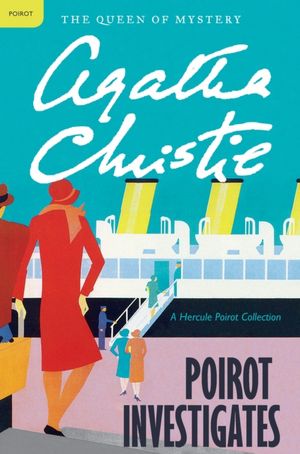
Poirot Investigates

Poirot Investigates. Agatha Christie. 1924/2011. HarperCollins. 256 pages.

I loved Poirot Investigates. Perhaps because I had low expectations? This was my first experience reading Christie's short stories. And since I'm not generally a fan of short stories, I didn't have great expectations for enjoying these fourteen stories. Each story is narrated by Captain Hastings. And he is a character that I tend to love and adore. I've found that Hercule Poirot needs a little help either from Hastings or Ariadne Oliver to help tame his arrogance. I have definitely come to love Hercule Poirot through the mysteries I've read, but, it was a long road for me. It wasn't instantaneous like it was with Miss Marple.

This collection of short stories was originally published in 1925. So it is "early" Poirot. The short stories in this collection are:

The Adventure of the Western Star
The Tragedy at Marsdon Manor
The Adventure of the Cheap Flat
The Mystery of Hunter's Lodge
The Million Dollar Bond Robbery
The Adventure of the Egyptian Tomb
The Jewel Robbery at the Grand Metropolitan
The Kidnapped Prime Minister
The Disappearance of Mr. Davenheim
The Adventure of the Italian Nobleman
The Case of the Missing Will
The Veiled Lady
The Lost Mine
The Chocolate Box

It's not that any one story is amazing or incredible. That's not why I loved this collection. For me it is all about the relationship between Poirot and Hastings. Their conversations. Their friendship. Seeing these two together. There is just something DELIGHTFUL about spending time in their company. 

© 2012 Becky Laney of Becky's Book Reviews

Ten Stories by Ray Bradbury

A few years ago I made a good attempt to read The Stories of Ray Bradbury. This collection of short stories is over 1,100 pages!!! I did manage to read just over 400 pages. But. It wasn't until his death that I decided I really needed to make a second attempt. Here are the three posts that cover the first attempt: first twelve, next twenty-six, next three

"The Man Upstairs"
He remembered how carefully and expertly Grandmother would fondle the cold cut guts of the chicken and withdraw the marvels therein; the wet shining loops of meat-smelling intestine, the muscled lump of heart, the gizzard with the collection of seeds in it. 
My thoughts: While this one wouldn't normally ever be listed among my favorites, viewed solely in terms of the ten stories I'm sharing today, it would probably be among the best. It is creepy, odd, and the details are, well, disgusting. But it actually made sense, a twilight zone kind of sense, but sense. You knew what the beginning, middle, and end all meant. As for what it is about, well, let's just say something not quite human moves into Grandma's boarding house, and, Douglas, the young hero of the story, sees it for what it is.

"Touched With Fire"
They stood in the blazing sunlight for a long while, looking at the bright faces of their old-fashioned railroad watches, while the shadows tilted beneath them, swaying, and the perspiration ran out under their porous summer hats.
My thoughts: This one would be among my favorites--viewed solely in terms of this ten. This story is about two men who try their very best to warn a cranky old woman to watch her attitude. Why? Well, they know HOW VERY HOT it is, and how the heat is getting to everyone, and they have a theory that 92 degrees is the perfect degree for murder.
More murders are committed at ninety-two degrees Fahrenheit than any other temperature. Over one hundred, it's too hot to move. Under ninety, cool enough to survive. But right at ninety-two degrees lies the apex of irritability, everything is itches and hair and sweat and cooked pork. The brain becomes a rat rushing around a red-hot maze. The least thing, a word, a look, a sound, the drop of a hair--and irritable murder. Irritable murder, there's a pretty and terrifying phrase for you. (422)
Will she listen? Will the thermometer make it that fatal degree?

"The Emissary"
Martin knew it was autumn again, for Dog ran into the house bringing wind and frost and a smell of apples turned to cider under trees.
My thoughts: Not a favorite, but it gets worse. Martin LOVES his Dog because Dog always brings back visitors to visit Martin. He does have a favorite visitor, Miss Haight. When Miss Haight dies, Martin gets lonely, then, Dog disappears too...will he ever get visitors again... This one is creepy, and would be perfect for the R.I.P challenge, and it does still make sense. It's a creepy story that won't necessarily be for everyone. But I still knew what happened in it.

"The Jar"
It was one of those things they keep in a jar in the tent of a sideshow on the outskirts of a little, drowsy town. 
My thoughts: Didn't like this one. I'm not sure I hated it, but I didn't care for it. Every one sees something different in this jar--one sees a dead baby, one sees a dead kitten, one sees a dead jellyfish, etc. So what is really in the jar? Well, no one knows...for sure...and would knowing be a good thing or a bad thing?

"The Small Assassin"
Just when the idea occurred to her that she was being murdered she could not tell. 
My thoughts: For the first two or three pages, I thought, well, this might be a good companion piece to "The Yellow Wallpaper." A few more pages, and I thought THIS IS THE WORST STORY EVER. I seriously hate this one. HATE, HATE, HATE. It is about a woman who thinks her newborn baby is trying to KILL her. I won't spoil this one, I won't. But believe me it is AWFUL.

"The Next in Line"
It was a little caricature of a town square.
My thoughts: I'm not sure I understood enough of this one to actually hate it. I'm not sure if it's just unreliable narrators at work, if there's a thread of insanity at play, or, if it's meant to be one of those bizarre Twilight-Zone type stories where there is no explanation, but, by the end of the story I was very confused and a bit annoyed. It appears to be about a couple on vacation in Mexico, and the woman keeps getting more and more anxious because they seem "trapped" in this town--their car broke down and the mechanic is supposed to be fixing it.

"Jack in the Box"
He looked through the cold morning windows with the Jack-in-the-Box in his hands, prying the rusted lid.
My thoughts: Does this story make sense to anyone? Am I the only one who is confused? This story is 90% nonsense, the only paragraphs that make sense are the last two or three. The only thing that has changed is the narrator--we go from a child to an outsider adult perspective. But I couldn't say exactly what this one is about.

"The Leave-Taking"
She was a woman with a broom or a dustpan or a washrag or a mixing spoon in her hand.
My thoughts: I liked this one. It's not that I love it exactly, though it is perhaps the most normal, most sane of the ten I'm discussing today. This story is about the death of a great-grandmother and how she gathers her family around her, talks to them, passes along words of wisdom, and welcomes death.

"Exorcism"
She came out of the bathroom putting iodine on her finger where she had almost lopped it off cutting herself a chunk of coconut cake.
My thoughts: I believe this one is supposed to be a comedy! I certainly read it that way. A rivalry gone wrong between two women who want to be president of the same club. One woman, the narrator, is the clumsiest woman in town. She's accusing her neighbor and fellow club-member of being a witch and using witchcraft to keep her from winning the election. (She always has only one vote--her own.) She also writes out a list of every "accident" and illness she's had in the past year. (She totals it all up and says that this other woman is responsible for $98 worth of medicine.) No one is taking her seriously, which, is a good thing I suppose. It ends in laughter and tears.

"The Happiness Machine"
On Sunday morning Leo Auffmann moved slowly through his garage, expecting some wood, a curl of wire, a hammer or wrench to leap up crying, "Start here!" But nothing leaped, nothing cried for a beginning.
My thoughts: The story of a man obsessed with building a "happiness machine" doesn't realize that happiness is made of of small passing moments, that happiness isn't something that you can program into a machine, it isn't something that can be bought or manufactured. He is driving his family--particularly his wife--CRAZY with his obsession to build this machine. He just doesn't get it...will he ever?

Current Progress: 540/1112

© 2012 Becky Laney of Becky's Book Reviews
Lin McLean

Lin McLean. Owen Wister. 1898/1998. Forge. 230 pages.

In the old days, the happy days, when Wyoming was a Territory with a future instead of a State with a past, and the unfenced cattle grazed upon her ranges by prosperous thousands, young Lin McLean awaked early one morning in cow camp, and lay staring out of his blankets upon the world. 

It helped me tremendously to know that this was Owen Wister's first novel. (I am even tempted to say "novel" just because this book feels more like a short story collection than a cohesive novel.) Unfortunately, I didn't learn that this was his first novel until after I read it and had been disappointed. Last year, I read and LOVED, LOVED, LOVED Owen Wister's novel The Virginian. It was a complete surprise to me because I am allergic to westerns. I wanted to find another Wister novel that compared to The Virginian, and I didn't find it in Lin McLean. (Though the Virginian makes a couple of appearances in the stories within Lin McLean.) But is that fair to expect Lin McLean to be as good, as great as The Virginian? Probably not.

The stories found in Lin McLean are
  • How Lin McLean Went East
  • The Winning of the Biscuit-Shooter
  • Lin McLean's Honey-Moon
  • A Journey In Search of Christmas
  • Separ's Vigilante
  • Destiny at Drybone
  • In the After-Days (a poem, not a story)
If I had to sum up the book, sum up the stories, I would say Lin McLean was about a cowboy who was good at losing his money gambling, a man easily distracted by women and cards and booze, a man who despite his shortcomings found the love of a young boy and a good woman.

My favorite stories were, without a doubt, "Lin McLean's Honey-Moon," "Separ's Vigilante," and "Destiny at Drybone."

Read Lin McLean
  • If you like westerns
  • If you're looking to catch early glimpses of the man who would become THE VIRGINIAN
  • If you like western short stories
© 2012 Becky Laney of Becky's Book Reviews

The Martian Chronicles (YA/Adult)

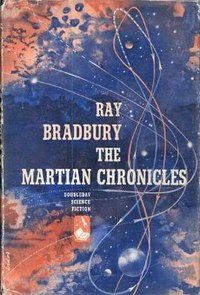
1997, edition of The Martian Chronicles
Martian Chronicles. Ray Bradbury. HarperCollins. 1997 edition. 288 pages.
One minute it was Ohio winter, with doors closed, windows locked, the panes blind with frost, icicles fringing every roof, children skiing on slopes, housewives lumbering like great black bears in their furs, along the icy streets.
And then a long wave of warmth crossed the small town. A flooding sea of hart air; it seemed as if someone had left a bakery door open. The heat pulsed among the cottages and bushes and children. The icicles dropped, shattering, to melt. The doors flew open. The windows flew up. The children worked off their wool clothes. The housewives shed their bear disguises. The snow dissolved and showed last summer's ancient green lawns.
Rocket summer. The words passed among the people in the open, airing houses. Rocket summer. The warm desert air changing the frost patterns on the windows, erasing the art work. The skis and sleds suddenly useless. The snow, falling from the cold sky upon the town, turned to a hot rain before it touched the ground. Rocket summer. People leaned from their dripping porches and watched the reddening sky. (1)
The 2012 Mass Paperback of The Martian Chronicles
I LOVE, LOVE, LOVE Ray Bradbury's The Martian Chronicles. This is the second or third time I've read this one. And each time I read it, I end up loving it even more. It's like each time I'm surprised by how much I love it. Like in between readings I forget how engaging and compelling it is. I settle into thinking that it was just me exaggerating things (again). That it couldn't possibly be that good. But no. It is that good.

The edition I read this time had twenty-seven stories; some of these 'stories' are just vignettes, or short preludes, transition pieces of a paragraph or two. But many are full-length stories. There are some great stories in this one.
  • January 2030 Rocket Summer
  • February 2030 Ylla
  • August 2030 The Summer Night
  • August 2030 The Earth Men
  • March 2031 The Taxpayer
  • April 2031 The Third Expedition
  • June 2032 --And the Moon Be Still as Bright
  • August 2032 The Settlers
  • December 2032 The Green Morning
  • February 2033 The Locusts
  • August 2033 Night Meeting
  • October 2033 The Shore
  • November 2033 The Fire Balloons
  • February 2034 Interim
  • April 2034 The Musicians
  • May 2034 The Wilderness
  • 2035-2036 The Naming of Names
  • April 2036 Usher II
  • August 2030 The Old Ones
  • September 2036 The Martian
  • November 2036 The Luggage Store
  • November 2036 The Off Season
  • November 2036 The Watchers
  • December 2036 The Silent Towns
  • April 2057 The Long Years
  • August 2057 There Will Come Soft Rains
  • October 2057 The Million Year Picnic
1950 edition of The Martian Chronicles
I wasn't aware that there were different editions of this one, and that the stories could vary depending on the edition. Also the dates have been modified (by thirty years) in some editions, like the edition I read this time around. The very, very newest edition has the original dates, 1999-2026. This newest edition does not have "The Fire Balloons." Also, instead of "The Wilderness" it has "Way in the Middle of the Air."

My thoughts on individual stories, and, first sentences from the stories

"Ylla"
They had a house of crystal pillars on the planet Mars by the edge of an empty sea, and every morning you could see Mrs. K eating the golden fruits that grew from the crystal walls, or cleaning the house with handfuls of magnetic dust which, taking all dirt with it, blew away on the hot wind.
A story told solely from the perspective of the Martians, in this case, a husband and wife. A husband has a very definite reaction to his wife's strange dreams. She dreams of a man, Nathaniel York, coming in a ship, in a rocket, and landing. The dream even tells her where and when. But her controlling and perhaps jealous husband has a way of dealing--for once and for all--with his wife's dreams.

"The Earth Men"
Whoever was knocking at the door didn't want to stop. Mrs. Ttt threw the door open. "Well?"
The story of the second expedition. Let's just say that the welcoming committee wasn't quite what they expected! First, NO ONE wanted to bother with them, then they were greeted by a strange assortment of Martians all claiming to be from Earth. And then....well, that wouldn't be polite of me to spoil it!


"The Third Expedition" (aka Mars is Heaven)
The ship came down from space. It came from the stars and the black velocities, and the shining movements, and the silent gulfs of space. It was a new ship; it had fire in its body and men in its metal cells, and it moved with a clean silence, fiery and warm. In it were seventeen men, including a captain. 
This one is a classic short story that you may have stumbled across in another context from The Martian Chronicles. (I've heard two radio adaptations, for example.) And the title is self-explanatory. It is the story of what happens when the third expedition lands. It is the story of what they see and  WHO they see. It is a story that stretches you, perhaps. But it's a good one!

"--And the Moon Be Still As Bright"
It was so cold when they first came from the rocket into the night that Spender began to gather the dry Martian wood and build a small fire. He didn't say anything about a celebration; he merely gathered the wood, set fire to it, and watched it burn.
And now we're on to the fourth expedition, the fourth rocket ship to successfully land on Mars. This time they manage to stay alive past the initial day or two or three. This is the story of what happens when one of the crew members, Spender, goes off on his own to learn the Martian culture, to explore the ruins, to explore the cities, to examine the artifacts and remnants of a culture that is gone with the wind. What happens next...well....there are a million reasons why readers shouldn't sympathize with Spender, but, like Captain Wilder, they may feel the pull all the same.

"The Settlers"
The men of Earth came to Mars. They came because they were afraid or unafraid, because they were happy or unhappy, because they felt like Pilgrims or did not feel like Pilgrims. There was a reason for each man. They were leaving bad wives or bad jobs or bad towns; they were coming to find something or leave something or get something, to dig up something or bury something or leave something alone. They were coming with small dreams or large dreams or none at all.
One of my favorite vignettes. For some reason it reminds me of John Steinbeck.

"Night Meeting"
Before going on up into the blue hills, Tomas Gomez stopped for gasoline at the lonely station.
There is something haunting and fantastical about this short story of a human and Martian meeting and not exactly seeing the same reality.

"The Fire Balloons"
Fire exploded over summer night lawns. 
 I first read "The Fire Balloons" in another collection of Ray Bradbury stories. I didn't, at the time, see it as being part of The Martian Chronicles. (And, in fact, it wasn't part of the edition I first read.) But now it is one of my favorite stories! In it two priests go to Mars as missionaries. One at least was expecting, was hoping, to meet Martians, to actually BE a missionary TO Martians, to an alien species. So when given the opportunity of going out into the hills and trying to communicate with blue balloon-like hovering creatures OR ministering to humans who have migrated to Mars, the answer is clear to Father Peregrine. But do the Martians need his church? This story has one of my favorite quotes:
"Father Peregrine, won't you ever be serious?"
"Not until the good Lord is. Oh, don't look so terribly shocked, please. The Lord is not serious. In fact, it is a little hard to know just what else He is except loving. And love has to do with humor, doesn't it? For you cannot love someone unless you put up with him, can you? And you cannot put up with someone constantly unless you can laugh at him. Isn't that true? And certainly we are ridiculous little animals wallowing in the fudge bowl, and God must love us all the more because we appeal to His humor."
 "The Wilderness"
Oh, the Good Time has come at last--
It was twilight and Janice and Leonora packed steadily in their summer house, singing songs, eating little, and holding to each other when necessary. But they never glanced at the window where the night gathered deep and the stars came out bright and cold.
This is another story that I ended up loving. And it was new-to-me too, it not being part of the original. But in this story we meet two women who are about to travel to Mars to get married and settle down. (The men having gone first.) The story likens exploring and settling Mars to exploring and settling the Old West (places like Wyoming, California, Oregon, etc.) It is about how the two handle their last night on Earth.
Is this how it was over a century ago, she wondered, when the women, the night before, lay ready for sleep, or not ready, in the small towns of the East, and heard the sound of horses in the night and the creak of the Conestoga wagons ready to go, and the brooding of oxen under the trees, and the cry of children already lonely before their time?...Is this then how it was so long ago? On the rim of the precipice, on the edge of the cliff of stars. In their time the smell of buffalo, and in our time the smell of the Rocket. Is then then how it was? And she decided, as sleep assumed the dreaming for her, that yes, yes indeed, very much so, irrevocably, this was as it had always been and would forever continue to be. 
"Usher II" (aka Carnival of Madness)
"During the whole of a dull, dark and soundless day in the autumn of the year, when the clouds hung oppressively low in the heavens, I had been passing alone on horseback, through a singularly dreary tract of country, and at length found myself, as the shades of evening drew on, within view of the melancholy House of Usher..." Mr. William Stendahl paused in his quotation. There, upon a low black hill, stood the house, its cornerstone bearing the inscription: 2036 A.D.
I remembered this as being one of the stories in A PLEASURE TO BURN, a Ray Bradbury collection celebrating the creative stories leading up to the writing/publishing of Fahrenheit 451. And it was first published as "Carnival of Madness." But it was also part of Ray Bradbury's book, The Martian Chronicles. And it is perhaps one of the most memorable of the collection. It is a true must read for anyone who loves Fahrenheit 451, for it continues on some of the same themes. I don't want to say too much about it really, because it shouldn't be spoiled at all if you want to get the full enjoyment of it!

"The Martian"
The blue mountains lifted into the rain and the rain fell down into the long canals and old LaFarge and his wife came out of their house to watch. 
An elderly couple have come to Mars and one night they are surprised by the appearance of their "son" (who died and was buried back on Earth). Their "son" doesn't want to leave the house, and is enjoying his family too much to risk getting "trapped" by going into the city and interacting with others. This story is creepy.

"The Luggage Store," "The Off Season," "The Watchers," "The Silent Towns," "The Long Years," "There Will Come Soft Rains," and "The Million Year Picnic."

These stories, I feel, work best as a sequence showing what happens both on Earth and Mars when the worst happens--atomic war on Earth. In "The Luggage Store," one speculates that his business will improve greatly if the war happens, if the worst happens. He feels that everyone will want to go back home to Earth to be with their loved ones, to find out if their loved ones are okay, to try to piece their society and civilization back together. In "The Off Season" readers learn that the war has started and the destruction has begun. There is nothing truly comical about it, but, it does happen to be told from the point of view of a man who has just opened a hot dog stand. "The Watchers" shows the people leaving Mars to return to Earth--for better or worse. "The Silent Towns" and "The Long Years" are two stories set on Mars. The first, "The Silent Towns" is told from the point of view of a man who chose to stay behind. He's lonely, but not THAT lonely it turns out. He does meet one woman who stayed behind, but, he decides that his own company is enough after all. "The Long Years" sees the return of Captain Wilder, I believe, who discovers a man and his family. There is a twist, however, which prevents this one from being a happy story. "There Will Come Soft Rains" is a very, very, very lonely story where we get a glimpse--just a small glimpse perhaps--of the desolation and destruction of life as we know it in at least one human city. We see the ending of an era, perhaps. There are no human characters in this one. "The Million Year Picnic" resonates even more when seen back-to-back with "There Will Come Soft Rains." In this story, readers meet a family: parents and sons who have come to Mars on their own private Rocket--a rocket that has been hidden away for many years, a rocket that has been saved for a true emergency. We meet a father who has prepared for THE END in a big, big way.

Read The Martian Chronicles
  • If you love science fiction
  • If you like science fiction
  • If you enjoy short stories; if you don't enjoy short stories
  • If you are a fan of Ray Bradbury
  • If you are a fan of the Twilight Zone

© 2012 Becky Laney of Becky's Book Reviews

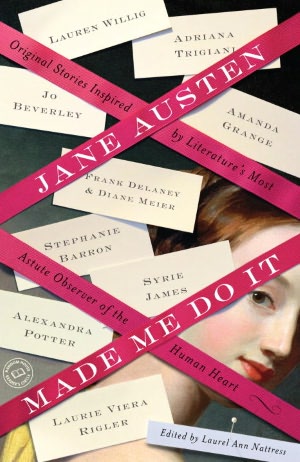
Jane Austen Made Me Do It

Jane Austen Made Me Do It. Edited By Laurel Ann Nattress. 2011. Random House. 464 pages. Featuring stories by Lauren Willig • Adriana Trigiani • Jo Beverley • Alexandra Potter • Laurie Viera Rigler • Frank Delaney & Diane Meier • Syrie James • Stephanie Barron • Amanda Grange • Pamela Aidan • Elizabeth Aston • Carrie Bebris • Diana Birchall • Monica Fairview • Janet Mullany • Jane Odiwe • Beth Pattillo • Myretta Robens • Jane Rubino and Caitlen Rubino-Bradway • Maya Slater • Margaret C. Sullivan • and Brenna Aubrey, the winner of a story contest hosted by the Republic of Pemberley

Jane Austen Made Me Do It is a great, great short story collection!!! While I didn't LOVE each and every story in this one--some I merely liked--there were so many good stories in it, that it is definitely worth reading!!! This isn't one of those short story collections with one or two or even three good stories worth your time. No, this collection has MANY good stories to offer Austen fans. Granted, your favorites may not be my favorites, and my favorites may not be your favorites. There's just enough diversity in these stories to please everyone.

The collection begins strong with Syrie James' Jane Austen's Nightmare. In this story, Jane awakes from a nightmare. She shares it, of course, with her dearest companion. In her dream almost all of her characters were confronting her, challenging her. None of her characters were happy with how they'd been presented. Of course, not all of her characters were complaining--Jane, Elizabeth, Darcy, and Bingley have more than enough reason to thank their creator. But for readers who dare to question the text, this story is playful and fun. Was Jane Austen 'too mean' to some of her characters? Should some of her bad boys have been reformed? Were some of her heroines too good to be true? Did any of her characters deserve different fates?

"Waiting," "Heard of You," and "Love Letter" relate to Persuasion, my favorite Austen novel. "Waiting" by Jane Odiwe stars Anne and Captain Wentworth. "Heard of You" by Margaret C. Sullivan imagines the love story of Wentworth's sister, Sophy, and Admiral Croft. And "Love Letter" by Brenna Aubrey uses a page ripped from a novel--the novel--to reunite a couple after years apart.

"Nothing Less Than Fairy-land"  by Monica Fairview imagines just how tricky a happy marriage might prove to be for Emma and Mr. Knightley. How her father won't be the easiest person in the world to live with, and how their happily ever after will have to be fought for day by day, not that it's not possible to love someone, to stay in love with someone. But that it takes work, it isn't effortless by any stretch of the imagination.

"Jane Austen and the Mistletoe Kiss" by Jo Beverley is a nice addition to this collection because for once it is the mother (the widow with grown daughters) who wins the guy...

"Mr. Bennet Meets His Match" by Amanda Grange imagines the courtship of Mr. and Mrs. Bennet.

"Jane Austen's Cat" by Diana Birchall is a quirky story, it's true, it may not be for everyone, but it's fun for cat lovers.

But my favorite story, my FAVORITE, FAVORITE, FAVORITE story from the collection is "Intolerable Stupidity" by Laurie Viera Rigler. This story is amazing, witty, clever, joyful. It is a true must read!!! Every page of has sparkle, has wit. It just begs to be read aloud so the giggles can be shared. In this story, the authors who have dared to touch the Creator's works have been put on trial. For any author who has dared to adapt, retell, modify, etc. This includes those who have filmed adaptations--the wet Mr. Darcy scene, for example. This includes those who have dared to add vampires, zombies, mummies, and sea monsters. To those who have dared enter the bedroom... This is very much a trial--and it features many characters from the novels! Including Mr. and Mrs. Darcy, of course. And Lady Catherine!!! Anyway, it's a true delight!!!! I just LOVED it.

© 2012 Becky Laney of Becky's Book Reviews

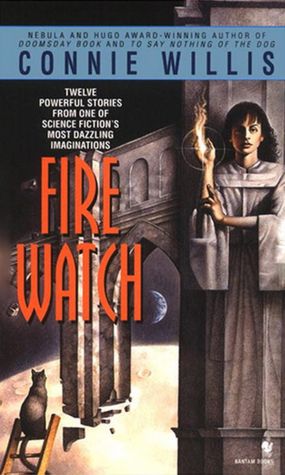
Fire watch

Firewatch. Connie Willis. 1985. Bantam Books. 271 pages.

Firewatch by Connie Willis is the FIRST short story collection I've read for the 2012 Short Story Reading Challenge.

I am SO GLAD this was not my first introduction to Connie Willis. I've discovered that I enjoy her novels so much more than her short stories.

With one little exception, the title story "Fire Watch."

Fire Watch is the FIRST story set in the world of Doomsday Book, To Say Nothing of the Dog, Blackout and All Clear. It introduces readers to the alternate-world where time travel is the way historians LEARN their subject. Readers meet Mr. Dunworthy and Kivrin, though the narrator is another historian, one who is accidentally going to St. Paul's during the London Blitz of 1940. His original assignment had him traveling WITH St. Paul! Quite a difference! This novella is great. It won both a Hugo Award and Nebula Award. And I would recommend this story to just about anyone who likes science fiction and time travel.
There are no guidelines for historians, and no restrictions either. I could tell everyone I'm from the future if I thought they would believe me. I could murder Hitler if I could get to Germany. Or could I? Time paradox talk abounds in the history department, and the graduate students back from their practica don't say a word one way or the other. Is there a tough, immutable past? Or is there a new past every day and do we, the historians, make it? And what are the consequences of what we do, if there are consequences? And how do we dare do anything without knowing them? Must we interfere boldly, hoping we do not bring about all our downfalls? Or must we do nothing at all, not interfere, stand by and watch St. Paul's burn to the ground if need be so that we don't change the future? All those are fine questions for a late-night study session. They do not matter here. I could no more let St. Paul's burn down than I could kill Hitler. No, that is not true. I found that out yesterday in the Whispering Gallery. I could kill Hitler if I caught him setting fire to St. Paul's. (12-13)
You may read the novelette online.

Other stories in the collection include:
  • Service for the Burial of the Dead
  • Lost and Found
  • All My Darling Daughters
  • The Father of the Bride
  • A Letter From the Clearys
  • And Come from Miles Around
  • The Sidon in the Mirror
  • Daisy, in the Sun
  • Mail-Order Clone
  • Samaritan
  • Blued Moon
My second favorite story was The Father of the Bride. This short story is a fairy-tale retelling. It is the Sleeping Beauty story from the father's perspective. It was very enjoyable! Definitely one of the highlights of the book for me. 

I would say that most of the other stories just weren't me. Service for the Burial of the Dead, Lost and Found, A Letter from the Clearys, and And Comes from Miles Around while not quite wowing me had some enjoyable qualities to them.

My least favorite has to be All My Darling Daughters.

Read Fire Watch
  • If you're a fan of Connie Willis
  • If you're a fan of short stories in the science fiction and fantasy genres
  • If you're wanting to read the first Willis time-travel story

© 2012 Becky Laney of Becky's Book Reviews

Home to Harmony

Home to Harmony. Philip Gulley. 2002. HarperCollins. 225 pages.

When I was in the second grade, my teacher, Miss Maxwell, read from The Harmony Herald that one in every four children lived in China. I remember looking over the room, guessing which children they might be. I wasn't sure where China was, but suspected it was on bus route three. 

One of the best, best, best books I've read lately. One of those books that had me at hello. It may not appeal to every one. I suppose you might say it is a little sentimental now and then. But. It is truly one of those cozy books that make you feel oh-so-happy. Or, I should say it made me feel oh-so-happy. There were chapters that had me laughing--really laughing hard. There were chapters that had me close to tears. And almost every chapter had something worth quoting. I realized this right away and didn't even try to mark them all. (Some books are like that.)

So the premise of this one is simple. Sam Gardner lives in the small town of Harmony. He went away--to school, to seminary--but now he's back. And unlike some in the town, he's very happy to be back, very happy to be living in Harmony. He understands--better than some--why it may not be a town for everyone, but to him it's right where he wants to be.

The book is a collection of stories. Some set in the past, some set in the present. The stories are arranged by season--spring, summer, fall, winter. And the stories are about the community, the people who live there or who have lived there. We meet Bob Miles Sr. and Dale Hinshaw. The narrator is a Quaker minister.

My favorite stories were: Miss Rudy, Wilbur, and Friday Nights; Burma-Shave; The Birds and the Bees; This Callous Pride; Mutiny; The Twins; Miriam and Ellis; and The Spelling Bee. 

"He had been inoculated with a small dose of Christianity, which had kept him from catching the real thing." (51)

"When love takes you by the hand and leaves you better, that is home." (63)

"The Dale Hinshaw Effect is simply this: If there is a bad idea to be thought, Dale Hinshaw will think it." (67)

© 2011 Becky Laney of Becky's Book Reviews