The Sunday Salon: Watching Jane Eyre (1996)

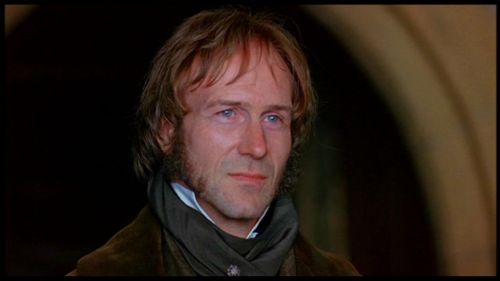
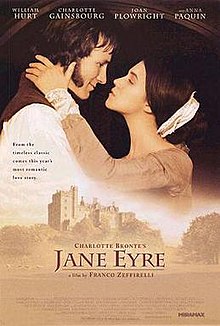
This week I'm sharing my thoughts on the 1996 film, Jane Eyre. This adaptation stars Charlotte Gainsbourg as Jane Eyre and William Hurt as Edward Rochester.

I have been having so much FUN watching all these adaptations of Jane Eyre. You might not think it would be fun to watch Jane Eyre and only Jane Eyre for weeks at a time, but, surprisingly enough I am having a delightful time with this project of mine. Why? Even though not every adaptation gets every, little thing right, even though some interpretations of Bronte's original novel don't make me giddy in delight--even though a few scenes in a few adaptations make me cringe--I have found enough to enjoy in each and every adaptation.

For the most part I enjoyed this adaptation of Jane Eyre. I really enjoyed William Hurt as Mr. Rochester. I think he did a good job in capturing Charlotte Bronte's hero. Perhaps he isn't fully-fully realized or brought to life in this adaptation, a few scenes are missing, a few exchanges are missing, but, for the most part he plays the role right. (The gypsy-fortune-teller scene is missing from this adaptation. And some of the couple's conversations are cut short or eliminated from this abridgment.)

The film did a good job in adapting two tricky scenes. I thought this film did a great job in portraying the first meeting between Mr. Rochester and Jane Eyre. This is closer to how I imagined it from the book. Perhaps this stood out to me because I thought it was done so horribly in the 1997 adaptation.
The second scene that has proved oh-so-tricky to get right is after-the-non-wedding, post-big-reveal scene. This movie gets a passing score not so much for what it does, but for what it doesn't do. It isn't a monstrous temper tantrum or a make-out session. Rochester isn't yelling, screaming, grabbing, pushing, pulling, or demanding.

NOW, what happens after she leaves, well, that certainly deviates from the book!!! Perhaps it took inspiration from the 1934 film?

Overall, this one does take liberties with the book. It is not as faithful as it could be. St. John Rivers is not her cousin, he is rector at Gateshead or near Gateshead. She meets St. John Rivers and his sister, Mary Rivers, not in her desperate hour of need when she's running away from Mr. Rochester, but, instead when she goes to visit her dying Aunt Reed. She returns to them after her bitter disappointment, but, they are already acquainted with her. She does inherit her money (unlike the 1997 adaptation) but she's never as desperate and friendless in this one. For St. John Rivers and his sister know they are taking care of a wealthy heiress.

My general thoughts are this was a very nice, very pleasant, very enjoyable, non-offensive adaptation of Jane Eyre. It may not be WOW, WOW, WOW this is the best Jane Eyre EVER, but, it works really well, in my opinion. It's a nice abridgment, nothing *too* essential was lost. And the romance was nicely done. I thought the age difference between the two worked. (In some adaptions, they are too close together in age to be believable as Jane and Edward. For example, in the 1944 adaptation starring Orson Welles and Joan Fontaine.) I enjoyed both William Hurt's portrayal as Mr. Rochester and Charlotte Gainsbourg's portrayal as Jane Eyre. Essentially, I thought they got all the most important elements right in this adaptation. True, it could have been longer, and if it had been longer, they could have been more faithful to the book or even more faithful to the book. But I think they did a good job in capturing the heart of the original. For this reason, I think I prefer it now to the 2006 adaptation. And I definitely prefer it to the 1997 adaptation.

First conversation
Second conversation
Third conversation
Jane Rescues Mr. Rochester (fire scene)
Blanche Ingram and "guests" on governesses
The Proposal 
The Wedding
Jane Leaves Mr. Rochester after the big reveal

Have you seen this adaptation? What did you think? Do you have a favorite adaptation?

Other Jane Eyre (movie) reviews

© 2012 Becky Laney of Becky's Book Reviews

Library Loot: Second Trip in July

New Loot:
  • Zoe Gets Ready by Bethanie Deeney Murguia
  • Winter King: Henry VII and the Dawn of Tudor England by Thomas Penn
  • That Woman: The Life of Wallis Simpson, Duchess of Windsor by Anne Sebba
  • The Rose of York: Love & War. Sandra Worth

Leftover Loot:
  • Good night, Mr. Holmes by Carole Nelson Douglas
  • Code Name Verity by Elizabeth Wein
  • The Stories of Ray Bradbury  
  • Welcome to Heartlake City by Helen Murray
  • Friends Forever by Helen Murray
  • The Tuesday Club Murders by Agatha Christie
  • Princess Academy by Shannon Hale
  • The Rise and Fall of Mount Majestic by Jennifer Trafton
  •  We Two: Victoria and Albert by Gillian Gill.
Library Loot is a weekly event co-hosted by Claire and Marg that encourages bloggers to share the books they’ve checked out from the library. If you’d like to participate, just write up your post-feel free to steal the button-and link it using the Mr. Linky any time during the week. And of course check out what other participants are getting from their libraries.     
 
© 2012 Becky Laney of Becky's Book Reviews

Books That Celebrate Playing

My Dad is the Best Playground. Luciana Navarro Powell. 2012. Random House. 26 pages. [Board Book]

My dad is the best playground, the most fun of all. 
He's the highest swing and a great climbing wall.
Dad is the longest tunnel I've ever crawled through.
Monkey bars, seesaw, and a bouncy trampoline, too.

These two little ones just LOVE their Dad. He does make the best playground, after all. Where big sister goes, baby soon follows, as you'll notice as you read this fun and playful new board book by Luciana Navarro Powell. The text is fun, playful, spirited, definitely matching the energy of the characters. The rhyming works for me, for the most part. I would definitely recommend this one!

Higher! Higher! Leslie Patricelli. 2010. Candlewick Press. 30 pages. [Board Book]

Higher! Higher!

How high can a father push his little girl on the swings? Read Leslie Patricelli's oh-so-delightful book Higher! Higher! and see for yourself. A little imagination goes a long, long, long way you'll see. For she goes higher and higher and higher, and she just might make it all the way to outer space! The illustrations are at the heart of this one, it is in paying attention to the illustrations that you'll find delight. The text of this one is extremely simple: just one word "Higher!" repeated again and again and again...as one little girl has a very fun time playing with her Dad. 

Faster! Faster! Leslie Patricelli. 2012. Candlewick Press. [Picture Book]

Faster! Faster!

I really LOVED Leslie Patricelli's Higher! Higher! I've loved all her baby books really. Faster! Faster! is no exception. In this playful follow-up, readers see a little girl and her Dad at the park once again. She wants a ride on his back, this time. (The swings are occupied, did you notice?!) She wants him to go faster! faster! Can Dad go faster than a dog chasing a ball? faster than a rabbit? faster than an ostrich? faster than a horse? Read for yourself and see!!! Just how long can he keep up this fast pace?! It is imaginative, fun, playful, spirited. And very, very simple!!! 

Read My Dad is the Best Playground; Higher! Higher!; and Faster! Faster!
  • If you've got little ones, energetic little ones that love to play and bounce and imagine
  • If you're looking for books that encourage play, time spent with Dad
  • If you're looking for fun books to read out loud
  • If you're a fan of Leslie Patricelli

© 2012 Becky Laney of Becky's Book Reviews

Twelve Stories of Ray Bradbury

I am slowly-but-surely making my way through The Stories of Ray Bradbury. To visit the other posts in the series: first twelve, next twenty-six, next three, next ten. Since Sunday, I've been able to read twelve more stories in this massive collection--it's over 1,100 pages.

Calling Mexico
And then there is that day when all around, all around you hear the dropping of the apples, one by one, from the trees. 
A short story about death. I'm sure I should remember more than that--after all, it's only been three or four days since I read this one, but, an old man dying is all I can seem to remember.

The Wonderful Ice Cream Suit
It was summer twilight in the city, and out front of the quiet-clicking pool hall three young Mexican-American men breathed the warm air and looked around at the world. 
This story, on the other hand, I remember quite well! I just loved it, found it very fun, rather light-hearted, charming in tone and not too dark. It is a story about a group of friends who came together, in a way, because they are all the same size. Because they are the same size, they can share this one wonderful, marvelous suit. A suit that none of the men could have dreamed of buying on their own. But they take turns wearing it, and have the time of their lives.

Dark They Were, and Golden-Eyed
The rocket metal cooled in the meadow winds. 
Another short story that I just LOVED AND ADORED. This one is science fiction, it is set on Mars. It's the story of human settlers on Mars...and that's all I'm going to say about that. But it was FABULOUS. This one was not from Martian Chronicles, but, it was included in S is for Space.

The Strawberry Window
In his dream he was shutting the front door with its strawberry windows and lemon windows and windows like white clouds like clear water in a country stream.
Another short story set on Mars involving settlers. A husband knows his wife is homesick, but, he has a surprise for her. He has no idea if his surprise will be a total fail or a success. I enjoyed this one, I did. I'm not sure I loved it as much as "Dark They Were, and Golden-Eyed" though it is a lighter story, in a way.

A Scent of Sarsaparilla
Mr. William Finch stood quietly in the dark and blowing attic all morning and afternoon for three days. For three days in late November, he stood alone, feeling the soft, white flakes of Time falling out of the infinite cold steel sky, silently, softly, feathering the roof and powdering the eaves. 
Another story that I really really enjoyed! This one involves a man who discovers a way to travel in time! Well, if you believe him that is...it features a husband and wife...
"If you don't finish that attic today, I'll come up and toss everything out myself."
"Oh, no," he cried. "I have everything the way I want it!"
She looked at him coldly.
"Cora," he said, eating his lunch, relaxing, beginning to enthuse again, "you know what attics are? They're Time Machines, in which old, dim-witted men like me can travel back forty years to a time when it was summer all year round and children raided ice wagons. Remember how it tasted? You held the ice in your handkerchief. It was like sucking the flavor of linen and snow at the same time."
Cora fidgeted.
It's not impossible, he thought, half closing his eyes, trying to see it and build it. Consider an attic. Its very atmosphere is Time. It deals in other years, the cocoons and chrysalises of another age. All the bureau drawers are little coffins where a thousand yesterdays lie in state. Oh, the attic's a dark, friendly place, full of Time, and if you stand in the very center of it, straight and tall, squinting your eyes, and thinking and thinking, and smelling the Past, and putting out your hands to feel of Long Ago, why, it...
He stopped, realizing he had spoken some of this aloud. Cora was eating rapidly.
"Well, wouldn't it be interesting," he asked the part in her hair, "if Time Travel could occur? And what more logical, proper place for it to happen than in an attic like ours, eh?"
The Picasso Summer
George and Alice Smith detrained at Biarritz one summer noon and in an hour had run through their hotel onto the beach into the ocean and back out  to bake upon the sand.
Don't remember much about this one...except that it is about George's accidental meeting with a nameless (to readers) artist on the beach.

The Day It Rained Forever
The hotel stood like a hollowed dry bone under the very center of the desert sky where the sun burned the roof all day.
This story has atmosphere, but, I'm not quite sure I "get" every little thing about it. It is set in the desert at a hotel in a ghost town. The story features three men, three lonely, lonely men who are waiting for one thing and only one thing: the sound of rain. It is January 29th, the one day of the year--supposedly--when rain comes. But something--or someone--comes that day this year...

A Medicine for Melancholy
"Send for some leeches; bleed her," said Doctor Gimp
Melodrama perhaps at its best?! This is the DRAMATIC story of a young teen girl who is "dying." Her parents have tried everything to help their daughter get over her melancholy--including asking neighbors and strangers alike for "advice" on how to treat what ails her... the Dustman, for example, tells her that the moon will cure her...
The moon rose.
And the higher the moon, the larger grew Camillia's eyes as she watched the alleys, the courts, the streets until at last, at midnight, the moon moved over her to show her like a marble figure atop an ancient tomb.
A motion in darkness.
Camillia pricked her ears.
A faint melody sprang out on the air.
A man stood in the shadows of the court.
Camillia gasped.
The man stepped forth into moonlight, carrying a lute which he strummed softly. He was a man well-dressed, whose face was handsome and, now anyway, solemn.
"A troubadour," said Camillia aloud.
The man, his finger on his lips, moved slowly forward and soon stood by her cot.
"What are you doing out so late?" asked the girl, unafraid but not knowing why.
"A friend sent me to make you well." He touched the lute strings. They hummed sweetly. He was indeed handsome there in the silver light.
"That cannot be," she said, "for it was told me, the moon is my cure."
"And so it will be, maiden."
"What songs do you sing?"
"Songs of spring nights, aches, and ailments without name. Shall I name your fever, maiden?"
"If you know it, yes."
"First, the symptoms: raging temperatures, sudden cold, heart fast then slow, storms of temper, then sweet calms, drunkenness from having sipped only well water, dizziness from being touched only thus--"
He touched her wrist, saw her melt toward delicious oblivion, drew back.
"Depressions, elations," he went on. "Dreams--"
"Stop!" she cried, enthralled. "You know me to the letter. Now name my ailment!"
"I will." He pressed his lips to the palm of her hand so she quaked suddenly. "The name of the ailment is Camillia Wilkes."
The Shoreline at Sunset
Tom, knee-deep in the waves, a piece of driftwood in his hand, listened.
Don't remember this one at all. Not even a little bit.

Fever Dream
They put him between fresh, clean, laundered sheets and there was always a newly squeezed glass of thick orange juice on the table under the dim pink lamp. 
A truly strange story. I remember it, but I'm not sure I want to. About a sick little boy who feels his body is being taken over by microbes--that he is changing into something else, somebody else....

The Town Where No One Got Off
Crossing the continental United States by night, by day, on the train you flash past town after wilderness town where nobody ever gets off. 
And this is a darker Bradbury story. A creepy story about TWO creepy men...

All Summer in a Day
"Ready?"
"Now?"
"Soon."
Science fiction story with a classroom setting--it is about bullying in a way. On Venus, the sun is only visible two hours every seven years. Margot, the little girl bullied into a closet, is the only one who remembers what sunshine feels like--what summer feels like. (She still remembers Earth). The sun comes--but not everyone gets to share in the experience.... this one has a melancholy feel to it.


© 2012 Becky Laney of Becky's Book Reviews

Wild Romance

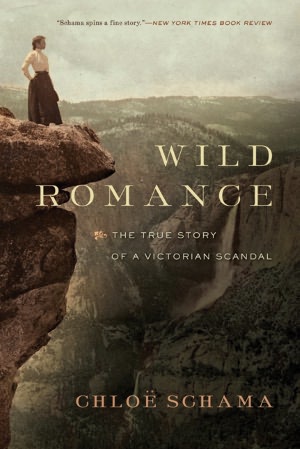
Wild Romance: The True Story of a Victorian Scandal. Chloe Schama. 2010. Walker & Company. 249 pages.

Loved the first half of this nonfiction book on the life of Theresa Longworth, but, the second half which chronicles her world-travels after her oh-so-famous trials left me bored.

I picked up Wild Romance: A Victorian Story of a Marriage, a Trial, and a Self-Made Woman because I'm a fan of Victorian literature. I've read a handful of novels that fall into the "inspired-by" category. Authors whose works deal with irregular marriages--Irish, Scottish, etc. Marriages whose legitimacy was sometimes called into question. Since in some cases, just saying "We're married" with no paperwork, no witnesses, no priest or clergyman could do the job. At the time, there was definitely debate about what made a marriage or union legal or illegal.

In the case of Theresa Longworth, she "married" allegedly married on two different occasions in two different countries, a man named William Charles Yelverton. In the moment, I suppose, he was willing enough. The couple traveled together as man and wife for a short time at least. But when the two separated, I believe he was in the military, he changed his mind. He found someone new, someone with money to marry. And marry he did. Theresa finding out after a very difficult illness that "her" husband was now married to someone else...and he was claiming that they'd never, ever been married. Furthermore, he started saying that she was chasing him, had been chasing him for years and years, and that she was the one who wanted a more intimate arrangement.

The first half of this one follows their "courtship" and "marriage" leading up to a handful of trials in a handful of countries. And these court cases meant big, big, big publicity. Especially for her, she had a way of winning the public's support...but not so much anyone else. Some thought his new wife was much, much classier mainly because she stayed quiet and stayed at home.

So the book gives readers very detailed accounts of their correspondence. And in a way, the book encourages readers to make up their own minds. Was Theresa Longworth pursuing him? Was she going above and beyond what was allowed of ladies of the time? Was there something indiscreet and shameful in her letters to him? Was she ever grounded in reality? Was William Charles Yelverton a jerk? Did he ever mean to do right by Theresa? Was lying to her about being married the only way he saw of getting her into bed?

The second half of the book, for better or worse, lets readers know what happened next in her life. And what happened next is that she started traveling the world. All over the world. She wrote about her travels and had them published. (She also wrote two novels, though reviews were mixed at best.)

The book concludes by discussing how this real-life court case inspired dozens of novels of the time. 

Read Wild Romance
  • If you're a fan of Victorian literature; particularly of Wilkie Collins.
  • If you're interested in history; if you're interested in this time period
  • If you're interested in court cases and scandals and he-said, she-said dramas
  • If you're interested in travel writing, in following the chronicles of a woman traveler during this time period.
© 2012 Becky Laney of Becky's Book Reviews
The Suspicions of Mr. Whicher

The Suspicions of Mr. Whicher: A Shocking Murder and the Undoing of a Great Victorian Detective. Kate Summerscale. 2008. Walker. 360 pages.

On Sunday, 15 July 1860, Detective-Inspector Jonathan Whicher of Scotland Yard paid two shillings for a hansom cab to take him from Millbank, just west of Westminster, to Paddington station, the London terminus of the Great Western Railway. 

 The Suspicions of Mr. Whicher is such a compelling book! How many (adult) nonfiction books have you read that you can honestly say you've read in one sitting? How many have you read that are nearly impossible to put down? I've read plenty that are good--great even; I've read plenty that I've found fascinating and enjoyable, such as Becoming Queen Victoria. But this one is just as captivating and suspenseful as a mystery or detective story.

The Suspicions of Mr. Whicher is a TRUE must read, if you enjoy detective or mystery fiction. If you find sensation novels thrilling, then, this one will prove a real treat. The author even spends a great deal of time discussing how real life court cases, real life crimes were influencing the fiction of popular authors, authors like Wilkie Collins, Charles Dickens, Mary Elizabeth Braddon, etc. The author discusses the characters and plots of these novels even quoting from them at times.

The Suspicions of Mr. Whicher is a nonfiction chronicle of a horrible murder. The murder occurs at Road Hill, in the Kent home, in June 1860. Within weeks, one of England's best detectives, Mr. Whicher, is on the case. He has opinions as to who did it. He has a definite suspect in mind; unfortunately, in the week after the arrest, he is not able to find enough evidence to make a case to bring the suspect to trial, and the person is released. (I'm trying SO hard not to spoil this one by using pronouns or names!!) It's a big disappointment to Whicher who feels that he did name the right person, but, Whicher loses some of his reputation at least because public opinion has gone against him and his suspect. In fact, the case has received so much attention that there are hundreds of letters coming in from people who feel they know who really did it based on piecing together clues from the newspaper.

The Suspicions of Mr. Whicher is about:
  • Mr. Jonathan Whicher before, during, and after this case or investigation
  • The Kent family before, during, and after this murder, trial, and investigation
  • The detective-police system/procedure in Britain at this time
  • A handful of other "big" cases during the 1860s 
I definitely loved this one!!! I'd easily recommend it to people who love Jane Eyre, The Moonstone, Woman in White, Bleak House, etc.

Read The Suspicions of Mr. Whicher
  • If you love fascinating, captivating, compelling nonfiction; nonfiction that reads like a novel but is well-researched.
  • If you have an interest in the Victorian period
  • If you are interested in sensation, mystery, or detective stories

© 2012 Becky Laney of Becky's Book Reviews

Idle Thoughts of an Idle Fellow

Idle Thoughts of an Idle Fellow. Jerome K. Jerome. 1889. 112 pages.
Now, this is a subject on which I flatter myself I really am au fait. The gentleman who, when I was young, bathed me at wisdom's font for nine guineas a term—no extras—used to say he never knew a boy who could do less work in more time; and I remember my poor grandmother once incidentally observing, in the course of an instruction upon the use of the Prayer-book, that it was highly improbable that I should ever do much that I ought not to do, but that she felt convinced beyond a doubt that I should leave undone pretty well everything that I ought to do.
I am afraid I have somewhat belied half the dear old lady's prophecy. Heaven help me! I have done a good many things that I ought not to have done, in spite of my laziness. But I have fully confirmed the accuracy of her judgment so far as neglecting much that I ought not to have neglected is concerned. Idling always has been my strong point. I take no credit to myself in the matter—it is a gift. Few possess it. There are plenty of lazy people and plenty of slow-coaches, but a genuine idler is a rarity. He is not a man who slouches about with his hands in his pockets. On the contrary, his most startling characteristic is that he is always intensely busy.
It is impossible to enjoy idling thoroughly unless one has plenty of work to do. There is no fun in doing nothing when you have nothing to do. Wasting time is merely an occupation then, and a most exhausting one. Idleness, like kisses, to be sweet must be stolen.
Is Idle Thoughts of an Idle Fellow worth reading? Is it as good as Three Men in a Boat? Is it as good as Diary of a Pilgrimage? I do think it's worth reading, just reading in a different way. It is not as good, in my opinion, as Three Men in a Boat or Diary of a Pilgrimage. Both Three Men in a Boat and Diary of a Pilgrimage were travel books, travel books written more to amuse and delight, perhaps, but the books had structure, they were going somewhere, they were doing something. Idle Thoughts for an Idle Fellow, well, it's a book about nothing and everything. Some essays were good--very, very good. Others not so much. But I did like this one!!!

On idling:
I like idling when I ought not to be idling; not when it is the only thing I have to do. That is my pig-headed nature. The time when I like best to stand with my back to the fire, calculating how much I owe, is when my desk is heaped highest with letters that must be answered by the next post. When I like to dawdle longest over my dinner is when I have a heavy evening's work before me. And if, for some urgent reason, I ought to be up particularly early in the morning, it is then, more than at any other time, that I love to lie an extra half-hour in bed.
On sleeping late:
Ah! how delicious it is to turn over and go to sleep again: "just for five minutes." Is there any human being, I wonder, besides the hero of a Sunday-school "tale for boys," who ever gets up willingly? 
I think myself that I could keep out of bed all right if I once got out. It is the wrenching away of the head from the pillow that I find so hard, and no amount of over-night determination makes it easier. I say to myself, after having wasted the whole evening, "Well, I won't do any more work to-night; I'll get up early to-morrow morning;" and I am thoroughly resolved to do so—then. In the morning, however, I feel less enthusiastic about the idea, and reflect that it would have been much better if I had stopped up last night.
On alarm clocks: 
artful contrivances that go off at the wrong time and alarm the wrong people
On love:
Love is like the measles; we all have to go through it. Also like the measles, we take it only once. One never need be afraid of catching it a second time.
A man's heart is a firework that once in its time flashes heavenward.
On affection:
Affection will burn cheerily when the white flame of love is flickered out. Affection is a fire that can be fed from day to day and be piled up ever higher as the wintry years draw nigh.
On blame:
But we are so blind to our own shortcomings, so wide awake to those of others. Everything that happens to us is always the other person's fault.
 On truth:
Speak truth, and right will take care of itself.
 On blogging writing:
It is a most remarkable thing. I sat down with the full intention of writing something clever and original; but for the life of me I can't think of anything clever and original—at least, not at this moment.
On cats:
As for cats, they nearly equal human beings for vanity. I have known a cat get up and walk out of the room on a remark derogatory to her species being made by a visitor, while a neatly turned compliment will set them purring for an hour.
I do like cats. They are so unconsciously amusing. There is such a comic dignity about them, such a "How dare you!" "Go away, don't touch me" sort of air. Now, there is nothing haughty about a dog. They are "Hail, fellow, well met" with every Tom, Dick, or Harry that they come across. When I meet a dog of my acquaintance I slap his head, call him opprobrious epithets, and roll him over on his back; and there he lies, gaping at me, and doesn't mind it a bit.
Fancy carrying on like that with a cat! Why, she would never speak to you again as long as you lived. No, when you want to win the approbation of a cat you must mind what you are about and work your way carefully. If you don't know the cat, you had best begin by saying, "Poor pussy." After which add "did 'ums" in a tone of soothing sympathy. You don't know what you mean any more than the cat does, but the sentiment seems to imply a proper spirit on your part, and generally touches her feelings to such an extent that if you are of good manners and passable appearance she will stick her back up and rub her nose against you. Matters having reached this stage, you may venture to chuck her under the chin and tickle the side of her head, and the intelligent creature will then stick her claws into your legs; and all is friendship and affection...
On sympathy:
It is in our faults and failings, not in our virtues, that we touch one another and find sympathy. We differ widely enough in our nobler qualities. It is in our follies that we are at one.
 On flattery:
Fill a person with love for themselves, and what runs over will be your share, says a certain witty and truthful Frenchman whose name I can't for the life of me remember. (Confound it! I never can remember names when I want to.)
On novels:
But then not one novelist in a thousand ever does tell us the real story of their hero. It is in the petty details, not in the great results, that the interest of existence lies.
On babies:
Odd little people! They are the unconscious comedians of the world's great stage. They supply the humor in life's all-too-heavy drama. Each one, a small but determined opposition to the order of things in general, is forever doing the wrong thing at the wrong time, in the wrong place and in the wrong way. Give an average baby a fair chance, and if it doesn't do something it oughtn't to a doctor should be called in at once.

© 2012 Becky Laney of Becky's Book Reviews