Tampilkan postingan dengan label 2007. Tampilkan semua postingan

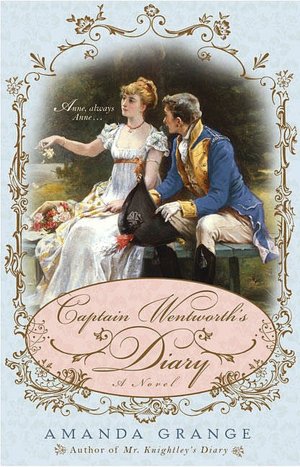
Captain Wentworth's Diary

Captain Wentworth's Diary. Amanda Grange. 2007. Penguin. 304 pages.

Thursday 5 June
At last I am on my way to Somerset!

I do like Amanda Grange's series, and, sometimes I really LOVE her books. But I didn't quite love Captain Wentworth's Diary. Persuasion is one of my favorite books, and definitely my favorite Jane Austen novel. I think I prefer the story from Anne's perspective.

Captain Wentworth's diary begins before he first meets Anne Elliot. The book portrays the courtship of the two, the sweet proposal, the bitter disappointment after she changes her mind. The novel then jumps ahead to Wentworth's successful return. Readers then see the events and scenes of Persuasion through Wentworth's eyes, for the most part. Though it's just a fraction of the story.

I liked this one. I felt Grange got the characters right, for the most part. And it was interesting to see their first meeting. Their first conversation was something. But. It just wasn't as amazing as Austen's original.

Read Captain Wentworth's Diary
  • If you're a fan of Amanda Grange 
  • If you're a fan of Jane Austen
  • If you like historical romances told in diary format 

© 2012 Becky Laney of Becky's Book Reviews

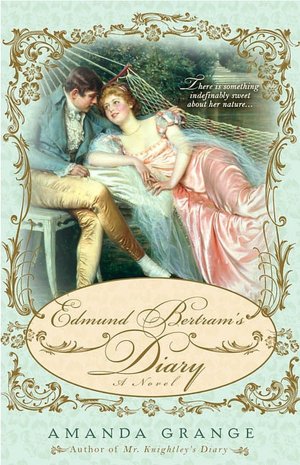
Edmund Bertram's Diary

Edmund Bertram's Diary. Amanda Grange. 2007/2008. Penguin. 304 pages.

Tuesday 8 July
Tom was eager to try out his new horse's paces and so we rode out together this morning, jumping walls and hedges, until he was satisfied he had made a good bargain.

I enjoyed Amanda Grange's retelling of Mansfield Park through the diary of Edmund Bertram. Edmund Bertram isn't always the wisest or brightest hero, but, his genuine friendship for Fanny Price is clear throughout the novel. The romance between Fanny Price and Edmund Bertram has always bothered me slightly. At least in Austen's novel, perhaps because Edmund Bertram's reformation or change of heart was so rushed, the "romance" being almost an afterthought thrown into the last few pages of the novel.

I thought Amanda Grange did a good job with in in this adaptation. For readers see that the love and affection is genuine, sincere. That Edmund does truly care for Fanny Price in that way, and that she feels exactly the same way about him. That he isn't marrying her out of duty or desperation, that Fanny is the one for him, and that he should have been miserable without her by his side.

Grange also did a good job with the other characters, particularly with Mary Crawford and Fanny Price. It would have perhaps been difficult to create a sympathetic Henry Crawford within this novel or adaptation. Though I would LOVE to see her try in another book--diary or not.

I love Amanda Grange's novels. I love her adaptations. While I've loved others a bit more, I still really enjoyed this one and would recommend it.

Read Edmund Bertram's Diary
  • If you liked Mansfield Park by Jane Austen OR even if you didn't particularly "like" it (the change of perspective might make it easier for you to enjoy)
  • If you are a fan of Jane Austen and/or Amanda Grange
  • If you like novels in diary format
  • If you like historical romance

© 2012 Becky Laney of Becky's Book Reviews
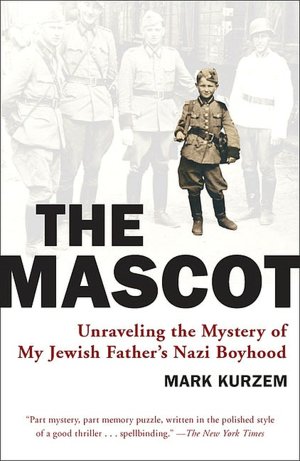
The Mascot

Mascot: Unraveling the Mystery of My Jewish Father's Nazi Boyhood. Mark Kurzem. 2007. Penguin. 432 pages.

If I'm ever asked, "What's your father like?" a simple answer always escapes me. Even though I can look back on a lifetime spent in his company, I have never been able to take his measure. One part of him is a shy, brooding Russian peasant who shows a certain air of naivete, if not gullibility, with strangers. Then there is another side: alert, highly gregarious, and astonishingly worldly. His unexpected appearance on my doorstep in Oxford one May afternoon in 1997 left me more mystified than ever.

The Mascot is such a powerful and compelling biography. It is not your traditional biography--Holocaust or not. It is the story of how one man's past is revealed, how a father chooses to share his memories--some quite vivid, others very vague or fuzzy--with his adult son. The father's life is revealed to his son in a series of conversations and through the son's research to validate his father's story.

Mark, our narrator, always knew his father had his secrets. His father had a brown bag he carried with him everywhere. No one was allowed to see this bag's contents. But. Occasionally, the father would share with his family--his wife and sons--stories from the past. On these occasions, he'd pull out a photograph, an article, an item from the bag. Mark suspected that these stories were just that--stories, being part fact, part embellishment.

But one day his father tries to tell him the truth, the whole truth, the whole UGLY truth about his past. Pieces and fragments. A memory here and there. What is certainly understandable is just how much is missing, how much he doesn't know about who he is and where he comes from.

He was told by his rescuers (Latvian police men or Latvian soldiers?) that he was found in the woods or forest. Alone. Wandering. Obviously struggling to survive. He was taken in by the soldiers and "adopted" into their company. They gave him a name. They gave him a birthday. They gave him a small uniform--from 1941 to 1945 he was given three uniforms. Though he was taken into one man's home--"adopted" (though not legally) by a husband and wife--he stayed connected or associated with a unit of soldiers. He witnessed things NO CHILD of five, six, seven, eight, or nine should EVER witness. He saw men, women, children, babies being killed--in one instance herded together into a building which was then set on fire.

Though he doesn't remember his name--his family name, the names of his brother and sister, father and mother--or the name of his village, the name of his country--he does remember one thing: he witnessed the slaughter of his mother, his younger brother, his baby sister. He witnessed the slaughter of an entire neighborhood or village. At the time, he didn't realize this violence, this bloody slaughter, was because they were Jewish. In fact, his very "Jewishness" was buried deep inside him. At times he seemed aware that he too was Jewish, that his life was at risk if his Jewishness was revealed. But at the same time, the only way he could cope with his present--with his new reality, his new identity, the company he was keeping--was forced to keep in a way--was to bury his 'true' Jewish identity and become the boy others wanted/needed him to be. To survive, he had to deny so very very much.

So the story Mark hears from his father is fragmented, in a way, with very few clues. But it is emotional and intense. Almost too much for him to handle. In fact, it is almost too much for him--the father--to handle. And at one point, he asks himself and he asks his son why. Why bother remembering the past? What good--if any--can come from remembering, from seeking to remember, from uncovering the truth, from piecing everything together, from telling and sharing his story with his family, his friends, his community. For those expecting a clear answer to this, you might be disappointed. The truth is not that black and white. A son and father learn much about one another. The family is at times strengthened, but at other times put under great stress and pressure--by all this. There were things that seemed a little shocking to me, for one, that there were certain organizations (if organizations is the right word?) that denied and rejected his story. Who told him that he was NOT Jewish, that he did NOT suffer during the war, that his story was not part of the Holocaust. Still others (sometimes just individuals, other times groups of individuals) who denied his story, who essentially said that his story was all lies, that it could not happen, did not happen. I think this shocked the son as well, that people could hear the story, see the photographs, and come to the conclusion that this small child (he was found at the age of five) was a willing participant in the war, that he voluntarily joined the enemy, that he was a Nazi just like the others--the adult soldiers. Was he ethically responsible for the actions taken by others? True, you might argue, that the soldiers were trying to "train" him to be a little Nazi, a good, little soldier. But what choice--if any--would he have had? 

Read The Mascot
  • If you can't get enough nonfiction about World War II (like me)
  • If you enjoy reading Jewish books; Holocaust books.
  • If you are interested in family dynamics (relationships); this one is great at exploring a father-son relationship.
  • If you are interested in history and research; this one provides a behind-the-scenes look at how research is done in a very practical, personal way. (Research isn't just about getting a grade.)
  • If you enjoy biographies.

© 2012 Becky Laney of Becky's Book Reviews

Mr. Darcy's Diary

Mr. Darcy's Diary. Amanda Grange. Sourcebooks. 2007. 320 pages.

Monday, 1st July
Have I done the right thing in establishing Georgiana in London, I wonder? The summer is proving to be very hot, and when I visited her this morning, I found her lacking her usual energy. I think I will send her to the coast for a holiday.

Do I have a favorite Amanda Grange novel? I'm not sure. I definitely LOVED this one, Mr. Darcy's Diary!!! The first Amanda Grange "diary" I read was Colonel Brandon's Diary.  I've since read Mr Knightley's Diary, Wickham's Diary, and Henry Tilney's Diary. (I'd love to make time to read Captain Wentworth's Diary and Edmund Bertram's Diary.)

I also JUST discovered there will be *new* Amanda Grange this year!!! Pride & Pyramids: Mr. Darcy in Egypt which releases in July. Also Dear Mr. Darcy: A Retelling of Pride and Prejudice which releases in August. I believe this gives an insider's look on Darcy's correspondence (as opposed to his diaries).

So I have high expectations for Amanda Grange. And she has never once disappointed me!!! She gets her Austen characters just right. True, I don't love *all* her books equally. But that is in part because I don't love  all of Jane Austen's characters equally. And since her characters are so very true-to-the-book and yet so vividly brought to life all at the same time, it is only natural that I have a similar reaction. At least to a certain degree. I will say this, she can make me appreciate characters that I have been indifferent to in the past. And she can make me appreciate even more characters that I already love and adore.

I loved many, many things about Mr. Darcy's Diary. The thing I love most is how it gives a new perspective on Darcy's relationship with Charles Bingley. In Jane Austen's Pride and Prejudice, readers don't really get a chance to know--really know--Charles Bingley all on his own. I loved reading the scenes with Charles Bingley and Mr. Darcy. You really do get an impression of him, a clearer impression of him. And even though Bingley is far, far from perfect, I can't help smiling at his scenes. As for Mr. Darcy, well, that's only to be expected that there's a high degree of charm to be found. True, he can be smug and arrogant, a bit blinded to reality, but, his transformation is all that much more wondrous as seen slowly through the course of these diary entries.

Read Mr. Darcy's Diary
  • If you love Jane Austen
  • If you love Austen's characters, if you want to spend more time with them, if you want newer, fresher perspectives on their inner lives
  • If you enjoy clean Austen retellings/adaptations
  • If you're a fan of Amanda Grange
  • If you love the book or movie, Pride and Prejudice

© 2012 Becky Laney of Becky's Book Reviews
Rereading Unwind

Unwind. Neal Shusterman. 2007. Simon & Schuster. 336 pages.

The prologue:  The Second Civil War, also known as "The Heartland War," was a long and bloody conflict fought over a single issue. To end the war, a set of constitutional amendments known as "The Bill of Life" was passed. It satisfied both the Pro-life and the Pro-choice armies. The Bill of Life states that human life may not be touched from the moment of conception until a child reaches the age of thirteen. However, between the ages of thirteen and eighteen, a parent may choose to retroactively "abort" a child...on the condition that the child's life doesn't technically end. The process by which a child is both terminated and yet kept alive is called "unwinding." Unwinding is now a common and accepted practice in society. 

First sentence: "There are places you can go," Ariana tells him, "and a guy as smart as you has a decent chance of surviving to eighteen." Connor isn't so sure, but looking into Ariana's eyes makes his doubts go away, if only for a moment. 

Did you know there is going to be a sequel to Unwind?! I know!!!! It's very exciting news. As soon as I learned about Unwholly--which releases in late August 2012--I knew I just HAD to reread Unwind. It's been years since I read Unwind, and essentially I just remembered how great it was and how it was near impossible to put it down. It was just so intense, so compelling, so DIFFERENT from what I was used to reading--at least at the time.

And I am very glad I took the time to reread this one. It is just as great as I remembered.

Imagine living in a world where—if you're a teenager—your life is constantly in danger. If you anger your parents just one time too many, you could be on the next bus out of town heading to a Harvest camp or the "chop shop" as it's called in slang. Your organs—every single part of you (except maybe your appendix), stripped away and 'donated' to make someone else's life better. This scenario is about to become terrifyingly real to three teenagers.

Connor is a guy who hasn't always had the best temper or attitude. But he never thought his parents could be so cruel as to unwind him just because he's going through a "difficult" stage. After accidentally finding the papers that will end his life—at least as he knows it—he decides to run away. After all, if he can manage to survive for two or three years—until his eighteenth birthday—he'll be safe and legal.

Risa is a girl from the State Home. She is a musical prodigy, but after making a few mistakes at a concert, she's told she's reached her potential in life and that she can best serve society now as an Unwind. After all, they can only feed and house so many, and new babies arrive all the time. It's normal to eliminate at least 5% of the teen population every year.

 Lev is different from Connor and Risa. He's only thirteen. But the big difference? Lev has known all along that he was 'destined' to be unwound. He's a tithe. A baby set apart from birth—chosen from birth—to be sacrificed on his thirteenth birthday for the good of society. He is told that his is a holy service, a holy life. It's a "religious" and "spiritual" experience or gift. After all, there is no greater gift of love than when a man lays down his life, right? When these three meet for the first time, it is pure chaos. But their lives, their destinies, are woven together for better or worse. Can these teens escape their fate?

Told through many narrators, Unwind is a suspenseful, fast-paced read. While the premise is fascinating in and of itself, Shusterman manages to make this story resonate with strong characters. The world he creates is haunting yet not completely without hope and redemption as people—teens and adults—team up to change the world one step at a time.

Unwind by Neal Shusterman is dystopia at its best.

Quotes:
"Funny but when he was little Connor was terrified of the boogeyman. He would have to sleep with the lights on, he would have his parents check his closet every night. They told him that the boogeyman wasn't real, but they lied. The Bill of Life made the boogeyman real, and he didn't need the closet; he came walking right in through the front door." (4) 
"What does it take to unwind the unwanted? It takes twelve surgeons, in teams of two, rotating in and out as their medical specialty is needed. It takes nine surgical assistants and four nurses. It takes three hours." (288)
Read Unwind
  • If you're a fan of dystopias, yes, it is YA dystopia, but I think adults will enjoy this one too.
  • If you're a fan of science fiction; if you like thought-provoking science fiction.
  • If you're looking for a book that's hard to put down.
  • If you're a fan of Neal Shusterman.
  • If you're looking forward to the sequel, Unwholly, and want to refresh your memory of the first book. 
© 2012 Becky Laney of Becky's Book Reviews
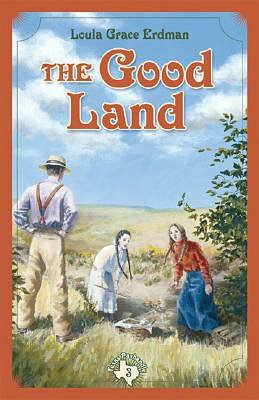
The Good Land (MG)

The Good Land. Loula Grace Erdman. 1959/2007. Bethlehem Books. 185 pages.

Carolyn Pierce, pulling the white linen cloth straight on the long dining-room table, thought that perhaps the worst problem a girl could have was for people to think she didn't have any at all. 

I really, really, really liked this one. It is the last in Loula Grace Erdman's historical trilogy set in the Texas Panhandle. It concludes the hint of romance between Katie and Bryan--from the second book. And Carolyn herself has an admirer! I definitely liked the lightness, the sweetness, the innocence of these three romances. (Melinda and Dennis met in the first book, were married in the second book, and had a boy and a girl by the third book.)

Carolyn is looking forward to going to high school in Amarillo, but that is a year away still when the novel opens. And while it may seem like 'nothing happens' in her own community--farming and ranching community--that isn't exactly true. They've got new stand-offish neighbors for one thing...

The Good Land may not be an adventurous novel with one thrill after another. (The big event is a prairie fire.) But it is a quiet-and-happy novel all the same. For people who love historical fiction, I think it holds enough interest.

Read The Good Land
  • If you love historical fiction set in Texas
  • If you love historical fiction with the lightest, sweetest touches of romance
  • If you enjoy coming-of-age stories 

© 2012 Becky Laney of Becky's Book Reviews

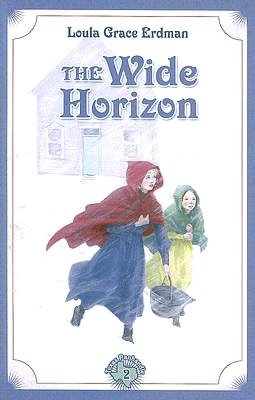
The Wide Horizon (MG)

The Wide Horizon. Loula Grace Erdman. 1956/2007. Bethlehem Books. 279 pages.

Katie Pierce was sure she must be the luckiest girl in the whole Panhandle of Texas. Luckier even than her older sister Melinda who, after five years of waiting, was going to marry Dennis Kennedy in June and go with him to live in Amarillo. Dennis was a real doctor now, driving around the town and the surrounding country, looking after sick folks. 

The Wide Horizon is my favorite, favorite, favorite book in Loula Grace Erdman's Texas Panhandle trilogy. (It might have something to do with the fact that I read it a dozen times as a child. I never got a chance to read the first or last book in this series.)

The narrator is Katie Pierce. She's excited because she's not only going to be singing at her sister's wedding, she'll be a bridesmaid too. And then that fall, she'll be going back to East Texas to live with her grandmother and attend a fancy academy for young ladies. But except for the singing, nothing quite goes like plan. For on the day of a wedding, a stranger-soon-not-to-be-a-stranger, Bryan Cartwright, interrupts bringing Dr. Kennedy urgent news. He must leave the wedding ceremony so he can see one of his patients. (The ceremony continues when he returns.) The other unexpected news of the summer is that Katie won't be going away after all. Her grandmother has fallen and broken her hip. Katie's mom will be going to nurse her back to health. Katie is needed right where she is. She'll need to take care of her brothers and younger sister. Katie will have to learn fast how to fill her mother's place on the farm! And it's quite a learning experience. The chapter on cooking beans was hilarious!

There were so many things I loved about this one!

Read The Wide Horizon
  • If you enjoy historical fiction, if you enjoy pioneer stories with a "Little House" feel
  • If you like stories with blizzards in them! (Katie finds herself responsible for caring for the children left behind at the school)
  • If you like coming-of-age stories
© 2012 Becky Laney of Becky's Book Reviews

Pink, More Pink, Even More Pink

Pinkalicious. Victoria Kann & Elizabeth Kann. 2006. HarperCollins. 40 pages.

It was a rainy day, too wet to go outside. Mommy said, "Let's make cupcakes! What color do you want?"
"Pink!" I said. "Pink, pink, pink!"
Mommy put in some pink. 
"More!" I cried. "More, more, more!"
I gobbled up a couple of cupcakes while Mommy and I frosted them. They were so yummy--they were Pinkalicious! 

The star of Pinkalicious just LOVES the color pink. And in this first adventure, she is delightfully munching pink cupcakes. To her surprise--to everyone's surprise--eating so many pink cupcakes turns her to varying shades of pink. But when is enough enough?

I liked this book. I did. It was fun. It was clever. And I liked her little brother, Peter, too. I liked this one the best of all the series.

Purplicious. Victoria Kann & Elizabeth Kann. 2007. HarperCollins. 40 pages.

I was in art class, painting a picture.

In Pinkalicious' second adventure, she learns that kids can be very mean and bossy. It's no secret that the star of this book LOVES the color pink. So when the girls in her class tell her that pink is only for babies, well, it upsets her. She just CAN'T like black like all the others. It's black. But after a few days of this nonsense, she feels that pink is a lonely color.  Will the new girl--who loves purple--cheer her up and cure her blues?!

Goldilicious. Victoria Kann. 2009. HarperCollins. 40 pages.


I was putting flowers on the mane of my pet unicorn. "Pinkalicious, why are you dropping flowers on the rug?" asked Mommy. "I'm not dropping flowers. I am getting Goldie ready for the Unicorn Ball," I said, prancing around the room.
"What unicorn? I don't see any unicorn," said Peter.
"She's right here and she's not ANY unicorn, she is my unicorn. Her name is Goldilicious, Goldie for short. Oh, Goldie--you shouldn't have done that on the floor! You know better. Just neigh when you need to go potty. I'm sorry, Peter, but you are stepping right in it," I said.

This is the third picture book starring Pinkalicious. In my opinion, it is probably the weakest of the series. In this adventure, readers learn about Pinkalicious' (imaginary) unicorn, Goldie. Readers see the two have some adventures together. But these adventures aren't without their difficulties. Peter sees to that. (I would have liked this one more if it hadn't talked about wizards, casting spells, and crystal balls.)

Silverlicious. Victoria Kann. 2011. HarperCollins. 40 pages.


I had a wiggly tooth. It had been wiggling for days. 


In this adventure, Pinkalicious loses a tooth. But not just any tooth. She loses her sweet tooth. Ever since she lost this tooth, she's not been able to enjoy anything sweet. Her family has also noticed how losing this tooth has made her CRANKY and ungrateful. Can Pinkalicious learn her lesson and become a sweet little girl again?

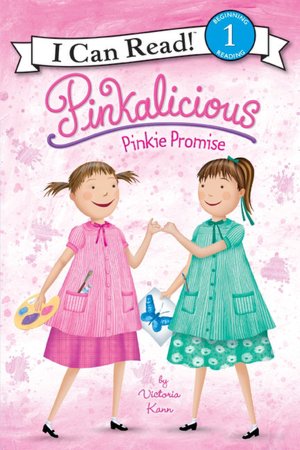
I also read three I Can Read books starring Pinkalicious. I read Pinkalicious: Pink Around the Rink, Pinkalicious School Rules!, and Pinkalicious: Pinkie Promise. I found I actually preferred these early readers to some of the picture book sequels. For example, in School Rules! is an early reader about Goldie and Pinkalicious. Having her imaginary unicorn with her during the school day may help her behave herself because she's having to show him all the rules. Pinkie Promise shows Pinkalicious successfully resolving a conflict with her best friend. She promised her friend that she wouldn't use all her pink paint--she was borrowing her friend's paint--but not only did she use all the pink paint, she also used most of the red and white too. But there is hope for the friendship yet... And in Pink Around the Rink, Pinkalicious turns her new boring white ice skates into one-of-a-kind skates with the help of a pink marker...

Read Pinkalicious (and all its sequels)
  • If you are looking for a fun series to read aloud to little girls
  • If you love the color pink, cupcakes, unicorns, etc.
  • If you are looking for sweet picture books with family-friendly messages and themes 
  • If you like enthusiastic narrators
© 2012 Becky Laney of Becky's Book Reviews
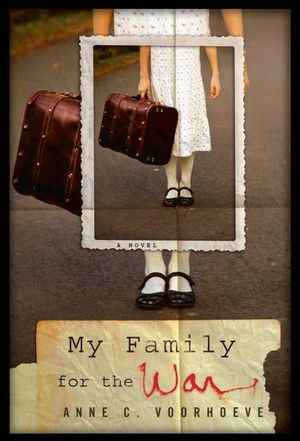
My Family for the War (YA)

My Family for the War. Anne C. Voorhoeve. Translated by Tammi Reichel. 2012. February 2012. Penguin. 412 pages. 

I would never find another friend like Rebekka Liebich. she crouched on the narrow windowsill, one hand holding tight to the frame, and held the other hand stretched out in front of her, as if that would somehow shorten the distance of almost five feet between her and the trunk of the birch tree. I stood in the courtyard three floors below and would have liked to close my eyes, but I couldn't even manage that. I stared up at her, hypnotized. 

I just LOVED, LOVED, LOVED My Family for the War. I just loved it. It is beautifully written and stars unforgettable characters. I loved the heroine, Franziska Mangold. (Her nickname, in Germany, is Ziska. When she travels to England, she's renamed Frances.) I loved her narrative voice. I found it compelling and haunting. The events of the novel can be dramatic--here and there--but I never felt it was too much. I felt it was done very realistically. It made me think, but more importantly it made me feel.

So. My Family For the War opens with Ziska and her best friend, Bekka, working on their survival plans. The year is 1938. The setting is Berlin, Germany. Bekka and Ziska are Jews. Though I believe both are Christian, their families having converted to the Christian faith several generations previously. But Hitler and his Nazis don't care what a person believes, any one with even a trace of Jewish blood in their family--no matter how past, no matter how distant--is considered Jewish. And to be Jewish in Nazi Germany is a dangerous thing. It is a matter of life and death. Which is why their parents are doing anything and everything to get out of the country--filling out applications to migrate to any country still accepting Jews. Which is why their children don't exactly play. They make plans on how to survive attacks from bullies. Mapping out places to hide, mapping out different ways to get home, always wanting to find places they can disappear. They are not always successful. Ziska comes home beaten and bruised a time or two at least. But it isn't easy to "escape" Germany--not even in 1938. (Though perhaps it is easier in 1938 than it would be after the war officially starts).

One day Bekka tells Ziska about the kindertransports. There is hope for Jewish children under the age of sixteen. England is accepting Jewish children and placing them with foster parents. This option won't save entire families, but it will save some of the children at least. And some adults realize just what this could mean. That this means life, this means a future, for their child. At first, Ziska is angry that her mother would even consider--for half a minute--sending her away to strangers, sending her alone to a strange country where she doesn't speak the language. But Ziska is one of the children who finds herself being rescued through the kindertransports. Bekka is not. At least not yet...the two had hoped to go at the same time, but that didn't work out.

Most of the book follows her life...as Frances. As the young girl who grows into a young woman...in England. She's settled with an Orthodox family. The novel is about her experiences with her foster mom and dad, with her new brother, Gary. The novel is about what it's like to start a new life while being so very unsure about the old one. She is able to communicate with her mother...until the war starts. But then everything changes. Especially when the Germans start bombing England.

As I said, I just LOVED, LOVED, LOVED My Family for the War. I absolutely loved the characters. I really just loved them all. I loved Frances. I loved Gary. (I just loved him, thought he was a GREAT brother. And just the right person to start the healing process for Frances.) I loved Amanda, the foster mom. I just felt for her so much. And to see these two grow together, well, it was magical. And her foster Dad was great as well. And then there are the friends she meets--including one from the kindertransport, Walter. There was so much to love about him as well!!! This novel is just so wonderful, so well-written.

Read My Family for the War
  • If you are looking for a great YA book
  • If you are looking for a great historical novel 
  • If you are looking for a compelling story set during World War II
  • If you are looking to read more about the London Blitz
  • If you are interested in reading Jewish books
  • If you are looking for an emotional, unforgettable read
  • If you are looking to read books in translation, this one was published in Germany in 2007

*All quotes are taken from an ARC. They may not match the final, printed version of the novel.

© 2012 Becky Laney of Becky's Book Reviews